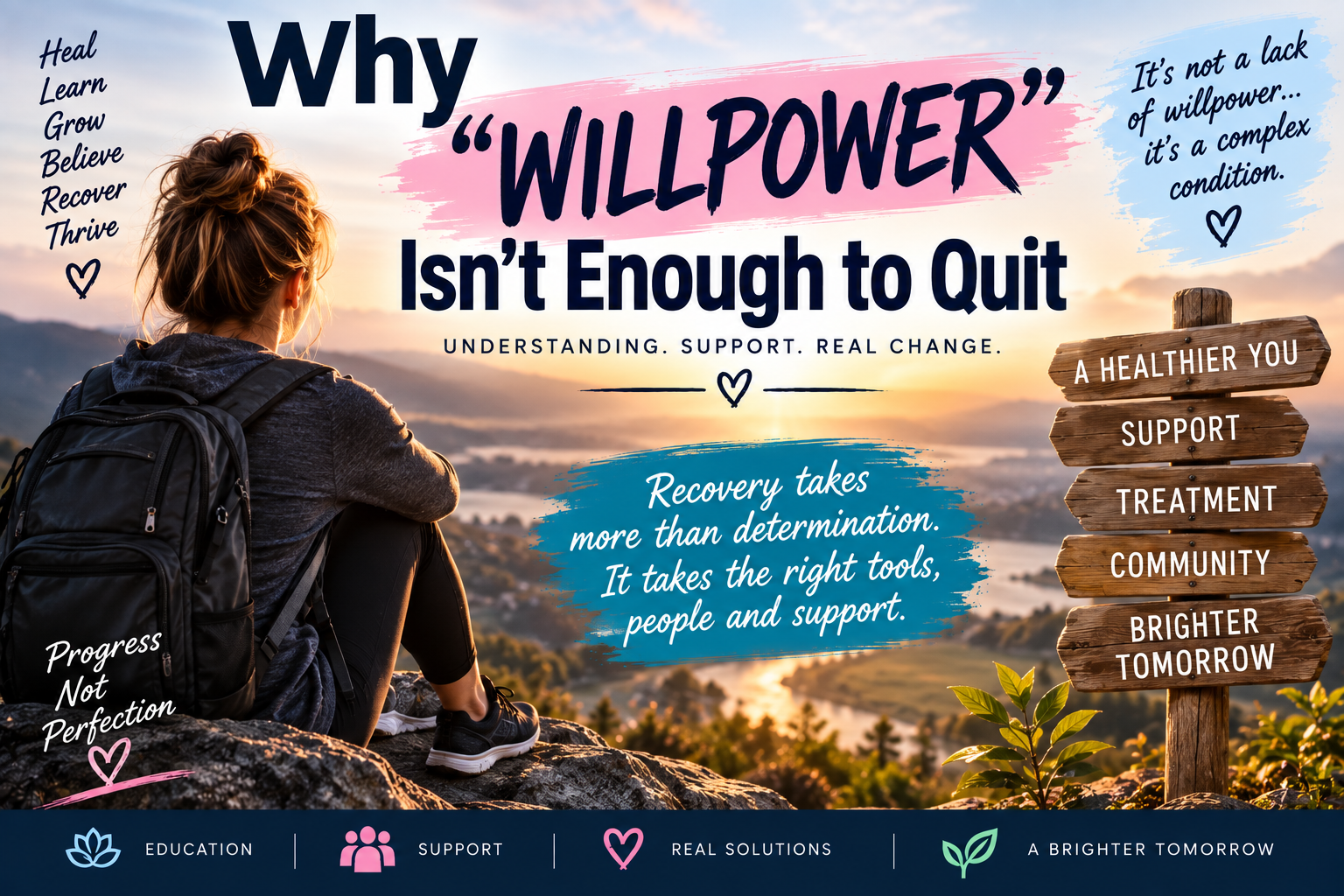
“Why can’t you just stop?” is a question many people struggling with addiction hear, yet it overlooks the challenges involved in changing compulsive behaviors. To someone on the outside, quitting alcohol, drugs, nicotine, gambling, or another addictive behavior may seem like a matter of making a firm decision and sticking to it. When negative consequences continue to grow, family members and friends may believe that greater determination should be enough to bring about change. However, addiction involves complex interactions among brain processes, learned behaviors, emotional challenges, environmental influences, and personal circumstances. Recovery requires more than willpower alone.
Although motivation and personal commitment play important roles, lasting recovery often depends on developing healthier coping strategies, recognizing triggers, changing harmful routines, and building a reliable support system. For many people with substance use disorders, professional treatment and appropriate medications can also be essential parts of recovery. Rather than viewing continued struggles as a sign of weakness, we can approach addiction with understanding, accountability, and practical support. Instead of asking, “Why aren’t you strong enough to quit?” a more helpful question is, “What tools, treatment, and support could help you make lasting changes?”
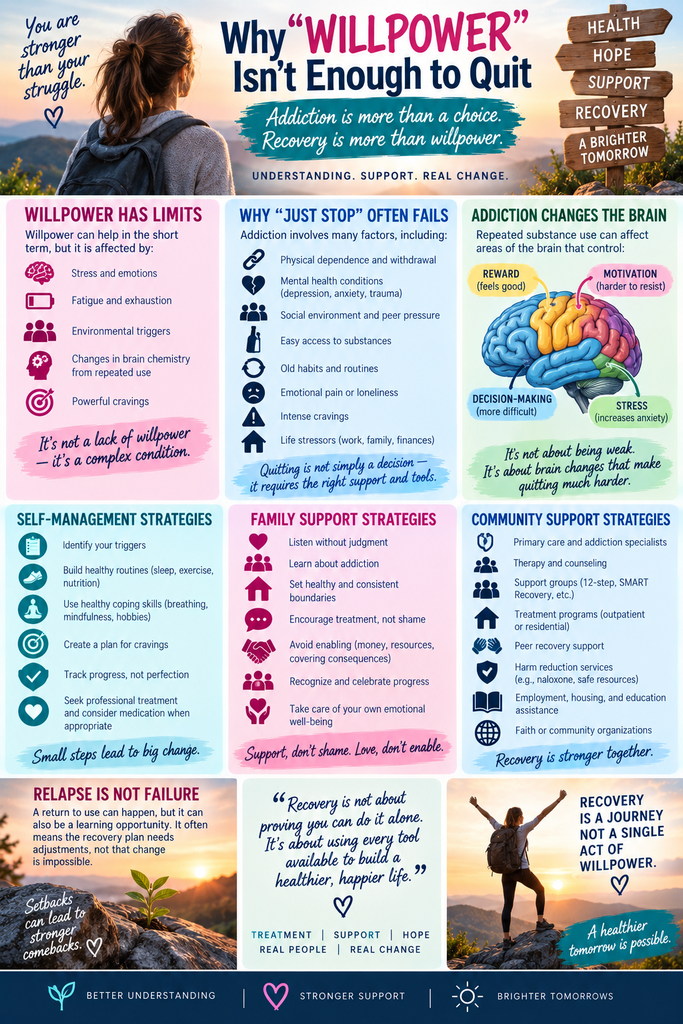
Why Willpower Has Limits
Willpower is the ability to resist an immediate impulse in pursuit of a longer-term goal. It can be useful, but it is affected by stress, exhaustion, emotions, environmental cues, and repeated exposure to triggers.
Someone may genuinely decide in the morning that they will not use a substance and still experience overwhelming cravings later that day. This does not necessarily mean the original commitment was dishonest.
Addiction involves learned patterns of reward, reinforcement, and behavior. Repeated substance use can also affect brain systems involved in motivation, reward, stress, and decision-making. As addiction progresses, continuing to use despite harmful consequences can become one of its defining characteristics.
Why “Just Stop” Often Fails
Telling someone to “just stop” overlooks many factors that may maintain substance use.
These can include:
- Physical dependence and withdrawal.
- Powerful cravings.
- Stress and emotional distress.
- Trauma or unresolved grief.
- Depression, anxiety, or other co-occurring conditions.
- Friends or environments associated with substance use.
- Loneliness and social isolation.
- Easy access to alcohol or drugs.
- Established routines and habits.
- Fear of withdrawal or life without the substance.
Removing the substance without addressing these factors can leave someone with the same triggers but fewer ways of coping with them.
The Brain Learns Addiction—and Recovery
Repeated behaviors become associated with people, places, emotions, and routines. A particular neighborhood, payday, an argument, a song, a bar, or a group of friends can eventually trigger cravings.
Recovery therefore involves more than resisting urges. It often requires developing alternative responses.
Instead of:
Stress → substance use
Recovery may gradually create:
Stress → recognize trigger → use coping strategy → seek support → allow craving to pass
Practicing this new pattern repeatedly can help healthier behaviors become more automatic.
Self-Management Strategies
Personal responsibility remains important in recovery, but responsibility is more effective when paired with realistic tools and appropriate treatment.
- Identify triggers. Keep track of people, places, emotions, situations, and times associated with cravings.
- Create a craving plan. Decide beforehand whom to call, where to go, and what coping strategy to use when cravings become intense.
- Change the environment. Removing substances and avoiding high-risk situations can reduce unnecessary exposure to triggers.
- Build structure. Regular sleep, meals, exercise, work, treatment, and meaningful activities can reduce unstructured periods associated with substance use.
- Practice healthy coping skills. Breathing exercises, walking, journaling, mindfulness, hobbies, and social connection can provide alternatives to substance use.
- Delay the impulse. A craving does not automatically require action. Creating time between an urge and a response can help someone choose differently.
- Track progress rather than demanding perfection. A setback should become information about what needs strengthening rather than evidence that recovery is impossible.
- Seek evidence-based treatment. Counseling, behavioral therapies, peer support, and medications for certain substance use disorders can strengthen recovery.
Family Support Strategies
Families sometimes believe they can motivate recovery through arguments, threats, shame, or constant monitoring. These approaches may increase conflict without addressing the underlying addiction.
Families can instead:
- Learn about addiction, cravings, withdrawal, and relapse.
- Communicate concerns without humiliation or name-calling.
- Encourage treatment rather than relying solely on promises to stop.
- Establish clear and consistent boundaries.
- Avoid providing money or resources that knowingly support substance use.
- Recognize positive recovery behaviors.
- Develop an emergency plan for overdose or other crises.
- Consider counseling or support groups for themselves.
- Protect their own emotional, physical, and financial well-being.
Supporting recovery does not mean protecting someone from every consequence of substance use.
Community Support Strategies
Recovery becomes more achievable when people have access to resources beyond their immediate families.
Helpful community supports can include:
- Primary-care and addiction medicine providers.
- Mental health professionals.
- Outpatient and residential treatment programs.
- Medications for opioid or alcohol use disorders when clinically appropriate.
- Peer recovery specialists.
- Mutual-help and recovery groups.
- Harm-reduction and overdose-prevention services.
- Naloxone education and availability for opioid overdose risk.
- Recovery housing.
- Employment, transportation, childcare, and educational assistance.
- Community and faith-based organizations when they align with the individual’s preferences.
Recovery is easier to sustain when people have meaningful alternatives to the environment and circumstances that previously supported addiction.
Medication Is Not “Cheating”
One harmful extension of the willpower myth is the belief that medication makes recovery less legitimate.
For opioid use disorder, medications such as buprenorphine and methadone can be important components of evidence-based treatment. Naltrexone is another option for some individuals. Medications are also available to help treat alcohol use disorder.
Using appropriate medication does not mean someone lacks determination. Treatment should be based on clinical needs, risks, preferences, and evidence rather than an expectation that suffering through cravings or withdrawal somehow makes recovery more authentic.
What About Relapse?
A return to substance use can occur during recovery, but it should not automatically be interpreted as proof that someone does not want to change.
Instead, it can signal that something in the recovery plan needs attention.
Questions might include:
What triggered the return to use?
Was treatment stopped?
Did stress suddenly increase?
Was the person exposed to substances or high-risk relationships?
Were depression, anxiety, trauma, or other mental health symptoms worsening?
Was enough support available?
The goal is not to excuse harmful behavior. It is to identify what happened so that the recovery plan can be strengthened.
Motivation Still Matters
Saying that willpower is not enough does not mean that personal choices are irrelevant.
Recovery requires participation. People may need to attend appointments, take medications as prescribed, practice coping skills, avoid high-risk environments, repair relationships, and repeatedly choose behaviors that support recovery.
The difference is that recovery does not ask motivation to work alone.
Think of willpower as one tool in the recovery toolbox—not the entire toolbox.
Replacing Shame With Strategy
Shame often says:
“You failed because you’re weak.”
A recovery-focused approach asks:
“What made this situation difficult, and what can we change before it happens again?”
That shift is powerful because it moves attention from character to strategy.
Someone who repeatedly experiences cravings after work, for example, may need a structured evening routine rather than another lecture about determination. Someone who uses substances to cope with trauma may need trauma-informed treatment. Someone experiencing withdrawal may need medical care rather than encouragement to “tough it out.”
When Medical Help Is Important
Abruptly stopping some substances can cause significant withdrawal. Alcohol and benzodiazepine withdrawal can sometimes become medically dangerous, including the risk of seizures or severe complications.
People with significant physical dependence should discuss safe withdrawal and treatment options with an appropriate healthcare professional rather than assuming they must quit completely on their own.
Opioid overdose risk also deserves particular attention. Naloxone can temporarily reverse an opioid overdose and should be available when overdose risk is present.
Conclusion
Willpower can help someone begin recovery, but it is rarely the only ingredient needed to sustain it. Addiction can involve powerful interactions among brain reward systems, learned behaviors, cravings, emotional distress, physical dependence, environmental triggers, and social circumstances.
Successful recovery therefore involves building a system stronger than the addiction itself.
That system may include personal commitment, professional treatment, medication when appropriate, coping skills, healthy routines, family boundaries, peer connection, and community resources.
The better question is not, “Why don’t you have enough willpower?”
It is, “What combination of treatment, skills, support, and resources will give you the strongest chance of recovery?”
Recovery is not about proving that you are strong enough to do everything alone. It is about learning how to use every effective tool available to build a healthier life.
Frequently Asked Questions
Here are some common questions:
1. Why isn’t willpower alone enough to overcome addiction?
Willpower can help someone make decisions, but addiction involves more than motivation. Cravings, physical dependence, learned behaviors, stress, environmental triggers, and changes in brain systems involved in reward and motivation can make stopping difficult even when someone sincerely wants to quit.
2. Does struggling to quit mean someone is weak?
No. Difficulty stopping alcohol or drugs should not automatically be interpreted as weak character. Substance use disorders are health conditions influenced by biological, psychological, behavioral, and social factors.
3. Why do people continue using substances when they know the consequences?
Addiction can make immediate relief or reward feel extremely powerful compared with future consequences. Withdrawal, cravings, stress, mental health symptoms, habits, and environmental cues can also contribute to continued use.
4. What happens in the brain during addiction?
Repeated substance use can affect brain systems involved in reward, motivation, learning, stress, and decision-making. Over time, substances and substance-related cues can become strongly associated with pleasure, relief, or escape, making cravings difficult to ignore.
5. Why does telling someone to “just stop” often fail?
It identifies the desired outcome without addressing what is driving the behavior. Someone may need treatment for withdrawal, strategies for cravings, treatment for co-occurring mental health conditions, environmental changes, medication, or stronger social support.
6. Does saying willpower isn’t enough remove personal responsibility?
No. Recovery still requires active participation. People may need to attend treatment, practice coping strategies, follow medication plans, avoid high-risk environments, establish healthier routines, and make repeated recovery-focused decisions. The difference is that determination does not have to work alone.
7. What are common addiction triggers?
Triggers can include stress, conflict, loneliness, trauma reminders, certain people or places, celebrations, boredom, money, relationship difficulties, and seeing or smelling substances. Recognizing individual triggers allows someone to prepare healthier responses.
8. What self-management strategies can strengthen recovery?
Helpful approaches include identifying triggers, developing a craving plan, maintaining regular sleep and meals, exercising, changing high-risk routines, practicing stress-management techniques, building meaningful activities, tracking progress, and seeking professional treatment.
9. Why is changing the environment important?
People, places, and routines can become strongly associated with substance use. Removing alcohol or drugs from the home, avoiding high-risk settings, and changing routines can reduce exposure to cues while healthier habits become established.
10. Can medication help someone recover from addiction?
Yes, for certain substance use disorders. Evidence-based medications are available for opioid and alcohol use disorders, among others. Medication should be individualized with an appropriate healthcare professional and can be combined with counseling and other supports.
11. Is using medication for addiction “replacing one drug with another”?
That description can be misleading. Medications such as buprenorphine and methadone are established treatments for opioid use disorder when appropriately prescribed and monitored. Treatment is intended to reduce harmful use, withdrawal, cravings, overdose risk, and other consequences while supporting recovery.
12. What role does family support play?
Families can learn about addiction, listen without humiliation, encourage treatment, establish healthy boundaries, recognize recovery progress, and develop emergency plans. Family members should also protect their own emotional and financial well-being.
13. What is the difference between supporting and enabling?
Support encourages behaviors that promote health and recovery. Enabling may involve repeatedly shielding someone from consequences or providing resources that knowingly facilitate continued substance use. Healthy boundaries can allow families to remain compassionate without supporting harmful behavior.
14. What community resources can strengthen recovery?
Resources may include addiction medicine providers, therapists, treatment programs, peer recovery specialists, mutual-help groups, recovery housing, harm-reduction programs, employment assistance, and community or faith-based organizations when consistent with the person’s preferences.
15. Does relapse mean treatment failed?
Not necessarily. A return to substance use can indicate that treatment or the recovery plan needs reassessment. Identifying what happened before the return to use can reveal triggers, gaps in support, medication issues, worsening mental health symptoms, or environmental risks that need attention.
16. What should someone do after a return to substance use?
Seek support quickly rather than allowing shame to delay help. Review what triggered the episode, reconnect with treatment, adjust the recovery plan, and consider whether additional medical, psychological, family, or peer support is needed.
17. Can quitting suddenly be dangerous?
Yes, depending on the substance and level of dependence. Withdrawal from alcohol and benzodiazepines can become medically dangerous and may cause serious complications, including seizures. People with significant dependence should seek medical guidance about stopping safely.
18. Why is naloxone important in opioid addiction?
Naloxone is a medication that can rapidly reverse an opioid overdose. Keeping naloxone available and ensuring family members or others know how to use it can provide an important layer of protection for someone at risk of opioid overdose.
19. What is a healthier alternative to asking, “Why can’t you just quit?”
Try asking, “What is making it difficult to stop, and what support would help?” This changes the conversation from blame to identifying practical solutions.
20. What is the main message about willpower and recovery?
Willpower matters, but it is one tool—not the entire recovery toolbox. Sustainable recovery may require motivation combined with treatment, coping skills, medication when appropriate, healthy routines, supportive relationships, community resources, and environmental changes.
The goal is not to prove that someone can recover alone. The goal is to build a recovery system strong enough that they do not have to.
Video: Why you can’t just quit on your own #addiction #recovery #truth