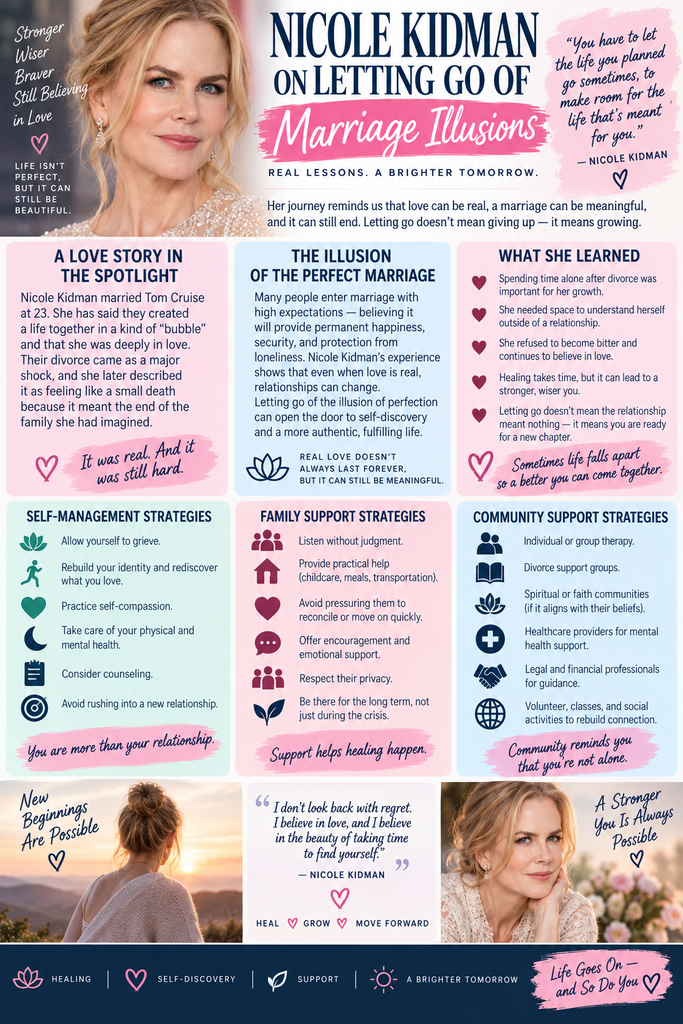
Nicole Kidman’s journey through love, marriage, divorce, and personal growth offers insight into the challenges of letting go of idealized expectations about relationships. After marrying Tom Cruise at 23, Kidman became deeply invested in their life together and later described the end of their marriage as painful and unexpected. She has reflected on how spending time alone afterward helped her rediscover her identity and develop a greater sense of independence. Her experiences with marriage and separation highlight the importance of accepting that love does not always unfold as imagined. Letting go of marriage illusions does not mean abandoning the possibility of love; it means recognizing that personal happiness, emotional security, and self-worth extend beyond any single relationship. Through self-reflection, resilience, and support, the end of a marriage can become an opportunity for healing, personal growth, and new beginnings.
The Illusion of the “Perfect” Marriage
People often enter relationships carrying expectations about what marriage is supposed to provide: permanent companionship, emotional security, happiness, stability, or protection from loneliness. Those expectations can become especially powerful when a relationship appears successful from the outside.
Kidman once described her marriage to Cruise as existing in a kind of “bubble,” in which the two became very dependent on each other. She has also said she was deeply in love and initially believed their life together was essentially perfect. When the marriage ended, she described the experience as a major shock that took considerable time to heal from.
This does not mean the love within a marriage was false. Instead, it demonstrates how a relationship can be meaningful and genuine while still failing to last forever.
When the Future You Imagined Disappears
Divorce involves more than losing a partner. A person may also grieve the future they expected to have.
That grief can involve losing:
- The identity of being someone’s spouse.
- Daily routines and traditions.
- A shared home or social circle.
- Financial or emotional security.
- Dreams about growing old together.
- Expectations surrounding children and family life.
- Confidence in one’s own judgment.
- The belief that the relationship was permanent.
Kidman has described divorce as resembling a small death because it involves the demise of the family structure someone believed they had. Years later, she also reflected that having substantial time alone after divorce was valuable because she had married so young and needed space to mature independently.
Letting Go Does Not Mean the Relationship Meant Nothing
One of the most difficult parts of healing is accepting two truths simultaneously: a relationship may have contained genuine love, and it may still have needed to end.
People sometimes try to rewrite an entire marriage after divorce, deciding that everything must have been a mistake because the relationship did not last. That black-and-white interpretation can make grief more difficult.
A healthier perspective may be: This relationship was an important part of my life, but it was not meant to define my entire life.
Kidman herself has resisted reducing her earlier marriage to something meaningless, describing it at different times as a relationship in which she was deeply in love while also acknowledging how much she had to learn afterward.
Self-Management Strategies
Releasing marriage illusions involves rebuilding an identity that exists independently of relationship status.
- Allow yourself to grieve. Divorce can involve sadness, anger, loneliness, relief, fear, and hope—sometimes simultaneously.
- Separate reality from expectations. Ask yourself what the relationship actually provided rather than what you hoped it would eventually become.
- Avoid defining yourself solely through the marriage. Reconnect with interests, friendships, career goals, creativity, spirituality, or activities that belong to you.
- Spend time alone without treating solitude as failure. Healthy solitude can provide an opportunity to understand your values and needs before beginning another relationship.
- Avoid rushing into another relationship solely to escape loneliness. Emotional recovery may require learning that being alone and being lonely are not the same thing.
- Protect sleep, nutrition, exercise, and daily routines. Major relationship changes can disrupt basic self-care.
- Consider counseling. Therapy can help identify relationship patterns, process grief, establish boundaries, and rebuild confidence.
- Practice self-compassion. A marriage ending does not automatically mean that either person’s entire life or identity has failed.
Family Support Strategies
Family and friends can strongly influence how someone experiences separation and divorce.
- Listen without demanding explanations for every relationship decision.
- Avoid pressuring someone to reconcile or to move on immediately.
- Do not repeatedly criticize the former spouse, particularly when children are involved.
- Help with childcare, meals, transportation, appointments, or household responsibilities during difficult periods.
- Encourage healthy coping instead of excessive alcohol use, isolation, revenge, or impulsive relationships.
- Respect privacy and allow the individual to determine what details should be shared.
- Continue providing companionship after the immediate crisis has passed.
Support should help someone regain independence rather than create another form of emotional dependency.
Community Support Strategies
Relationship loss can become isolating, making community connection particularly important.
- Individual therapy can provide a confidential environment for processing grief and identity changes.
- Divorce or separation support groups can connect people experiencing similar transitions.
- Faith or spiritual communities may offer a sense of connection when they align with an individual’s values.
- Community recreation, volunteering, classes, and social organizations can help rebuild social identity outside marriage.
- Healthcare professionals can evaluate persistent depression, anxiety, sleep problems, or other symptoms following a major relationship loss.
- Legal and financial professionals can help people understand the practical issues surrounding separation without having to navigate everything alone.
Community support reminds people that the end of one relationship does not require withdrawal from the rest of life.
Learning to Be Alone Without Feeling Abandoned
One of Kidman’s particularly useful reflections came when she discussed spending considerable time alone following her divorce from Cruise. She later described that period as beneficial because she had been so young when she married and needed to grow independently.
This distinction matters. Solitude can initially feel frightening after years of partnership, but it can eventually become a place for self-discovery.
Someone can use this period to ask:
Who am I outside this relationship?
What did I learn about myself?
Which boundaries did I ignore?
What do I want differently in future relationships?
What parts of myself do I want to rediscover?
These questions shift attention away from simply asking, “Why did the marriage fail?” toward the more constructive question, “What can I build from here?”
Letting Go of Perfection Without Giving Up on Love
Healing after divorce does not require becoming cynical about relationships.
After her divorce from Cruise, Kidman publicly said she refused to become bitter and continued to believe in love. That distinction is important. Emotional maturity does not require believing that relationships always last. It involves understanding that healthy love requires two evolving individuals, not an idealized promise that nothing will ever change.
Relationships can provide companionship, intimacy, security, and growth, but no partner can completely eliminate loneliness, insecurity, grief, or uncertainty from another person’s life.
When Additional Help Is Needed
Relationship loss can sometimes trigger significant depression, anxiety, substance misuse, or hopelessness. Professional help should be considered when emotional distress persists, daily functioning deteriorates, sleep becomes severely disrupted, or alcohol or drugs are increasingly being used to cope.
Thoughts of suicide or self-harm require immediate attention. In the United States, people experiencing a mental health crisis can call or text 988, and immediate danger warrants emergency medical assistance.
Conclusion
Nicole Kidman’s reflections on marriage and divorce demonstrate that letting go of marriage illusions does not require denying the love that once existed. It means accepting that a relationship can be real, meaningful, and deeply loved without being permanent.
Her journey also illustrates the value of allowing yourself to exist outside a partnership. Time alone can become an opportunity to grieve, mature, rediscover identity, strengthen boundaries, and determine what you genuinely need from future relationships.
Sometimes healing means letting go of the life you thought you were supposed to have so you can begin living the life that actually exists. Marriage may be an important chapter in someone’s story, but it does not have to become the measure of their worth, identity, or future happiness.
Frequently Asked Questions
Here are some common questions:
1. What does “letting go of marriage illusions” mean?
It means letting go of the unrealistic expectation that marriage must always be perfect, permanent, or capable of providing complete happiness and emotional security. A marriage can contain genuine love and still change or end.
2. Has Nicole Kidman spoken about the emotional impact of divorce?
Yes. Kidman has publicly reflected on the emotional difficulty of divorce, particularly following the end of her marriage to Tom Cruise. She has described being deeply in love and experiencing significant grief when the marriage ended.
3. Why can losing a marriage feel like losing more than a partner?
Divorce can also mean grieving routines, traditions, family structure, financial security, shared friendships, identity as a spouse, and the imagined future of growing old together. People may therefore grieve both the relationship and the future they expected.
4. Did Nicole Kidman regret her marriage to Tom Cruise?
Kidman has generally avoided reducing the marriage to something meaningless simply because it ended. She has acknowledged that she was deeply in love and reflected on what she learned as she matured.
5. Why is accepting that a relationship has ended so difficult?
People can become emotionally attached not only to their partner but also to the future they imagined. Letting go may therefore require accepting that the expected future will not unfold as originally planned.
6. Can a marriage be meaningful even if it ends?
Absolutely. The length of a relationship does not determine whether its experiences, love, memories, or lessons were meaningful. A relationship can matter deeply without lasting forever.
7. What can someone learn from spending time alone after divorce?
Healthy solitude can provide opportunities to rediscover interests, examine relationship patterns, strengthen boundaries, clarify personal values, and develop an identity that does not depend entirely on being someone’s partner.
8. What self-management strategies can help after a marriage ends?
Helpful strategies include allowing yourself to grieve, maintaining sleep and healthy routines, reconnecting with personal interests, avoiding excessive alcohol or substance use, spending time with supportive people, practicing self-compassion, and considering professional counseling.
9. Should someone immediately begin dating after divorce?
There is no required timeline. Dating can be healthy when someone feels emotionally ready, but beginning another relationship primarily to escape loneliness may interfere with processing grief and understanding what they want differently in the future.
10. How can family members support someone going through divorce?
Family members can listen without judgment, provide practical assistance, respect privacy, encourage healthy coping, and avoid pressuring the person to reconcile or immediately find another partner.
11. Why should families avoid constantly criticizing an ex-spouse?
Constant criticism can intensify anger and make healing more difficult. It may be especially harmful when children are involved, as they can feel caught between parents they love.
12. What community resources can help after divorce?
Individual counseling, divorce support groups, community organizations, social activities, healthcare professionals, faith communities (when personally meaningful), and legal or financial professionals can provide various forms of support.
13. Does letting go mean giving up on love?
No. Letting go of an unhealthy or completed relationship does not require becoming cynical about love. Someone can accept that one relationship ended while remaining open to healthy relationships in the future.
14. How can someone rebuild their identity after divorce?
Rebuilding may involve returning to hobbies, strengthening friendships, pursuing education or career goals, traveling, volunteering, exercising, exploring creativity, or simply learning what feels meaningful when decisions are no longer organized around a marriage.
15. What questions can help someone reflect after a relationship ends?
Useful questions include: Who am I outside this relationship? What did this relationship teach me? Which boundaries do I want to strengthen? What patterns should I avoid repeating? What do I need from a healthy relationship?
16. When should someone seek professional mental health support?
Professional help may be appropriate when sadness, anxiety, hopelessness, insomnia, isolation, or difficulty functioning becomes persistent or overwhelming. Increasing reliance on alcohol or drugs to cope is another reason to seek assistance.
17. Can divorce eventually lead to personal growth?
For some people, yes. Divorce itself is not automatically positive, but working through it can lead to greater self-awareness, stronger boundaries, increased independence, and a clearer understanding of what someone needs from future relationships.
18. What is the central lesson from Nicole Kidman’s reflections on relationships?
A useful takeaway is that letting go of the expectation of a perfect or permanent relationship does not erase the love that existed. Healing can involve honoring what was meaningful, accepting what has changed, rediscovering yourself, and allowing room for a different future.
19. What is the healthiest way to view a marriage that ended?
Rather than labeling the entire marriage a success or failure, it may be healthier to recognize its complexity. A relationship can contain love, mistakes, growth, disappointment, and meaningful memories at the same time.
20. What message can someone take forward after divorce?
Your relationship status does not determine your worth. The end of a marriage may close an important chapter, but it does not end the larger story. Healing can create space for self-discovery, healthier boundaries, new beginnings, and hope for a brighter tomorrow.
Video: Nicole Kidman Love After Loss