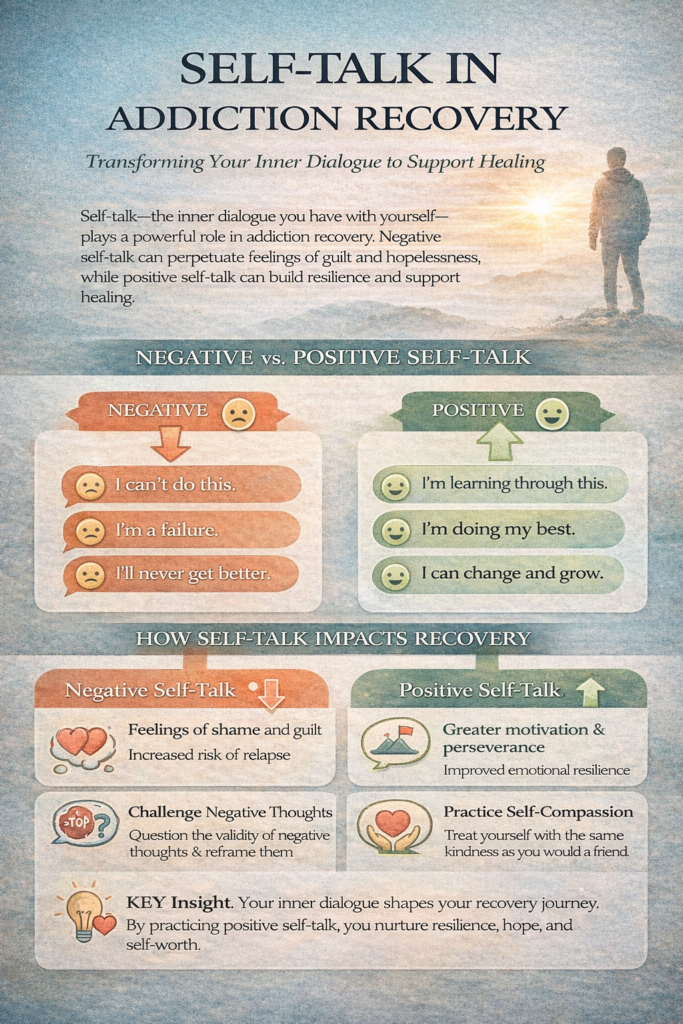
Self-talk plays a critical role in addiction recovery, shaping how individuals perceive themselves, their progress, and their ability to change. For those experiencing Substance Use Disorder, internal dialogue is often influenced by past experiences, stigma, and repeated setbacks, leading to patterns of negative thinking. Thoughts such as self-doubt, guilt, and hopelessness can reinforce harmful behaviors and create barriers to recovery. Understanding how self-talk operates—and how it influences emotions and decision-making—is essential for developing healthier coping strategies and building a more resilient mindset.
Self-Talk in Addiction Recovery: Rewriting the Inner Voice for Lasting Change
Recovery from addiction is not only about changing behaviors—it’s about changing the way you think. One of the most powerful yet often overlooked factors in this process is self-talk, the internal dialogue that shapes how you see yourself and your ability to heal. For individuals facing Substance Use Disorder, self-talk can either reinforce shame and relapse patterns or support growth and long-term recovery.
Learning to recognize and reshape your inner voice is a critical step toward rebuilding your life.
What Is Self-Talk?
Self-talk is the continuous stream of thoughts you have about yourself, your experiences, and your future. It can be:
- Negative (self-critical, hopeless, discouraging)
- Positive (supportive, realistic, encouraging)
In addiction, negative self-talk often becomes deeply ingrained, influencing behavior and decision-making.
How Self-Talk Impacts Addiction
Your thoughts directly affect your emotions and actions. For example:
- “I’ll never change” → hopelessness → increased risk of relapse
- “I messed up, but I can try again” → resilience → continued effort
Negative self-talk can:
- Reinforce shame and guilt
- Lower motivation for recovery
- Justify continued substance use
Positive, balanced self-talk can:
- Increase self-awareness
- Build confidence
- Support healthier coping strategies
Common Negative Self-Talk Patterns in Recovery
Many individuals in recovery experience thoughts like:
- “I’m a failure.”
- “I’ve already ruined everything.”
- “There’s no point in trying.”
These thoughts often come from past experiences, stigma, or repeated setbacks—but they are not facts.
Reframing Self-Talk: Changing the Narrative
Recovery involves learning to challenge and reframe these thoughts.
🔄 Examples of Reframing:
- “I failed again.” → “I’m learning what triggers me.”
- “I can’t do this.” → “This is hard, but I’m working on it.”
- “I’m not strong enough.” → “I’m building strength step by step.”
This doesn’t mean ignoring reality—it means interpreting it in a way that supports growth.
Strategies to Improve Self-Talk
🧠 1. Increase Awareness
Pay attention to your thoughts, especially during stressful moments or setbacks.
✍️ 2. Write It Down
Journaling helps identify patterns in your thinking and makes it easier to challenge them.
🛑 3. Challenge Negative Thoughts
Ask yourself:
- Is this thought true?
- Is there another way to look at this?
💬 4. Practice Self-Compassion
Speak to yourself the way you would speak to someone you care about.
🔁 5. Use Repetition and Affirmations
Consistently replacing negative thoughts with balanced ones helps retrain your brain over time.
The Connection Between Self-Talk and Relapse Prevention
Self-talk plays a key role in how you respond to challenges:
- Negative thoughts may lead to giving up
- Positive, realistic thoughts support persistence
By changing your internal dialogue, you change how you handle triggers, stress, and setbacks.
A Key Insight: Your Thoughts Are Influential, Not Absolute
Just because you think something doesn’t make it true. Thoughts are shaped by past experiences, emotions, and habits—but they can be changed.
What This Means for Recovery
When you improve your self-talk:
- You build resilience
- You reduce shame and self-criticism
- You stay more engaged in recovery
- You develop a stronger sense of self-worth
Recovery becomes not just about stopping substance use, but about creating a healthier relationship with yourself.
Final Thoughts
Your inner voice can either hold you back or help you move forward. In addiction recovery, learning to shift that voice from critical to supportive is one of the most powerful changes you can make.
You don’t have to believe every negative thought—but you can choose to build new ones that support your healing.
Self-Talk in Addiction Recovery: Self-Management Strategies for Building a Stronger Inner Voice
Recovery from addiction is not just about changing behaviors—it’s about changing the way you think. Self-talk, the internal dialogue that shapes how you view yourself and your progress, plays a powerful role in recovery from Substance Use Disorder. Negative self-talk can reinforce shame and setbacks, while positive, balanced self-talk can strengthen resilience and motivation.
The key is learning how to manage your thoughts intentionally. With the right self-management strategies, you can begin to reshape your inner voice into one that supports—not sabotages—your recovery.
Why Self-Management Matters in Self-Talk
Self-talk often runs automatically, shaped by past experiences and habits. Without awareness, negative patterns can take over.
Self-management helps you:
- Recognize harmful thought patterns
- Take control of your internal dialogue
- Respond to challenges more effectively
- Build confidence and emotional stability
Self-Management Strategies for Improving Self-Talk
🧠 1. Increase Awareness of Your Thoughts
Start by noticing what you say to yourself throughout the day.
Ask:
- “What am I telling myself right now?”
- “Is this helpful or harmful?”
Awareness is the first step to change.
📓 2. Track Your Self-Talk Patterns
Write down recurring thoughts, especially during:
- Stressful situations
- Cravings or triggers
- Setbacks
This helps you identify patterns and understand when negative self-talk is most likely to occur.
🔍 3. Challenge Negative Thoughts
Not every thought is true.
Ask yourself:
- “Is there evidence for this thought?”
- “Am I being too harsh on myself?”
This creates space between you and your thoughts.
🔄 4. Reframe Your Inner Dialogue
Replace negative thoughts with more balanced ones:
- “I failed again.” → “I’m learning what doesn’t work.”
- “I can’t do this.” → “This is difficult, but I’m trying.”
Reframing helps shift your mindset from defeat to growth.
❤️ 5. Practice Self-Compassion
Treat yourself with the same kindness you would offer someone else.
Remind yourself:
- “Recovery is a process.”
- “I’m allowed to make mistakes.”
Self-compassion reduces shame and builds resilience.
🛑 6. Interrupt Negative Thought Loops
When you notice repetitive negative thinking:
- Pause
- Take a breath
- Redirect your focus
Breaking the cycle prevents thoughts from escalating.
🔁 7. Use Repetition to Build New Patterns
Positive self-talk becomes stronger with practice.
Repeat supportive statements like:
- “I’m making progress.”
- “I can handle this moment.”
Over time, these thoughts become more natural.
🧩 8. Connect Thoughts to Actions
Your thoughts influence your behavior.
When you shift your thinking:
- You’re more likely to stay engaged in recovery
- You respond better to stress and triggers
- You make healthier choices
A Key Insight: You Are Not Your Thoughts
One of the most important realizations is that thoughts are not facts—they are mental habits that can be changed. You can observe, question, and reshape them.
What This Means for Recovery
When you actively manage your self-talk:
- Confidence and motivation increase
- Shame and self-doubt decrease
- You become more resilient during setbacks
- Recovery feels more achievable and sustainable
Your inner voice becomes a tool for growth instead of a barrier.
Final Thoughts
Changing your self-talk doesn’t happen overnight—but every small shift matters. By becoming aware of your thoughts and practicing new ways of thinking, you begin to take deeper control of your recovery.
You don’t have to believe every negative thought. You can choose to create a voice that supports your healing, one thought at a time.
Self-Talk in Addiction Recovery: Family Support Strategies for Shaping a Healthier Inner Voice
Recovery from addiction is not only about changing behaviors—it’s about changing the way individuals think and speak to themselves. Self-talk, the internal dialogue that shapes emotions, confidence, and decision-making, plays a critical role in recovery from Substance Use Disorder. While self-talk happens internally, it is strongly influenced by external relationships—especially family.
Families have the unique ability to help reshape negative self-talk into a more supportive, compassionate, and empowering inner voice.
Why Family Support Matters in Self-Talk
Many individuals in recovery struggle with deeply ingrained thoughts like:
- “I’m not good enough.”
- “I’ll never change.”
- “I always mess things up.”
These beliefs are often reinforced over time through experiences, criticism, or stigma. Family interactions can either strengthen these negative patterns or help replace them with healthier ones.
Supportive family environments can:
- Reduce shame and self-criticism
- Encourage self-worth and confidence
- Reinforce positive thinking patterns
- Support long-term recovery efforts
Family Support Strategies for Improving Self-Talk
👂 1. Listen Without Judgment
When your loved one expresses negative thoughts, listen fully before responding.
Instead of correcting immediately, try:
- “That sounds really hard—tell me more.”
Feeling heard is the first step in changing internal dialogue.
🧠 2. Gently Challenge Negative Self-Talk
Help your loved one question harmful thoughts:
- “Is that really true?”
- “What would you say to someone else in your situation?”
This encourages reflection and helps separate thoughts from facts.
💬 3. Use Positive and Supportive Language
External words often become internal beliefs.
Instead of:
- “You keep messing up.”
Try:
- “You’re trying, and that matters.”
Consistent encouragement helps reshape self-talk over time.
🤝 4. Reinforce Effort and Progress
Focus on what your loved one is doing right—even if progress is little.
Acknowledge:
- Showing up to treatment
- Making healthier choices
- Trying new coping strategies
This shifts internal thinking from failure to growth.
❤️ 5. Promote Self-Compassion
Encourage your loved one to treat themselves with kindness.
You might say:
- “You deserve patience while you’re healing.”
- “It’s okay to struggle and still keep going.”
This helps replace harsh self-criticism with understanding.
🛑 6. Avoid Shame and Blame
Negative language can reinforce harmful self-talk patterns.
Avoid:
- Criticism
- Guilt-based comments
- Comparisons
Instead, focus on support and solutions.
🧩 7. Model Healthy Self-Talk
Families can lead by example.
- Speak kindly about your own mistakes
- Show how you reframe challenges
- Avoid self-criticism in front of others
This creates a positive environment for learning healthier thinking.
🧑⚕️ 8. Support Professional Help
Therapies like cognitive-behavioral therapy (CBT) help individuals change negative thinking patterns.
Families can:
- Encourage participation
- Reinforce strategies learned in therapy
- Celebrate progress
A Key Insight: Inner Voices Are Learned Through Relationships
The way people are spoken to—especially by those closest to them—often becomes the voice they carry internally. Family support can help transform that voice from critical to encouraging.
What This Means for Recovery
When families actively support healthier self-talk:
- Confidence and motivation increase
- Shame and self-doubt decrease
- Coping skills improve
- Recovery becomes more sustainable
A supportive environment helps turn self-talk into a tool for healing rather than a barrier.
Final Thoughts
You don’t have to control your loved one’s thoughts to make a difference—you just have to influence the environment those thoughts grow in. Through empathy, encouragement, and patience, families can help reshape self-talk in powerful ways.
Sometimes, the words you say today become the voice they rely on tomorrow.
Self-Talk in Addiction Recovery: How Community Resources Strengthen Your Inner Voice
Recovery from addiction is not just about changing behaviors—it’s about changing the way you think. Self-talk, or the internal dialogue you have with yourself, plays a powerful role in shaping your recovery journey. For individuals facing Substance Use Disorder, negative self-talk can reinforce shame and relapse, while positive, balanced self-talk can support healing and growth.
While self-talk may feel like a private, internal experience, it is heavily influenced by your environment. Community resources can play a key role in helping you understand, challenge, and reshape that inner voice.
Why Community Resources Matter for Self-Talk
Self-talk doesn’t develop in isolation—it is shaped by past experiences, relationships, and social influences. Community resources help by:
- Providing new perspectives that challenge negative thinking
- Offering validation and shared experiences
- Teaching practical tools for cognitive change
- Reinforcing positive and realistic thinking patterns
Being part of a supportive community can help replace self-criticism with self-understanding.
Community Resource Strategies for Improving Self-Talk
👥 1. Join Peer Support Groups
Support groups (such as recovery meetings) create a space where individuals share their experiences openly.
Benefits include:
- Hearing others challenge similar negative thoughts
- Learning how people reframe self-criticism
- Feeling less alone in your struggles
Listening to others often helps you recognize and question your own internal dialogue.
🧑⚕️ 2. Engage in Therapy and Counseling
Mental health professionals can help you:
- Identify harmful thought patterns
- Learn cognitive-behavioral techniques (CBT)
- Practice reframing negative self-talk
Therapy provides structured guidance for changing how you think and respond to challenges.
📚 3. Attend Community Education Programs
Workshops and classes on mental health and recovery often teach:
- The science behind thoughts and behavior
- How self-talk affects emotions and actions
- Practical strategies for building healthier thinking patterns
Education helps you understand that negative thoughts are learned—and can be unlearned.
🤝 4. Connect with Recovery and Advocacy Organizations
Organizations focused on addiction recovery provide:
- Educational materials
- Helplines and support networks
- Tools for building self-awareness
They often emphasize the importance of self-compassion and realistic thinking in recovery.
🌐 5. Use Online Recovery Communities Thoughtfully
Online communities can offer:
- Encouragement and motivation
- Shared experiences and advice
- Access to support anytime
However, it’s important to balance online input with professional guidance to avoid misinformation.
🧩 6. Participate in Group Therapy or Skill-Building Programs
Programs focused on coping skills often include:
- Thought-challenging exercises
- Role-playing conversations
- Practicing positive self-talk in real time
These interactive settings help reinforce new thinking patterns.
📓 7. Combine Community Support with Personal Practice
Community resources are most effective when paired with self-reflection.
Practice:
- Journaling your thoughts
- Identifying patterns
- Applying techniques learned in groups or therapy
Then bring those insights back into community discussions for feedback and growth.
A Key Insight: Your Inner Voice Is Influenced by Your Environment
If you surround yourself with critical, negative messages, your self-talk may reflect that. But when you engage with supportive, informed communities, your inner dialogue begins to shift toward encouragement and resilience.
What This Means for Recovery
When community resources support your self-talk:
- You develop more balanced and realistic thinking
- You reduce shame and self-judgment
- You respond to setbacks with resilience
- You stay more engaged in recovery
Your internal voice becomes a source of strength rather than a barrier.
Final Thoughts
You don’t have to change your self-talk alone. Community resources provide the tools, support, and perspectives needed to reshape how you think about yourself and your recovery.
By connecting with others, learning new strategies, and practicing self-awareness, you can transform your inner voice into one that supports healing, growth, and lasting change.
Frequently Asked Questions
Here are some common questions:
What is self-talk in addiction recovery?
Self-talk refers to the internal dialogue you have with yourself—your thoughts, beliefs, and interpretations about your experiences. In the context of Substance Use Disorder, self-talk can either support recovery or contribute to relapse, depending on whether it is positive or negative.
Why is self-talk important in recovery?
Self-talk influences how you feel and act. Negative thoughts can lead to shame and hopelessness, while positive, balanced thoughts can:
- Increase motivation
- Improve emotional resilience
- Support healthier decision-making
What are examples of negative self-talk in recovery?
Common examples include:
- “I’m a failure.”
- “I’ll never change.”
- “I’ve already messed up, so why try?”
These thoughts can reinforce harmful patterns and make recovery more difficult.
What does positive self-talk look like?
Positive self-talk is realistic and supportive, such as:
- “I’m working on improving.”
- “This is hard, but I can get through it.”
- “I can learn from this setback.”
It focuses on growth rather than perfection.
Is positive self-talk the same as ignoring problems?
No. Positive self-talk is not about pretending everything is fine—it’s about responding to challenges in a constructive and balanced way rather than with self-criticism.
How does self-talk affect relapse risk?
Negative self-talk can:
- Increase feelings of guilt and shame
- Lower confidence in recovery
- Lead to giving up after setbacks
Positive self-talk helps:
- Maintain motivation
- Encourage persistence
- Support healthier coping strategies
Can self-talk really be changed?
Yes. Self-talk is learned over time, which means it can be unlearned and replaced with healthier patterns through:
- Awareness
- Practice
- Therapy or support groups
What are simple ways to improve self-talk?
You can:
- Notice and write down your thoughts
- Challenge negative beliefs
- Replace them with more balanced statements
- Practice self-compassion
Consistency is key to making these changes stick.
How long does it take to change self-talk?
It varies for each person. Changing thought patterns takes time and repetition, but even small shifts can make a meaningful difference in recovery.
Does therapy help with self-talk?
Yes. Approaches like cognitive-behavioral therapy (CBT) are specifically designed to help individuals identify and change negative thinking patterns related to Substance Use Disorder.
Can self-talk affect how I see myself in recovery?
Absolutely. Your internal dialogue shapes your self-image. Supportive self-talk can help rebuild self-worth, while negative self-talk can reinforce feelings of failure or shame.
What if I keep having negative thoughts?
That’s normal. The goal isn’t to eliminate negative thoughts completely, but to:
- Recognize them
- Question them
- Choose not to let them control your actions
Conclusion
Recognizing the impact of self-talk in the context of Substance Use Disorder highlights its importance in long-term recovery. By learning to challenge negative thoughts and replace them with more balanced, constructive perspectives, individuals can reduce shame, increase motivation, and strengthen their commitment to change. Self-talk is not fixed—it can be reshaped through awareness, practice, and support. Ultimately, cultivating a more compassionate and empowering inner voice can transform recovery from a struggle with self-criticism into a process of growth, self-acceptance, and lasting healing.
Video: The Self-Talk Mistake Keeping You Stuck #AddictionRecovery #MentalWellness #Recovery