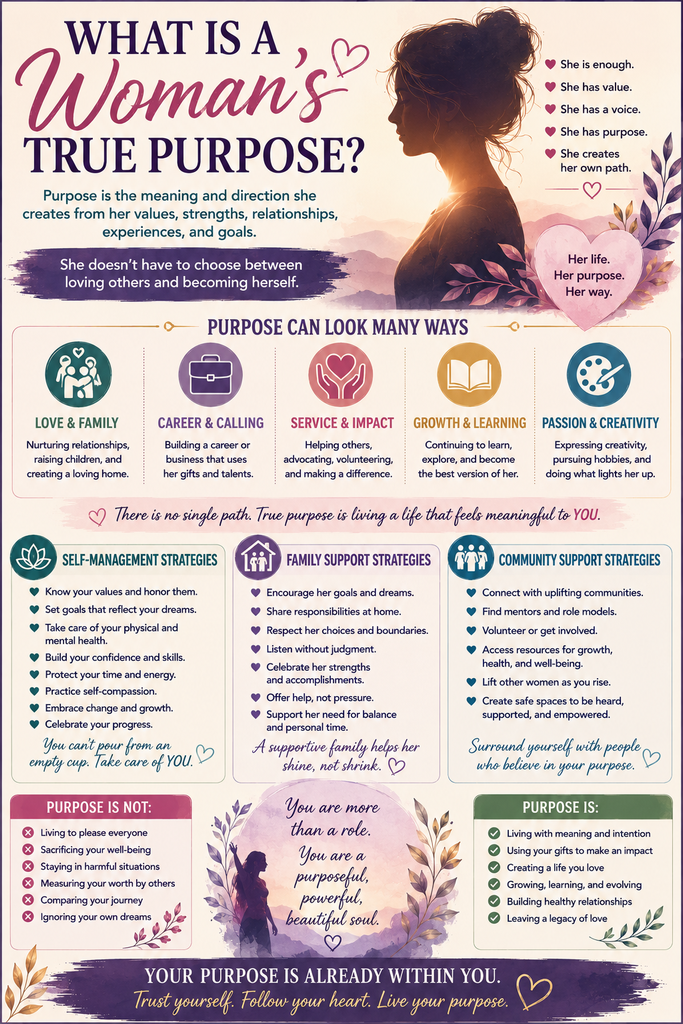
What is a woman’s true purpose? For generations, women have received different answers: become a wife, raise children, care for others, build a career, serve the community, pursue faith, or achieve independence. Each of these paths can be deeply meaningful—but none represents the universal purpose of every woman.
What Is a Woman’s True Purpose?
A woman’s purpose is not determined solely by her gender, relationship status, motherhood, career, appearance, age, or ability to care for others. Purpose is the meaning and direction she develops from her values, relationships, responsibilities, strengths, experiences, and goals.
For one woman, motherhood may become a central source of meaning. Another may find purpose through medicine, teaching, business, creativity, advocacy, faith, caregiving, leadership, friendship, or service. Many women find purpose in several of these areas simultaneously, and those priorities may change throughout life.
The better question may therefore be:
“What gives my life meaning, and how do I want to use the life I have?”
Purpose Is More Than a Role
Roles are important, but roles can change.
A woman may be a daughter, wife, mother, grandmother, professional, caregiver, friend, student, or community leader. Yet underneath these roles remains an individual with her own values, personality, abilities, needs, and aspirations.
When identity becomes completely dependent on one role, major life transitions can create a painful sense of emptiness.
Children grow up.
Relationships sometimes end.
Careers change.
People retire.
Loved ones die.
Health and circumstances change.
Developing a broader sense of purpose can help a woman maintain meaning through life’s transitions.
1. Purpose Begins With Knowing Yourself
It can be difficult to build a meaningful life without understanding what actually matters to you.
Ask yourself:
- What values guide my decisions?
- What activities make me feel useful or fulfilled?
- What am I naturally good at?
- What problems do I care about solving?
- Who matters most to me?
- What kind of person do I want to become?
- What would I regret never trying?
- What do I want people to remember about how I treated them?
Purpose does not always arrive as one dramatic realization. It often develops gradually through everyday choices.
2. Purpose Can Include Relationships Without Losing Yourself
Relationships can provide enormous meaning.
Loving a partner, raising children, supporting relatives, caring for aging parents, maintaining friendships, and becoming part of a community can all foster a sense of belonging.
But healthy relationships should not require a woman to erase herself.
A meaningful relationship allows room for:
- Individual interests
- Personal goals
- Friendships
- Healthy boundaries
- Independent thinking
- Education and growth
- Mutual respect
- Emotional safety
Caring for others and caring for yourself do not have to be opposites.
3. Motherhood Can Be a Purpose—but It Is Not the Only Purpose
For many women, motherhood becomes one of life’s most meaningful experiences.
Raising children can involve teaching, protecting, nurturing, guiding, sacrificing, and helping them develop independence.
But not every woman becomes a mother, and motherhood is not a requirement for a meaningful life.
Women without children can build extraordinary lives through relationships, careers, mentorship, creativity, community involvement, service, and countless other paths.
A woman’s worth should never be measured by whether she has children.
4. Work Can Provide Purpose Without Becoming Your Entire Identity
Meaningful work can provide independence, a sense of achievement, intellectual stimulation, social connection, and opportunities to help others.
Purposeful work does not necessarily require wealth or prestige.
Purpose can exist in:
- Healthcare
- Education
- Business
- Science
- Art
- Caregiving
- Entrepreneurship
- Public service
- Skilled trades
- Volunteer work
- Homemaking
- Community leadership
The important question is not whether society considers the role impressive.
It is whether the work contributes meaningfully to the life the woman wants to build.
5. Purpose Includes Growth
A meaningful life does not require remaining the same person forever.
Women can continue learning, changing, and beginning again throughout adulthood.
Growth may involve:
- Returning to school
- Changing careers
- Learning a skill
- Traveling
- Improving physical health
- Strengthening emotional health
- Developing healthier relationships
- Leaving harmful environments
- Building financial independence
- Becoming involved in the community
- Discovering new interests
There is no age at which personal growth becomes irrelevant.
6. Purpose Can Grow From Pain
Difficult experiences sometimes change what a woman values.
Loss, relationship struggles, addiction in the family, caregiving, financial hardship, trauma, illness, or major life transitions can lead someone to reconsider what matters.
Pain does not automatically make someone stronger, and suffering should never be romanticized.
However, people can sometimes create meaning from their experiences.
A woman may eventually use difficult experiences to:
- Help someone facing similar circumstances
- Advocate for change
- Mentor younger people
- Educate her community
- Strengthen family relationships
- Establish healthier boundaries
- Develop greater compassion
- Create something meaningful
The painful chapter does not have to become the final chapter.
Self-Management Strategies for Finding Purpose
Finding purpose requires more than waiting for inspiration. It often involves intentionally building a meaningful life.
Helpful strategies include:
- Identify your core values. Determine which principles you want your life to reflect.
- Set meaningful goals. Choose goals aligned with your values rather than solely external expectations.
- Protect your identity. Maintain interests and relationships outside your major roles.
- Develop your strengths. Continue learning and improving skills throughout life.
- Establish healthy boundaries. Purpose should not require constant self-sacrifice.
- Take care of your health. Physical and emotional well-being support your ability to pursue meaningful goals.
- Make time for reflection. Journaling, meditation, prayer, counseling, or quiet reflection can clarify priorities.
- Accept changing seasons. Your purpose at 25 may look different at 45, 65, or 85.
- Take small actions. Purpose is often created through consistent daily behavior rather than discovered all at once.
Family Support Strategies
Families strongly influence how women understand their roles and possibilities.
Healthy families can encourage women to develop identities that include both connection and individuality.
Family members can:
- Respect her personal goals and interests.
- Avoid defining her worth only through marriage or motherhood.
- Share household and caregiving responsibilities.
- Encourage education and professional development.
- Support healthy boundaries.
- Recognize accomplishments.
- Respect changing priorities throughout life.
- Encourage independence alongside family connection.
- Listen when she expresses dissatisfaction or uncertainty.
- Celebrate different definitions of success.
Families can provide a sense of belonging without deciding another person’s entire future.
Community Support Strategies
Purpose often grows through connection.
Communities provide opportunities to learn, contribute, build relationships, and discover abilities that might otherwise remain unexplored.
Helpful community connections may include:
- Educational programs
- Professional organizations
- Volunteer opportunities
- Mentorship programs
- Women’s organizations
- Community centers
- Support groups
- Creative organizations
- Fitness and wellness groups
- Faith communities when personally meaningful
- Entrepreneurship networks
- Local charities
- Civic organizations
Community involvement can transform the question “What should I do with my life?” into “Where can my abilities make a meaningful contribution?”
Purpose During Major Life Transitions
Purpose can feel uncertain when a familiar role disappears.
A woman may experience this during:
- Divorce
- Retirement
- Children leaving home
- Becoming a caregiver
- Losing a spouse
- Career changes
- Moving to a new community
- Becoming a grandmother
- Recovering from a major setback
These transitions can create grief, but they can also create opportunities to redefine meaning.
Ask:
What is ending?
What remains important?
What is now possible?
Purpose can be rewritten without erasing everything that came before.
Understanding Her Journey
A woman’s journey is rarely a straight line.
She may spend one period building a career and another raising children. She may care for others for decades and later decide to focus more intentionally on herself. She may discover a passion at 20 or find an entirely new calling at 70.
There is no universal schedule.
Comparison can be especially harmful when women feel “behind” because someone else has achieved marriage, motherhood, professional success, financial independence, or another milestone first.
A meaningful life is not a competition.
What a Woman’s Purpose Is Not
Purpose should not require:
- Living entirely for other people’s approval
- Remaining in harmful relationships
- Sacrificing every personal goal
- Achieving perfection
- Meeting unrealistic beauty standards
- Becoming wealthy or famous
- Following someone else’s timeline
- Having children to prove her worth
- Having a career to prove her independence
- Constantly appearing strong
- Never asking for help
A woman’s value exists before she accomplishes any of these things.
So, What Is a Woman’s True Purpose?
There is no single answer that applies to every woman.
A woman’s purpose may involve loving, learning, creating, caring, leading, teaching, healing, building, exploring, serving, protecting, mentoring, growing, or simply living according to deeply held values.
She does not have to choose between being strong and compassionate.
She does not have to choose between loving others and respecting herself.
She does not have to become a mother to have purpose, nor does she need to reject motherhood to demonstrate independence.
She does not have to follow someone else’s definition of a successful woman.
Ultimately, a woman’s true purpose is not a role assigned to her.
It is a meaningful life she actively creates.
Through relationships, contribution, growth, values, and everyday choices, she can build a life that answers a much more important question than what society expects from her:
“Who do I want to become, and what do I want my life to stand for?”
Frequently Asked Questions
Here are some common questions:
1. What is a woman’s true purpose?
There is no single purpose assigned to every woman. Purpose is the meaning and direction a woman creates through her values, relationships, strengths, responsibilities, experiences, goals, and contributions. It may include family, career, service, creativity, faith, learning, leadership, or personal growth.
2. Is motherhood a woman’s primary purpose?
Motherhood can be a deeply meaningful purpose for women who choose or experience it, but it is not the only path to a meaningful life. Women who do not have children can find profound purpose through relationships, careers, mentorship, service, creativity, community involvement, and many other pursuits.
3. Does a woman need marriage to have purpose?
No. Marriage can provide love, companionship, family, and shared meaning, but a woman’s value and purpose do not depend on having a spouse. Single, married, divorced, and widowed women can all build meaningful and fulfilling lives.
4. Can a career become part of a woman’s purpose?
Absolutely. Work can provide meaning through achievement, creativity, service, independence, leadership, or helping others. However, a career does not have to become a woman’s entire identity to be meaningful.
5. How can a woman discover what gives her life meaning?
Start with reflection.
Ask:
- What matters most to me?
- What am I naturally good at?
- What activities make me feel fulfilled?
- Who do I want to help?
- What would I regret never trying?
- What problems do I care about solving?
- What kind of person do I want to become?
- What do I want my life to represent?
Purpose often becomes clearer through action rather than thinking alone.
6. What if I don’t know my purpose yet?
That is normal. Purpose does not always arrive as one dramatic realization. It can develop gradually through relationships, education, work, volunteering, hobbies, caregiving, challenges, and new experiences.
You do not need your entire life figured out before taking the next meaningful step.
7. Can a woman’s purpose change throughout her life?
Yes. Purpose can evolve as circumstances, priorities, relationships, and responsibilities change.
What gives meaning at 25 may look very different at 45, 65, or 85. Changing direction does not mean the previous chapter was meaningless.
8. Can caring for other people be part of a woman’s purpose?
Yes. Caring for children, partners, parents, patients, friends, or community members can provide tremendous meaning. However, caring for others should not require completely abandoning one’s own health, identity, boundaries, and aspirations.
9. Is choosing to be a homemaker a meaningful purpose?
It can be. Creating a home, caring for family members, managing household responsibilities, and supporting children can provide significant meaning. A woman’s choice should not be considered less valuable simply because the work occurs primarily within the home.
10. Can a woman choose both family and career?
Yes. Purpose does not have to fit into a single category. Many women find meaning through several areas simultaneously, including family, career, relationships, education, service, creativity, and personal development.
Balance may also change during different seasons of life.
11. Why do some women lose their sense of purpose?
Major life changes can disrupt identity. These may include:
- Children leaving home
- Retirement
- Divorce
- Relationship changes
- Career transitions
- Caregiving responsibilities
- Moving
- Loss of a loved one
- Financial changes
- Aging
When a major role changes, a woman may temporarily wonder who she is without it. This can also become an opportunity to explore new sources of meaning.
12. How can a woman rebuild purpose after her children leave home?
She can reconnect with interests, friendships, education, work, travel, volunteering, hobbies, health goals, community involvement, or new relationships. Motherhood remains part of her identity, but it need not be the final chapter of her personal growth.
13. Is it selfish for a woman to focus on herself?
Healthy self-care is not the same as selfishness. Protecting physical health, emotional well-being, finances, personal goals, and boundaries can improve a woman’s ability to participate meaningfully in relationships and responsibilities.
14. What role do boundaries play in living with purpose?
Boundaries protect time, energy, emotional health, and personal priorities. Without them, someone may spend so much time trying to meet other people’s expectations that she loses touch with her own values and goals.
15. Can painful experiences help someone discover purpose?
Sometimes. Pain itself should not be romanticized, but people can create meaning from difficult experiences. A woman may use what she has learned to mentor others, advocate for change, strengthen relationships, educate her community, or develop greater compassion.
Her past can influence her purpose without defining her future.
16. How can families support a woman’s sense of purpose?
Families can:
- Encourage her goals.
- Respect her choices.
- Share household responsibilities.
- Support education and career development.
- Recognize her accomplishments.
- Respect healthy boundaries.
- Avoid defining her worth only through caregiving.
- Encourage interests outside family responsibilities.
- Celebrate new goals throughout life.
Supportive families help women grow rather than requiring them to shrink themselves to maintain relationships.
17. How can community involvement help women find purpose?
Communities provide opportunities for connection and contribution. Volunteering, mentoring, professional organizations, educational programs, creative groups, civic organizations, support groups, and faith communities can help women discover where their abilities can benefit others.
18. Should a woman follow society’s definition of success?
Not necessarily. Marriage, motherhood, professional achievement, wealth, appearance, and social status may matter to some women, but none should automatically determine everyone’s definition of success.
A meaningful life should reflect personal values rather than constant comparison.
19. Am I too old to discover a new purpose?
No. Purpose has no expiration date.
A woman can return to school, volunteer, mentor someone, start a business, develop a hobby, travel, write, create, strengthen relationships, or become involved in her community at virtually any stage of adulthood.
A new chapter does not require being young.
20. What is the most important message about a woman’s purpose?
A woman does not need to prove her worth by becoming everything to everyone.
She can love others without losing herself.
She can be independent while accepting support.
She can be ambitious and compassionate.
She can choose motherhood, a career, both, or neither.
She can change direction.
She can begin again.
Ultimately, purpose is less about discovering a role someone else has assigned and more about intentionally creating a life that reflects what matters most.
Her life. Her values. Her journey. Her purpose.
Video: Why I stopped letting ‘mom’ be my only title #motivation #womenempowerment #shorts