Rejection is one of life’s most painful emotional experiences. Whether it comes from a broken relationship, a lost job opportunity, strained family connections, or social exclusion, rejection can trigger feelings of sadness, shame, loneliness, anger, and self-doubt.
For individuals recovering from alcohol or drug addiction, these emotions may become particularly challenging. Rejection can activate memories of previous failures, intensify negative self-beliefs, and increase the temptation to use substances as a way to escape emotional discomfort.
However, rejection does not have to determine the direction of someone’s recovery.
With appropriate coping strategies, supportive relationships, and professional guidance, individuals can learn to process rejection in healthier ways and use difficult experiences as opportunities for personal growth.
Turning rejection into motivation does not mean ignoring emotional pain or pretending that disappointment is easy. It means recognizing that rejection is an experience, not a definition of personal worth.
Sobriety is not about proving your value to people who rejected you. It is about recognizing your own value and building a healthier future.
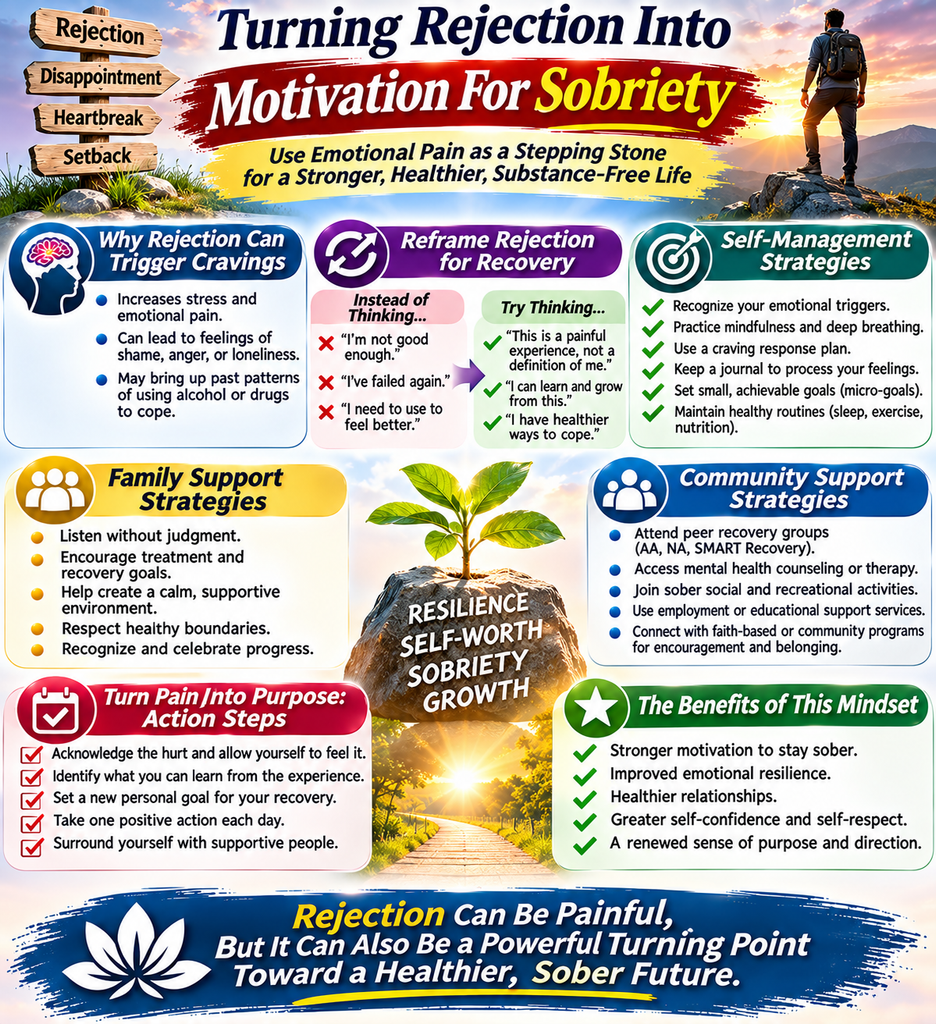
Understanding Why Rejection Can Trigger Addiction Cravings
Rejection can activate emotional and physiological stress responses that influence mood, decision-making, and behavior.
For individuals with substance use disorders, intense emotional distress may increase cravings, especially when alcohol or drugs have previously been used to manage uncomfortable feelings.
Stress can affect brain systems involved in reward, motivation, emotional regulation, and behavioral control.
When someone experiences rejection, the resulting emotional discomfort may become associated with a desire for immediate relief.
Common emotional reactions to rejection include:
- Shame: Feeling personally defective or unworthy.
- Anger: Experiencing resentment toward the person or situation associated with rejection.
- Loneliness: Feeling disconnected from important relationships.
- Anxiety: Worrying about future rejection or abandonment.
- Sadness: Grieving the loss of a relationship, opportunity, or expectation.
- Self-doubt: Questioning personal abilities, identity, or progress.
- Hopelessness: Believing that circumstances will never improve.
These reactions are understandable, but they do not need to control behavior.
Learning to recognize and regulate difficult emotions is an important component of relapse prevention.
Rejection and the Risk of Relapse
Emotional distress is a recognized trigger for substance use in some individuals.
Someone who previously relied on alcohol to cope with relationship conflict may experience cravings after a breakup.
Another person may feel tempted to use drugs after losing a job or being excluded from a social group.
However, rejection does not automatically cause relapse. Substance use recurrence is influenced by multiple biological, psychological, social, and environmental factors.
Why rejection may increase vulnerability
Rejection can contribute to:
- Increased stress and emotional exhaustion.
- Negative self-talk and feelings of inadequacy.
- Withdrawal from supportive relationships.
- Disruption of healthy routines.
- Increased exposure to high-risk situations.
- Difficulty managing cravings.
- Reduced motivation to participate in recovery activities.
The goal of relapse prevention is not to eliminate painful emotions but to develop healthier responses when those emotions arise.
Reframing Rejection: From Personal Failure to Personal Growth
One of the most valuable skills in recovery is learning to separate an experience from personal identity.
Rejection may involve disappointment, but it does not establish that someone is unworthy, incapable, or undeserving of support.
Cognitive behavioral therapy (CBT) can help individuals identify distorted thought patterns and develop more balanced interpretations.
For example, someone rejected for a job might think:
“Nobody will ever hire me because of my past addiction.”
A more balanced interpretation might be:
“This opportunity did not work out. I can evaluate what happened, improve my skills, and continue searching for employment.”
Healthy ways to reframe rejection
- Recognize that rejection is not always a judgment of personal worth.
- Identify what is within your control.
- Avoid assuming you know another person’s motives.
- Focus on learning rather than self-punishment.
- Set realistic goals for future opportunities.
- Practice self-compassion while accepting responsibility for past actions.
Reframing does not guarantee that every rejection will lead to success. It helps individuals respond constructively rather than automatically returning to harmful coping behaviors.
Self-Management Strategy: Recognizing Emotional Triggers
Self-management begins with awareness.
Individuals in recovery benefit from understanding which situations, thoughts, and emotions increase their vulnerability to cravings.
A rejection-related trigger may involve criticism from a supervisor, conflict with a family member, an unsuccessful relationship, or feeling excluded from a social event.
Create an emotional trigger journal
A journal can help identify patterns between rejection, emotional distress, and cravings.
Consider recording:
- What happened?
- What emotions did I experience?
- What thoughts appeared immediately afterward?
- Did I experience cravings?
- How intense were those cravings?
- What healthy coping strategy did I use?
- What could I try differently next time?
Over time, this practice may improve emotional awareness and support relapse prevention planning.
Turning Emotional Pain Into Healthy Motivation
Motivation for sobriety becomes more sustainable when it is connected to personal values rather than anger, revenge, or the desire to prove others wrong.
For example, someone may initially want to remain sober after a breakup to demonstrate that they can succeed without their former partner.
Although that feeling may temporarily increase motivation, lasting recovery is generally better supported by personally meaningful goals.
Examples of healthier motivation
- Improving physical and mental health.
- Rebuilding trust through consistent behavior.
- Developing financial independence.
- Strengthening parenting and family relationships.
- Pursuing education or career opportunities.
- Creating meaningful friendships.
- Developing confidence and emotional resilience.
The goal is to transform rejection into an opportunity to clarify personal priorities.
Recovery becomes more meaningful when sobriety is something you choose for yourself, not something you pursue to gain another person’s approval.
Self-Management Strategy: Building Emotional Regulation Skills
Emotional regulation is the ability to recognize, understand, and respond to feelings without becoming overwhelmed.
For individuals recovering from addiction, these skills can reduce reliance on substances as a coping mechanism.
A. Practice mindfulness
Mindfulness involves paying attention to the present moment without immediately judging thoughts or emotions.
When rejection triggers sadness or anger, individuals can acknowledge the feeling without acting impulsively.
B. Use grounding techniques
Grounding exercises can help redirect attention during moments of emotional distress.
One approach is the 5-4-3-2-1 technique:
- Identify five things you can see.
- Notice four things you can feel.
- Identify three things you can hear.
- Notice two things you can smell.
- Identify one thing you can taste.
C. Practice healthy emotional expression
Talking with a counselor, writing in a journal, or participating in creative activities can provide constructive ways to process difficult feelings.
D. Develop a craving response plan
When rejection leads to cravings, individuals can contact a trusted supporter, leave a high-risk environment, attend a recovery meeting, or practice a coping skill learned in treatment.
E. Maintain healthy routines
Regular sleep, physical activity, nutritious meals, and consistent treatment participation can support emotional stability.
These activities complement professional addiction treatment rather than replace it.
Setting Micro-Goals After Rejection
Rejection can make large goals feel overwhelming.
Micro-goals are small, achievable actions that help individuals rebuild confidence and maintain momentum.
Instead of focusing entirely on a major outcome, such as repairing a relationship or obtaining a new job, individuals can identify manageable daily steps.
Examples of recovery-focused micro-goals
- Attend one recovery support meeting.
- Spend ten minutes journaling.
- Take a short walk after a stressful conversation.
- Contact one supportive friend.
- Complete one employment application.
- Practice a relaxation exercise.
- Schedule a counseling appointment.
- Avoid a personally triggering environment.
Small accomplishments can provide structure and reinforce a sense of personal agency.
Your 7-day rejection-to-resilience plan
Select each action as you complete it.
0 of 7 days
Day 1: Acknowledge what happened and name your emotions.
Day 2: Identify rejection-related triggers and cravings.
Day 3: Practice a healthy coping skill for 10 minutes.
Day 4: Connect with a trusted supporter.
Day 5: Set one realistic personal recovery goal.
Day 6: Engage in a meaningful, substance-free activity.
Day 7: Reflect on your progress and plan your next step.
Family Support: Helping Loved Ones Cope With Rejection
Family members can play an important role in helping individuals navigate rejection without returning to substance use.
However, family support should emphasize compassion, healthy boundaries, and respect for personal independence.
A. Listen without minimizing emotional pain
Statements such as “just get over it” may unintentionally invalidate someone’s experience.
Instead, family members can acknowledge the disappointment and encourage healthy emotional expression.
B. Avoid shame-based communication
Criticism and humiliation can intensify feelings of inadequacy.
Families should focus on constructive communication rather than repeatedly emphasizing past mistakes.
C. Encourage professional treatment
When rejection leads to persistent emotional distress or cravings, family members can encourage counseling or addiction treatment.
D. Support healthy routines
Families can help by encouraging regular meals, rest, physical activity, and participation in recovery-related activities.
E. Respect personal boundaries
Family members should avoid controlling every decision or making recovery conditional on meeting unrealistic expectations.
F. Recognize meaningful progress
Positive reinforcement can help individuals acknowledge healthy choices and personal growth.
For example, a family member might say:
“I know that rejection was painful. I appreciate that you talked about it and reached out for support instead of trying to handle everything alone.”
Rebuilding Relationships After Rejection
Addiction can affect relationships through broken trust, emotional conflict, and inconsistent behavior.
During recovery, some individuals may hope to repair relationships that were damaged during periods of substance use.
However, reconciliation is not always possible or appropriate.
Other people have the right to establish boundaries, decline contact, or choose not to rebuild a relationship.
Healthy approaches to relationship repair
- Accept responsibility for past behavior without excessive self-blame.
- Offer sincere apologies when appropriate.
- Respect another person’s boundaries.
- Avoid pressuring others to forgive or reconnect.
- Demonstrate change through consistent actions.
- Seek counseling when communication remains difficult.
- Build new supportive relationships when reconciliation is not possible.
A person’s sobriety should not depend on whether someone else chooses to restore a relationship.
Community Support: Finding Belonging After Rejection
Social connection is an important component of recovery.
When individuals experience rejection, supportive communities can help reduce isolation and provide opportunities to develop meaningful relationships.
A. Peer recovery groups
Groups such as Alcoholics Anonymous, Narcotics Anonymous, and SMART Recovery offer opportunities to connect with people who understand addiction-related challenges.
Peer support may help individuals feel less isolated and more motivated to continue treatment.
B. Mental health counseling
Therapists can help individuals process rejection, identify negative thought patterns, and develop healthier coping strategies.
CBT, dialectical behavior therapy skills, and other evidence-based approaches may be useful depending on individual needs.
C. Recovery-friendly social activities
Community organizations can provide substance-free events, recreational activities, volunteer opportunities, and educational programs.
These activities help individuals develop connections outside environments associated with previous substance use.
D. Employment and educational support
Rejection during job searches or educational applications may affect confidence.
Vocational rehabilitation, career counseling, and community education programs can help individuals identify new opportunities.
E. Faith-based and spiritual communities
For individuals who find spirituality meaningful, faith-based groups may provide emotional support, social connection, and a sense of purpose.
These resources can complement professional treatment when aligned with personal preferences.
When Rejection Becomes a Threat to Sobriety
Although rejection is a common human experience, intense or persistent emotional distress may increase relapse vulnerability.
Individuals should seek additional support when they experience:
- Persistent hopelessness or severe depression.
- Strong or escalating substance cravings.
- Withdrawal from supportive relationships.
- Increasing thoughts about returning to alcohol or drugs.
- Significant sleep or appetite changes.
- Difficulty functioning at work, school, or home.
- Thoughts of self-harm or suicide.
These warning signs warrant timely professional assessment.
If someone is experiencing suicidal thoughts or an emotional crisis, they can call or text 988 in the United States. Immediate danger requires emergency assistance.
The Difference Between Healthy Motivation and Revenge-Based Motivation
Not all forms of motivation are equally sustainable.
Rejection sometimes creates a desire to prove others wrong. Although this may temporarily increase determination, motivation based primarily on resentment or external approval can become emotionally exhausting.
| Revenge-based motivation | Recovery-centered motivation |
|---|---|
| “I’ll show them what they lost.” | “I want to become healthier for myself.” |
| “They’ll regret rejecting me.” | “I can build a meaningful future.” |
| “I need their approval to feel successful.” | “My progress has value regardless of their opinion.” |
| “If they don’t come back, I’ve failed.” | “I can continue growing even if the relationship ends.” |
| “My past defines me.” | “My past can inform my choices without defining my identity.” |
Recovery-centered motivation emphasizes personal values, emotional well-being, and long-term behavioral change.
Evidence-Based Treatment for Rejection-Related Cravings
Self-management strategies can help individuals respond to emotional triggers, but persistent cravings may require additional professional treatment.
Evidence-based approaches include:
- Cognitive behavioral therapy: Helps individuals challenge negative beliefs and develop healthier responses to rejection.
- Motivational interviewing: Strengthens personally meaningful reasons for change.
- Contingency management: Reinforces treatment goals and substance-free behaviors, particularly for stimulant use disorders.
- Relapse prevention therapy: Identifies high-risk situations and develops practical coping plans.
- Family therapy: Addresses communication difficulties and strengthens supportive relationships.
- Medication treatment: For alcohol use disorder, medications such as naltrexone or acamprosate may be appropriate. For opioid use disorder, buprenorphine and methadone are effective options.
Treatment should be individualized based on substance use patterns, medical history, mental health needs, and personal goals.
Important Lessons About Rejection and Sobriety
Rejection can be painful, but it does not have to undermine addiction recovery.
Several lessons are particularly important:
First, rejection does not determine personal worth. A declined opportunity or relationship does not define someone’s identity or potential.
Second, emotional pain deserves attention. Ignoring sadness, anger, or shame may interfere with healthy coping.
Third, cravings are signals, not commands. Individuals can learn to recognize urges and respond with healthier behaviors.
Fourth, personal values provide more sustainable motivation than revenge. Sobriety becomes more meaningful when connected to health, relationships, and long-term goals.
Fifth, family and community support matter. Compassionate relationships can help individuals process rejection and remain engaged in recovery.
Finally, seeking help is a strength. Professional treatment can provide the tools needed to manage difficult emotions and prevent substance-related harm.
Addiction Recovery and Emotional Support Resources
Individuals experiencing rejection-related cravings, emotional distress, or substance use problems can access several resources:
- SAMHSA National Helpline: 1-800-662-HELP (4357), providing confidential treatment referrals.
- FindTreatment.gov: Find addiction and mental health treatment services.
- SMART Recovery: Explore recovery meetings and coping strategies.
- Alcoholics Anonymous: Find alcohol recovery support meetings.
- Narcotics Anonymous: Find drug recovery support meetings.
- 988 Suicide & Crisis Lifeline: Call or text 988 for emotional crisis support in the United States.
Conclusion: Rejection Can Become a Turning Point, Not an Ending
Rejection can challenge confidence, emotional stability, and motivation, especially for individuals recovering from addiction.
However, experiencing rejection does not mean someone has failed or that their recovery is less meaningful.
By developing self-management skills, recognizing emotional triggers, practicing healthy coping strategies, and setting achievable goals, individuals can respond to disappointment without relying on alcohol or drugs.
Families can provide encouragement through compassionate communication, healthy boundaries, and support for professional treatment.
Communities can strengthen recovery by offering peer support, mental health services, employment assistance, and opportunities for meaningful connection.
The goal is not to eliminate rejection or transform every painful experience into immediate success. It is to develop the emotional resilience needed to continue moving forward.
Rejection may close one door, but it does not have to close the door to recovery, self-respect, and a healthier future.
Your sobriety is not a response to someone else’s rejection. It is an investment in your own life.
Frequently Asked Questions and Answers
Understanding Rejection and Addiction Recovery
1. Why does rejection feel especially painful during addiction recovery?
Rejection can activate feelings of shame, loneliness, insecurity, and fear of abandonment.
For individuals recovering from addiction, these emotions may be especially difficult if substances were previously used to manage emotional discomfort.
Recovery often involves learning to experience difficult emotions without relying on alcohol or drugs.
Recognizing emotional pain as a normal human experience is an important step toward developing healthier coping skills.
2. Can rejection trigger alcohol or drug cravings?
Yes. Rejection can act as an emotional trigger for some individuals with substance use disorders.
Stressful experiences may activate brain systems involved in stress responses, reward processing, and learned substance-use behaviors.
However, rejection does not automatically cause cravings or relapse.
The response depends on personal history, coping skills, environmental factors, and available support.
3. Does rejection increase the risk of relapse?
Rejection-related stress may increase relapse vulnerability, particularly when accompanied by isolation, intense cravings, or difficulty managing emotions.
However, relapse is influenced by multiple factors, including substance-related cues, mental health conditions, treatment engagement, and social support.
Developing a relapse prevention plan can help individuals respond constructively to rejection.
4. Why do some people use alcohol or drugs after experiencing rejection?
Some individuals use substances to temporarily escape sadness, anger, shame, or loneliness.
Alcohol and drugs can affect brain reward and stress systems, creating short-term changes in emotional experience.
However, substance use may worsen psychological distress, disrupt relationships, and create additional health problems.
Healthier coping strategies and professional treatment can help address the underlying emotional difficulties.
5. Can rejection become a source of motivation for sobriety?
Yes. Some individuals use rejection as an opportunity to reassess personal goals, strengthen boundaries, and develop healthier routines.
However, motivation is generally more sustainable when connected to personal values rather than revenge or a desire to prove someone wrong.
The goal is to build a meaningful life, not to obtain approval from someone who rejected you.
Self-Management Strategies for Turning Rejection Into Motivation
6. What is the first step toward coping with rejection without using substances?
The first step is acknowledging the emotional experience without immediately trying to escape it.
Individuals can identify their feelings, recognize associated thoughts, and allow themselves time to process the situation.
Journaling, mindfulness, or speaking with a trusted person may help.
If cravings become intense, following a personalized relapse prevention plan is important.
7. How can someone stop taking rejection personally?
Cognitive reframing can help individuals separate a disappointing experience from their overall self-worth.
For example, instead of thinking, “I was rejected because I am not good enough,” a person might consider, “This opportunity did not work out, but it does not define my value.”
Cognitive behavioral therapy can help individuals identify distorted thinking patterns and develop more balanced interpretations.
8. What are healthy ways to manage anger after rejection?
Healthy anger-management strategies include:
- Taking a short walk or engaging in physical activity.
- Practicing slow breathing or grounding techniques.
- Writing about emotions before responding impulsively.
- Talking with a trusted friend or counselor.
- Taking time away from conflict.
- Avoiding alcohol or drugs as emotional coping mechanisms.
Anger is a normal emotion, but responding impulsively can create additional problems.
9. How can mindfulness help someone cope with rejection?
Mindfulness involves paying attention to the present moment without immediately judging or reacting to thoughts and feelings.
It may help individuals recognize sadness, anger, or cravings without acting on them.
Mindfulness-based strategies can support emotional regulation and stress management, particularly when combined with professional addiction treatment.
10. What should someone do when rejection causes strong cravings?
A structured response can help interrupt automatic substance-use behaviors.
Five steps to manage rejection-related cravings
- Recognize: Identify the craving and the emotion connected to it.
- Pause: Delay impulsive decisions and move away from immediate triggers.
- Regulate: Practice breathing, grounding, or another learned coping skill.
- Connect: Contact a trusted supporter, counselor, or recovery peer.
- Respond: Follow your relapse prevention plan and seek additional treatment support if needed.
Cravings often fluctuate, but persistent or escalating urges warrant professional attention.
11. Can setting small goals help rebuild confidence after rejection?
Yes. Small, achievable goals can help individuals regain a sense of direction and personal agency.
Examples include attending a recovery meeting, exercising for 15 minutes, completing a job application, or reconnecting with a supportive friend.
Micro-goals create opportunities to recognize progress without becoming overwhelmed by larger expectations.
12. How can journaling help with rejection and addiction recovery?
Journaling provides an opportunity to identify emotions, negative thoughts, triggers, and behavioral patterns.
A person might record what happened, how they felt, whether cravings occurred, and which coping strategies were helpful.
Over time, journaling may improve emotional awareness and provide useful information for counseling or relapse prevention planning.
13. What is the difference between healthy motivation and revenge-based motivation?
Healthy motivation focuses on personal growth, well-being, and meaningful goals.
Revenge-based motivation focuses on proving someone wrong, obtaining approval, or making another person regret their decision.
| Revenge-based thinking | Recovery-centered thinking |
|---|---|
| “I’ll prove they were wrong about me.” | “I want to become healthier for myself.” |
| “They’ll regret rejecting me.” | “I can build a meaningful future.” |
| “I need their approval.” | “My progress matters regardless of their opinion.” |
| “I failed because they rejected me.” | “This experience does not define my worth.” |
Recovery-centered motivation can provide a more stable foundation for long-term change.
14. Can exercise help manage rejection-related emotional distress?
Regular physical activity can support mood, sleep, stress regulation, and overall health.
Walking, cycling, swimming, yoga, and strength training may provide constructive outlets for emotional tension.
Exercise can complement addiction treatment but should not replace evidence-based care.
15. How can someone develop emotional resilience during recovery?
Emotional resilience involves adapting to difficult experiences while maintaining healthy behaviors.
Helpful strategies include practicing self-compassion, developing coping skills, maintaining supportive relationships, and setting realistic goals.
Resilience does not mean avoiding sadness or never experiencing cravings.
It means learning to respond to setbacks without allowing them to determine future decisions.
Family Support and Relationship Recovery
16. How can families help someone cope with rejection during sobriety?
Families can provide emotional reassurance, encourage healthy coping strategies, and support professional treatment.
Helpful approaches include:
- Listening without judgment.
- Acknowledging emotional pain.
- Avoiding criticism or shame-based communication.
- Encouraging participation in recovery activities.
- Respecting personal boundaries.
- Recognizing healthy choices and progress.
Families should support recovery without assuming responsibility for controlling another person’s substance use.
17. What should family members avoid saying to someone experiencing rejection?
Statements such as “just get over it,” “you’re overreacting,” or “you should be stronger” may unintentionally invalidate emotional pain.
More supportive communication acknowledges the person’s experience.
For example:
“I can see that this was painful. I’m here to listen, and we can talk about what might help you feel supported.”
Compassionate communication can encourage openness and reduce isolation.
18. Can relationship rejection interfere with addiction recovery?
Yes. Relationship rejection may contribute to grief, loneliness, anxiety, and cravings.
For individuals who previously used substances to manage emotional distress, a breakup or family conflict may become a high-risk situation.
Counseling, peer support, and healthy routines can help individuals navigate these experiences.
19. Should someone try to rebuild a relationship after being rejected?
Reconciliation depends on the circumstances and the willingness of everyone involved.
Individuals should respect another person’s boundaries and avoid pressuring them to reconnect.
Recovery may involve accepting that some relationships cannot or should not be restored.
Personal growth remains meaningful even when reconciliation does not occur.
20. How can families rebuild trust after addiction-related conflict?
Trust is generally rebuilt through consistent actions over time.
Helpful approaches include honest communication, accountability, healthy boundaries, and participation in treatment.
Family counseling may help address unresolved conflicts and improve communication.
Forgiveness and reconciliation cannot be demanded or guaranteed.
Community Support and Long-Term Sobriety
21. How can recovery support groups help someone experiencing rejection?
Recovery groups provide opportunities to connect with individuals who understand addiction-related challenges.
Peer support may reduce isolation, strengthen motivation, and provide practical coping strategies.
Programs such as Alcoholics Anonymous, Narcotics Anonymous, and SMART Recovery offer different approaches to recovery support.
22. Can professional counseling help someone turn rejection into personal growth?
Yes. Counseling can help individuals identify emotional triggers, challenge negative beliefs, and develop healthier coping skills.
Cognitive behavioral therapy may be particularly useful for addressing self-critical thinking.
Other approaches, including acceptance and commitment therapy and dialectical behavior therapy skills, may support emotional regulation and values-based behavior.
Treatment should be individualized according to the person’s needs.
23. What community activities can help rebuild confidence after rejection?
Meaningful social activities can help individuals develop new connections and interests.
Examples include:
- Volunteering for local organizations.
- Joining exercise or recreational groups.
- Participating in educational programs.
- Attending substance-free community events.
- Exploring creative activities.
- Joining faith-based or spiritual communities when personally meaningful.
These activities can support recovery by reducing isolation and creating opportunities for positive experiences.
24. When should someone seek additional addiction or mental health treatment after rejection?
Professional help is especially important when rejection is followed by persistent depression, intense cravings, substance use recurrence, severe anxiety, or difficulty functioning.
Urgent assessment is needed when someone experiences suicidal thoughts or feels unable to remain safe.
In the United States, call or text 988 for immediate crisis support. Call emergency services when there is imminent danger.
25. What is the most important lesson about turning rejection into motivation for sobriety?
The most important lesson is that rejection does not determine personal worth or eliminate the possibility of recovery.
Individuals can use difficult experiences to clarify goals, strengthen coping skills, and build healthier relationships.
However, emotional pain does not need to become a motivational achievement to be valid.
Sobriety is most sustainable when connected to personal well-being, meaningful values, and appropriate treatment.
Seven-Day Rejection-to-Resilience Recovery Plan
A practical self-management checklist for rebuilding confidence after emotional setbacks.
My recovery progress
0 of 7 completed
Day 1: Acknowledge the rejection and identify your emotions.
Day 2: Recognize personal triggers and negative thought patterns.
Day 3: Practice mindfulness, grounding, or another coping skill.
Day 4: Connect with a trusted friend, family member, or recovery supporter.
Day 5: Set one realistic personal recovery goal.
Day 6: Participate in a meaningful substance-free activity.
Day 7: Reflect on progress and develop a plan for the coming week.
Addiction Recovery and Emotional Support Resources
- SAMHSA National Helpline: 1-800-662-HELP (4357), offering confidential treatment referrals.
- FindTreatment.gov: Find addiction and mental health treatment services.
- SMART Recovery: Explore recovery meetings and self-management resources.
- Alcoholics Anonymous: Find alcohol recovery support meetings.
- Narcotics Anonymous: Find drug recovery support meetings.
- 988 Suicide & Crisis Lifeline: Call or text 988 for emotional crisis support in the United States.
Video: