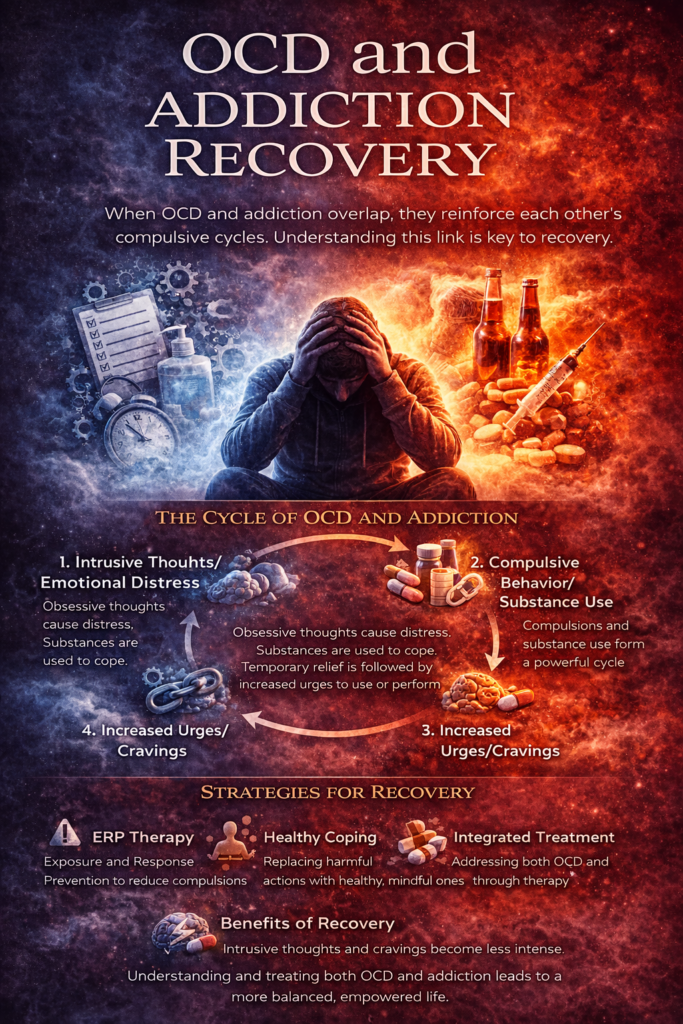
Recovery from the intersection of Obsessive-Compulsive Disorder (OCD) and addiction involves addressing two deeply connected cycles of behavior and emotion. OCD is characterized by intrusive thoughts and compulsive actions, while addiction centers on repeated substance use to manage distress. When these conditions occur together, they can reinforce one another, making it more difficult to break free from patterns of temporary relief and recurring discomfort. Understanding how these cycles interact is essential, as recovery requires not only stopping harmful behaviors but also learning new ways to respond to anxiety, uncertainty, and emotional triggers.
Breaking the Loop: OCD and Addiction Recovery
Recovery from the intersection of Obsessive-Compulsive Disorder (OCD) and addiction presents a unique challenge—one defined by cycles of thought and behavior that reinforce each other. OCD is characterized by intrusive thoughts (obsessions) and repetitive behaviors (compulsions), while addiction involves repeated substance use despite negative consequences. When these conditions overlap, they can create a powerful loop of distress and temporary relief that is difficult to interrupt.
Understanding how these patterns interact is essential for building an effective and sustainable recovery process.
How OCD and Addiction Interact
At their core, both OCD and addiction involve compulsivity—a strong urge to act in order to relieve discomfort.
- In OCD, compulsions are performed to reduce anxiety caused by intrusive thoughts
- In addiction, substances are used to escape or alter emotional states
When combined, substances may become part of the compulsive cycle:
- Obsessive thoughts → anxiety → substance use → temporary relief → return of distress
This overlap can intensify both conditions, making symptoms more frequent and harder to manage.
The Cycle of Compulsion and Dependency
The interaction between OCD and addiction often follows a reinforcing loop:
- Intrusive Thought or Emotional Trigger
- Rising Anxiety or Distress
- Compulsive Behavior or Substance Use
- Temporary Relief
- Return of Obsessions or Cravings
Over time, the brain learns to rely on these behaviors for relief, strengthening the cycle.
Challenges in Recovery
Recovery is more complex when both OCD and addiction are present because:
- Avoidant behaviors can reinforce OCD symptoms
- Substance use can worsen intrusive thoughts and anxiety
- Compulsions may shift forms (e.g., from rituals to substance use)
- Emotional regulation becomes more difficult
This means treatment must address both conditions together—not separately.
Key Strategies for Recovery
1. Exposure and Response Prevention (ERP)
ERP is a core treatment for OCD. It involves:
- Gradual exposure to anxiety-provoking thoughts or situations
- Resisting the urge to perform compulsions
This helps retrain the brain to tolerate discomfort without needing immediate relief.
2. Developing Healthy Coping Mechanisms
Instead of relying on substances or compulsions, individuals can learn to:
- Sit with discomfort without reacting
- Use grounding techniques and mindfulness
- Engage in structured, healthy activities
The goal is to replace harmful patterns with sustainable ones.
3. Addressing Thought Patterns
OCD often involves distorted thinking, such as:
- Overestimating danger
- Needing certainty or control
Cognitive strategies help challenge these thoughts and reduce their intensity.
4. Integrated Treatment Approach
Effective recovery often includes:
- Therapy (CBT and ERP)
- Addiction counseling or support groups
- Medication when appropriate
Treating both OCD and addiction together increases long-term success.
5. Building Tolerance for Uncertainty
A major component of OCD is the need for certainty. Recovery involves learning to:
- Accept uncertainty without immediate resolution
- Let thoughts exist without trying to “fix” them
This reduces both compulsive behaviors and the urge to escape through substances.
The Role of Support Systems
Recovery is not meant to happen in isolation. Support from therapists, peer groups, and trusted individuals provides:
- Accountability
- Perspective during difficult moments
- Encouragement to stay consistent with treatment
The Long-Term Outlook
Recovery from OCD and addiction is not about eliminating all intrusive thoughts or cravings—it’s about changing how you respond to them.
With time:
- Urges become less intense and less frequent
- Emotional regulation improves
- Confidence in managing discomfort increases
The cycle of compulsion and dependency can be replaced with one of awareness and control.
Conclusion
OCD and addiction both thrive on the need for immediate relief. Recovery, however, is built on something different—the ability to pause, tolerate discomfort, and choose a healthier response.
Breaking the loop doesn’t happen all at once. But with the right strategies and support, it becomes possible to move from a life driven by compulsion to one guided by intention.
Taking Control of the Cycle: Self-Management Strategies for OCD and Addiction Recovery
Recovery from the intersection of Obsessive-Compulsive Disorder (OCD) and addiction requires more than awareness—it requires intentional, consistent self-management. Both conditions are driven by cycles of discomfort and relief: intrusive thoughts or emotional distress lead to compulsions or substance use, which provide temporary relief but reinforce the pattern over time.
Self-management strategies focus on breaking this cycle by building the ability to tolerate discomfort, regulate emotions, and respond differently to urges.
Understanding the Shared Cycle
Before applying strategies, it’s important to recognize the pattern:
- Trigger: intrusive thought, anxiety, or emotional distress
- Urge: compulsion or craving to use substances
- Action: ritual or substance use
- Relief: short-term reduction in discomfort
- Reinforcement: cycle becomes stronger
Self-management works by interrupting this sequence—especially between the urge and the action.
Core Self-Management Strategies
1. Build Awareness of Triggers and Patterns
You can’t change what you don’t recognize. Start by identifying:
- Common intrusive thoughts or obsessions
- Emotional triggers (stress, uncertainty, boredom)
- Situations where urges increase
Keeping a simple log of triggers and responses can reveal patterns and give you more control over them.
2. Practice Response Prevention (Pause Before Action)
A key skill is learning to delay or resist the urge to act on compulsions or cravings.
Try:
- Waiting 5–10 minutes before responding to an urge
- Reminding yourself: “This feeling will pass.”
- Observing the urge without acting on it
This weakens the automatic connection between discomfort and behavior.
3. Develop Emotional Regulation Skills
Both OCD and addiction are fueled by the need to escape discomfort. Self-management involves staying present with emotions instead of avoiding them.
Helpful techniques:
- Deep breathing or grounding exercises
- Physical movement (walking, stretching)
- Naming emotions to reduce their intensity
The goal is not to eliminate discomfort, but to handle it without reacting impulsively.
4. Challenge Distorted Thinking
OCD often involves rigid or exaggerated thoughts (e.g., needing certainty, overestimating danger), while addiction may involve justifying substance use.
Practice asking:
- Is this thought realistic or extreme?
- What evidence supports or challenges it?
- What would I tell someone else in this situation?
This helps reduce the power of intrusive or impulsive thoughts.
5. Replace Compulsions and Substance Use with Healthier Actions
Simply stopping behaviors leaves a gap. It’s important to fill that space with alternative responses:
- Anxiety → grounding or mindfulness
- Urge to use → call someone or engage in an activity
- Intrusive thought → acknowledge and redirect attention
Replacement behaviors don’t need to be perfect—just functional.
6. Create Structure and Routine
Unstructured time can increase both obsessive thinking and cravings.
Build a daily routine that includes:
- Regular sleep and meals
- Planned activities
- Time for rest and connection
Structure reduces uncertainty, which is a major trigger for both OCD and addiction.
7. Build Tolerance for Uncertainty
A core feature of OCD is the need for certainty, while addiction often seeks immediate relief. Recovery involves accepting that:
- Not all thoughts need answers
- Not all discomfort needs to be fixed immediately
Learning to sit with uncertainty reduces both compulsions and substance use urges.
8. Use Support as Part of Self-Management
Self-management doesn’t mean doing everything alone. It includes knowing when to reach out.
Support can include:
- Therapy (especially CBT and ERP)
- Peer recovery groups
- Trusted individuals for accountability
Proactively using support strengthens your ability to manage difficult moments.
The Long-Term Shift
With consistent practice:
- Urges become less intense and less frequent
- Emotional reactions become more manageable
- Confidence in handling discomfort increases
What once felt like an uncontrollable loop becomes a pattern you can recognize—and interrupt.
Conclusion
Self-management in OCD and addiction recovery is about reclaiming control over how you respond to your internal experiences. You may not be able to stop every thought or feeling, but you can choose what you do next.
And that choice—repeated over time—is what breaks the cycle.
Supporting the Healing Process: Family Strategies for OCD and Addiction Recovery
Recovery from the intersection of Obsessive-Compulsive Disorder (OCD) and addiction can be complex—not only for the individual, but for the entire family. Both conditions involve cycles of distress and temporary relief, which can be difficult to understand from the outside. Intrusive thoughts, compulsive behaviors, and substance use may appear confusing or frustrating, especially when they seem repetitive or resistant to change.
However, when families understand the underlying patterns, they can shift from reacting to behaviors → to supporting recovery in a meaningful, informed way.
Understanding OCD and Addiction as a Family
OCD and addiction share a key feature: compulsivity. In both cases, behaviors are driven by an urgent need to relieve discomfort.
- OCD: intrusive thoughts → anxiety → compulsive behaviors
- Addiction: emotional distress → substance use → temporary relief
When these overlap, substances can become part of the compulsive cycle. This means your loved one isn’t simply “choosing” these behaviors—they are responding to intense internal discomfort.
Recognizing this helps families move from judgment to understanding.
Why Family Support Matters
Family environments can either reinforce these cycles or help interrupt them. Supportive, informed families can:
- Reduce stress and emotional triggers
- Encourage healthier coping strategies
- Provide consistency and accountability
The goal is not to control recovery but to create conditions in which recovery is more likely to succeed.
Core Family Support Strategies
1. Educate Yourself on Both Conditions
Understanding how OCD and addiction interact is essential.
Learn about:
- Intrusive thoughts and compulsions
- The role of anxiety and uncertainty
- How substances reinforce relief cycles
Knowledge reduces misinterpretation (e.g., seeing compulsions as “choices”) and improves how you respond.
2. Avoid Reinforcing Compulsions or Substance Use
Families sometimes unintentionally support the cycle by:
- Providing reassurance that feeds OCD
- Accommodating rituals to reduce conflict
- Minimizing or covering up substance use
Instead:
- Encourage your loved one to use coping strategies
- Gently avoid participating in compulsive behaviors
- Support accountability without shaming
This helps break the reinforcement loop.
3. Practice Supportive, Non-Judgmental Communication
How you communicate matters.
Instead of:
- “Just stop doing that.”
Try:
- “I can see this is really stressful—how can I support you right now?”
Focus on:
- Listening without interrupting
- Validating feelings (not harmful behaviors)
- Staying calm during difficult moments
This builds trust and reduces defensiveness.
4. Encourage Professional Treatment
OCD and addiction often require structured, evidence-based treatment.
Support involvement in:
- Therapy (especially CBT and Exposure and Response Prevention)
- Addiction counseling or recovery programs
- Medication management is recommended
Frame this as support, not pressure: “You don’t have to do this alone.”
5. Set Clear and Healthy Boundaries
Boundaries protect both the individual and the family.
Examples:
- Not participating in compulsive rituals
- Setting limits around substance use in the home
- Following through consistently on expectations
Boundaries are not punishment—they create stability and reduce enabling.
6. Be Patient with the Recovery Process
Recovery from OCD and addiction is not linear. There may be:
- Setbacks or relapses
- Periods of increased anxiety or compulsions
- Slow progress that feels frustrating
What helps:
- Focusing on long-term progress, not perfection
- Recognizing small improvements
- Staying consistent in your support
Patience reinforces persistence.
7. Take Care of Your Own Well-Being
Supporting someone through recovery can be emotionally demanding. Families need support, too.
Consider:
- Therapy or support groups for family members
- Maintaining your own routines and boundaries
- Recognizing what you can and cannot control
Healthy supporters provide more effective support.
The Long-Term Impact
As recovery progresses:
- Compulsions and cravings become more manageable
- Emotional regulation improves
- Family relationships often strengthen
Supportive family involvement can significantly improve outcomes—not by “fixing” the problem, but by creating a stable, understanding environment.
Conclusion
OCD and addiction are driven by the need for immediate relief from distress. Family support, when done effectively, introduces something different: stability, patience, and understanding.
You don’t need to have all the answers. What matters most is showing up consistently in a way that supports growth, not the cycle—and that can make a powerful difference in recovery.
Building the Network: Community Resource Strategies for OCD and Addiction Recovery
Recovery from the intersection of Obsessive-Compulsive Disorder (OCD) and addiction is not something that happens in isolation. Both conditions are driven by cycles of distress and relief—intrusive thoughts, anxiety, compulsions, and substance use—that can be difficult to break without structured support. Community resources provide the external framework needed to understand these patterns, develop new coping skills, and maintain long-term recovery.
Rather than relying solely on willpower, individuals benefit from a network that reinforces stability, accountability, and growth.
Why Community Resources Are Essential
OCD and addiction share overlapping features such as compulsivity, avoidance, and difficulty tolerating uncertainty. Community resources help address these by offering:
- Education about how thoughts, emotions, and behaviors interact
- Structured environments that reduce impulsive decision-making
- Access to professional and peer support
- Opportunities to practice new coping strategies in real-life settings
These supports transform recovery from an internal struggle into a supported process.
Core Community Resource Strategies
1. Specialized Therapy Services (CBT & ERP)
Evidence-based therapies are critical for addressing OCD and addiction together.
- Cognitive Behavioral Therapy (CBT): helps identify and change distorted thinking patterns
- Exposure and Response Prevention (ERP): teaches individuals to face anxiety without performing compulsions
Community clinics and outpatient programs often provide access to these treatments, helping individuals retrain their responses to distress.
2. Addiction Recovery Programs: Structure and Accountability
Recovery programs (such as outpatient treatment or peer-based groups) provide:
- Regular meeting schedules
- Accountability through check-ins
- A space to discuss cravings and triggers
These programs help individuals understand how substance use fits into the compulsive cycle and how to interrupt it.
3. Peer Support Groups: Shared Experience and Normalization
Peer groups allow individuals to connect with others facing similar challenges.
Benefits include:
- Reducing isolation and shame
- Learning practical coping strategies
- Gaining perspective from others in recovery
Hearing others describe similar obsessive thoughts or urges can make the experience feel more manageable and less overwhelming.
4. Mental Health and Psychiatric Services
Since OCD often involves severe anxiety and intrusive thoughts, professional mental health care is essential.
Community resources may offer:
- Psychiatric evaluations
- Medication management when appropriate
- Ongoing mental health monitoring
These services support both emotional stability and symptom reduction.
5. Recovery Centers and Intensive Outpatient Programs (IOPs)
For individuals needing more structure, IOPs and recovery centers provide:
- Scheduled therapy sessions
- Skill-building workshops
- Supervised support without full hospitalization
This level of care helps stabilize both compulsions and substance use patterns.
6. Skill-Building and Life Development Programs
Recovery is not only about stopping harmful behaviors—it’s about building a functional life.
Community programs can help with:
- Stress management and emotional regulation
- Job training and education
- Social skills and relationship building
These resources reduce the likelihood of returning to old coping mechanisms.
7. Crisis and Immediate Support Services
Moments of intense anxiety or craving can lead to impulsive decisions.
Crisis resources provide:
- Immediate emotional support
- Guidance during high-risk situations
- Connection to additional services
Having access to real-time help can interrupt compulsive or addictive behaviors before they escalate.
Using Community Resources Effectively
To maximize benefit:
- Start with a few consistent supports rather than overwhelming yourself
- Combine different types (therapy + peer support + structured programs)
- Stay consistent, even when motivation is low
- Be open to adjusting resources until you find the right fit
Recovery is strengthened through repetition and engagement—not perfection.
The Long-Term Impact
With consistent use of community resources:
- Intrusive thoughts become less controlling
- Compulsions and cravings decrease in intensity
- Emotional regulation improves
- Confidence in managing uncertainty grows
The cycle of OCD and addiction begins to weaken, replaced by healthier patterns of response.
Conclusion
Community resources don’t replace personal effort—they strengthen it. In OCD and addiction recovery, where internal experiences can feel overwhelming, external support provides the structure needed to create lasting change.
Recovery becomes more than breaking a cycle—it becomes building a system that supports a new way of living.
Frequently Asked Questions
Here are some common questions:
1. How are OCD and addiction connected?
Obsessive-Compulsive Disorder (OCD) and addiction are linked through compulsive behavior. Both involve repetitive actions used to relieve distress—OCD through rituals and addiction through substance use. Over time, both reinforce a cycle of temporary relief followed by returning discomfort.
2. Can someone have both OCD and addiction at the same time?
Yes. This is called co-occurring or comorbid conditions. When OCD and addiction occur together, they often intensify each other, making symptoms more difficult to manage without integrated treatment.
3. Why do people with OCD sometimes develop addiction?
People with OCD may turn to substances to cope with intrusive thoughts, anxiety, or emotional distress. Substances can provide temporary relief, increasing the likelihood of repeated use and eventual dependence.
4. Does addiction make OCD symptoms worse?
Yes. Substance use can increase anxiety, disrupt brain function, and reduce the effectiveness of coping strategies. This often leads to stronger intrusive thoughts and more frequent compulsions.
5. What does the cycle of OCD and addiction look like?
The cycle typically includes:
- Intrusive thoughts or emotional distress
- Anxiety or discomfort
- Compulsive behavior or substance use
- Temporary relief
- Return of distress (often stronger)
This loop reinforces both OCD symptoms and addiction.
6. Can OCD be mistaken for addiction or vice versa?
Sometimes. Both involve repetitive behaviors and urges, but the motivations differ. OCD behaviors are driven by anxiety and the need to reduce it, while addiction is driven by cravings and reward. However, they can overlap and appear similar.
7. What treatments are effective for both conditions?
Integrated treatment is most effective, including:
- Cognitive Behavioral Therapy (CBT)
- Exposure and Response Prevention (ERP) for OCD
- Addiction counseling or recovery programs
- Medication when appropriate
Treating both conditions together improves outcomes.
8. What is ERP, and why is it important?
Exposure and Response Prevention (ERP) is a therapy that helps individuals face anxiety-provoking thoughts or situations without performing compulsions. It teaches the brain that discomfort can decrease without needing harmful behaviors.
9. How long does recovery take?
Recovery is different for everyone. Some improvements may occur within weeks, but long-term recovery often takes months or longer. Progress depends on consistency, support, and addressing both OCD and addiction together.
10. Is relapse common in OCD and addiction recovery?
Relapse can happen and does not mean failure. It often reflects a need for stronger coping strategies or additional support. Recovery is a process, not a single event.
11. How can someone manage urges and intrusive thoughts?
Helpful strategies include:
- Pausing before acting on urges
- Practicing grounding or mindfulness
- Challenging distorted thoughts
- Using support systems (therapy, peers)
The focus is on changing responses, not eliminating thoughts entirely.
12. When should someone seek professional help?
Professional help is recommended if:
- Intrusive thoughts feel overwhelming
- Substance use is difficult to control
- Daily functioning is affected
- There are repeated relapses or worsening symptoms
Early intervention improves recovery outcomes.
Conclusion
OCD and addiction recovery is a complex but achievable process that requires patience, consistency, and a comprehensive approach. By addressing both the compulsive patterns of OCD and the dependency cycle of substance use, individuals can begin to regain control over their thoughts and behaviors. Over time, with the support of effective strategies and resources, the intensity of urges and intrusive thoughts can decrease, allowing for greater emotional stability and resilience. Ultimately, recovery is not about eliminating all discomfort, but about developing the ability to respond to it in healthier, more intentional ways, leading to a more balanced and sustainable life.
Video: Why OCD and Addiction Are Impossible to Break Apart #OCDRecovery #AddictionCycle