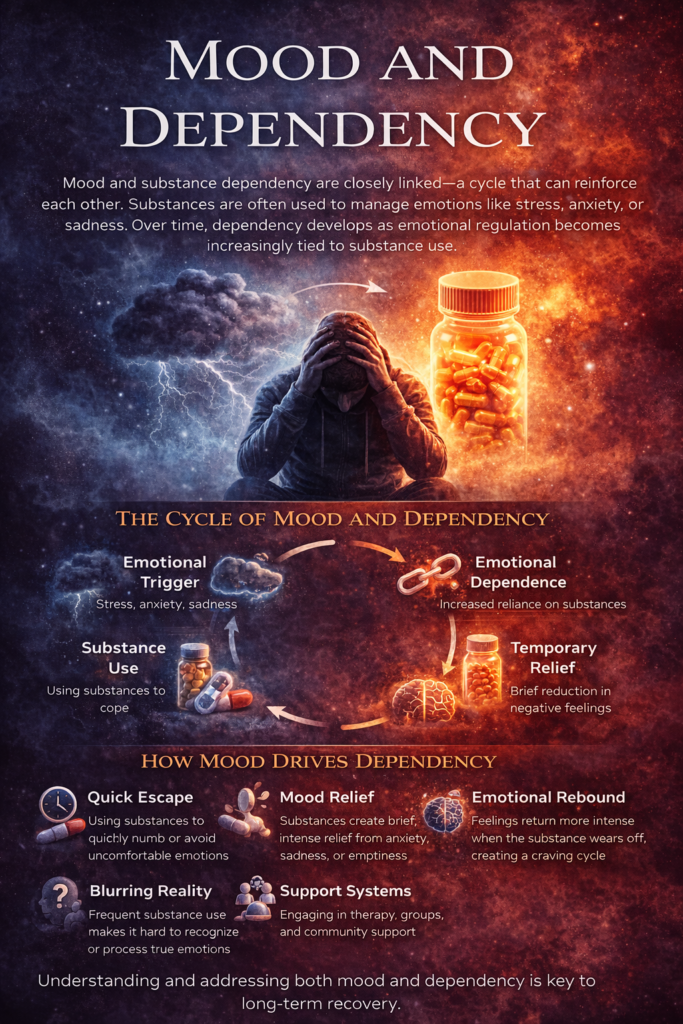
Mood and dependency are closely intertwined, forming a cycle that can significantly impact an individual’s thoughts, behaviors, and overall well-being. Substances are often used as a way to cope with difficult emotions such as stress, anxiety, sadness, or even emptiness. Over time, this reliance can develop into dependency, where the mood no longer feels manageable without external support. Understanding the connection between emotional regulation and substance use is essential, as it highlights that dependency is not just a matter of behavior, but also a response to internal psychological states.
Mood and Dependency: The Emotional Cycle Behind Addiction
Mood and dependency are deeply interconnected, forming a cycle that can be difficult to recognize and even harder to break. While addiction is often viewed as a behavioral issue, it is equally an emotional and psychological process. Substances are not only used for pleasure—they are frequently used as tools to manage internal states such as stress, anxiety, sadness, or even emptiness. Understanding this relationship is key to addressing both the cause and the continuation of dependency.
The Link Between Mood and Substance Use
At its core, dependency often begins as an attempt to regulate mood. Individuals may turn to substances to:
- Reduce anxiety or stress
- Escape negative thoughts or emotions
- Enhance feelings of pleasure or confidence
- Cope with trauma or unresolved experiences
Over time, the brain begins to associate substance use with emotional relief. This creates a learned pattern: feel something uncomfortable → use something to change it.
The Cycle of Mood and Dependency
What starts as relief can quickly become a loop:
- Emotional Trigger – Stress, sadness, boredom, or frustration arises
- Substance Use – The individual uses substances to alter or escape the feeling
- Temporary Relief – The substance provides short-term emotional change
- Aftereffects – Guilt, shame, or worsened mood may follow
- Increased Vulnerability – Negative emotions return, often stronger
This cycle reinforces itself. The more it repeats, the more the brain relies on substances as the primary means of regulating mood.
When Mood Disorders and Dependency Overlap
Many individuals experience both substance use issues and underlying mental health conditions, such as anxiety or depression. In these cases, substances may initially feel like a form of self-medication.
However, dependency often intensifies these conditions by:
- Disrupting brain chemistry
- Increasing emotional instability
- Reducing the effectiveness of natural coping strategies
This creates a dual challenge: managing both mood and dependency at the same time.
Breaking the Cycle
Recovery requires more than stopping substance use—it involves learning new ways to manage mood effectively. Key components include:
- Emotional Awareness: Recognizing triggers and identifying feelings
- Healthy Regulation: Using coping strategies like exercise, mindfulness, or journaling
- Cognitive Restructuring: Challenging negative thought patterns
- Support Systems: Therapy, peer groups, and trusted relationships
These strategies help replace the role substances once played.
Rebuilding Emotional Stability
In early recovery, emotions may feel more intense or unpredictable. This is a normal part of the adjustment process. The brain is relearning how to regulate itself without artificial interference.
With time and consistency:
- Emotional responses become more balanced
- Triggers become easier to manage
- Natural sources of satisfaction return
The goal is not to eliminate difficult emotions, but to respond to them in healthier, more sustainable ways.
Conclusion
Mood and dependency are not separate issues—they are deeply intertwined. Addressing one without the other often leads to incomplete recovery. By understanding how emotions drive substance use, individuals can begin to break the cycle and build a more stable, self-directed way of living—one where mood is managed, not escaped.
Regaining Control: Self-Management Strategies for Mood and Dependency
Mood and dependency are closely linked, often reinforcing one another in ways that feel automatic and difficult to interrupt. Substances are frequently used to manage emotional states—whether to reduce distress, escape discomfort, or enhance pleasure. Over time, this creates a reliance on external substances rather than internal regulation. Understanding this connection is essential, but more importantly, learning to manage it leads to lasting change.
Self-management strategies provide the tools needed to break this cycle. They shift the focus from reacting to emotions → to responding with awareness, structure, and intention.
Understanding Your Emotional Patterns
The first step in self-management is recognizing how mood influences behavior. Many people use substances not randomly, but in response to specific emotional triggers such as stress, loneliness, boredom, or frustration.
Start by asking:
- What emotions tend to come before the urge to use?
- Are there patterns in time, environment, or social situations?
- What am I trying to change or avoid in that moment?
This awareness transforms dependency from something that feels uncontrollable into something that can be understood and addressed.
Building Emotional Regulation Skills
Dependency often develops because substances provide quick emotional relief. Without them, emotions may feel more intense or harder to manage.
Self-management means learning to regulate emotions without escaping them:
- Pause and label emotions (e.g., “This is anxiety, not danger”)
- Use grounding techniques like deep breathing, movement, or sensory focus
- Allow emotions to pass rather than reacting immediately
Over time, this builds tolerance for discomfort—the ability to experience emotions without needing to eliminate them instantly.
Creating Structure and Predictability
Unstructured time can increase emotional vulnerability and cravings. A consistent routine helps stabilize both mood and behavior.
Effective structure includes:
- Regular sleep and wake times
- Planned daily activities (even simple ones)
- Balanced time for productivity, rest, and connection
Structure reduces uncertainty, which in turn lowers emotional reactivity.
Replacing the Function of Substances
Substances often serve a purpose—relief, stimulation, distraction, or connection. Simply removing them without addressing that function leaves a gap.
Ask:
- What need was this meeting for?
- What healthier behavior can meet that need, even partially?
Examples:
- Stress → exercise or relaxation techniques
- Loneliness → reaching out to someone
- Boredom → engaging in hobbies or learning something new
The goal is not perfection, but functionality.
Rewiring the Reward System
Dependency alters how the brain experiences reward. In early recovery, natural pleasures may feel less satisfying.
To rebuild this system:
- Engage in small, repeatable positive activities
- Focus on consistency rather than intensity
- Acknowledge small achievements
With repetition, the brain begins to respond to natural rewards again.
Challenging Thought Patterns
Mood and dependency are often maintained by automatic thoughts such as:
- “I can’t handle this without using.”
- “This feeling will never go away.”
- “One time won’t matter.”
Self-management involves questioning these thoughts:
- Is this thought accurate or exaggerated?
- What evidence supports or challenges it?
- What would I say to someone else in this situation?
This process weakens the mental patterns that drive dependency.
Using Support as a Strategy, Not a Last Resort
Self-management doesn’t mean doing everything alone. It includes knowing when and how to seek support:
- Therapy or counseling
- Peer support groups
- Trusted individuals for accountability
Support reinforces skills and provides perspective during difficult moments.
The Long-Term Shift
As self-management skills develop:
- Emotional responses become more stable
- Cravings become less frequent and intense
- Confidence in handling difficult situations increases
What once felt like a cycle of mood and dependency becomes a process of awareness and control.
Conclusion
Understanding mood and dependency is only the beginning. Real change happens when that understanding is paired with consistent self-management. By learning to respond to emotions rather than escape them, individuals can break the cycle of dependency and build a more stable, self-directed life.
Stronger Together: Family Support Strategies for Understanding Mood and Dependency
Mood and dependency are deeply connected, often forming a cycle that affects not only the individual but also the family system around them. When someone uses substances to cope with emotional distress, their behavior may seem unpredictable, frustrating, or even personal to loved ones. However, understanding the relationship between mood and dependency allows families to respond with clarity rather than confusion, and support rather than reaction.
Family support is not about controlling behavior—it’s about creating an environment where healthier patterns can develop.
Understanding Mood and Dependency as a Family
Dependency is rarely just about the substance itself. It is often a response to emotional discomfort such as anxiety, depression, stress, or unresolved pain. Substances may temporarily regulate these feelings, which reinforces their use over time.
For families, this means:
- Mood changes are often triggers, not just reactions
- Substance use may be an attempt to cope, not simply a choice
- Emotional instability can be part of the recovery process
Shifting this perspective helps families move from “Why are they doing this?” to “What might they be trying to manage?”
Why Family Support Matters
Family dynamics can either unintentionally reinforce dependency or help interrupt it. Supportive environments reduce stress, increase accountability, and provide emotional stability—all of which are critical for recovery.
The goal is not perfection, but consistency.
Core Family Support Strategies
1. Educate Yourself on Mood and Dependency
Understanding the emotional drivers behind substance use reduces misinterpretation and blame.
Learn about:
- How mood influences behavior
- The cycle of emotional triggers and substance use
- The role of the brain in dependency
Knowledge helps families respond thoughtfully rather than react emotionally.
2. Practice Empathetic Communication
How families communicate can either open or shut down trust.
Instead of:
- “Why can’t you just stop?”
Try:
- “I’ve noticed things seem really overwhelming lately—do you want to talk about it?”
Focus on:
- Listening without interrupting
- Validating feelings without endorsing harmful behavior
- Using calm, non-judgmental language
Empathy strengthens connection, which is protective in recovery.
3. Avoid Enabling While Offering Support
Supporting someone does not mean removing all consequences of their behavior.
Healthy support includes:
- Encouraging responsibility
- Not covering up or rescuing from consequences
- Offering help that promotes growth, not dependence
This balance allows accountability without rejection.
4. Encourage Healthy Emotional Expression
Many individuals with dependency struggle to express or tolerate emotions.
Families can help by:
- Creating a safe space for honest conversation
- Normalizing emotional expression
- Modeling healthy ways to cope with stress
This helps replace avoidance with communication.
5. Establish Clear and Consistent Boundaries
Boundaries protect both the individual and the family.
Examples:
- Defining acceptable behavior in the home
- Setting limits around substance use
- Following through consistently on consequences
Boundaries are not punishments—they are structure.
6. Support Professional Help
Mood and dependency often require more than family support alone.
Encourage:
- Therapy or counseling
- Support groups
- Medical or psychiatric care when needed
Frame it as support, not pressure: “I want you to have every resource that can help.”
7. Take Care of Your Own Well-Being
Supporting someone with a dependency can be emotionally exhausting. Families must also manage their own stress and boundaries.
This may include:
- Seeking counseling or support groups for families
- Maintaining personal routines and self-care
- Recognizing limits to what you can control
Healthy families provide better support.
The Long-Term Shift
As individuals learn to manage mood without substances, family dynamics also begin to change. Communication improves, trust is rebuilt, and emotional stability increases.
This process takes time—and often includes setbacks—but consistent, informed support makes a significant difference.
Conclusion
Understanding mood and dependency transforms how families respond to addiction. Instead of reacting to behaviors alone, families can address the emotional roots behind them. With empathy, boundaries, and consistency, family support becomes a powerful force—not in controlling outcomes but in creating the conditions for recovery to grow.
Building Support Systems: Community Resource Strategies for Understanding Mood and Dependency
Mood and dependency are not isolated experiences—they are shaped and reinforced by environment, access to support, and available resources. While personal insight and family support are important, community resources play a critical role in helping individuals understand and manage the connection between emotional states and substance use. These resources provide structure, education, and connection, all of which are essential for breaking the cycle of dependency.
Understanding how to effectively use community support can turn recovery from an individual struggle into a supported, sustainable process.
Why Community Resources Matter
Dependency often develops in environments where emotional needs are unmet or coping strategies are limited. Community resources help fill these gaps by offering:
- Access to education about mood and behavior
- Opportunities to build healthy routines
- Safe spaces for connection and accountability
- Professional guidance and skill development
These supports reduce isolation and create a framework for long-term stability.
Core Community Resource Strategies
1. Peer Support Groups: Shared Understanding
Peer groups provide a space where individuals can connect with others who have similar experiences with mood and dependency.
Benefits include:
- Hearing others describe similar emotional triggers
- Learning practical coping strategies
- Reducing shame through shared experience
Groups such as 12-step programs or alternative recovery models help individuals understand that dependency is not just about substances—it’s about patterns of coping.
2. Mental Health Services: Addressing the Root Causes
Since mood often drives dependency, addressing underlying mental health conditions is essential.
Community-based services may include:
- Individual therapy
- Group counseling
- Psychiatric evaluation and medication management
These services help individuals develop emotional regulation skills and understand how their mood influences behavior.
3. Educational Programs: Increasing Awareness
Many community organizations offer workshops or classes focused on:
- Stress management
- Emotional regulation
- Relapse prevention
- Life skills development
Education empowers individuals to recognize patterns and make informed decisions rather than reacting impulsively.
4. Recovery Centers and Outpatient Programs: Structured Support
Structured programs provide a higher level of care while allowing individuals to remain in their communities.
They offer:
- Scheduled therapy sessions
- Skill-building activities
- Accountability through regular check-ins
This structure helps stabilize mood and reduce the likelihood of returning to old patterns.
5. Recreational and Skill-Based Programs: Rebuilding Healthy Rewards
Dependency often replaces natural sources of enjoyment. Community programs can help reintroduce these experiences.
Examples include:
- Fitness groups
- Art or music classes
- Volunteer opportunities
These activities provide positive reinforcement and help rebuild a sense of purpose and satisfaction.
6. Crisis and Support Hotlines: Immediate Access to Help
During moments of intense emotional distress, immediate support is critical.
Hotlines and crisis services offer:
- Real-time emotional support
- Guidance during high-risk situations
- Connection to additional resources
Having access to immediate help can interrupt the cycle of mood-driven substance use.
7. Case Management and Social Services: Stabilizing Life Conditions
External stressors such as housing instability, unemployment, or lack of healthcare can worsen both mood and dependency.
Community services help address these factors by providing:
- Housing assistance
- Employment support
- Access to healthcare
Stability in these areas reduces emotional strain and supports recovery.
Using Community Resources Effectively
Simply having access to resources is not enough—how they are used matters.
Effective strategies include:
- Starting with a manageable number of supports rather than overloading
- Being consistent, even when motivation is low
- Trying different resources to find the right fit
- Combining multiple supports (e.g., therapy + peer groups + activities)
Recovery is strengthened through repetition and engagement.
The Long-Term Impact
As individuals consistently engage with community resources:
- Emotional awareness improves
- Healthier coping strategies become routine
- Dependency loses its role as a primary coping mechanism
Over time, the relationship between mood and behavior becomes more balanced and intentional.
Conclusion
Understanding mood and dependency requires more than insight—it requires support, structure, and opportunity. Community resources provide the environment where these elements come together. By actively engaging with these supports, individuals can move from reactive patterns to intentional living, building a life where emotions are managed constructively rather than escaped.
Frequently Asked Questions
Here are some common questions:
1. What is the relationship between mood and dependency?
Mood and dependency are closely connected. Many individuals use substances to manage or change how they feel—whether to reduce stress, numb pain, or enhance mood. Over time, this creates a pattern where emotional regulation becomes dependent on substance use.
2. Does dependency always start with emotional issues?
Not always, but emotional factors are very common. Some people begin using substances socially or recreationally, but continued use often becomes tied to coping with stress, anxiety, depression, or other emotional challenges.
3. Can mood disorders lead to addiction?
Yes. Conditions like anxiety or depression can increase the risk of dependency because individuals may use substances as a form of self-medication. However, substance use can also worsen these conditions over time, creating a cycle.
4. How does dependency affect mood over time?
While substances may provide short-term relief, they often disrupt brain chemistry. This can lead to:
- Increased anxiety or depression
- Mood instability
- Irritability or emotional numbness
Over time, mood becomes more difficult to regulate naturally.
5. What is the “cycle” of mood and dependency?
The cycle typically looks like this:
- Emotional discomfort (stress, sadness, etc.)
- Substance use to cope
- Temporary relief
- Negative aftereffects (guilt, worsening mood)
- Increased urge to use again
This loop reinforces dependency.
6. Why do emotions feel stronger in recovery?
Substances often suppress or dull emotions. When they are removed, feelings return more intensely because the brain is relearning how to regulate emotions without external substances.
7. Can dependency exist without noticeable mood problems?
Yes, but it’s less common. Even if mood issues aren’t obvious at first, dependency often leads to emotional changes over time due to its effects on the brain and behavior.
8. How can someone manage mood without substances?
Healthy alternatives include:
- Practicing emotional awareness and labeling feelings
- Using coping strategies like exercise, mindfulness, or journaling
- Building routines and structure
- Seeking therapy or peer support
These approaches help develop long-term emotional stability.
9. Is relapse related to mood?
Often, yes. Emotional triggers such as stress, loneliness, or frustration are common causes of relapse. Learning to manage these emotions is a key part of preventing them.
10. How long does it take for the mood to stabilize after stopping substance use?
It varies. Some improvements happen within weeks, while full emotional stabilization can take months. Factors like duration of use, mental health, and support systems all play a role.
11. Should mood and dependency be treated together?
Yes. Treating only the substance use without addressing the underlying emotional issues often leads to relapse. Integrated treatment that focuses on both is more effective.
12. When should someone seek professional help?
Professional help is recommended if:
- Mood symptoms feel overwhelming or persistent
- Substance use is difficult to control
- There are co-occurring mental health concerns
- Daily functioning is affected
Early support can prevent the cycle from worsening.
Conclusion
The relationship between mood and dependency is complex, but not unchangeable. By recognizing how emotions influence substance use, individuals can begin to break the cycle and develop healthier ways of coping. With self-awareness, support, and consistent strategies, it becomes possible to manage mood without relying on substances. Ultimately, addressing both emotional health and dependency together creates a stronger foundation for long-term stability, resilience, and personal growth.
Video: The Mood Trap Gets Stronger Each Time #AddictionAwareness #Cycle