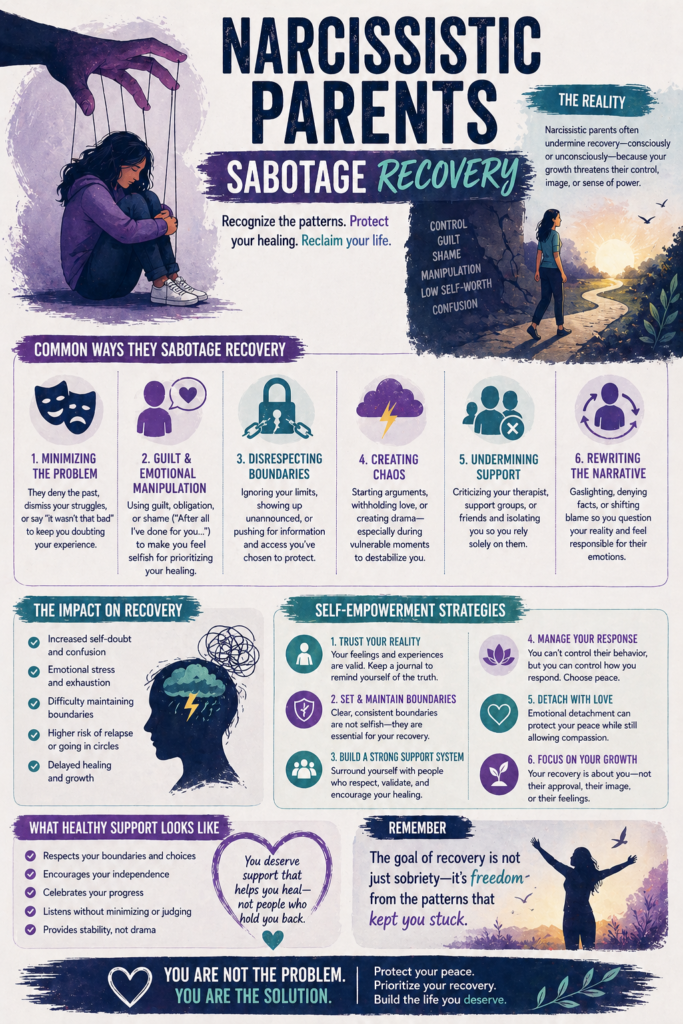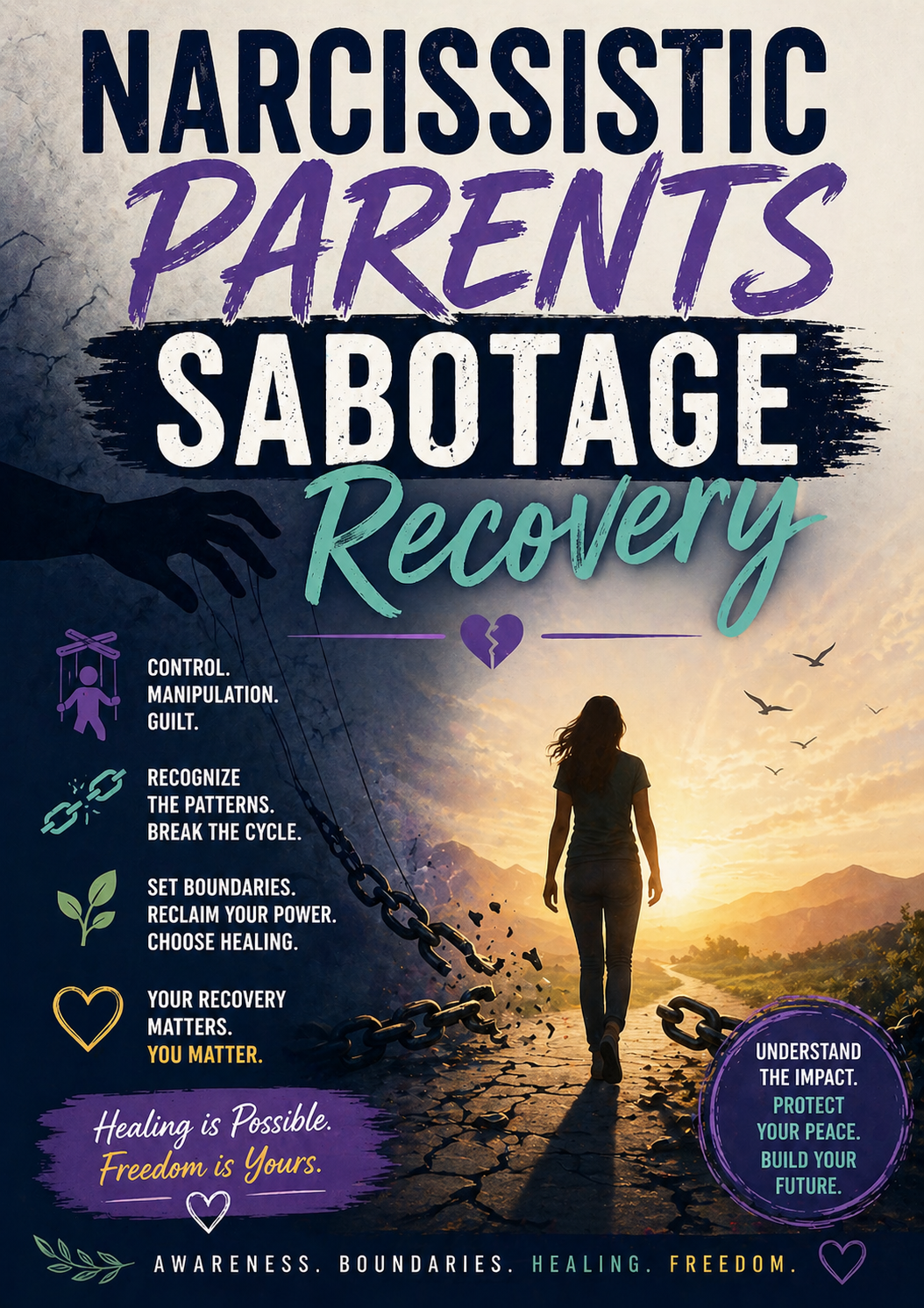
Recovery is often viewed as an individual commitment to change, but in reality, it unfolds within the influence of relationships—especially family. For those raised by narcissistic parents, the path to recovery can be complicated by patterns of control, manipulation, and emotional invalidation that persist into adulthood. As individuals begin to heal, set boundaries, and reclaim their autonomy, these changes can disrupt long-standing family dynamics. In response, narcissistic parents may—consciously or unconsciously—engage in behaviors that undermine progress. Understanding how this sabotage operates is essential not to assign blame but to recognize the external forces that can affect recovery and make it more difficult to sustain.
When Healing Threatens Control: How Narcissistic Parents Sabotage Recovery
Recovery is often described as a personal journey—but for many, it unfolds within the context of family dynamics that can either support or quietly undermine it. For individuals raised by narcissistic parents, recovery can feel especially complicated. As healing begins, old patterns are challenged, roles shift, and boundaries emerge. And in some cases, this change is met not with support, but with resistance.
Understanding how narcissistic parents may sabotage recovery is not about blame—it’s about clarity. Because what looks like “lack of progress” is sometimes the result of active or subtle interference from the environment.
Understanding Narcissistic Family Dynamics
Narcissistic parenting is often characterized by:
- A strong need for control or admiration
- Difficulty acknowledging others’ needs or autonomy
- Emotional manipulation (guilt, blame, gaslighting)
- Conditional love or approval
In these environments, children often learn to:
- Prioritize the parents’ emotions over their own
- Suppress their needs or identity
- Take on roles (caretaker, scapegoat, peacekeeper)
Addiction can develop as a coping mechanism within this system—and recovery can threaten it.
Why Recovery Can Trigger Sabotage
Recovery introduces change:
- Setting boundaries
- Gaining independence
- Questioning past dynamics
- Developing self-worth
For a narcissistic parent, this may feel like:
- Loss of control
- Threat to their self-image
- Fear of being exposed or blamed
Instead of supporting growth, they may try—consciously or not—to pull the person back into old roles.
Common Ways Recovery Is Undermined
1. Minimizing or Denying the Problem
- “You’re overreacting.”
- “It wasn’t that bad.”
This can create confusion and self-doubt, making it harder to stay committed to recovery.
2. Guilt and Emotional Manipulation
- “After everything I’ve done for you…”
- “You’re abandoning your family.”
Guilt can pressure individuals to prioritize the parent over their own healing.
3. Disrupting Boundaries
- Ignoring limits or rules set during recovery
- Pushing for access, control, or involvement
Boundaries are essential in recovery—but often challenged in narcissistic dynamics.
4. Creating Chaos or Conflict
- Starting arguments during vulnerable moments
- Introducing stress or instability
Stress can increase the urge to return to old coping behaviors.
5. Undermining Support Systems
- Criticizing therapists, friends, or recovery groups
- Isolating the individual from outside help
This limits access to healthier perspectives and support.
6. Rewriting the Narrative
- Gaslighting past experiences
- Shifting blame onto the individual
This can make it difficult to trust one’s own perception of reality.
The Emotional Impact
These dynamics can lead to:
- Increased self-doubt
- Guilt around prioritizing recovery
- Difficulty maintaining boundaries
- Emotional exhaustion
- Higher risk of relapse
It’s not just about resisting substances—it’s about navigating relational pressure and psychological patterns.
Strategies to Protect Your Recovery
1. Strengthen Your Awareness
Recognize patterns:
👉 “Is this support—or is this control?”
Naming the behavior reduces its power.
2. Set and Maintain Boundaries
- Limit conversations that become manipulative
- Decide what you will and won’t tolerate
- Understand that boundaries may not be respected—but can still be enforced
3. Build External Support Systems
- Therapists
- Recovery groups
- Trusted friends
These provide validation and grounding outside the family dynamic.
4. Separate Guilt from Responsibility
You are not responsible for:
- Your parent’s emotions
- Their reactions to your growth
Recovery requires prioritizing your well-being—even when it feels uncomfortable.
5. Limit Exposure When Necessary
In some cases, reducing contact (temporarily or long-term) may be part of protecting recovery.
This is not punishment—it’s self-preservation.
6. Reclaim Your Narrative
Trust your experiences.
- Journal
- Reflect
- Validate your own reality
You don’t need external approval to recognize what you’ve been through.
The Bigger Picture
Recovery in a narcissistic family system is not just about breaking free from addiction—it’s about breaking free from patterns that made addiction necessary in the first place.
This kind of healing is deeper, more complex, and often more challenging—but also more transformative.
Conclusion
If your healing is met with resistance, it doesn’t mean you’re doing something wrong.
Sometimes, it means you’re finally doing something different.
And in environments built on control, growth will always look like disruption.
Your recovery is allowed to come first—even if others don’t understand it.
Protecting Your Healing: Self-Management Strategies for Navigating Narcissistic Parents in Recovery
Recovery is already a complex and deeply personal process. But when it unfolds within a family dynamic shaped by narcissism, it can feel like you’re trying to heal while being pulled backward at the same time. Understanding how narcissistic parents may sabotage recovery is important—but equally important is learning how to manage yourself within that environment.
Self-management, in this context, isn’t about controlling them. It’s about protecting your clarity, boundaries, and progress—even when external support is inconsistent or undermining.
Understanding the Dynamic First
Before applying strategies, it’s essential to recognize a key truth:
👉 You cannot change their behavior—but you can change how you respond to it.
Narcissistic sabotage may show up as:
- Guilt-tripping or emotional pressure
- Minimizing your recovery
- Ignoring or pushing boundaries
- Creating conflict during vulnerable moments
- Undermining your support systems
These behaviors are often about control, not care—even if they are framed as concern.
1. Strengthen Your Internal Reality
One of the most powerful self-management tools is trusting your own perception.
Practice:
- Journaling interactions and how they made you feel
- Naming manipulation patterns (gaslighting, guilt, deflection)
- Reminding yourself: “My experience is valid.”
This helps counteract confusion and self-doubt.
2. Create Emotional Detachment (Not Disconnection)
You don’t have to absorb everything directed at you.
Try:
- Observing behavior instead of reacting immediately
- Mentally labeling interactions (“This is guilt, not truth”)
- Limiting emotional investment in triggering conversations
This is sometimes called “stepping out of the emotional hook.”
3. Set Clear, Realistic Boundaries
Boundaries are essential—but they must be self-focused, not dependent on the other person’s cooperation.
Instead of:
- “You need to stop doing this.”
Shift to:
- “If this continues, I will leave the conversation.”
Consistency matters more than perfection.
4. Prepare for Predictable Patterns
Narcissistic dynamics are often repetitive.
Ask yourself:
- When do conflicts usually happen?
- What triggers these interactions?
Then plan ahead:
- Shorten conversations
- Avoid high-risk topics
- Have exit strategies ready
Preparation reduces emotional impact.
5. Separate Guilt from Responsibility
A major challenge in these dynamics is false guilt.
Remind yourself:
- You are not responsible for their emotions
- Their reaction to your growth is not your fault
- Prioritizing recovery is not selfish—it’s necessary
👉 Guilt does not equal wrongdoing.
6. Protect Your Energy During Vulnerable Moments
Recovery involves times when you are more emotionally open or fragile.
During these times:
- Limit exposure to triggering interactions
- Delay difficult conversations
- Increase supportive contact with safe people
Self-awareness helps you guard your most vulnerable spaces.
7. Strengthen External Anchors
When internal doubt is triggered, external support becomes critical.
Build connections with:
- Therapists or counselors
- Recovery groups
- Trusted friends
These anchors help reinforce reality when it’s challenged.
8. Practice Grounding After Interactions
After difficult exchanges, your nervous system may stay activated.
Use grounding techniques:
- Deep breathing or slow exhale
- Physical movement (walking, stretching)
- Sensory focus (touch, temperature, sound)
This helps your body return to a state of safety.
9. Reframe What “Support” Means
Not all parents are capable of providing healthy support.
Self-management includes accepting:
👉 “Support may not come from them—and that’s not a reflection of my worth.”
This allows you to stop seeking validation where it’s unlikely to be given.
10. Give Yourself Permission to Create Distance
Distance can be emotional, physical, or situational.
This might include:
- Shorter visits
- Limited topics of conversation
- Reduced or structured contact
Distance is not rejection—it’s protection.
The Bigger Picture
Managing recovery in the presence of narcissistic parents is not just about staying sober—it’s about relearning what healthy relationships, boundaries, and self-worth look like.
It’s about breaking two cycles at once:
- The cycle of addiction
- The cycle of control and emotional manipulation
Conclusion
You don’t need their approval to heal.
You don’t need their understanding to grow.
Self-management in this context is about choosing, again and again:
👉 “My recovery matters—even when it’s inconvenient for others.”
And sometimes, the strongest step forward is not changing them—but finally standing firmly in yourself.
Supporting Without Enabling: Family Strategies for Navigating Narcissistic Sabotage in Recovery
When someone is working toward recovery, family support can be one of the most powerful influences in their success. But in families shaped by narcissistic dynamics, support can become complicated. What may appear as concern, involvement, or even “tough love” can sometimes function as control, manipulation, or subtle sabotage.
For families who want to truly help, understanding these patterns is essential. The goal is not to assign blame—but to shift from unintentionally reinforcing harm to actively supporting healing.
Understanding the Dynamic First
In narcissistic family systems, patterns often include:
- Control over decisions and identity
- Difficulty respecting boundaries
- Emotional manipulation (guilt, blame, gaslighting)
- Prioritizing the parents’ needs over the child’s
When recovery begins, these patterns are disrupted. The individual may:
- Set boundaries
- Seek independence
- Challenge old roles
This change can feel threatening, leading to behaviors that undermine recovery rather than support it.
👉 Family awareness is the first step toward change.
1. Recognize the Difference Between Support and Control
Support empowers. Control restricts.
Ask yourself:
- Am I helping them grow—or trying to manage their choices?
- Am I listening—or trying to direct?
Healthy support looks like:
- Encouraging autonomy
- Respecting decisions
- Offering help without pressure
2. Respect Boundaries—Even When They’re Uncomfortable
Boundaries are not rejection—they are a core part of recovery.
Support strategies:
- Accept limits without arguing or guilt-tripping
- Avoid pushing for access, information, or control
- Understand that boundaries may feel unfamiliar, but they are necessary
Respect builds trust. Resistance breaks it.
3. Avoid Guilt-Based Communication
Statements like:
- “After everything we’ve done for you…”
- “You’re hurting the family by doing this…”
…can create emotional pressure that interferes with recovery.
Instead:
- Speak from your own feelings without blame
- Focus on support, not obligation
Example:
👉 “I care about you and want to support your recovery in a way that helps you.”
4. Validate Their Experience Without Rewriting It
Minimizing or denying their experience can create confusion and self-doubt.
Avoid:
- “It wasn’t that bad.”
- “You’re overreacting.”
Practice:
- Listening without interrupting
- Acknowledging their perspective, even if you don’t fully understand it
Validation strengthens stability and trust.
5. Support Their External Support Systems
Recovery often requires help beyond the family.
Families can:
- Respect therapists, sponsors, and support groups
- Avoid criticizing or competing with these supports
- Encourage continued engagement
Outside support provides balance and perspective.
6. Reduce Conflict and Emotional Volatility
High-conflict environments can increase stress and relapse risk.
Support includes:
- Staying calm during disagreements
- Avoiding escalation or power struggles
- Choosing appropriate times for serious conversations
A stable environment supports emotional regulation.
7. Shift Focus from Control to Connection
Instead of trying to “fix” behavior, focus on:
- Building trust
- Maintaining open communication
- Showing consistent care
Connection is more effective than control in supporting change.
8. Educate Yourself About Narcissistic Patterns
Self-awareness within the family is crucial.
Learn about:
- Emotional manipulation patterns
- Boundary-setting
- Healthy communication
Understanding these dynamics helps prevent unintentional harm.
9. Accept That You May Not Be the Primary Support
This can be difficult—but it’s important.
Recovery may rely more on:
- Therapists
- Peer groups
- External mentors
This does not mean you are unimportant—it means support is shared.
10. Seek Support for Yourself
Family members also need space to process:
- Emotions
- Frustration
- Confusion
Consider:
- Therapy
- Family support groups
- Educational resources
You can’t provide healthy support if you are overwhelmed or unsupported yourself.
The Bigger Picture
When narcissistic dynamics are present, recovery is not just about overcoming addiction—it’s about changing the relational environment that may have contributed to it.
Families have the opportunity to:
👉 Move from patterns of control and conflict
👉 Toward patterns of respect, support, and growth
Conclusion
Support is not about holding on tighter—it’s about learning when to step back, listen, and respect the process.
When families shift from control to understanding, they don’t just stop sabotaging recovery—they begin to actively strengthen it.
From Awareness to Action: Community Resource Strategies for Addressing Narcissistic Parental Sabotage in Recovery
Recovery does not happen in isolation—it is shaped by relationships, environments, and access to support. For individuals raised by narcissistic parents, the recovery process can be especially vulnerable to disruption. Patterns of control, manipulation, and boundary violations don’t always end when recovery begins. In fact, they may intensify.
This is where community resources become essential. They serve not only as support systems, but as protective buffers—helping individuals recognize sabotage, maintain stability, and build healthier frameworks for healing.
Understanding the Community’s Role
When family dynamics are harmful or destabilizing, communities provide something critical:
- Validation of reality
- Alternative perspectives
- Emotional and practical support
Without this, individuals may remain stuck in cycles of confusion, self-doubt, or relapse risk.
👉 Community resources help shift the narrative from “What’s wrong with me?” to “What’s happening around me?”
1. Provide Education on Narcissistic Family Dynamics
Many individuals in recovery struggle to name or understand what they’ve experienced.
Community programs can:
- Offer workshops on narcissistic behaviors (gaslighting, guilt-tripping, control)
- Teach how these patterns impact addiction and recovery
- Normalize the experience of family-related interference
Awareness reduces self-blame and increases clarity.
2. Create Safe, Non-Judgmental Spaces
People impacted by narcissistic families often fear being misunderstood or dismissed.
Communities should:
- Foster environments where experiences are believed and validated
- Avoid minimizing family-related struggles
- Encourage open sharing without pressure or judgment
Safety allows individuals to process what they may have never been able to express.
3. Strengthen Peer Support Networks
Peer connection is especially powerful for those navigating similar dynamics.
Communities can:
- Facilitate support groups focused on family dysfunction and recovery
- Encourage sharing of lived experiences
- Promote mentorship between individuals at different stages of healing
Hearing “you’re not alone” can be transformative.
4. Teach Boundary-Setting Skills
Boundaries are essential—but often unfamiliar or difficult for those raised in narcissistic environments.
Community resources can provide:
- Practical boundary-setting techniques
- Role-playing or communication exercises
- Strategies for maintaining boundaries under pressure
These tools help individuals protect their recovery in real-life situations.
5. Offer Trauma-Informed Care
Narcissistic family dynamics often involve emotional trauma.
Community programs should:
- Recognize trauma responses (hypervigilance, self-doubt, emotional reactivity)
- Avoid shame-based approaches
- Prioritize emotional safety and empowerment
Trauma-informed care supports healing at a deeper level.
6. Support External Anchors of Stability
When family is not a safe base, alternative anchors are critical.
Communities can help individuals build:
- Consistent routines
- Trusted relationships
- Access to professional support (therapy, case management)
These anchors reduce reliance on unstable family systems.
7. Address Isolation and Rebuild Connection
Narcissistic families often isolate individuals—emotionally or socially.
Community strategies include:
- Encouraging social engagement in safe environments
- Providing group activities beyond formal recovery settings
- Helping individuals rebuild trust in relationships
Connection is a key protective factor in recovery.
8. Provide Flexible and Accessible Resources
Not everyone can easily access support.
Communities should offer:
- Online and in-person options
- Low-cost or free services
- Flexible scheduling
- Culturally and socially inclusive programming
Accessibility ensures that support is reachable, not just available.
9. Train Providers to Recognize Family-Based Sabotage
Professionals and volunteers should be equipped to identify:
- Patterns of manipulation or control
- Signs of emotional abuse
- The impact of family dynamics on relapse risk
Training allows providers to respond with informed, effective support.
10. Empower Individuals to Reclaim Their Narrative
A core impact of narcissistic environments is distorted self-perception.
Community resources can help individuals:
- Validate their experiences
- Rebuild self-trust
- Develop a sense of identity separate from family roles
Empowerment is a key step in long-term recovery.
The Bigger Picture
Addressing narcissistic parental sabotage in recovery requires more than individual effort—it requires community awareness and intentional support structures.
Communities have the power to:
👉 Interrupt harmful patterns
👉 Reinforce healthy ones
👉 Provide stability where it has been lacking
Conclusion
When family dynamics undermine recovery, community becomes more than support—it becomes a lifeline.
Healing doesn’t just come from breaking free from addiction.
It also comes from finding spaces where your reality is recognized, your boundaries are respected, and your growth is protected.
Recovery thrives where people are not controlled—but understood.
Frequently Asked Questions
Here are some common questions:
1. What does it mean when narcissistic parents sabotage recovery?
It refers to behaviors—intentional or not—that interfere with someone’s healing process, such as:
- Undermining progress
- Ignoring boundaries
- Creating emotional stress
- Discouraging outside support
This can make recovery more difficult to maintain.
2. Do narcissistic parents sabotage on purpose?
Sometimes—but not always consciously.
Often, these behaviors are driven by:
- A need for control
- Fear of losing influence
- Threats to their self-image
Even if it’s not intentional, the impact on recovery is still very real.
3. Why does recovery trigger these behaviors?
Recovery involves:
- Setting boundaries
- Gaining independence
- Changing family roles
For a narcissistic parent, this can feel like:
👉 Loss of control or relevance
👉 A challenge to their authority
So they may try to pull things back to the “old normal.”
4. What are common signs of sabotage?
- Minimizing your struggles (“It’s not that bad”)
- Guilt-tripping (“After all I’ve done for you”)
- Ignoring boundaries
- Creating conflict or drama
- Criticizing your therapist or support system
- Gaslighting or rewriting past events
5. How does this affect recovery?
It can lead to:
- Self-doubt and confusion
- Emotional exhaustion
- Difficulty maintaining boundaries
- Increased relapse risk
Recovery becomes harder when the environment is unstable or invalidating.
6. Is it wrong to distance yourself from a parent during recovery?
No.
Distance can be:
- Emotional
- Physical
- Situational
It’s not about punishment—it’s about protecting your stability and well-being.
7. How can you tell the difference between concern and control?
Ask:
- Does this support my growth—or restrict it?
- Do I feel empowered—or guilty and pressured?
👉 Support feels respectful.
👉 Control feels demanding or manipulative.
8. What are healthy boundaries in this situation?
Examples include:
- Limiting certain conversations
- Ending interactions when they become harmful
- Not sharing personal recovery details
- Controlling access to your time and space
Boundaries are about what you will do—not what they must do.
9. Why do I feel guilty for prioritizing my recovery?
Because guilt is often conditioned in narcissistic dynamics.
You may have learned:
- To prioritize their needs first
- That independence equals disloyalty
👉 But prioritizing recovery is not selfish—it’s necessary.
10. Can narcissistic parents ever be supportive?
In some cases, yes—but often inconsistently.
Support may depend on:
- Whether it aligns with their needs or image
- How much control they feel they have
It’s important to observe patterns, not just isolated moments.
11. How can someone protect their recovery in this environment?
- Build strong external support systems
- Practice emotional detachment
- Prepare for predictable patterns
- Reinforce boundaries consistently
- Validate your own experiences
Recovery requires both internal and external protection.
12. Should you confront the behavior directly?
It depends.
Direct confrontation can sometimes:
- Escalate conflict
- Lead to denial or manipulation
In many cases, changing your response is more effective than trying to change them.
13. What role does therapy play here?
Therapy can help:
- Identify manipulation patterns
- Rebuild self-trust
- Develop boundary-setting skills
- Process emotional impact
It provides a safe space for clarity and validation.
14. Is it possible to recover fully in this environment?
Yes—but it may require:
- Strong boundaries
- External support
- Possibly reducing contact
Recovery is harder in these dynamics—but still absolutely possible.
15. What’s the most important mindset shift?
From:
👉 “I need their approval to heal.”
To:
👉 “My recovery is valid, even if they don’t understand or support it.”
Conclusion
The impact of narcissistic parental dynamics on recovery highlights that healing is not just about breaking free from addiction, but also from patterns that have shaped one’s sense of self and relationships. Sabotage, whether subtle or overt, can create confusion, guilt, and setbacks—but awareness of these dynamics offers a path forward. By recognizing these patterns, individuals can begin to separate their recovery from family expectations and build stronger, healthier boundaries. Ultimately, recovery becomes more sustainable when it is rooted in self-trust, clarity, and environments that support growth rather than control.
Video: When Your Family Won’t Let You Move Forward #NarcissisticParents #Healing