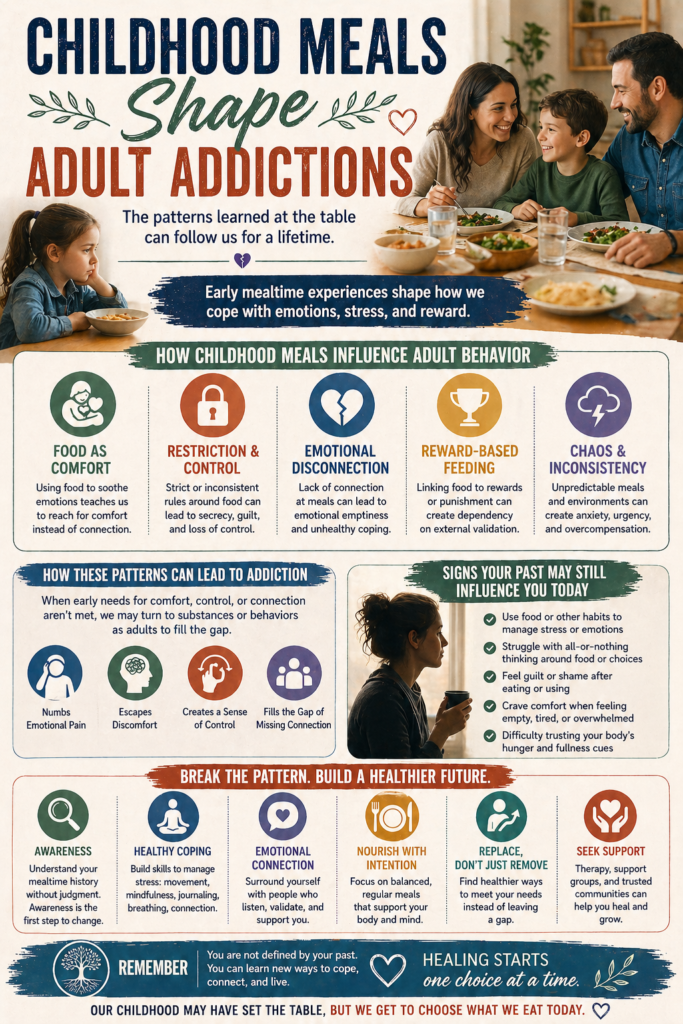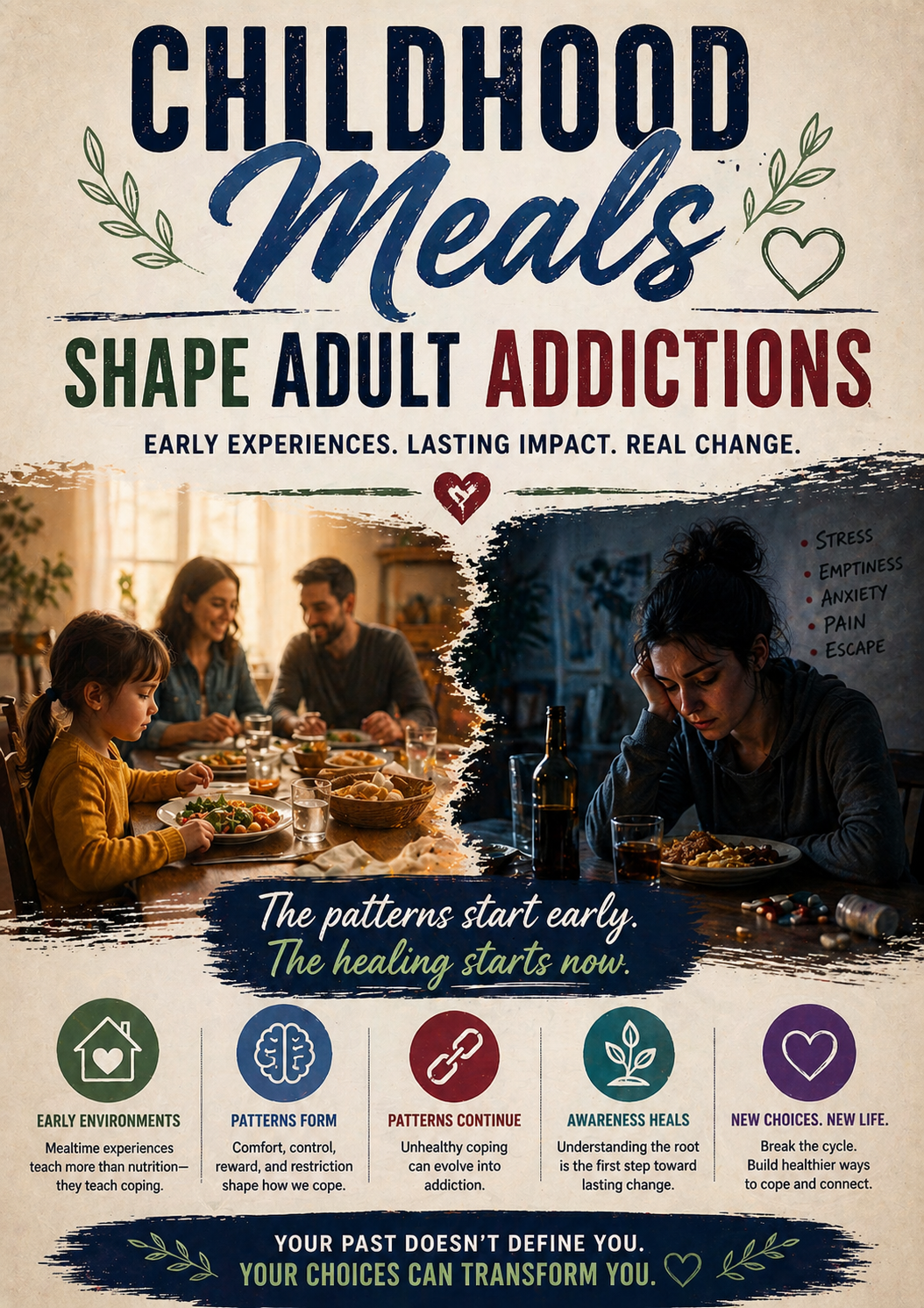
The connection between childhood experiences and adult behavior is often deeper than it appears, and one of the earliest influences comes from something as routine as mealtime. Childhood meals are not just about nourishment—they are environments where individuals first learn about comfort, control, consistency, and emotional expression. Whether meals were structured or chaotic, nurturing or stressful, these experiences can shape how a person responds to discomfort and meets their needs later in life. In some cases, these early patterns contribute to the development of addictive behaviors, as individuals replicate familiar ways of coping with stress, emotion, or unmet needs.
From the Table to the Habit: How Childhood Meals Shape Adult Addictions
Food is one of the earliest ways we experience comfort, connection, and control. Long before we understand emotions or coping strategies, we learn through mealtime experiences—what it feels like to be nourished, ignored, rewarded, restricted, or soothed. These early patterns don’t just shape our relationship with food—they can quietly influence how we cope as adults, including the development of addictive behaviors.
Understanding how childhood meals shape adult addictions isn’t about blame. It’s about recognizing how early environments can program patterns that continue long after childhood ends.
More Than Food: What Meals Really Teach Us
Childhood meals are not just about nutrition—they are emotional and psychological experiences.
They can teach:
- Whether needs are consistently met
- How emotions are handled (ignored, punished, comforted)
- Whether food is tied to reward or control
- What “normal” consumption looks like
👉 In many ways, the dinner table becomes a training ground for regulation, connection, and coping.
Early Patterns That Can Carry Into Adulthood
1. Food as Comfort
If food was used to soothe distress (“Here, have something to feel better”), a child may learn:
👉 Discomfort = something to be numbed
Later, this pattern can extend beyond food to substances or behaviors that provide similar relief.
2. Restriction and Control
Strict or inconsistent control around food can lead to:
- Preoccupation with consumption
- Rebellion through overuse
- Difficulty trusting internal cues
This can translate into addictive patterns where control and loss of control become central themes.
3. Emotional Disconnection at Meals
If meals lacked connection (e.g., conflict, silence, neglect), children may not learn:
- Emotional expression
- Co-regulation (feeling safe with others)
As adults, they may turn to substances or behaviors to fill that emotional gap.
4. Reward-Based Feeding
Using food as a reward (“You were good, so you get this”) can create:
👉 A link between behavior, worth, and external reward
This pattern can evolve into seeking external validation or relief through addictive behaviors.
5. Chaos or Inconsistency
Unpredictable meal environments (irregular meals, stress, instability) can lead to:
- Anxiety around availability
- Urgency or overconsumption when resources are present
This can mirror patterns seen in addiction—feast, deprivation, and compulsion.
How These Patterns Connect to Addiction
Addiction often serves a purpose:
- Numbing emotional pain
- Creating a sense of control
- Providing comfort or escape
- Replacing a missing connection
If early experiences linked relief, control, or comfort to external sources, the brain may continue seeking those patterns in adulthood—sometimes through substances or addictive behaviors.
It’s Not Just About Food
While food is the starting point, the deeper issue is:
👉 How we learned to regulate emotions and meet our needs
Childhood meals can shape:
- Emotional awareness
- Self-soothing abilities
- Relationship with control and reward
- Sense of safety and consistency
These are the same systems often involved in addiction.
Breaking the Pattern
The past influences—but does not define—the future.
1. Build Awareness
- Reflect on early food and mealtime experiences
- Notice current coping patterns
- Ask: What did I learn about comfort, control, and reward?
2. Relearn Regulation
- Develop non-destructive ways to manage stress (movement, breathing, connection)
- Practice sitting with discomfort without immediately escaping it
3. Separate Emotion from Consumption
Recognize when urges are emotional, not physical
- Pause before reacting automatically
4. Create New Associations
- Build routines around nourishment, not punishment or reward
- Develop healthier sources of comfort and connection
5. Seek Support
- Therapy or recovery programs
- Nutrition-informed counseling
- Support groups
Understanding patterns is easier with guidance and validation.
The Bigger Picture
Childhood meals are one of the first places we learn:
👉 What it means to be cared for
👉 How to respond to discomfort
👉 Whether our needs matter
When those lessons are distorted, addiction can become a way of compensating.
But those patterns are learned—and what is learned can be unlearned.
Conclusion
Your relationship with food—and with coping—didn’t start today.
But it doesn’t have to end the same way it began.
Healing is not about erasing the past—it’s about understanding it well enough to choose something different.
Rewriting the Script: Self-Management Strategies for Understanding How Childhood Meals Shape Adult Addictions
The connection between childhood meals and adult addiction isn’t always obvious—but it’s often deeply ingrained. Early experiences around food can shape how you understand comfort, control, reward, and emotional regulation. Over time, these patterns may extend beyond food into other coping behaviors, including addiction.
Self-management in this context isn’t about blaming your past—it’s about understanding it well enough to respond differently in the present.
Start with Awareness: What Did You Learn at the Table?
Before changing patterns, you need to identify them.
Reflect on questions like:
- Was food used to comfort or distract from emotions?
- Were meals structured, chaotic, restrictive, or inconsistent?
- Did food feel like a reward, a punishment, or a necessity?
- Were emotions talked about—or avoided—during meals?
👉 These early experiences often shape how you respond to stress and discomfort today.
1. Identify Your Current Coping Patterns
Notice how your behaviors today may mirror early conditioning.
Ask yourself:
- Do I reach for something (food, substances, distractions) when I feel overwhelmed?
- Do I associate relief with consumption?
- Do I struggle with control—either too much or too little?
The goal is not judgment—it’s pattern recognition.
2. Separate Physical Needs from Emotional Needs
One of the most important skills is learning the difference between:
- Physical hunger
- Emotional hunger (stress, boredom, loneliness, anxiety)
Practice:
- Pausing before acting on an urge
- Asking: “What do I actually need right now?”
This creates space between feeling and reaction.
3. Build New Regulation Strategies
If childhood meals didn’t teach emotional regulation, you can learn it now.
Try:
- Deep breathing or grounding exercises
- Physical movement (walking, stretching)
- Journaling or expressing emotions
- Talking to someone you trust
These help your nervous system settle without relying on harmful coping behaviors.
4. Reframe Your Relationship with Comfort
If comfort has always been tied to food or external rewards, it’s important to broaden your definition of comfort.
Explore:
- Comfort through connection (friends, support groups)
- Comfort through environment (music, space, routine)
- Comfort through self-care (rest, creativity, mindfulness)
👉 Comfort doesn’t have to come from consumption.
5. Create Consistency Where There Was Chaos
If your early environment was unpredictable, your brain may still seek a sense of urgency or overcompensate.
Support yourself by:
- Establishing regular routines (meals, sleep, activities)
- Planning ahead to reduce impulsive decisions
- Creating a sense of stability in daily life
Consistency helps regulate both behavior and emotion.
6. Challenge All-or-Nothing Thinking
Early experiences may have taught extremes:
- “I have to control everything.”
- “I’ve already messed up, so it doesn’t matter.”
Practice:
- Flexible thinking
- Allowing imperfection without giving up
- Seeing progress as gradual, not absolute
This reduces the cycle of restriction and overindulgence.
7. Rebuild Trust in Your Body and Mind
If your early environment disrupted your internal cues, you may struggle to trust yourself.
Self-management includes:
- Listening to your body’s signals (hunger, fullness, fatigue)
- Respecting emotional needs without immediately escaping them
- Practicing self-compassion instead of self-criticism
Trust is rebuilt through consistent, supportive choices over time.
8. Replace, Don’t Just Remove
Addiction often fills a gap. Removing the behavior without replacing it leaves that gap open.
Ask:
👉 What need was this meeting for?
Then replace it with something healthier:
- Stress → grounding or movement
- Loneliness → connection
- Boredom → engagement or creativity
Sustainable change comes from meeting the need differently.
9. Set Gentle Boundaries with Yourself
Self-management is not about strict control—it’s about supportive structure.
Examples:
- Limiting exposure to triggering situations
- Creating intentional routines
- Giving yourself permission to pause instead of react
Boundaries with yourself should feel protective, not punishing.
10. Seek Support When Needed
Understanding these patterns can be complex.
Consider:
- Therapy (especially trauma-informed or behavioral approaches)
- Support groups
- Nutrition or recovery counseling
You don’t have to untangle these patterns alone.
The Bigger Picture
Childhood meals may have shaped your early understanding of comfort, control, and coping—but they don’t have to define your future. Self-management is about rewriting those patterns with awareness, intention, and compassion.
Conclusion
You learned how to cope in the environment you were given.
Now, you have the opportunity to learn something new:
👉 How to meet your needs without losing yourself in the process.
Healing at the Table: Family Support Strategies for Understanding How Childhood Meals Shape Adult Addictions
Addiction doesn’t begin in isolation—it often grows from early experiences that shaped how a person learned to cope, feel, and connect. One of the most overlooked influences is the role of childhood meals. The dinner table is more than a place for food—it’s where patterns around comfort, control, reward, and emotional expression are formed.
For families, understanding this connection can shift the approach from “fixing behavior” to supporting healing at its roots. The goal is not to assign blame for the past, but to create a healthier environment in the present.
Understanding the Family’s Role
Childhood meal environments can teach:
- How emotions are handled (soothed, ignored, or dismissed)
- Whether needs are consistently met
- How comfort and reward are experienced
- What “normal” coping looks like
If these patterns contributed to addictive behaviors later in life, families now have an opportunity to reshape those experiences through support, consistency, and awareness.
1. Shift from Blame to Understanding
It’s easy for families to feel guilt or defensiveness when reflecting on the past. But healing doesn’t come from blame—it comes from awareness.
Instead of:
- “We did everything wrong.”
Shift to:
- “What patterns might have been learned, and how can we support change now?”
This creates space for growth instead of shame.
2. Create Emotionally Safe Mealtime Environments
Meals can become powerful opportunities for connection.
Support includes:
- Encouraging open, judgment-free conversation
- Avoiding conflict-heavy or stressful discussions at the table
- Being present and attentive
A calm, supportive environment helps rewire associations between food, safety, and connection.
3. Separate Food from Reward or Punishment
If food was previously tied to behavior (“You earned this” or “You don’t deserve that”), it can reinforce unhealthy patterns.
Families can:
- Offer food as nourishment, not control
- Avoid using food to manage emotions or behavior
- Encourage balanced, neutral relationships with eating
This helps break the link between emotion and consumption.
4. Support Emotional Expression Beyond the Table
If emotions were not openly expressed in childhood, individuals may rely on external coping methods.
Encourage:
- Talking about feelings without judgment
- Validating emotional experiences
- Listening more than correcting
This builds emotional awareness, reducing the need for escape through addictive behaviors.
5. Model Healthy Coping Strategies
Family behavior is one of the strongest influences.
Demonstrate:
- Healthy ways of managing stress (communication, movement, rest)
- Balanced relationships with food and routines
- Self-awareness and emotional regulation
Modeling provides a real-life example of alternative coping mechanisms.
6. Establish Consistency and Predictability
If childhood environments were chaotic or inconsistent, stability becomes especially important.
Families can:
- Create regular meal times
- Maintain predictable routines
- Reduce sudden changes when possible
Consistency helps regulate both emotions and behavior.
7. Encourage Autonomy and Internal Awareness
Recovery involves rebuilding trust in one’s own needs and signals.
Support includes:
- Allowing individuals to listen to their body (hunger, fullness, rest)
- Avoiding over-control of choices
- Encouraging self-awareness rather than external rules
This helps shift from external control → internal regulation.
8. Be Mindful of Language Around Food and Behavior
Language can reinforce or reshape beliefs.
Avoid:
- Labeling foods as “good” or “bad.”
- Using shame-based comments
- Making assumptions about behavior
Instead:
- Use neutral, supportive language
- Focus on balance and well-being
Words matter in rebuilding a healthy mindset.
9. Support Without Over-Controlling
Families often want to help—but too much control can recreate old patterns.
Balance support by:
- Offering help without forcing it
- Respecting boundaries
- Allowing the individual to take ownership of their recovery
Support should feel empowering, not restrictive.
10. Seek Family-Based or Individual Support When Needed
Understanding these patterns can be complex.
Consider:
- Family therapy
- Recovery-informed counseling
- Educational resources on addiction and early conditioning
Professional support can help families work through patterns together.
The Bigger Picture
Childhood meals may have shaped early coping patterns—but families have the power to help reshape them. By creating environments that emphasize safety, consistency, and emotional connection, they can support recovery more deeply.
Conclusion
Healing doesn’t require rewriting the past—it requires responding differently in the present.
When families turn the table into a place of connection instead of control, they don’t just change how someone eats—they help change how someone copes, feels, and heals.
From Plates to Patterns: Community Strategies for Understanding How Childhood Meals Shape Adult Addictions
Addiction is often viewed through an individual lens—but its roots and solutions are deeply connected to community environments. One overlooked influence is how childhood meal experiences shape long-term coping behaviors, including addiction. These early patterns around food, comfort, control, and connection don’t just stay within the family—they ripple outward into schools, neighborhoods, and social systems.
Communities play a powerful role in both understanding and reshaping these patterns. By addressing the broader environment, they can help transform early conditioning into healthier, more supportive pathways for individuals across the lifespan.
Understanding the Community’s Influence
Childhood meals don’t happen in a vacuum. They are shaped by:
- Cultural norms around food and behavior
- Socioeconomic factors (access, stability, food security)
- Community stress levels (violence, instability, isolation)
- Social messaging about reward, discipline, and coping
These influences contribute to how individuals learn to:
👉 Regulate emotions
👉 Seek comfort
👉 Respond to stress
When these patterns go unaddressed, they can evolve into addictive coping strategies later in life.
1. Promote Early Education on Emotional and Behavioral Health
Communities can start early by integrating education into schools and youth programs.
This includes:
- Teaching emotional regulation skills
- Helping children identify hunger vs. emotional needs
- Encouraging healthy coping strategies
Early awareness helps prevent the development of unconscious patterns tied to consumption and escape.
2. Support Family Education Programs
Many caregivers are unaware of how mealtime dynamics influence long-term behavior.
Community initiatives can offer:
- Workshops on healthy feeding practices
- Education on emotional development and regulation
- Guidance on creating consistent, supportive meal environments
Supporting families helps address the issue at its source.
3. Address Food Insecurity and Environmental Stress
Inconsistent access to food or high-stress environments can shape patterns of urgency, scarcity, and overconsumption.
Communities can:
- Provide food assistance programs
- Support stable access to nutritious meals
- Reduce environmental stressors through local initiatives
Stability in basic needs supports emotional and behavioral stability.
4. Create Safe Spaces for Connection
Isolation is a major factor in both addiction and unhealthy coping patterns.
Communities can foster:
- Group meals or community dining programs
- Youth centers and support groups
- Spaces for open, non-judgmental interaction
Connection helps replace the need for external coping mechanisms.
5. Normalize Conversations Around Food and Coping
Stigma and silence can prevent awareness.
Communities can:
- Host discussions on the link between early experiences and addiction
- Share accessible, non-judgmental information
- Encourage open dialogue across age groups
Normalization reduces shame and increases understanding and engagement.
6. Integrate Trauma-Informed Approaches
Many early food-related patterns are connected to stress or trauma.
Community programs should:
- Recognize signs of emotional distress
- Avoid shame-based messaging
- Focus on safety, empowerment, and understanding
Trauma-informed care supports long-term behavioral change.
7. Provide Accessible Mental Health Resources
Understanding patterns is only the first step—support is needed to change them.
Communities can expand access to:
- Counseling and therapy
- Addiction recovery programs
- Behavioral and nutritional support
Accessibility ensures individuals can move from awareness to action.
8. Encourage Positive Role Modeling in Community Spaces
Children and adults learn from what they observe.
Community leaders, educators, and organizations can:
- Model balanced relationships with food
- Demonstrate healthy coping strategies
- Reinforce consistency and stability
These examples help reshape what is considered “normal.”
9. Offer Alternative Coping and Engagement Opportunities
Addiction often fills a gap—communities can help fill it differently.
Provide:
- Creative outlets (art, music, writing)
- Physical activities and movement programs
- Skill-building workshops
These alternatives offer healthy ways to manage stress and emotion.
10. Build Long-Term Support Systems
Change doesn’t happen in a single program or event.
Communities should:
- Maintain ongoing support networks
- Provide follow-up resources
- Create sustainable programs for all age groups
Consistency strengthens lasting change.
The Bigger Picture
Understanding how childhood meals shape adult addictions requires a shift from individual blame to collective awareness. Communities are not just observers—they are active participants in shaping early experiences and long-term outcomes.
Conclusion
The patterns formed at the table don’t have to define a lifetime.
When communities come together to provide education, stability, connection, and support, they help transform early lessons into healthier futures.
Because lasting change doesn’t just happen within individuals—it happens when the environment around them evolves too.
Frequently Asked Questions
Here are some common questions:
1. How can childhood meals influence addiction later in life?
Childhood meals are not just about food—they teach:
- How to cope with emotions
- What comfort looks like
- How control and reward work
If food were tied to soothing, control, or stress, those patterns can carry into adulthood and sometimes evolve into addictive coping behaviors.
2. Is this really about food, or something deeper?
It’s about something deeper.
👉 The real issue is how we learned to regulate emotions and meet our needs.
Food is often the first tool used to teach these patterns, but the lessons can extend to substances, habits, or behaviors later on.
3. What are examples of unhealthy mealtime patterns?
- Using food to comfort distress
- Strict or inconsistent food rules
- Rewarding or punishing with food
- Chaotic or unpredictable meal schedules
- Lack of emotional connection during meals
These experiences can shape how someone responds to stress and discomfort.
4. Does this mean all addiction starts in childhood?
No.
Childhood is one contributing factor, not the only one.
Addiction is influenced by:
- Genetics
- Environment
- Trauma
- Mental health
- Life experiences
Childhood meals are just one piece of a larger picture.
5. How does “food as comfort” relate to addiction?
If a child learns:
👉 “When I feel bad, I eat to feel better.”
That pattern can evolve into:
👉 “When I feel bad, I use something to escape or soothe.”
The behavior changes, but the underlying pattern stays the same.
6. What is emotional hunger vs. physical hunger?
- Physical hunger: A biological need for food
- Emotional hunger: A response to feelings like stress, boredom, or loneliness
Confusing the two can lead to habitual coping through consumption, which may extend beyond food.
7. Can chaotic meal environments affect adult behavior?
Yes.
Unpredictable or stressful meal settings can lead to:
- Anxiety around consumption
- Urgency or overconsumption
- Difficulty with regulation
These patterns can mirror cycles seen in addiction.
8. What are the signs that these patterns are still affecting me?
- Using food or substances to cope with emotions
- All-or-nothing thinking (“I messed up, so it doesn’t matter”)
- Feeling guilt or shame around consumption
- Difficulty recognizing hunger or emotional needs
- Seeking comfort through external sources
9. Can these patterns be changed?
Yes.
Because they are learned behaviors, they can be unlearned through:
- Awareness
- New coping strategies
- Emotional regulation skills
- Support systems
Change is possible at any stage of life.
10. What is the first step to breaking the pattern?
Awareness.
Ask yourself:
👉 “What did I learn about comfort, control, and coping growing up?”
Understanding the pattern is the first step toward changing it.
11. How can someone develop healthier coping strategies?
- Practice emotional regulation (breathing, movement, journaling)
- Build supportive relationships
- Create consistent routines
- Learn to sit with discomfort without escaping it
These replace harmful patterns with sustainable ones.
12. How can families help reshape these patterns?
Families can:
- Create calm, supportive mealtime environments
- Avoid using food as a reward or punishment
- Encourage open emotional expression
- Model healthy coping behaviors
Support in the present can help reshape the impact of the past.
13. Does this only apply to food-related addictions?
No.
The pattern is about coping, not just eating.
It can extend to:
- Substance use
- Behavioral addictions (shopping, screens, etc.)
- Emotional avoidance habits
14. Is it possible to heal without remembering everything from childhood?
Yes.
You don’t need perfect memory—you need pattern recognition in the present.
Focus on:
- What triggers you now
- How you respond
- What needs are underneath
15. What’s the biggest takeaway from this concept?
Those early experiences shape patterns—but they don’t define your future.
👉 You can learn new ways to cope, regulate, and meet your needs.
Conclusion
Understanding how childhood meals shape adult addictions highlights the importance of looking beyond surface behaviors to the patterns formed early in life. These influences are not about assigning blame, but about gaining insight into how coping mechanisms develop over time. With awareness, individuals can begin to separate past conditioning from present choices and build healthier ways of responding to stress and emotion. Ultimately, healing involves not just changing behaviors but relearning how to meet one’s needs in ways that support long-term well-being rather than dependence.
Video: That Childhood Meal Pattern Is Still Controlling You #psychology #emotionalhealth #recovery