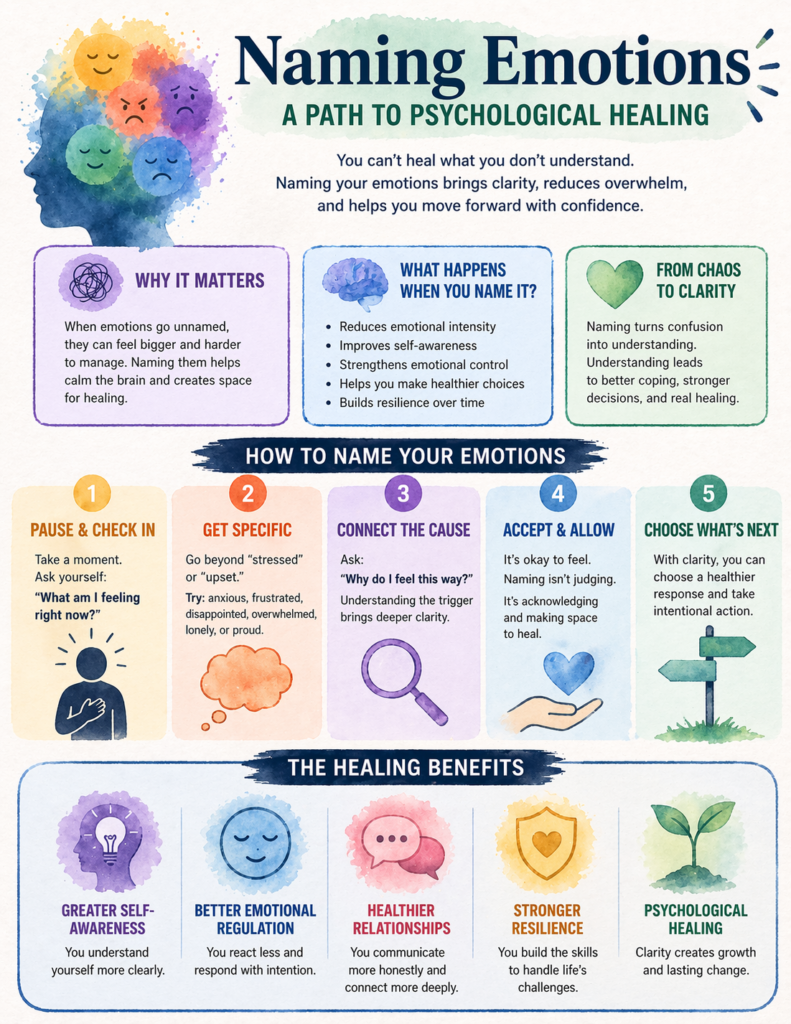
Emotions are a natural and constant part of human experience, yet they are often misunderstood or left undefined. When feelings remain vague—described only as “stress” or “being overwhelmed”—they can intensify and become harder to manage. Naming emotions, also known as affect labeling, provides a simple yet powerful way to clarify these internal experiences. By putting feelings into words, individuals begin to shift from reacting impulsively to understanding what they are actually experiencing. This process is a foundational step in psychological healing, as it transforms confusion into awareness and creates space for more intentional responses.
Name It to Heal It: The Power of Labeling Emotions
Emotions can feel overwhelming, confusing, and at times impossible to control. When feelings build without clarity, they often create a sense of chaos—like something is wrong, but you can’t quite explain what it is. This is where one of the simplest yet most powerful psychological tools comes in: naming your emotions.
Often called affect labeling, the process of putting feelings into words can significantly reduce emotional intensity and help you regain a sense of control.
Why Emotions Feel So Overwhelming
When emotions are vague or undefined, the brain processes them as a general threat. Anxiety, stress, frustration, and sadness can blend together, making it difficult to respond effectively.
Without clarity:
- Feelings feel bigger than they are
- Reactions become automatic
- Coping often turns into avoidance or escape
This is why people may turn to distractions or self-medication—they’re trying to manage something they don’t fully understand.
What Happens When You Name an Emotion
Labeling your emotions activates more rational, language-based parts of the brain. This has a calming effect on the emotional centers.
In simple terms:
- You move from feeling → to understanding
- From reacting → to responding
For example, instead of saying:
- “I feel bad.”
You might say:
- “I feel anxious about this situation.”
- “I feel overwhelmed and mentally drained.”
- “I feel frustrated because I feel out of control.”
This specificity reduces intensity and increases awareness.
From Chaos to Clarity
Naming emotions creates structure. It turns something abstract into something defined.
That clarity helps you:
- Identify what you actually need
- Choose more effective coping strategies
- Communicate better with others
For instance, anxiety might call for calming strategies, while frustration might require problem-solving or boundaries.
How This Supports Psychological Healing
Healing isn’t just about removing distress—it’s about understanding it.
When you regularly name your emotions:
- You build emotional awareness
- You reduce impulsive reactions
- You improve emotional regulation over time
This process strengthens your ability to sit with discomfort rather than immediately escape it.
How to Practice Naming Emotions
You don’t need a complicated system. Start simple:
- Pause and check in
Ask: “What am I feeling right now?” - Be specific
Go beyond “stressed” or “upset.” - Connect it to a cause
“I feel anxious because…”
“I feel frustrated about…” - Accept the feeling
Naming is not judging—it’s acknowledging
Even doing this once or twice a day can make a difference.
Why It Can Feel Difficult at First
Many people aren’t used to identifying emotions in detail. It might feel:
- Uncomfortable
- Unnatural
- Hard to put into words
That’s normal. Like any skill, emotional awareness improves with practice.
Final Thought
You can’t manage what you don’t understand.
Naming your emotions doesn’t make them disappear—but it makes them manageable. It creates space between you and the feeling, allowing you to respond with intention rather than react out of habit.
In many ways, healing begins the moment you can say, clearly and honestly, “This is what I’m feeling.”
Name It to Heal It: The Power of Labeling Emotions
Emotions can feel overwhelming, confusing, and at times impossible to control. When feelings build without clarity, they often create a sense of chaos—like something is wrong, but you can’t quite explain what it is. This is where one of the simplest yet most powerful psychological tools comes in: naming your emotions.
Often called affect labeling, the process of putting feelings into words can significantly reduce emotional intensity and help you regain a sense of control.
Why Emotions Feel So Overwhelming
When emotions are vague or undefined, the brain processes them as a general threat. Anxiety, stress, frustration, and sadness can blend together, making it difficult to respond effectively.
Without clarity:
- Feelings feel bigger than they are
- Reactions become automatic
- Coping often turns into avoidance or escape
This is why people may turn to distractions or self-medication—they’re trying to manage something they don’t fully understand.
What Happens When You Name an Emotion
Labeling your emotions activates more rational, language-based parts of the brain. This has a calming effect on the emotional centers.
In simple terms:
- You move from feeling → to understanding
- From reacting → to responding
For example, instead of saying:
- “I feel bad.”
You might say:
- “I feel anxious about this situation.”
- “I feel overwhelmed and mentally drained.”
- “I feel frustrated because I feel out of control.”
This specificity reduces intensity and increases awareness.
From Chaos to Clarity
Naming emotions creates structure. It turns something abstract into something defined.
That clarity helps you:
- Identify what you actually need
- Choose more effective coping strategies
- Communicate better with others
For instance, anxiety might call for calming strategies, while frustration might require problem-solving or boundaries.
How This Supports Psychological Healing
Healing isn’t just about removing distress—it’s about understanding it.
When you regularly name your emotions:
- You build emotional awareness
- You reduce impulsive reactions
- You improve emotional regulation over time
This process strengthens your ability to sit with discomfort rather than immediately escape it.
How to Practice Naming Emotions
You don’t need a complicated system. Start simple:
- Pause and check in
Ask: “What am I feeling right now?” - Be specific
Go beyond “stressed” or “upset.” - Connect it to a cause
“I feel anxious because…”
“I feel frustrated about…” - Accept the feeling
Naming is not judging—it’s acknowledging
Even doing this once or twice a day can make a difference.
Why It Can Feel Difficult at First
Many people aren’t used to identifying emotions in detail. It might feel:
- Uncomfortable
- Unnatural
- Hard to put into words
That’s normal. Like any skill, emotional awareness improves with practice.
Final Thought
You can’t manage what you don’t understand.
Naming your emotions doesn’t make them disappear—but it makes them manageable. It creates space between you and the feeling, allowing you to respond with intention rather than react out of habit.
In many ways, healing begins the moment you can say, clearly and honestly, “This is what I’m feeling.”
Helping Them Find the Words: Family Support for Emotional Healing
Emotions can be difficult to understand—especially when they feel intense, confusing, or overwhelming. For many individuals, the challenge isn’t just feeling emotions, but making sense of them. This is where naming emotions becomes a powerful tool for psychological healing.
Families play a critical role in this process. The way emotions are acknowledged, discussed, and responded to at home can either support emotional growth or unintentionally shut it down.
Why Naming Emotions Matters in Families
When emotions go unnamed, they often come out in other ways—irritability, withdrawal, or impulsive behavior. Without clear language, it’s harder to understand what’s really going on.
By helping individuals name their emotions, families:
- Reduce confusion and emotional overwhelm
- Encourage healthier expression
- Create opportunities for problem-solving and support
This turns emotional moments into learning moments.
Model Emotional Awareness
One of the most effective ways families can support emotional development is by modeling it themselves.
Instead of hiding or dismissing feelings, try expressing them clearly:
- “I feel frustrated right now, so I need a minute.”
- “I’m feeling overwhelmed, and I need to slow down.”
This shows that emotions are normal, manageable, and safe to talk about.
Encourage Expression Without Judgment
People are more likely to share their feelings when they feel safe.
To create that safety:
- Listen without interrupting or correcting
- Avoid minimizing statements like “It’s not a big deal.”
- Validate the feeling, even if you don’t agree with the reaction
For example:
- “That sounds really stressful.”
- “I can see why you’d feel that way.”
Validation helps reduce defensiveness and builds trust.
Help Expand Emotional Vocabulary
Not everyone has the language to describe what they’re feeling.
Families can gently guide this by asking:
- “Do you feel more anxious or frustrated?”
- “Is it more like anger, or more like disappointment?”
This helps move from vague emotions to a more specific understanding, which improves regulation.
Pause Before Problem-Solving
It’s natural to want to fix things quickly—but jumping to solutions too fast can skip an important step.
Before offering advice:
- Help identify the emotion
- Explore what’s behind it
- Acknowledge it fully
Sometimes, being understood is more helpful than being “fixed.”
Create Regular Opportunities to Talk
Emotional awareness grows with practice, not just in crisis moments.
Families can build this by:
- Checking in during everyday conversations
- Asking open-ended questions like “How was today, really?”
- Making emotional discussions part of normal interaction
Consistency makes emotional expression feel natural, not forced.
Respond Calmly to Emotional Intensity
Strong emotional reactions can be challenging, but how families respond matters.
Staying calm:
- Prevents escalation
- Helps regulate the other person
- Keeps the focus on understanding rather than conflict
When emotions are met with calmness, they become easier to process.
Support, Not Control
The goal is not to control emotions, but to help understand them.
Families can support by:
- Guiding awareness
- Encouraging expression
- Providing stability and consistency
This creates an environment where emotional growth can happen over time.
Final Thought
Naming emotions is a simple skill with powerful effects—but it often develops through relationships. Families have a unique opportunity to shape how emotions are understood and expressed.
By modeling awareness, encouraging open communication, and responding with empathy, families can help turn confusion into clarity. Over time, this builds stronger emotional regulation, a deeper connection, and a foundation for lasting psychological well-being.
Sometimes, the most important support isn’t having the right answers—it’s helping someone find the right words.
Healing Together: Community Strategies for Naming Emotions
Emotions don’t exist in isolation—they are shaped, expressed, and understood within the environments people live in. While naming emotions is a powerful individual skill, it is often learned and reinforced through social and community experiences. Communities play a critical role in either encouraging emotional awareness or unintentionally discouraging it.
When communities support the practice of naming emotions, they create environments where psychological healing becomes more accessible and sustainable.
Why Community Support Matters
Many individuals grow up in environments where emotions are minimized, ignored, or misunderstood. Without the language to describe what they feel, people may struggle with confusion, stress, or unhealthy coping behaviors.
Community support helps:
- Normalize emotional expression
- Reduce stigma around mental health
- Provide shared language for understanding feelings
When emotional awareness is reinforced socially, it becomes easier to practice individually.
Promoting Emotional Education
One of the most effective strategies is integrating emotional education into community spaces such as schools, workplaces, and local programs.
This can include:
- Teaching emotional vocabulary and awareness
- Encouraging reflection and discussion
- Providing tools for emotional regulation
When people are taught how to identify and name emotions early, they are better equipped to manage them later in life.
Creating Safe Spaces for Expression
People are more likely to express emotions when they feel safe and supported.
Communities can foster this by:
- Offering support groups or discussion circles
- Creating environments that are non-judgmental and inclusive
- Encouraging open dialogue about mental health
These spaces allow individuals to practice naming emotions without fear of criticism or dismissal.
Training Community Leaders and Educators
Teachers, mentors, healthcare providers, and community leaders often guide emotional conversations—whether intentionally or not.
Providing training on:
- Recognizing emotional cues
- Encouraging emotional expression
- Responding with empathy and validation
can significantly improve emotion regulation in community settings.
Normalizing Conversations About Emotions
In many environments, emotions are only discussed during crises. Shifting this pattern is key.
Communities can:
- Encourage regular check-ins in schools and workplaces
- Promote campaigns that normalize emotional expression
- Use language that validates rather than dismisses feelings
When emotional conversations become routine, they feel less intimidating and more natural.
Using Peer Support as a Tool
Peers have a strong influence on emotional expression, especially among adolescents and young adults.
Peer-based strategies include:
- Peer mentoring programs
- Group discussions led by trained facilitators
- Encouraging supportive communication among friends
When individuals see others naming and discussing emotions, they are more likely to do the same.
Reducing Stigma Around Emotional Expression
One of the biggest barriers to naming emotions is the fear of being judged or misunderstood.
Communities can reduce stigma by:
- Framing emotional awareness as strength, not weakness
- Highlighting the benefits of emotional understanding
- Sharing stories and experiences that normalize vulnerability
This creates an environment where emotional honesty is accepted.
Connecting Emotional Awareness to Overall Well-Being
Naming emotions is not just about feelings—it impacts behavior, relationships, and mental health.
Communities that emphasize this connection help individuals see emotional awareness as a practical, valuable skill rather than an abstract concept.
Final Thought
Naming emotions is a simple but powerful step toward psychological healing—but it is not developed in isolation. Communities shape how emotions are understood, expressed, and valued.
By promoting education, creating safe spaces, and normalizing emotional conversations, communities can help individuals turn confusion into clarity. Over time, this builds stronger emotional resilience, healthier relationships, and a more supportive social environment.
Healing becomes more effective when it is not just an individual effort—but a shared one.
Frequently Asked Questions
Here are some common questions:
1. What does “naming emotions” mean?
Naming emotions means identifying and putting specific words to what you’re feeling, such as “anxious,” “frustrated,” or “overwhelmed,” instead of using vague terms like “bad” or “stressed.”
2. Why is naming emotions important for mental health?
When emotions are clearly identified, they become easier to understand and manage. Naming emotions reduces confusion, lowers intensity, and helps you respond more thoughtfully instead of reacting impulsively.
3. Does naming emotions actually change how you feel?
Yes. Research shows that labeling emotions can calm the brain’s emotional centers and activate more rational thinking. This can reduce the intensity of feelings and increase a sense of control.
4. What is affect labeling?
Affect labeling is the psychological term for naming emotions. It refers to the process of putting feelings into words, which helps regulate emotional responses.
5. Why do emotions feel overwhelming when they aren’t named?
When emotions are unclear, the brain treats them as a general threat. This makes feelings seem bigger and harder to manage, often leading to stress, anxiety, or avoidance behaviors.
6. What are examples of naming emotions correctly?
Instead of saying:
- “I feel bad.”
Try:
- “I feel anxious about this situation.”
- “I feel frustrated because I feel stuck.”
- “I feel disappointed about the outcome.”
Specificity creates clarity.
7. Is naming emotions the same as controlling them?
Not exactly. Naming emotions doesn’t eliminate them, but it helps you understand and manage them more effectively. It creates space to choose how to respond.
8. Why is it hard for some people to name their emotions?
Many people:
- Were never taught emotional vocabulary
- Grew up in environments where emotions weren’t discussed
- Feel uncomfortable or unsure expressing feelings
Like any skill, it improves with practice.
9. Can naming emotions help reduce anxiety or stress?
Yes. By identifying the specific feeling, you reduce uncertainty and gain a clearer understanding of what’s causing distress, which helps lower overall anxiety.
10. How often should I practice naming my emotions?
Regularly. Even brief daily check-ins—such as asking yourself “What am I feeling right now?”—can build emotional awareness over time.
11. What if I don’t know what I’m feeling?
Start broad and narrow it down:
- Ask: “Is this more like anxiety, sadness, or frustration?”
- Use emotion lists or charts if needed
- Focus on physical sensations as clues
It’s okay if it’s not perfect—progress matters more than accuracy.
12. Can naming emotions improve relationships?
Yes. When you can clearly express how you feel, communication improves. This reduces misunderstandings and helps others respond more effectively.
13. How does naming emotions relate to unhealthy coping behaviors?
When emotions are unclear, people may try to escape them through behaviors like avoidance or self-medication. Naming emotions reduces this need by making feelings more manageable.
14. What is the most important takeaway?
You can’t effectively manage what you don’t understand. Naming your emotions turns confusion into clarity, which is a key step toward emotional regulation and psychological healing.
Conclusion
Naming emotions does not eliminate difficult feelings, but it changes how they are experienced and managed. By identifying and understanding emotions more clearly, individuals gain greater control over their reactions and reduce the need to rely on unhealthy coping strategies. Over time, this practice strengthens emotional awareness, resilience, and decision-making. Psychological healing is not about avoiding emotions, but about learning to understand and respond to them effectively. In many cases, the simple act of saying, “This is what I feel,” becomes the starting point for meaningful and lasting change.
Video: Emotions Control You Until You Name Them #psychology #mentalwellness