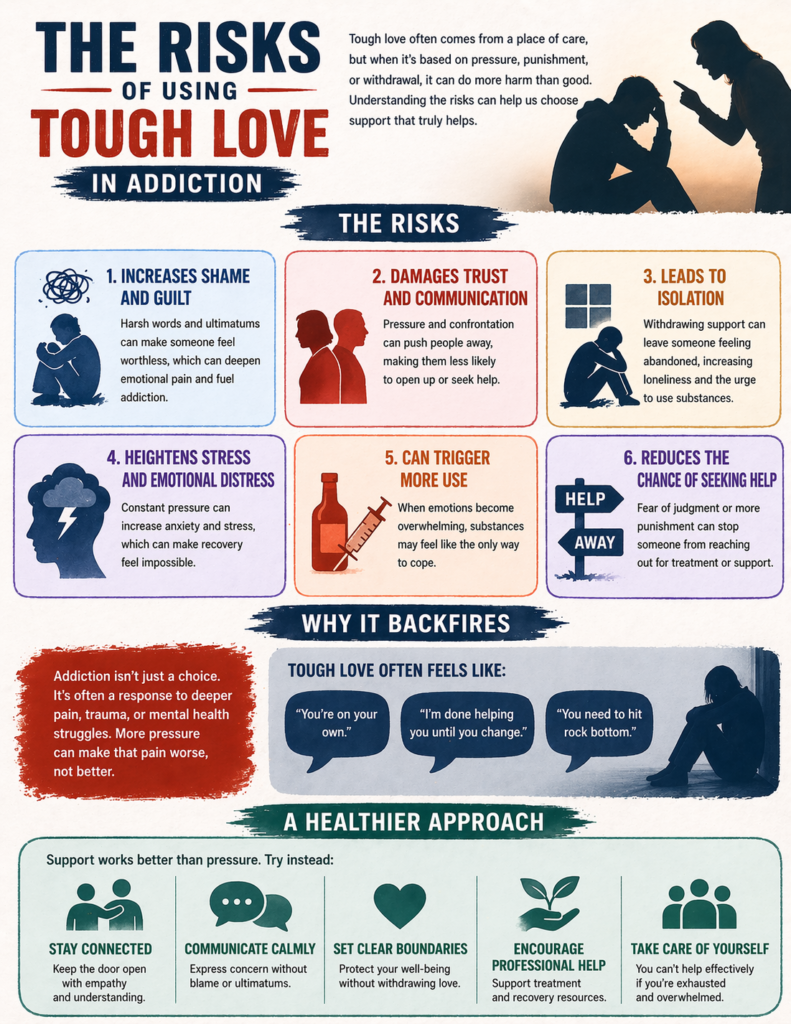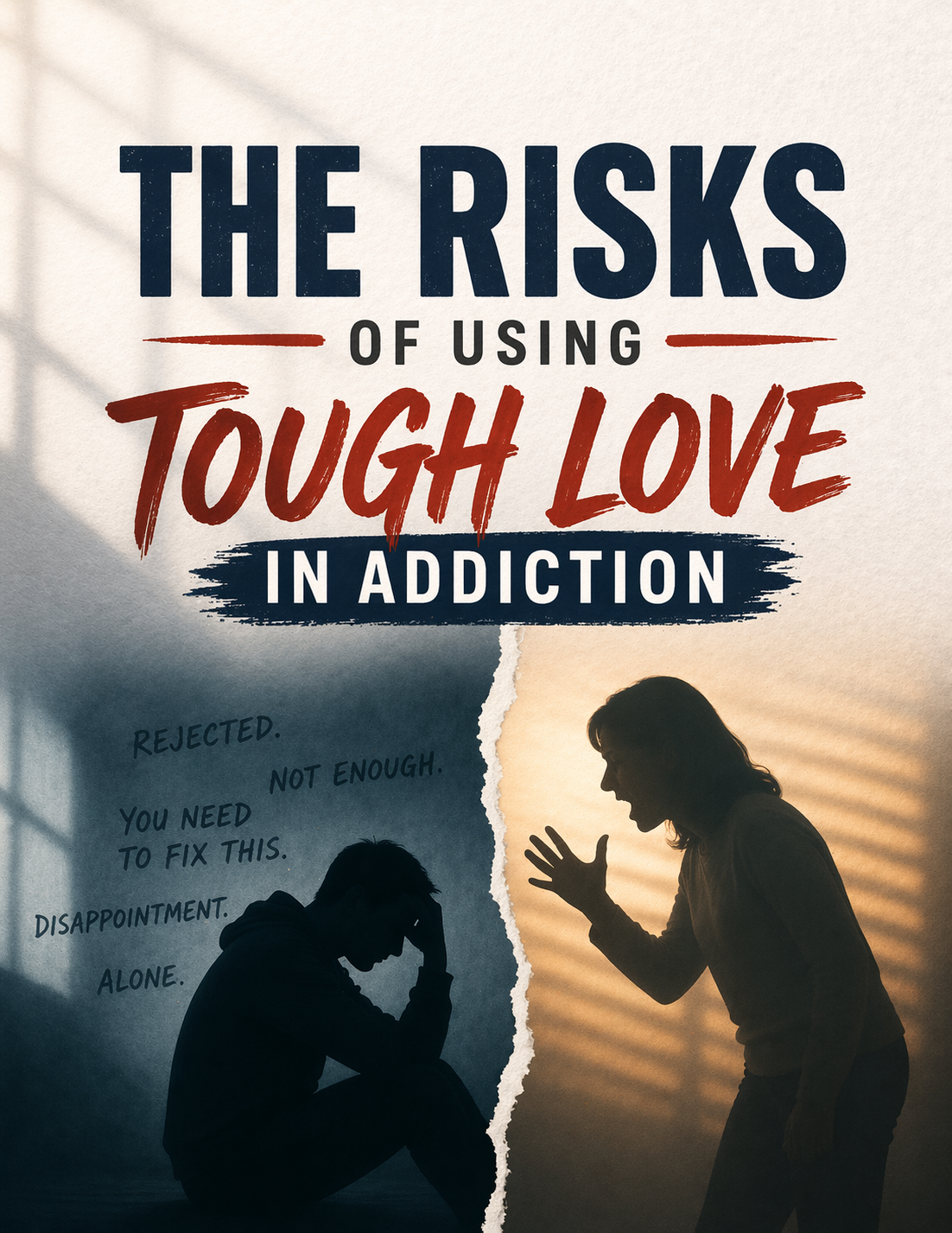
“Tough love” is often seen as a necessary response when someone is struggling with addiction—a way to set limits, enforce consequences, and push for change. It typically comes from a place of concern, frustration, and a desire to help. However, addiction is rarely just a matter of choice or discipline; it is often closely tied to emotional distress, such as anxiety, trauma, or shame. When these underlying factors are not considered, tough love approaches can unintentionally increase the very pressures that drive addictive behavior. Understanding the risks of tough love is essential for recognizing when well-intentioned actions may do more harm than good.
When Tough Love Backfires: The Risks in Addiction Support
When someone struggles with addiction, families and loved ones often feel a sense of urgency to act. Out of fear, frustration, or a desire to help, many turn to what is commonly called “tough love”—a strategy based on strict boundaries, confrontation, and pressure to change.
While the intention behind tough love is often positive, it does not always lead to the desired outcome. In some cases, it can actually make addiction more difficult to overcome.
What Is “Tough Love”?
Tough love typically involves:
- Setting strict rules or ultimatums
- Withdrawing support until behavior changes
- Using confrontation to push someone toward recovery
The idea is that consequences will force the person to recognize the seriousness of their situation and motivate change.
Why Tough Love Can Backfire
Addiction is not just a behavioral issue—it is often deeply connected to emotional distress, such as anxiety, shame, or trauma. When tough love is applied without understanding these underlying factors, it can intensify the problem.
Instead of motivating change, it may:
- Increase feelings of rejection or isolation
- Heighten stress and emotional pain
- Reinforce the need to escape through substances or behaviors
In other words, the very pressure meant to stop the behavior can strengthen the cycle.
The Role of Shame and Defensiveness
Confrontational approaches often trigger shame.
When someone feels judged or attacked, they are more likely to:
- Become defensive
- Deny or minimize the problem
- Withdraw from support systems
Shame does not typically lead to lasting change—it often leads to avoidance.
When Support Feels Like Rejection
From the outside, tough love may look like strength. But from the perspective of the person struggling, it can feel like abandonment.
Statements like:
- “You need to figure this out on your own.”
- “I’m done helping you until you change.”
can be interpreted as rejection rather than support, especially if the person already feels overwhelmed or alone.
The Importance of Boundaries—Done Differently
It’s important to clarify: avoiding tough love does not mean having no boundaries.
Healthy boundaries are still essential, but they should be:
- Clear and consistent
- Communicated calmly
- Focused on safety and respect, not punishment
For example:
- “I care about you, but I can’t support behaviors that harm you or others.”
This maintains structure without increasing emotional intensity.
A More Effective Approach: Support with Understanding
Research and clinical practice increasingly emphasize approaches that combine accountability with empathy.
More effective strategies include:
- Open, non-judgmental communication
- Encouraging professional support
- Focusing on underlying emotional needs
- Reinforcing small steps toward change
This approach reduces defensiveness and increases the likelihood of engagement.
Why Connection Matters in Recovery
Addiction often thrives in isolation. Recovery, on the other hand, is strengthened by connection.
When individuals feel:
- Understood
- Supported
- Not judged
They are more likely to:
- Reflect on their behavior
- Seek help
- Stay engaged in recovery
Connection doesn’t remove consequences—but it makes change more possible.
Final Thought
Tough love comes from a place of concern, but intention does not always equal impact.
When addiction is driven by emotional pain, increasing that pain rarely leads to healing. Real support requires a balance: clear boundaries paired with empathy, understanding, and consistent connection.
The goal isn’t to make someone feel worse so they change—it’s to create conditions where change is actually possible.
Pause Before You Push: Self-Management in Addiction Support
When someone you care about is struggling with addiction, it’s natural to feel overwhelmed, frustrated, and desperate to help. In those moments, many people turn to “tough love”—believing that being stricter, more forceful, or more confrontational will push the person toward change.
But as we begin to understand the risks of tough love, an important question emerges:
How do you manage your own reactions so that your support actually helps instead of harming?
Self-management is the key.
Step One: Recognize Your Emotional Triggers
Before responding to someone else’s behavior, it’s important to understand your own emotional state.
Common triggers include:
- Fear for their safety
- Frustration with repeated patterns
- Feeling out of control or helpless
- Anger or disappointment
These emotions are valid—but when they drive your response, they can lead to reactions that increase tension rather than reduce it.
Awareness creates a pause between feeling and reacting.
Step Two: Separate Urgency from Effectiveness
Addiction creates a sense of urgency: “Something needs to change now.”
That urgency can push you toward:
- Ultimatums
- Harsh confrontation
- Emotional withdrawal
But urgency doesn’t always equal effectiveness. In fact, reacting too quickly can escalate the situation.
Ask yourself:
- “Will this response help long-term, or just release my frustration in the moment?”
This question shifts your focus from immediate relief to meaningful impact.
Step Three: Regulate Before You Respond
Strong emotions often lead to strong reactions. Self-management means calming yourself before engaging.
Simple strategies include:
- Taking a few slow, controlled breaths
- Stepping away briefly from the situation
- Waiting before sending a message or starting a conversation
This helps you respond with intention rather than emotion.
Step Four: Reframe the Behavior
Instead of viewing addiction purely as defiance or poor choices, try to understand it as a coping mechanism tied to deeper distress.
This doesn’t excuse the behavior—but it changes your response.
Shift from:
- “Why are they doing this to us?”
To:
- “What might they be trying to cope with?”
This perspective reduces anger and increases empathy.
Step Five: Communicate with Clarity and Calmness
How you communicate matters as much as what you say.
Effective communication includes:
- Using calm, steady language
- Focusing on concern rather than blame
- Avoiding accusations or ultimatums
For example:
- “I’m really concerned about you and want to support you.”
is more effective than - “You need to get it together or else.”
Tone can either open or close the door to conversation.
Step Six: Set Boundaries Without Escalation
Self-management includes knowing where your limits are—but expressing them in a way that doesn’t increase harm.
Healthy boundaries are:
- Clear and consistent
- Focused on your own actions
- Not driven by punishment
For example:
- “I can’t support this behavior, but I’m here to help you find support.”
This maintains structure without adding pressure.
Step Seven: Accept What You Can’t Control
One of the hardest parts of supporting someone with addiction is recognizing that you cannot force change.
Trying to control outcomes often leads to:
- Increased frustration
- Escalation of conflict
- Greater emotional exhaustion
Self-management means focusing on:
- Your responses
- Your boundaries
- Your well-being
Letting go of control doesn’t mean giving up—it means shifting to what is actually within your influence.
Step Eight: Take Care of Your Own Well-Being
Supporting someone through addiction can be emotionally draining.
Self-management also means:
- Seeking your own support (friends, counseling, groups)
- Taking breaks when needed
- Maintaining your own routines and health
You are more effective when you are regulated and supported.
Final Thought
Understanding the risks of tough love is only the first step. The next step is managing your own reactions in moments that feel intense and uncertain.
Self-management allows you to move from impulsive responses to intentional support. It helps you balance boundaries with empathy, structure with understanding.
You can’t control someone else’s choices—but you can control how you show up. And sometimes, that makes more difference than force ever could.
Helping Without Harm: Family Strategies Beyond Tough Love
When a loved one is struggling with addiction, families often feel caught between two extremes—help too much and risk enabling, or pull back and risk pushing them further away. In that tension, many turn to “tough love,” believing that strict boundaries, confrontation, or withdrawal of support will force change.
But understanding the risks of tough love reveals a more complex reality: how families respond emotionally can either support recovery or unintentionally reinforce the cycle.
The goal isn’t to do nothing—it’s to respond in a way that helps rather than harms.
Understand What’s Beneath the Behavior
Addiction is rarely just about the substance or behavior itself. It is often connected to underlying emotional struggles like anxiety, stress, trauma, or shame.
When families focus only on stopping the behavior, they may miss what’s driving it.
Instead of asking:
- “Why won’t they stop?”
Shift to:
- “What might they be trying to cope with?”
This perspective doesn’t excuse the behavior—but it allows for more effective support.
Recognize How Tough Love Can Be Experienced
What feels like strength or discipline to a family member can feel like rejection or abandonment to the person struggling.
Tough love can:
- Increase feelings of isolation
- Trigger shame or defensiveness
- Reduce trust and communication
When emotional distress increases, the urge to escape through addictive behavior often increases as well.
Prioritize Connection Over Control
Connection is one of the most protective factors in recovery.
Families can support this by:
- Staying emotionally present, even when setting limits
- Expressing concern without judgment
- Reinforcing that care is not conditional
For example:
- “I care about you, and I’m here, even though I’m worried about what’s happening.”
This maintains a relationship while still acknowledging the issue.
Communicate in a Way That Reduces Defensiveness
How something is said often matters more than what is said.
Helpful communication includes:
- Using calm, steady language
- Focusing on observations instead of accusations
- Avoiding ultimatums or threats
For example:
- “I’ve noticed you seem really overwhelmed lately.”
is more effective than - “You’re ruining everything.”
Reducing defensiveness makes honest conversation more possible.
Set Boundaries That Support, Not Punish
Boundaries are essential—but they should be rooted in self-respect, not punishment.
Healthy boundaries:
- Are clear and consistent
- Focus on what you will and won’t do
- Avoid emotional escalation
For example:
- “I can’t support this behavior, but I will support you in getting help.”
This approach maintains structure without increasing emotional harm.
Avoid Enabling While Staying Supportive
Families often worry about enabling, and that concern is valid.
Support becomes enabling when it removes natural consequences or avoids addressing the issue.
Balanced support means:
- Not covering up or minimizing behavior
- Encouraging responsibility
- Offering help that moves toward recovery, not away from it
This creates accountability without shame.
Take Care of Family Well-Being
Supporting someone with addiction can be exhausting and emotionally draining.
Families need to:
- Seek their own support (therapy, groups, education)
- Set limits to protect their own well-being
- Recognize what they can and cannot control
A healthy support system is more effective than a burned-out one.
Be Patient with the Process
Change rarely happens quickly or in a straight line.
There may be:
- Resistance
- Setbacks
- Progress followed by regression
This doesn’t mean failure—it reflects the complexity of addiction and recovery.
Consistency matters more than intensity.
Final Thought
Tough love often comes from a place of fear and care—but without understanding, it can unintentionally create more harm than help.
Families are most effective when they balance boundaries with empathy, structure with connection, and concern with patience. By focusing on understanding rather than control, families create an environment in which change is more likely to occur.
Sometimes, the most powerful support isn’t pushing harder—it’s showing up differently.
Community Care Over Tough Love: Rethinking Addiction Support
For years, “tough love” has been promoted as a primary way to address addiction—both within families and across communities. The idea is simple: apply pressure, enforce consequences, and force change. But as understanding of addiction evolves, so does the recognition that these approaches can sometimes do more harm than good.
Communities play a critical role in shaping how addiction is understood and addressed. By moving beyond tough love and toward informed, supportive strategies, communities can create environments that promote recovery rather than reinforce the cycle.
Why Community Perspective Matters
Addiction does not exist in isolation. It is influenced by:
- Social environments
- Access to resources
- Cultural beliefs about substance use
When communities rely heavily on tough love approaches—such as stigma, punishment, or exclusion—they may unintentionally increase the very conditions that sustain addiction, like isolation and emotional distress.
Shifting from Punishment to Support
One of the most important community-level changes is moving away from punishment-based responses.
Instead of:
- Shaming individuals
- Excluding them from support systems
- Treating addiction as a moral failure
Communities can:
- Promote understanding of addiction as a health issue
- Encourage empathy and informed responses
- Provide pathways to support rather than barriers
This shift reduces stigma and increases the likelihood that individuals will seek help.
Expanding Access to Treatment and Resources
Tough love often assumes that individuals will “choose” recovery when faced with consequences. However, without accessible resources, that choice may not be realistic.
Communities can support recovery by:
- Offering affordable and accessible treatment programs
- Providing mental health services alongside addiction support
- Ensuring transportation, childcare, and flexible scheduling
When support is accessible, change becomes more possible.
Creating Safe and Inclusive Support Spaces
Fear of judgment is one of the biggest barriers to seeking help.
Community programs that are:
- Non-judgmental
- Confidential
- Inclusive
encourage individuals to engage without fear of shame or rejection.
Support groups, community centers, and outreach programs can provide spaces where people feel understood rather than punished.
Educating the Public on Effective Support
Misunderstanding addiction leads to ineffective responses.
Community education can:
- Explain the risks of tough love approaches
- Teach alternative strategies that balance accountability and empathy
- Help people recognize the emotional and psychological drivers of addiction
When communities are informed, they respond more effectively.
Training Professionals and Leaders
Teachers, law enforcement, healthcare providers, and community leaders often influence how addiction is handled.
Training in:
- Trauma-informed care
- De-escalation techniques
- Supportive communication
can improve outcomes and reduce harm.
Reducing Stigma and Promoting Connection
Stigma reinforces isolation, and isolation strengthens addiction.
Communities can counter this by:
- Sharing stories of recovery and resilience
- Promoting messages that encourage seeking help
- Treating individuals with dignity rather than judgment
Connection becomes a tool for healing rather than a barrier.
Providing Early Intervention and Prevention
Waiting until addiction becomes severe increases reliance on extreme measures like tough love.
Early intervention strategies include:
- School-based education programs
- Youth engagement initiatives
- Screening and support in healthcare settings
Addressing issues early reduces the need for reactive approaches later.
Final Thought
Tough love may come from a desire to help, but at the community level, it often reinforces the very problems it aims to solve.
Real progress comes from shifting the focus—from pressure to support, from punishment to understanding, and from isolation to connection. Communities that provide access, education, and empathy create conditions in which recovery is not just possible but sustainable.
Change doesn’t happen because people are pushed—it happens because they are supported in a way that makes change achievable.
Frequently Asked Questions
Here are some common questions:
1. What is “tough love” in addiction?
Tough love is an approach where individuals use strict boundaries, ultimatums, or withdrawal of support to push someone toward change in their addictive behavior.
2. Why do people use tough love?
It often comes from:
- Fear for the person’s safety
- Frustration with repeated behavior
- A belief that consequences will force change
Most people use it with good intentions, hoping it will motivate recovery.
3. What are the main risks of using tough love?
- Increased shame and guilt
- Damaged trust and communication
- Emotional withdrawal and isolation
- Increased stress and anxiety
- Reduced the likelihood of seeking help
These effects can reinforce addiction rather than reduce it.
4. Why can tough love make addiction worse?
Addiction is often tied to emotional distress. When tough love increases feelings like shame, rejection, or stress, it can intensify the need to escape—often through substance use.
5. Does tough love ever work?
In some cases, setting firm boundaries can be helpful. However, harsh, confrontational, or emotionally withdrawing approaches are more likely to backfire if they increase distress or isolation.
6. What’s the difference between tough love and healthy boundaries?
- Tough love: Often driven by control, pressure, or punishment
- Healthy boundaries: Clear, calm, and focused on self-respect without withdrawing care
Healthy boundaries maintain connection while setting limits.
7. How does tough love affect trust?
It can damage trust by making the person feel judged, misunderstood, or abandoned. This often leads to less openness and more secrecy.
8. Can tough love lead to isolation?
Yes. Withdrawing support or connection can leave someone feeling alone, which is a major risk factor for continued or worsening addiction.
9. Why is shame harmful in addiction recovery?
Shame often leads to:
- Avoidance
- Denial
- Hiding behavior
Rather than motivating change, it can deepen the cycle of addiction.
10. What does tough love feel like from the other person’s perspective?
It may feel like:
- “I’m not good enough.”
- “I’ve been abandoned.”
- “No one understands me.”
These feelings can reduce motivation to seek help.
11. What is a more effective alternative to tough love?
A balanced approach that includes:
- Empathy and understanding
- Clear, consistent boundaries
- Open communication
- Encouragement of professional support
This supports change without increasing harm.
12. Can you support someone without enabling them?
Yes. Support becomes enabling when it removes responsibility or consequences. Healthy support encourages accountability while still offering care and connection.
13. Why is connection important in recovery?
Connection reduces isolation and builds trust. People are more likely to seek help and stay engaged in recovery when they feel supported rather than rejected.
14. What is the most important takeaway?
Tough love may come from care, but pressure and disconnection often make addiction worse. Effective support balances boundaries with empathy, creating an environment where change is more likely to happen.
Conclusion
Recognizing the limitations of tough love allows for a more balanced and effective approach to supporting someone with addiction. While boundaries and accountability remain important, they are most effective when paired with empathy, clear communication, and ongoing connection. Responses that increase shame, isolation, or emotional distress can reinforce the cycle of addiction rather than break it. By shifting from control to understanding, and from pressure to support, individuals and communities can create conditions that make recovery more possible. Ultimately, meaningful change is more likely to occur in an environment where people feel supported, not pushed away.
Video: The Hidden Damage of Tough Love #shorts #recovery