Celebrity recovery stories are often presented publicly as inspiring transformations. What audiences do not always see is that recovery can include setbacks, and relapse may occur privately long before anyone outside a person’s inner circle realizes something has changed. For celebrities, maintaining privacy may be even more complicated because careers, contracts, public expectations, financial responsibilities, and constant media attention can create powerful incentives to appear as though everything is fine.
Relapse should not automatically be viewed as proof that treatment failed. Substance use disorders are treatable health conditions that may involve periods of recurrence. Understanding why someone might conceal renewed substance use can help families and communities respond with concern, boundaries, and appropriate support rather than humiliation.
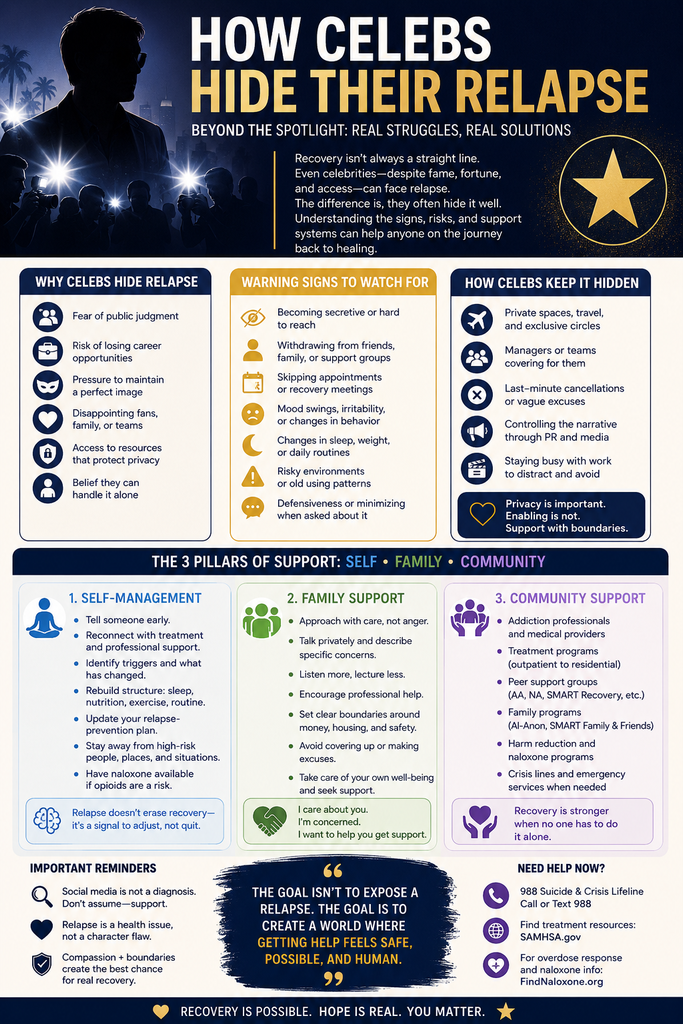
Why Might a Celebrity Hide a Relapse?
Celebrities often live under intense scrutiny. A private struggle can quickly become a headline, a social media debate, or a source of public criticism. Someone who has built a public identity around sobriety may feel particularly afraid of admitting that they are struggling again.
Reasons a relapse may be concealed include:
- Fear of public judgment or embarrassment
- Concern about losing acting, music, sports, or business opportunities
- Fear of disappointing family members, fans, or recovery supporters
- Shame about returning to substance use after a period of sobriety
- Denial about how serious the situation has become
- Easy access to money, travel, private spaces, or people who protect their privacy
- Fear that seeking treatment will attract media attention
- Believing they can regain control without professional help
These pressures are not exclusive to celebrities. Many people hide substance use because they fear consequences at home, at work, or within their communities.
What Concealed Relapse Can Look Like
There is no single behavior that proves someone has relapsed. Changes in appearance, mood, relationships, or public behavior can have many explanations, including physical illness, stress, grief, sleep deprivation, or mental health concerns.
However, families may notice patterns that deserve attention, particularly when several changes occur together.
Possible warning signs can include:
- Becoming increasingly secretive or difficult to reach
- Withdrawing from trusted recovery supports
- Missing treatment appointments or recovery meetings
- Returning to people, places, or situations strongly associated with previous substance use
- Unexplained changes in money or spending
- Significant changes in sleep or daily routines
- Neglecting important responsibilities
- Becoming defensive when substance use or recovery is discussed
- Minimizing behaviors that previously presented a relapse risk
Warning signs should encourage a supportive conversation rather than accusations.
The Pressure of Maintaining a Public Image
A celebrity may have managers, publicists, employees, assistants, friends, and family members helping maintain a professional image. While protecting reasonable privacy is appropriate, repeatedly covering up dangerous behavior can unintentionally become enabling.
For example, others may cancel commitments, provide excuses, pay debts, hide consequences, or repeatedly solve problems caused by substance use. These actions may temporarily protect a career or reputation while allowing the underlying problem to continue.
Privacy and enabling are not the same thing. A person deserves dignity and confidentiality, but protecting someone from every consequence of harmful substance use may delay recognition that additional treatment is needed.
Self-Management Strategies After Relapse
Recognizing a recurrence of substance use early can provide an opportunity to return to treatment before the consequences become more severe. A person does not need to wait until everything falls apart before asking for help.
Helpful self-management strategies include:
- Tell someone early. Contact a trusted clinician, sponsor, peer, counselor, or supportive family member instead of managing the situation alone.
- Identify what changed. Examine recent stress, cravings, relationships, environments, emotional difficulties, or interruptions in treatment.
- Reconnect with treatment. A clinical reassessment can determine whether outpatient care, medication, intensive outpatient treatment, partial hospitalization, residential care, or another level of support is appropriate.
- Rebuild structure. Restore consistent sleep, meals, appointments, exercise, responsibilities, and recovery activities.
- Reduce access to substances. Avoid high-risk environments and develop a practical plan for situations where substances may be available.
- Update the relapse-prevention plan. Identify triggers, early warning signs, coping strategies, emergency contacts, and specific actions to take when cravings intensify.
- Protect against overdose. After abstinence, opioid tolerance can decrease, making a return to previous amounts especially dangerous. Naloxone should be available when opioid exposure is possible.
Family Support Strategies
Families often experience fear, anger, disappointment, and confusion when someone returns to substance use. These emotions are understandable, but confrontation based on humiliation or punishment can make honest communication more difficult.
Families can provide healthier support by:
- Speaking privately and describing specific behaviors rather than making accusations
- Listening without immediately lecturing or arguing
- Encouraging professional assessment and treatment
- Learning about substance use disorders and relapse
- Keeping naloxone available when opioid use or exposure is possible
- Establishing clear boundaries around money, housing, transportation, and unsafe behavior
- Refusing to lie to employers, friends, or others to repeatedly conceal consequences
- Supporting recovery efforts without attempting to control every decision
- Seeking counseling or peer support for themselves
A useful family message is: “I care about you, I am concerned about what I am seeing, and I want to help you get appropriate support.”
Community Support Strategies
Long-term recovery usually requires more than individual determination. Community resources can create multiple layers of support, especially when someone feels ashamed about returning to treatment.
Helpful resources may include:
- Addiction medicine professionals
- Primary care clinicians
- Behavioral health counselors
- Intensive outpatient and residential treatment programs
- Peer recovery specialists
- Alcoholics Anonymous, Narcotics Anonymous, SMART Recovery, and other mutual-support communities
- Recovery community organizations
- Family programs such as Al-Anon and SMART Recovery Family & Friends
- Harm-reduction programs
- Naloxone distribution programs
- Crisis and emergency services when immediate safety is at risk
Celebrities may have access to private treatment options that most people do not, but privacy alone does not create recovery. Effective treatment still depends on evidence-based care, honest communication, continuing support, and willingness to address factors contributing to renewed substance use.
Social Media Is Not a Diagnostic Tool
When a celebrity behaves differently in an interview, cancels an appearance, loses weight, gains weight, appears emotional, or disappears from social media, online observers may quickly assume relapse.
That assumption can be harmful.
A person cannot reliably be diagnosed with a substance use disorder—or a relapse—through photographs, videos, rumors, or social-media posts. Unless the individual or a credible source has publicly confirmed the information, speculation should not be presented as fact.
The same principle applies outside celebrity culture. Families should focus on observable behaviors and genuine safety concerns rather than attempting to diagnose someone based on appearance alone.
Relapse Does Not Erase Previous Recovery
A return to substance use does not erase months or years of recovery. Instead, it may indicate that a treatment or recovery plan needs to be reassessed.
The important questions become: What contributed to the relapse? Which warning signs appeared first? What supports disappeared? What needs to change now?
Recovery is strengthened when people can answer those questions without being defined by their worst moment.
Conclusion
Celebrities may hide relapse because public disclosure can threaten their reputation, career, relationships, and carefully maintained image. But beneath celebrity status is the same human struggle experienced by many people with substance use disorders: fear, shame, cravings, stress, and uncertainty about asking for help again.
Families can respond with compassion while maintaining boundaries. Communities can provide accessible treatment, peer support, harm-reduction resources, and opportunities to return to care without humiliation. Individuals can respond to relapse by seeking help early, identifying triggers, strengthening treatment, and rebuilding their recovery plan.
The goal should not be to expose someone’s relapse. The goal is to create an environment where hiding it feels less necessary—and getting help feels possible.
Frequently Asked Questions
Here are some common questions:
1. Why might celebrities hide a relapse?
Celebrities may fear public judgment, negative headlines, career consequences, lost endorsements, or disappointing their families and fans. Shame can also make admitting a return to substance use difficult.
2. How can a celebrity keep a relapse private?
Fame and wealth may provide greater access to private residences, travel, assistants, security, and confidential treatment. However, privacy itself should not be confused with deception or proof of relapse.
3. What are possible warning signs of relapse?
Possible signs include increased secrecy, isolation, disrupted sleep, missed responsibilities, withdrawal from recovery supports, returning to high-risk environments, and unexplained behavioral changes. No single sign proves that someone has relapsed.
4. Can you tell whether a celebrity has relapsed from social media or photographs?
No. Changes in appearance, behavior, weight, speech, or social-media activity can have many explanations. A relapse should not be assumed unless reliable information has been disclosed.
5. Why is shame such an important factor in hidden relapse?
A person who has publicly celebrated sobriety may feel that relapse represents failure. Shame can encourage secrecy and isolation, which may make it harder to seek treatment early.
6. Does relapse mean addiction treatment failed?
Not necessarily. A return to substance use may indicate that treatment and the recovery plan need reassessment. It can reveal new triggers, stressors, or areas where additional support is needed.
7. How can family members respond to a suspected relapse?
Families can calmly describe specific behaviors they have noticed, express concern, listen, and encourage professional help. Accusations, humiliation, and public confrontation may make honest communication more difficult.
8. What is the difference between protecting privacy and enabling?
Protecting privacy respects a person’s dignity and confidentiality. Enabling involves repeatedly shielding someone from the consequences of harmful behavior—for example, providing money for substance use or continually making excuses for missed responsibilities.
9. What should someone do after a relapse?
They should consider contacting their treatment provider or another trusted professional as soon as possible. Reviewing triggers, reconnecting with recovery support, restoring healthy routines, and updating the relapse-prevention plan can help them return to recovery.
10. Why can opioid relapse be particularly dangerous?
After a period of abstinence, opioid tolerance may decrease. Returning to an amount previously used can therefore increase overdose risk. Naloxone should be available whenever opioid exposure is possible.
11. What community resources can support recovery after relapse?
Resources can include addiction medicine professionals, therapists, treatment programs, peer recovery specialists, recovery community organizations, harm-reduction services, and mutual-support groups such as AA, NA, or SMART Recovery.
12. Should the public expose a celebrity suspected of relapsing?
No. Speculation and public shaming can increase stigma without helping the individual. Substance use disorders deserve the same respect for privacy and evidence-based care as other health conditions.
13. Can someone recover after multiple relapses?
Yes. Multiple setbacks do not make recovery impossible. Treatment can be adjusted, risk factors addressed, and stronger recovery supports developed.
14. What can we learn from celebrity relapse stories?
They remind us that money, success, and fame do not eliminate vulnerability to substance use disorders. Recovery depends on ongoing support, treatment when needed, healthy coping strategies, and willingness to seek help when problems return.
15. What is the most important message about hidden relapse?
The goal should not be to catch or expose someone. The goal is to recognize concerning patterns, reduce shame, maintain appropriate boundaries, and make it easier for someone struggling to return to treatment and recovery.
Video: Why Celebrities Are Terrified To Admit Relapse #addiction #mentalhealth #celebrity