Recovery stories can be powerful. Hearing someone describe overcoming addiction may provide hope to people who are struggling and remind families that meaningful change is possible. Social media has made these stories more visible than ever, with celebrities, influencers, treatment advocates, and everyday people sharing their experiences publicly.
But not every recovery story should automatically be accepted at face value. Some accounts may exaggerate progress, leave out important details, promote questionable treatments, or be designed primarily to sell products or build an online following. At the same time, an imperfect or inconsistent story does not prove that someone is lying. Recovery is personal, nonlinear, and often complicated.
Learning to evaluate recovery stories critically means looking for credibility, accountability, realistic expectations, and evidence—not trying to prove that another person is a fraud.
What Is a “Fake” Recovery Story?
A misleading recovery story is one that intentionally misrepresents a person’s experiences, treatment, substance use, or outcomes. Sometimes the concern is less about outright fabrication and more about exaggeration or presenting one person’s experience as a guaranteed solution for everyone.
A questionable story might:
- Promise an instant or guaranteed cure
- Present one method as the only legitimate path to recovery
- Claim that professional treatment is unnecessary for everyone
- Promote expensive products as essential to sobriety
- Use dramatic claims without supporting evidence
- Constantly change major details when questioned
- Shame people who use medications or different recovery approaches
- Present recovery as effortless after one breakthrough
- Use fear or desperation to pressure people into buying something
These characteristics deserve scrutiny, but none independently proves dishonesty.
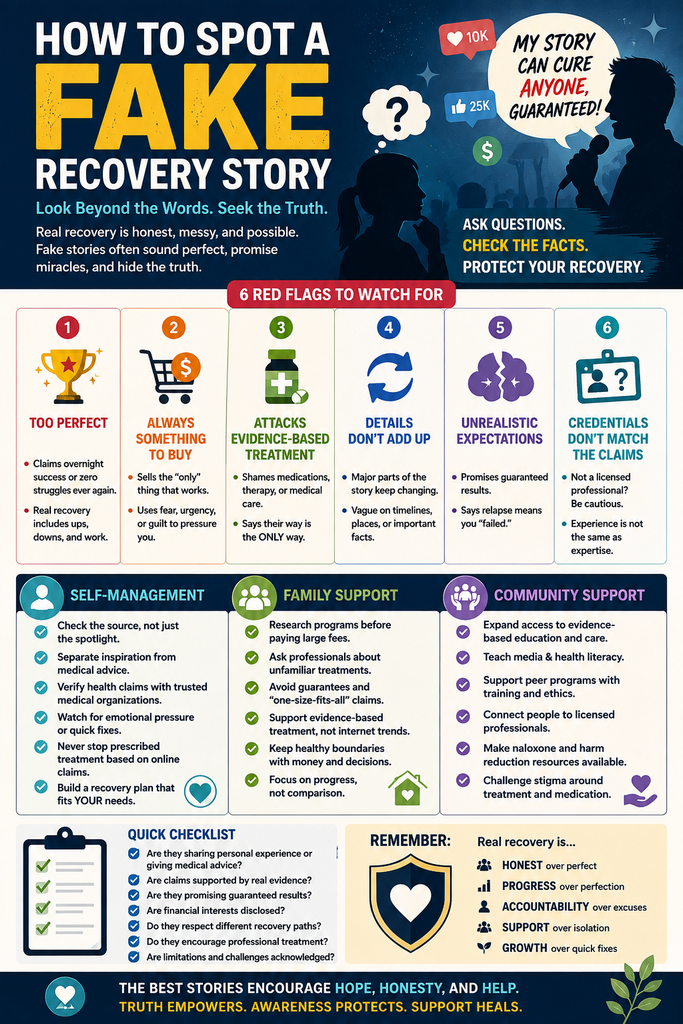
Red Flag #1: The Story Sounds Too Perfect
Real recovery usually involves challenges. People may experience cravings, difficult emotions, relationship problems, treatment changes, or periods when maintaining recovery requires significant effort.
A story claiming that addiction completely disappeared overnight and that the person has never struggled again deserves careful evaluation—especially when followed by a sales pitch.
Authentic recovery stories often acknowledge complexity rather than promising perfection.
Red Flag #2: There Is Always Something to Buy
People in recovery can legitimately write books, provide professional services, or create educational resources. Making money does not automatically make someone’s recovery story dishonest.
The concern arises when personal testimony is used to create fear or make unsupported medical claims.
Watch for statements such as:
- “This is the only program that works.”
- “Doctors don’t want you to know this.”
- “You don’t need treatment if you buy my system.”
- “This supplement eliminates addiction.”
- “I guarantee you’ll never relapse again.”
Substance use disorders are complex health conditions. No legitimate treatment can guarantee permanent recovery for every person.
Red Flag #3: Evidence-Based Treatment Is Attacked
Recovery can occur through many pathways. Some people benefit from counseling, medications, mutual-support groups, residential treatment, recovery coaching, harm-reduction services, faith communities, or combinations of these approaches.
Be cautious when someone claims that medications for opioid use disorder, professional counseling, or medical treatment make recovery “fake.”
Using evidence-based medication is treatment—not cheating.
Red Flag #4: Important Details Constantly Change
People may remember dates differently, forget details, or decide to disclose additional information over time. Trauma, substance use, and the passage of time can also affect memory.
Minor inconsistencies therefore do not establish deception.
However, repeatedly changing major claims—particularly when those claims are being used to sell a treatment or establish professional credibility—may justify asking additional questions.
Red Flag #5: The Story Creates Unrealistic Expectations
Recovery stories should inspire hope without promising certainty.
A misleading message may suggest:
- Everyone should recover the same way.
- Relapse means treatment failed.
- People who need medication are not truly sober.
- One treatment works for every substance use disorder.
- Recovery eliminates all emotional and relationship problems.
- Motivation alone should be enough.
Realistic recovery recognizes individual differences.
Red Flag #6: Credentials Don’t Match the Claims
A compelling personal recovery story does not automatically make someone a healthcare professional.
Lived experience can provide valuable insight, but it should not be presented as medical expertise without appropriate qualifications.
Before accepting treatment advice, consider asking:
- What are this person’s qualifications?
- Is the treatment supported by credible research?
- Are risks and limitations explained?
- Are they encouraging professional medical care when appropriate?
- Are financial relationships clearly disclosed?
Credible educators are generally willing to distinguish personal experience from medical advice.
Self-Management Strategies: Becoming a Smart Consumer of Recovery Information
You do not need to become suspicious of every recovery story. Instead, develop healthy critical-thinking habits.
Check the Source
Look beyond follower counts, celebrity status, emotional videos, or dramatic testimonials. Popularity is not evidence of medical effectiveness.
Separate Inspiration From Medical Advice
Someone’s personal experience can be meaningful without proving that the same approach will work for you.
Verify Health Claims
Check important treatment claims against reliable medical organizations, government health agencies, and qualified healthcare professionals.
Watch for Emotional Pressure
Be cautious when someone uses fear, guilt, urgency, or shame to pressure you into purchasing treatment.
Protect Your Recovery
Never abruptly stop prescribed addiction medication or other treatment because an influencer says you should. Discuss significant treatment changes with your healthcare provider.
Build Your Own Recovery Plan
Your recovery does not need to resemble someone else’s story. Treatment should reflect your medical needs, substance-use history, environment, goals, and available support.
Family Support Strategies
Families can become vulnerable to exaggerated recovery claims because they desperately want their loved one to get better. Hope is valuable, but desperation can make expensive promises especially persuasive.
Families can help by:
- Researching treatment programs before paying large fees
- Asking healthcare professionals about unfamiliar treatments
- Checking professional licenses and credentials when appropriate
- Avoiding programs that guarantee permanent recovery
- Supporting evidence-based treatment rather than internet trends
- Discussing questionable claims without ridicule
- Encouraging their loved one to develop an individualized treatment plan
- Maintaining healthy financial and emotional boundaries
- Recognizing that relapse does not automatically mean someone was dishonest about recovery
Families should also avoid comparing their loved one’s progress with celebrity or influencer recovery stories. Different people require different timelines and treatments.
Community Support Strategies
Communities can help people distinguish credible recovery resources from misinformation.
Helpful approaches include:
- Expanding access to evidence-based addiction education
- Teaching media and health literacy
- Providing affordable treatment options
- Supporting peer recovery organizations with appropriate training and ethical standards
- Connecting individuals with licensed addiction professionals
- Making naloxone and overdose-prevention education accessible
- Challenging stigma surrounding medications for addiction treatment
- Reporting fraudulent or dangerous healthcare claims through appropriate channels
Healthcare professionals and community organizations can also teach people how to evaluate online information rather than simply telling them what not to believe.
Authentic Recovery Does Not Mean Perfect Recovery
One of the biggest mistakes is assuming that a genuine recovery story must be flawless.
Someone can be sincerely committed to recovery and still:
- Experience cravings
- Make mistakes
- Change treatment approaches
- Struggle emotionally
- Need medication
- Return to treatment
- Experience relapse
- Decide to keep parts of recovery private
These experiences do not automatically make someone’s story fake.
Authenticity is better reflected through honesty, accountability, realistic expectations, and willingness to seek help when circumstances change.
Questions to Ask Before Trusting a Recovery Story
Instead of asking only, “Is this person telling the truth?”, consider asking:
- Are they sharing personal experience or giving medical advice?
- Are their health claims supported by evidence?
- Are they promising guaranteed results?
- Are they transparent about financial interests?
- Do they respect different pathways to recovery?
- Do they encourage appropriate professional treatment?
- Are they honest about limitations and challenges?
These questions shift attention away from judging the individual and toward evaluating the quality of the information.
Conclusion
Recovery stories can provide hope, connection, and motivation, but emotional storytelling should never replace critical thinking. A dramatic transformation, large social-media following, celebrity endorsement, or personal testimony does not prove that a treatment works.
At the same time, imperfect recovery should never automatically be labeled fake. Genuine recovery can include setbacks, medication, treatment changes, relapse, and renewed attempts to get well.
Look beyond the polished story. Evaluate the evidence, consider the person’s qualifications, recognize unrealistic promises, and pay attention when recovery is being used primarily as a marketing tool.
The best recovery stories do not promise perfection. They encourage honesty, accountability, appropriate treatment, continued growth, and hope.
Frequently Asked Questions
Here are some common questions:
1. What is a “fake recovery story”?
A fake or misleading recovery story intentionally misrepresents someone’s addiction, treatment, sobriety, or results. However, an incomplete or imperfect recovery story is not automatically dishonest. People may keep parts of their recovery private.
2. What are the biggest red flags in a questionable recovery story?
Watch for guaranteed cures, overnight transformations, claims that one method works for everyone, attacks on evidence-based treatment, constantly changing major details, or pressure to purchase a product or program.
3. Does relapse mean someone’s recovery story was fake?
No. Relapse does not prove that someone lied about being in recovery. Substance use disorders can involve recurrence, and a person may genuinely have been doing well before returning to substance use.
4. Should I distrust a recovery story that seems too perfect?
Not automatically, but approach extraordinary claims critically. Recovery often involves challenges, lifestyle changes, treatment adjustments, cravings, and ongoing work. Claims of effortless or guaranteed permanent recovery deserve closer examination.
5. Is someone selling a recovery program necessarily dishonest?
No. Qualified professionals and people with lived experience may legitimately offer services, books, education, or recovery programs. The concern arises when personal testimony is used to make unsupported medical claims or pressure vulnerable people into spending money.
6. What marketing language should raise concerns?
Be cautious of statements such as “100% guaranteed,” “works for everyone,” “instant cure,” “the only treatment you’ll ever need,” or claims that conventional healthcare professionals are deliberately hiding a cure.
7. Can testimonials prove that an addiction treatment works?
No. Testimonials describe individual experiences and cannot establish whether a treatment is safe or effective for everyone. Scientific evidence and appropriately designed research provide stronger evidence of treatment effectiveness.
8. Should I trust celebrity or influencer recovery advice?
Celebrity status and follower counts do not establish medical expertise. A person’s lived experience may be valuable, but medical recommendations should be evaluated using credible evidence and guidance from qualified healthcare professionals.
9. How can I check someone’s credentials?
Look for clearly stated professional qualifications and verify licenses through appropriate state licensing boards when necessary. Be cautious when someone presents personal recovery experience as equivalent to medical or mental health training.
10. Is medication-assisted recovery “fake recovery”?
No. Medications such as buprenorphine, methadone, and naltrexone are evidence-based treatment options for appropriate patients with opioid use disorder. Recovery should not be dismissed simply because medication is part of treatment.
11. Why do some misleading recovery stories attack medications or professional treatment?
Presenting conventional treatment as ineffective can make an alternative product or program appear more attractive. Claims that encourage people to forgo appropriate medical care should be treated with particular caution.
12. What should families do before paying for a recovery program?
Research the program, investigate its credentials, understand its treatment methods and costs, ask about evidence supporting its claims, and discuss unfamiliar approaches with a qualified healthcare professional.
13. What should I do if someone’s recovery story keeps changing?
Consider the significance of the inconsistencies. Minor differences may simply reflect memory or privacy. Repeated changes involving major treatment claims, qualifications, or outcomes deserve greater scrutiny—particularly when money is involved.
14. How can I distinguish personal experience from medical advice?
Statements such as “This helped me” describe personal experience. Statements such as “This will cure your addiction” make a much broader health claim requiring reliable evidence.
15. What does a credible recovery story usually sound like?
Credible stories generally acknowledge that recovery is individualized. They may discuss challenges and setbacks, avoid guaranteeing outcomes, respect different evidence-based treatment pathways, and clearly distinguish personal experience from professional advice.
16. Can someone have an authentic recovery story even after multiple relapses?
Yes. Recovery does not require a flawless history. A person can experience relapse, return to treatment, modify their recovery plan, and continue making meaningful progress.
17. How can communities protect people from misleading recovery information?
Communities can improve access to evidence-based treatment information, teach health and media literacy, support reputable peer-recovery services, connect people with qualified professionals, and challenge misinformation about addiction treatment.
18. What is the best question to ask when evaluating a recovery claim?
Ask: “What reliable evidence supports this claim?” Personal stories can inspire hope, but important treatment decisions should be based on credible evidence, individual needs, and appropriate professional guidance.
19. What should I do if online recovery advice conflicts with my treatment plan?
Do not abruptly stop medication or treatment because of an online testimonial. Discuss the information with your healthcare professional so the potential benefits, risks, and evidence can be evaluated.
20. What is the main message about spotting a fake recovery story?
The goal is not to become suspicious of everyone in recovery. It is to become a better-informed consumer of recovery information. Look for honesty over perfection, evidence over promises, accountability over excuses, and individualized support over one-size-fits-all cures.
Video: How to tell if a recovery story is actually real #AddictionRecovery #Tips