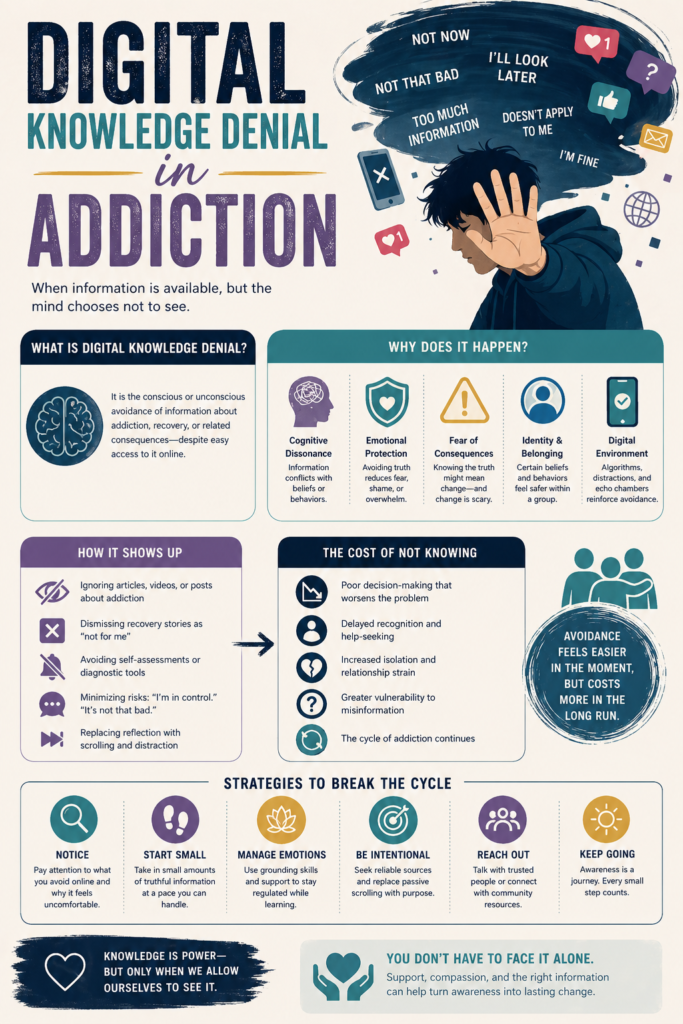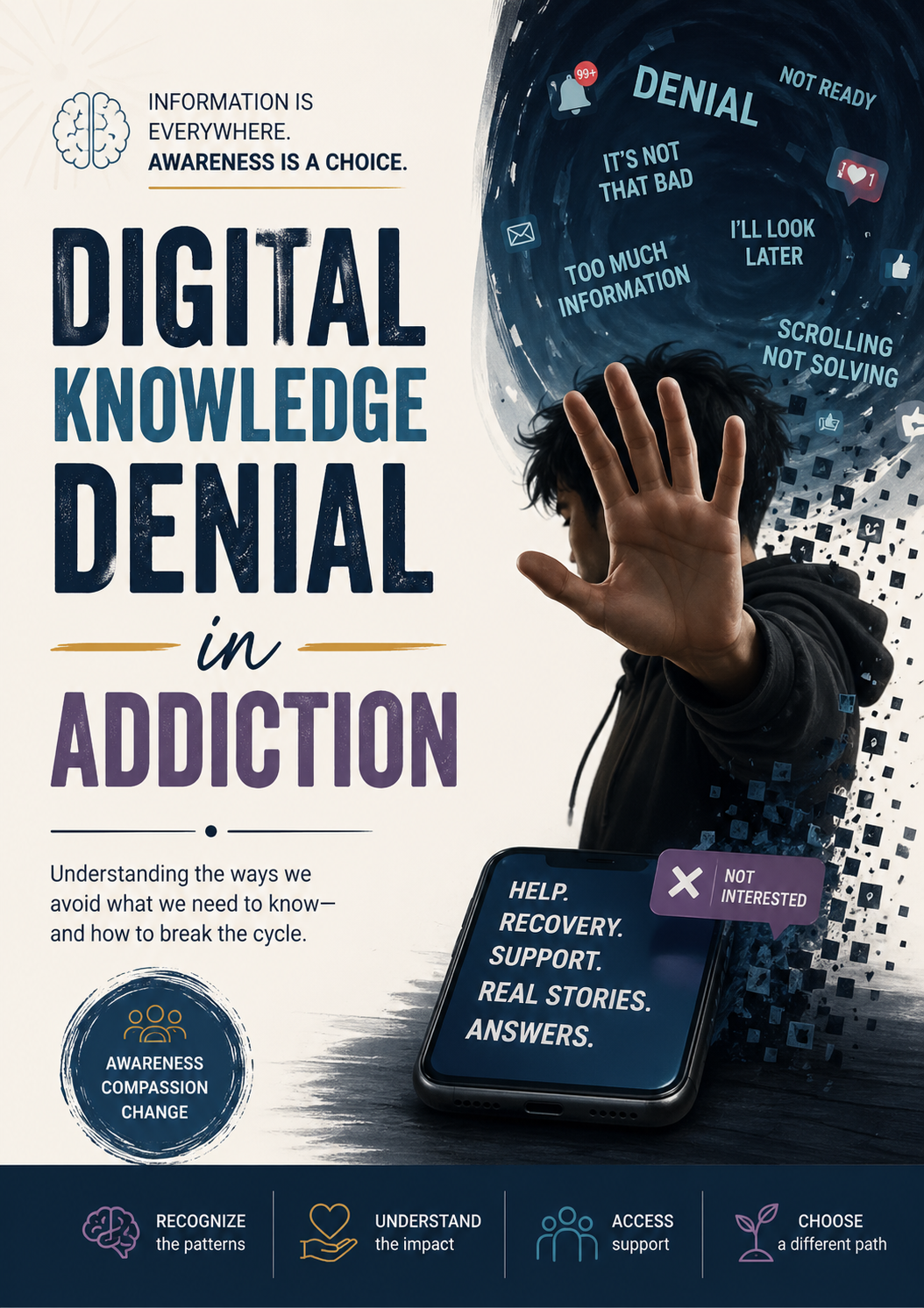
In an era where information about addiction is constantly available—through articles, social media, research, and personal stories—it might seem that awareness should come easily. Yet, many individuals struggling with addiction actively or unconsciously avoid engaging with this knowledge. This phenomenon, known as digital knowledge denial in addiction, reflects a deeper psychological process where access to information does not guarantee acceptance or understanding. Rather than a simple lack of awareness, it involves emotional self-protection, cognitive dissonance, and the fear of what acknowledging the truth might require. In this way, the digital environment becomes both a source of insight and a space for avoidance, allowing individuals to selectively engage with—or completely bypass—information that challenges their current behaviors.
Digital Knowledge Denial: Why We Choose Not to Know in an Age of Information
We live in a time where answers are never more than a few taps away. From global crises to personal health, from politics to psychology, information is abundant—overwhelmingly so. And yet, many people are not becoming more informed. In some cases, they are doing the opposite: actively or passively avoiding knowledge. This phenomenon can be called digital knowledge denial—the tendency to ignore, dismiss, or avoid readily accessible information.
What Is Digital Knowledge Denial?
Digital knowledge denial isn’t about a lack of access. It’s about a choice—sometimes conscious, often unconscious—to turn away from information. This can look like:
- Scrolling past important news without engaging
- Avoiding topics that feel uncomfortable or threatening
- Rejecting credible information in favor of simpler or more comforting narratives
- Saying “I don’t want to know” in a world built on knowing
At its core, it’s not ignorance by limitation—it’s ignorance by preference.
Why Do People Avoid Knowledge?
Understanding this behavior requires looking at a few psychological mechanisms:
1. Cognitive Dissonance
When new information conflicts with existing beliefs or behaviors, it creates mental discomfort. Rather than changing beliefs, many people reduce this discomfort by avoiding or dismissing the information altogether.
2. Information Overload
The human brain isn’t designed to process the constant stream of content we face today. When overwhelmed, people often cope by tuning out entirely—prioritizing mental survival over accuracy.
3. Emotional Self-Protection
Some knowledge hurts. Learning about injustice, health risks, or personal patterns can trigger anxiety, guilt, or fear. Avoidance becomes a form of emotional regulation.
4. Identity and Social Belonging
Beliefs are often tied to identity and community. Accepting new information might mean distancing from a group, so denial becomes a way to preserve connection.
The Digital Environment Makes It Easier
Modern platforms don’t just provide information—they curate it. Algorithms prioritize engagement, not truth. This creates:
- Echo chambers, where people only see what reinforces their views
- Selective exposure, where uncomfortable information is filtered out
- Endless distraction, where serious topics compete with entertainment
In this environment, avoiding knowledge isn’t just easy—it’s often the default.
The Hidden Costs of Not Knowing
Choosing not to know may feel easier in the short term, but it comes with long-term consequences:
- Poor decision-making (health, finances, relationships)
- Increased vulnerability to misinformation
- Reduced empathy for others’ experiences
- Stagnation in personal growth
On a larger scale, widespread denial of knowledge can weaken public discourse and collective problem-solving.
Is All Avoidance Bad?
Not necessarily. There’s a difference between intentional boundaries and denial.
Taking breaks from the news, limiting screen time, or choosing when to engage with heavy topics can be healthy. The key distinction is awareness:
- Healthy boundary → “I’ll come back to this when I’m ready.”
- Denial → “I don’t want to know, ever.”
Moving Toward Conscious Engagement
Addressing digital knowledge denial doesn’t mean consuming everything. It means being more intentional:
- Notice what you instinctively avoid—and ask why
- Diversify information sources
- Tolerate discomfort as part of growth
- Practice critical thinking, not just consumption
In a world overflowing with information, the real challenge isn’t access—it’s willingness.
Conclusion
Digital knowledge denial reflects a paradox of modern life: we have unprecedented access to truth, yet unprecedented ability to avoid it. The question is no longer “What can we know?” but “What are we willing to face?”
Facing What We Avoid: Self-Management Strategies for Digital Knowledge Denial in Addiction
In today’s hyperconnected world, information about addiction is everywhere—yet not always absorbed. Many people find themselves scrolling past, minimizing, or avoiding content that hits too close to home. This pattern—digital knowledge denial in addiction—isn’t laziness or lack of intelligence. It’s often a protective response.
But if avoidance becomes a habit, it can quietly maintain the cycle of addiction. The goal isn’t to overwhelm yourself with information—it’s to build the capacity to face it safely and intentionally.
Understanding the Pattern Before Changing It
Before applying strategies, it helps to recognize what’s happening internally.
Digital knowledge denial often shows up as:
- “This doesn’t apply to me,” thinking
- Skipping content that feels uncomfortable or confronting
- Downplaying risks or comparing oneself to “worst cases.”
- Replacing reflection with distraction (scrolling, binge-watching, etc.)
These are not random behaviors—they’re tied to emotional regulation. Avoidance reduces anxiety, shame, or fear in the moment, which reinforces the habit over time.
So any strategy that works has to respect that:
👉 You’re not just managing information—you’re managing emotions.
1. Build Awareness Without Judgment
The first step is noticing your avoidance patterns without immediately trying to “fix” them.
Try this:
- Pay attention to what you scroll past quickly
- Notice your internal reactions: resistance, irritation, dismissal
- Ask: “What about this feels uncomfortable?”
The goal isn’t to force engagement—it’s to name the avoidance. Awareness weakens automatic behavior.
2. Use “Micro-Exposure” to Difficult Information
Jumping into heavy content all at once can trigger a shutdown. Instead, use gradual exposure.
- Read or watch small, manageable pieces of information
- Set a short time limit (e.g., 2–5 minutes)
- Stop before you feel overwhelmed
This builds tolerance over time. You’re training your brain to see that discomfort is survivable, not dangerous.
3. Pair Information with Emotional Regulation
If knowledge triggers distress, your brain will keep avoiding it. So combine learning with grounding techniques:
- Deep breathing or slow exhale patterns
- Holding something cold or focusing on physical sensations
- Brief pauses to check in with your body
This helps your nervous system stay regulated while engaging with difficult truths.
4. Replace Passive Scrolling with Intentional Seeking
Digital environments are designed for distraction. Shift from passive to active engagement:
- Instead of scrolling, search for a specific question about addiction
- Choose sources that are clear and non-judgmental
- Limit exposure to content that glamorizes or minimizes harmful behavior
Even a small shift in intention changes how information is processed.
5. Challenge “All-or-Nothing” Thinking
A common trap is believing:
- “If I admit there’s a problem, everything has to change immediately.”
This belief fuels avoidance.
Instead, reframe:
- Awareness does not equal instant action
- Understanding your behavior is a step, not a commitment to drastic change
This reduces the perceived threat of knowing.
6. Create a Safe Context for Reflection
Processing information alone can feel overwhelming. Consider:
- Journaling reactions after engaging with content
- Talking with a trusted person
- Engaging in structured reflection (e.g., writing down thoughts vs. facts)
Support reduces the emotional load of awareness.
7. Set Boundaries—Not Barriers
It’s okay to limit exposure when needed. The key difference:
- Barrier (denial): “I’m not looking at this at all.”
- Boundary (self-management): “I’ll engage with this when I feel ready and in control.”
Healthy limits prevent overwhelm without reinforcing avoidance.
The Bigger Picture
Digital knowledge denial in addiction isn’t about refusing truth—it’s about protecting yourself from what feels unbearable. But long-term change requires slowly increasing your ability to face reality without shutting down.
Self-management is not about force. It’s about:
- pacing
- awareness
- emotional safety
Conclusion
You don’t have to confront everything at once. You don’t even have to be ready for full change.
But each moment of choosing to look, even briefly, interrupts the cycle of avoidance—and that’s where real change begins.
Helping Without Pushing Away: Family Support Strategies for Digital Knowledge Denial in Addiction
In a world saturated with information about addiction, it can be confusing—and frustrating—when someone you care about seems to ignore it. Articles, videos, recovery stories, and even direct conversations are often brushed aside or minimized. This isn’t just stubbornness. It can be part of digital knowledge denial in addiction—a protective pattern where a person avoids information that threatens their current behavior or sense of control.
For families, the instinct is often to push harder: send more links, present more facts, insist on awareness. But paradoxically, too much pressure can deepen avoidance. Supporting someone through this requires a different approach—one that balances truth with emotional safety.
Understanding What’s Really Happening
Before focusing on strategies, it’s important to reframe the behavior.
When someone avoids information about addiction, they may be trying to avoid:
- Shame or guilt
- Fear of losing control or identity
- Anxiety about change or consequences
- Feeling overwhelmed or “not ready.”
Avoidance reduces these feelings in the short term. That’s why it persists.
👉 This means the issue isn’t just information—it’s emotional capacity to handle that information.
1. Lead with Curiosity, Not Confrontation
Instead of trying to correct or convince, start with open-ended, non-judgmental questions:
- “What do you think about stuff like that?”
- “Does any of it feel relevant to you?”
- “What makes that hard to look at?”
This approach lowers defensiveness and invites reflection rather than resistance.
2. Reduce Information Overload
Flooding someone with articles, statistics, or videos can backfire. It can feel overwhelming or even threatening.
Try:
- Sharing one piece of content at a time
- Choosing materials that are relatable, not extreme
- Letting them decide if and when to engage
Less pressure often leads to more openness.
3. Validate Emotions Without Reinforcing Denial
You can acknowledge feelings without agreeing with avoidance.
Examples:
- “I get why that would feel overwhelming.”
- “It makes sense that you’d want to avoid something that feels heavy.”
This builds trust, making it safer for them to eventually face the information.
4. Model Healthy Engagement
People are often more influenced by what they observe than what they’re told.
- Talk openly about learning new things—even when they’re uncomfortable
- Show balanced engagement with information (not obsessive, not avoidant)
- Avoid shaming language or “I told you so” moments
Modeling creates a safe template for change.
5. Focus on the Relationship First
If the relationship feels unsafe, no amount of information will get through.
Prioritize:
- Consistency
- Emotional availability
- Respect for autonomy
When someone feels supported rather than judged, they’re more likely to lower their defenses.
6. Encourage Small Steps Toward Awareness
You don’t need immediate breakthroughs. Small shifts matter:
- Watching part of a video instead of all of it
- A brief conversation instead of a deep confrontation
- Acknowledging one concern instead of the entire problem
Progress in awareness is often gradual.
7. Set Boundaries for Yourself
Supporting someone doesn’t mean absorbing all the stress or abandoning your own needs.
Healthy boundaries might include:
- Limiting repeated arguments about the same topic
- Choosing when to engage and when to step back
- Seeking your own support (friends, groups, therapy)
You can be supportive without becoming overwhelmed.
8. Know When to Introduce Outside Support
Sometimes, information is easier to hear from someone outside the family dynamic.
This might include:
- Counselors or therapists
- Peer recovery groups
- Educational programs or workshops
External voices can reduce defensiveness and bring new perspectives.
The Bigger Picture
Digital knowledge denial in addiction isn’t about refusing help—it’s about not being ready to face what help implies. Families often try to solve this with more information, but the real shift happens when the person feels safe enough to be honest.
Conclusion
You can’t force someone to see what they’re not ready to face. But you can create an environment where looking becomes less threatening.
Support isn’t about breaking through denial—it’s about standing steady until they’re ready to lower it themselves.
Bridging the Gap: Community Resource Strategies for Digital Knowledge Denial in Addiction
In an age where information about addiction is widely available, a paradox persists: many individuals still avoid or disengage from that knowledge. This pattern—digital knowledge denial in addiction—is not simply a lack of access, but a complex interaction of emotional, psychological, and environmental factors.
While individuals and families play a role in addressing this, community resources are uniquely positioned to bridge the gap between information and engagement. The challenge is not just delivering knowledge—but making it accessible, safe, and usable.
Understanding the Community’s Role
Communities shape how people interact with information. They influence:
- What is considered “normal” or acceptable
- How safe it feels to acknowledge a problem
- Whether support is visible, accessible, and stigma-free
When communities rely solely on passive information (websites, pamphlets, statistics), they may unintentionally reinforce avoidance. Effective strategies go beyond availability—they focus on engagement and trust.
1. Shift from Information Delivery to Engagement
Simply providing facts about addiction is often not enough.
Community resources can:
- Use interactive formats (workshops, discussions, Q&A sessions)
- Create spaces where people can ask questions anonymously
- Focus on dialogue rather than one-way messaging
Engagement helps individuals process information rather than avoid it.
2. Normalize Conversations Around Addiction
Stigma fuels knowledge denial. If addiction is seen as shameful, people are more likely to avoid related information.
Communities can:
- Host open forums and storytelling events
- Highlight recovery narratives that are relatable—not extreme
- Integrate addiction education into broader wellness conversations
Normalization reduces the emotional threat of knowing.
3. Meet People Where They Are Digitally
If avoidance happens online, that’s where intervention can begin.
Strategies include:
- Creating non-judgmental, accessible digital content (short videos, posts, podcasts)
- Using language that invites curiosity rather than fear
- Avoiding overwhelming or overly clinical messaging
The goal is to lower the barrier to initial engagement.
4. Provide Tiered Access to Information
Not everyone is ready for the same level of depth.
Community resources can offer:
- Entry-level content (basic awareness, relatable examples)
- Intermediate resources (self-assessments, coping strategies)
- Advanced support (treatment options, recovery programs)
This allows individuals to engage at their own pace without feeling forced.
5. Integrate Emotional Support with Education
Knowledge alone can trigger avoidance if it’s not paired with emotional safety.
Effective programs:
- Include trained facilitators who understand trauma and resistance
- Offer grounding or coping tools alongside information
- Provide follow-up support after educational sessions
This helps individuals stay present rather than shut down.
6. Collaborate Across Systems
Addiction does not exist in isolation, and neither should resources.
Communities can collaborate with:
- Schools and universities
- Healthcare providers
- Faith-based organizations
- Local nonprofits and peer support groups
Cross-system collaboration increases reach and reinforces consistent messaging.
7. Address Barriers to Access
Even when people want to engage, practical barriers can get in the way.
Consider:
- Transportation and location of services
- Cost and insurance limitations
- Cultural relevance and language accessibility
- Scheduling flexibility
Reducing these barriers makes it easier to move from awareness to action.
8. Train Community Leaders and Gatekeepers
People often turn first to trusted figures—teachers, coaches, employers, or local leaders.
Providing them with:
- Basic education on addiction and denial
- Communication strategies
- Referral pathways
…can expand the support network beyond formal systems.
The Bigger Picture
Digital knowledge denial in addiction highlights a critical gap: information exists, but engagement does not always follow. Community resources have the power to close that gap by transforming how knowledge is shared, experienced, and supported.
Conclusion
Communities don’t just distribute information—they shape whether it’s heard, felt, and acted upon.
When resources move beyond awareness and into connection, safety, and accessibility, they don’t just inform—they invite people to take the first step toward change.
Frequently Asked Questions
Here are some common questions:
1. What is digital knowledge denial in addiction?
Digital knowledge denial in addiction is the tendency to avoid, ignore, or dismiss information about addiction—even when it is easily accessible online. This includes skipping articles, minimizing risks, or avoiding self-reflection triggered by digital content.
2. Is this the same as being in denial?
Not exactly. Traditional denial is broader, while digital knowledge denial is specifically tied to avoiding information in digital spaces. It’s a modern extension of denial shaped by constant access to (and avoidance of) online content.
3. Why would someone avoid information that could help them?
Because that information can feel emotionally threatening. It may trigger:
- Fear of change
- Shame or guilt
- Loss of control
- Anxiety about consequences
Avoidance becomes a way to protect oneself from these feelings.
4. Is this behavior intentional or unconscious?
It can be both:
- Unconscious: Automatically scrolling past or dismissing content
- Conscious: Actively choosing not to engage (“I don’t want to think about that”)
Most people experience a mix of both.
5. How does social media contribute to this?
Digital platforms can reinforce avoidance through:
- Algorithms that show preferred (comfortable) content
- Normalization of addictive behaviors (memes, trends)
- Constant distraction that replaces reflection
This makes it easier to stay in avoidance without noticing it.
6. What are common signs of digital knowledge denial?
- Ignoring or skipping addiction-related content
- Saying “that doesn’t apply to me” without reflection
- Minimizing risks (“I’m fine,” “It’s not that bad”)
- Avoiding self-assessments or conversations
- Replacing reflection with scrolling or distraction
7. Is avoiding this information always a bad thing?
Not always. Sometimes people need emotional space before they can process difficult truths.
The issue arises when avoidance becomes chronic and prevents awareness or help-seeking.
8. How does this affect recovery?
It can delay:
- Recognition of a problem
- Seeking support or treatment
- Making informed decisions
In many cases, it allows the addiction cycle to continue longer.
9. How can someone start overcoming digital knowledge denial?
Small, manageable steps work best:
- Notice what you avoid and why
- Engage with short, low-pressure content
- Replace passive scrolling with intentional searching
- Allow discomfort without immediately escaping it
Progress starts with awareness, not perfection.
10. How can family or friends help?
- Avoid overwhelming with too much information
- Use supportive, non-judgmental communication
- Share relatable (not extreme) content
- Focus on emotional safety, not just facts
People are more likely to engage when they feel understood, not pressured.
11. Can community resources make a difference?
Yes. Communities can:
- Reduce stigma around addiction
- Provide safe spaces for discussion
- Offer accessible and relatable information
- Connect individuals to support systems
Community support helps turn information into actionable awareness.
12. What’s the difference between avoidance and healthy boundaries?
- Healthy boundary: Taking breaks with the intention to return later
- Avoidance (denial): Consistently refusing to engage at all
The key difference is intent and long-term pattern.
13. Why is this issue more common now?
Because we live in a time of:
- Information overload
- Constant digital distraction
- Personalized content feeds
This creates an environment in which avoiding the truth is easier than ever.
14. What is the first step toward change?
Noticing the pattern.
Before behavior changes, there’s usually a moment of awareness:
👉 “I keep avoiding this… why?”
That moment is where the cycle begins to shift.
15. Is awareness enough to stop addiction?
No—but it’s essential.
Awareness doesn’t solve everything, but without it, change is unlikely. It opens the door to:
- Reflection
- Support
- Action
Conclusion
Digital knowledge denial in addiction highlights a critical paradox of modern life: the more accessible information becomes, the easier it can be to avoid it. This avoidance is not merely resistance, but often a coping mechanism shaped by fear, overwhelm, and the weight of potential change. Understanding this dynamic shifts the focus from simply providing more information to creating conditions where individuals feel safe enough to engage with it. Whether through personal awareness, family support, or community resources, addressing this form of denial requires patience, empathy, and intentional strategies. Ultimately, progress does not begin with knowing everything—it begins with the willingness to face even a small piece of the truth.
Video: Why You Ignore the Answers Right in Front of You #Psychology #Recovery