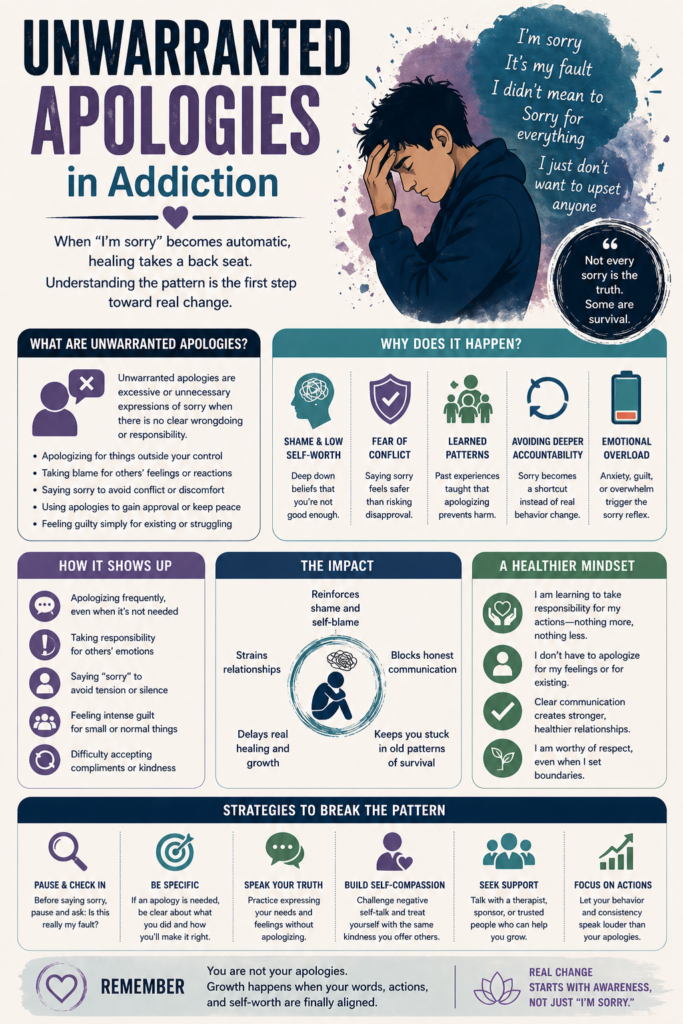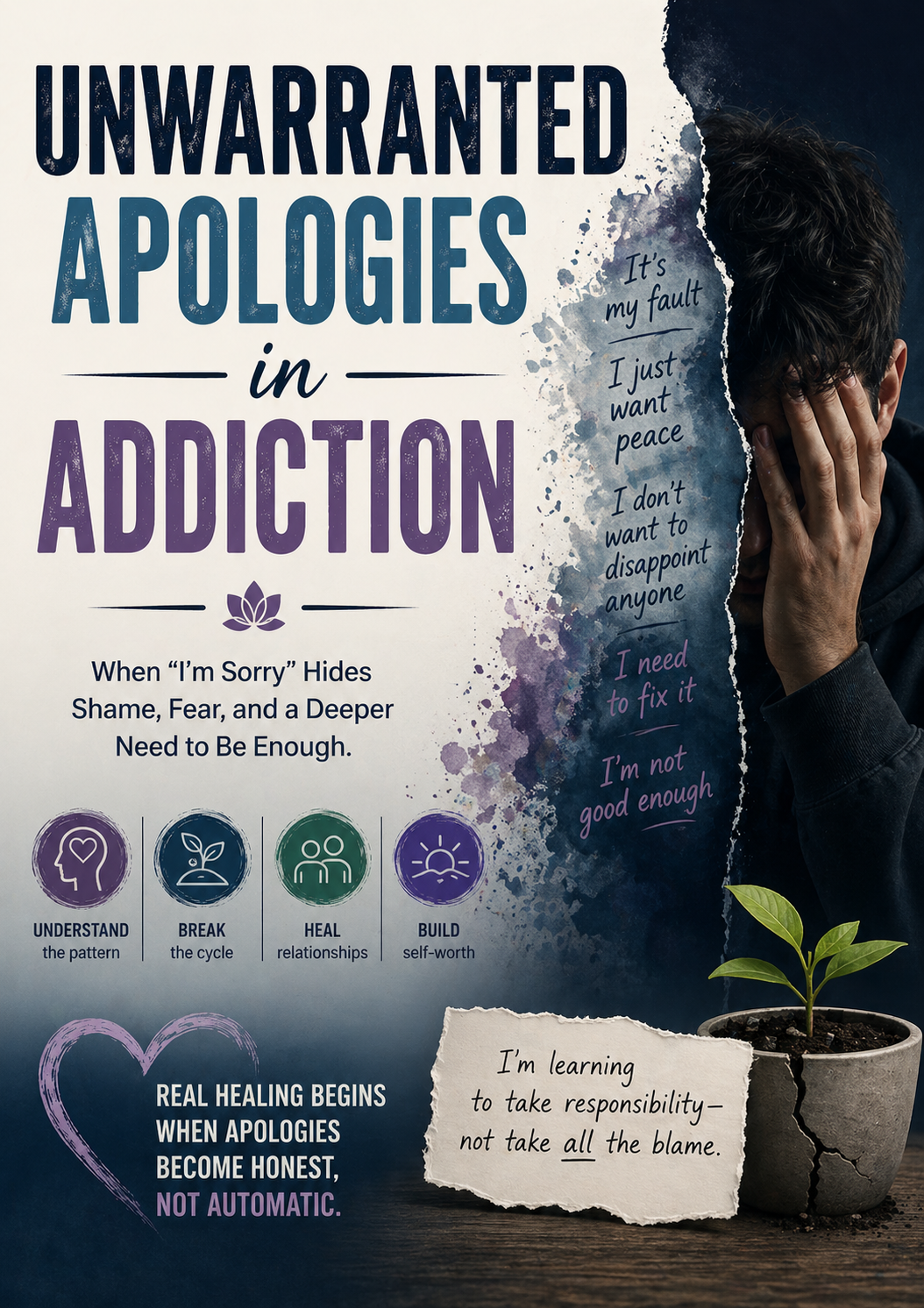
In the context of addiction and recovery, apologies are often seen as necessary steps toward accountability and repairing relationships. However, not all apologies reflect genuine responsibility. Unwarranted apologies in addiction—those given excessively, automatically, or without clear cause—can reveal deeper psychological patterns tied to shame, low self-worth, and emotional survival. Rather than signaling growth, these apologies may serve to manage discomfort, avoid conflict, or maintain a sense of control in uncertain situations. Understanding this behavior shifts the focus from simply hearing “I’m sorry” to examining why the apology is happening in the first place.
Sorry Isn’t the Solution: Unwarranted Apologies in Addiction
Apologizing is often seen as a sign of accountability, empathy, and growth—especially in the context of addiction and recovery. But what happens when apologies are given without true responsibility? When “I’m sorry” becomes automatic, excessive, or misplaced, it can shift from a meaningful act into a subtle barrier to real healing. This pattern—unwarranted apologies in addiction—reflects a deeper psychological dynamic where guilt, shame, and identity become entangled.
In these cases, apologizing isn’t always about making things right. Sometimes, it’s about managing discomfort, avoiding conflict, or preserving a fragile sense of self.
What Are Unwarranted Apologies in Addiction?
Unwarranted apologies occur when someone:
- Apologizes for things outside their control
- Takes responsibility for others’ emotions or reactions
- Says “sorry” to diffuse tension rather than address issues
- Uses apologies as a substitute for meaningful change
- Feels compelled to apologize simply for existing or struggling
In addiction, this can become a learned pattern—especially if the individual has internalized blame or developed a heightened sensitivity to conflict.
Why Do They Happen?
Unwarranted apologies don’t come from nowhere. They are often rooted in deeper emotional and psychological experiences.
1. Shame vs. Guilt
Healthy guilt says, “I did something wrong.”
Shame says, “I am doing something wrong.”
When shame dominates, apologies become constant because the person feels inherently at fault—even when they’re not.
2. People-Pleasing and Fear of Conflict
Many individuals in addiction develop people-pleasing tendencies:
- Avoiding confrontation
- Trying to maintain approval
- Prioritizing others’ comfort over truth
Apologizing becomes a quick way to reduce tension—even if it’s not warranted.
3. Learned Behavior from Past Environments
In some family or social environments, individuals may have:
- Been blamed unfairly
- Had to “keep the peace.”
- Learned that apologizing prevents escalation
These patterns can carry into addiction and recovery.
4. Avoidance of Deeper Accountability
Ironically, excessive apologizing can sometimes replace real accountability.
Saying “sorry” repeatedly may:
- Create the illusion of change
- Delay difficult conversations
- Prevent deeper self-examination
In this way, apologies become a form of emotional avoidance.
How This Impacts Recovery
While accountability is essential in recovery, unwarranted apologies can:
- Reinforce low self-worth
- Blur the line between responsibility and over-responsibility
- Frustrate relationships when apologies lack follow-through
- Prevent honest communication
- Keep individuals stuck in cycles of shame rather than growth
True recovery requires clarity, not constant self-blame.
What Healthy Accountability Looks Like
There’s a clear difference between meaningful accountability and habitual apologizing:
- Unwarranted apology: “I’m sorry for everything.”
- Healthy accountability: “I take responsibility for this specific action, and here’s how I’m working to change it.”
Healthy accountability is:
- Specific
- Action-oriented
- Grounded in reality
- Free from excessive self-criticism
Breaking the Pattern
Shifting away from unwarranted apologies takes awareness and practice.
1. Pause Before Saying “Sorry.”
Ask yourself:
- Did I actually do something wrong?
- Am I responsible for this situation?
2. Replace Apologies with Clarity
Instead of apologizing automatically:
- Express your needs
- Acknowledge feelings without taking blame
- Set boundaries when appropriate
3. Address Shame Directly
Work on separating identity from behavior:
- You are not your addiction
- You are not every mistake you’ve made
4. Focus on Action, Not Just Words
If an apology is needed, pair it with:
- Changed behavior
- Consistency over time
- Honest communication
5. Seek Support
Therapy, recovery groups, or trusted individuals can help unpack:
- Where the pattern started
- How to build healthier responses
The Bigger Picture
Unwarranted apologies in addiction highlight a powerful truth: not all “sorrys” are healing. Some are protective, automatic, or even avoidant. While they may ease tension in the moment, they can quietly reinforce the very patterns that recovery is trying to break.
Conclusion
Recovery isn’t about apologizing for everything—it’s about understanding what truly belongs to you, and what doesn’t.
Sometimes, healing begins not with saying “I’m sorry,” but with learning when you don’t have to.
Beyond “I’m Sorry”: Self-Management Strategies for Understanding Unwarranted Apologies in Addiction
In the journey of addiction and recovery, apologizing often becomes second nature. For some, “I’m sorry” is used frequently—sometimes even when no real wrongdoing has occurred. While accountability is an important part of healing, unwarranted apologies can signal something deeper: patterns of shame, over-responsibility, and emotional self-protection.
Understanding and changing this pattern doesn’t come from simply “stopping” the behavior. It requires intentional self-management—learning to recognize why the apology happens and how to respond differently.
Understanding the Pattern Before Managing It
Unwarranted apologies often serve a purpose, even if it’s not obvious. They can:
- Reduce anxiety in uncomfortable moments
- Prevent conflict or rejection
- Create a sense of control in uncertain situations
- Mask deeper feelings like shame or insecurity
In addiction, where emotions can feel intense or overwhelming, these apologies become a coping strategy—even if they are not helpful long-term.
👉 Self-management starts with recognizing: “This behavior is meeting a need—what is it?”
1. Build Awareness of Your “Sorry Reflex.”
Before changing the habit, you have to notice it.
Try this:
- Track when you say “sorry” throughout the day
- Identify triggers (conflict, silence, discomfort, perceived disapproval)
- Notice your thoughts right before apologizing
Ask yourself:
- Did I actually do something wrong?
- Or am I trying to manage a feeling?
Awareness turns an automatic reaction into a conscious choice.
2. Pause and Create a Response Gap
Unwarranted apologies are often impulsive. Creating a small pause can interrupt the cycle.
Practice:
- Take a breath before responding
- Count to three silently
- Allow yourself a moment to assess the situation
This pause helps you shift from reaction → intention.
3. Separate Responsibility from Emotion
One of the biggest challenges is confusing feelings with responsibility.
- Feeling uncomfortable ≠ doing something wrong
- Someone else being upset ≠ is your fault
A helpful reframe:
👉 “What am I actually responsible for here?”
This builds clarity and reduces over-apologizing.
4. Replace Apologies with More Accurate Language
Instead of defaulting to “sorry,” practice alternative responses:
- “Thank you for your patience.”
- “I understand that was frustrating.”
- “Let me clarify what I meant.”
- “I appreciate you bringing that up.”
These responses maintain respect without unnecessary self-blame.
5. Address Underlying Shame
Unwarranted apologies are often rooted in shame—the belief that something is inherently wrong with you.
Self-management includes:
- Challenging negative self-talk
- Practicing self-compassion
- Separating identity from behavior
👉 You are responsible for your actions—not your existence.
6. Tolerate Discomfort Without Fixing It Immediately
Apologizing can be a way to quickly “fix” tension. But not all discomfort needs immediate resolution.
Practice sitting with:
- Silence
- Disagreement
- Uncertainty
This builds emotional resilience and reduces the urge to over-apologize.
7. Align Words with Actions
When an apology is appropriate, make it meaningful:
- Be specific about what you’re apologizing for
- Focus on behavior, not identity
- Follow through with the change
This shifts apologies from habit → accountability.
8. Create Supportive Feedback Loops
Sometimes others can help you notice patterns you miss.
Consider:
- Asking a trusted person to gently point out over-apologizing
- Discussing patterns in therapy or recovery groups
- Reflecting on conversations afterward
External insight can strengthen internal awareness.
The Bigger Picture
Unwarranted apologies in addiction are not just about words—they reflect how a person relates to responsibility, identity, and emotional safety. Self-management is about retraining that relationship.
It’s not about becoming less accountable—it’s about becoming accurately accountable.
Conclusion
You don’t need to apologize for everything to be worthy of understanding or connection.
Recovery includes learning not just when to say “I’m sorry”—but also when to say something else, or nothing at all.
When “Sorry” Isn’t the Answer: Family Support Strategies for Unwarranted Apologies in Addiction
In addiction and recovery, families often expect to hear apologies—and for good reason. Accountability is an important part of healing relationships. But sometimes, what shows up instead is something different: constant, automatic, or unwarranted apologies. “I’m sorry” is repeated in moments when no clear harm was done, or used reflexively to ease tension rather than address reality.
For families, this can be confusing. It may seem like progress on the surface, but over time, it can feel empty, frustrating, or even concerning. Understanding this pattern is key. Unwarranted apologies in addiction are often not about responsibility—they’re about emotional survival.
Understanding What’s Behind the Apology
Before responding, it helps to recognize what the apology might actually mean.
When someone over-apologizes, they may be:
- Trying to avoid conflict or rejection
- Managing anxiety or discomfort in the moment
- Acting from deep-seated shame or low self-worth
- Repeating patterns learned in past environments
- Substituting words for deeper emotional work
👉 In many cases, “I’m sorry” really means: “I don’t feel safe,” “I don’t want to upset you,” or “I don’t know what else to say.”
This shifts the focus from correcting the words to understanding the need behind them.
1. Don’t Reinforce Automatic Apologies
It’s easy to respond to every apology with reassurance (“It’s okay,” “Don’t worry about it”), but this can unintentionally reinforce the habit.
Instead:
- Gently acknowledge without validating the unnecessary blame
- Redirect the conversation toward what actually matters
Example:
- Instead of: “It’s okay, don’t apologize.”
- Try: “You don’t need to apologize for that—let’s just talk about what’s going on.”
2. Help Differentiate Responsibility from Emotion
Families can play a key role in helping clarify what the person is actually responsible for.
You might say:
- “I don’t think this is something you need to take blame for.”
- “I hear that you’re feeling uncomfortable, but that doesn’t mean you did something wrong.”
This helps separate feeling bad from being at fault—a distinction that is often blurred.
3. Model Healthy Communication
People often mirror the communication styles around them.
Families can model:
- Clear, direct language instead of over-apologizing
- Accountability when it’s appropriate
- Emotional expression without self-blame
For example:
- “I felt frustrated earlier, but I’m not blaming you—I just want to talk about it.”
This creates a new template for interaction.
4. Focus on Behavior, Not Just Words
If apologies are frequent but change is limited, shift the focus:
- Encourage action over repetition
- Reinforce follow-through rather than verbal remorse
- Recognize effort and growth, even in small steps
Example:
- “I appreciate you saying that—what matters most to me is what we do moving forward.”
5. Create Emotional Safety in the Relationship
Over-apologizing often comes from fear—fear of conflict, rejection, or disappointment.
Families can reduce this by:
- Responding calmly rather than reactively
- Avoiding harsh criticism or shaming language
- Showing consistency and reliability
When someone feels safe, they’re less likely to rely on apology as a defense.
6. Gently Challenge Patterns When They Appear
Avoid ignoring the pattern completely. Instead, address it with care:
- “I notice you apologize a lot, even when it’s not necessary.”
- “You don’t have to take responsibility for everything.”
This brings awareness without judgment.
7. Encourage Deeper Emotional Expression
Help shift from automatic apologies to more meaningful communication:
- “What are you feeling right now?”
- “What’s going on for you in this moment?”
This invites honesty instead of reflex.
8. Support Professional and Peer Guidance
Unwarranted apologies often connect to deeper issues like shame, trauma, or people-pleasing patterns.
Encourage support through:
- Therapy or counseling
- Recovery groups
- Skills-based programs focused on communication and self-worth
External support can help unpack patterns that are hard to change within family dynamics alone.
The Bigger Picture
Unwarranted apologies in addiction are not just about words—they reflect how a person sees themselves. When someone believes they are always at fault, apologizing becomes a way of navigating the world.
Families don’t need to eliminate apologies—but they can help reshape them into something more meaningful, grounded, and honest.
Conclusion
Not every “I’m sorry” is about accountability. Sometimes, it’s about fear, habit, or learned survival.
Family support isn’t about correcting every apology—it’s about helping the person learn when they don’t need to apologize at all… and when something deeper needs to be said instead.
Beyond “Sorry”: Community Resource Strategies for Addressing Unwarranted Apologies in Addiction
In addiction and recovery spaces, apologies are often expected—and sometimes necessary. But within many communities, a different pattern quietly emerges: individuals who apologize constantly, even when they are not at fault. These unwarranted apologies are not just habits; they are often rooted in shame, trauma, and learned survival behaviors.
For communities—whether recovery groups, treatment centers, or local support networks—this presents an important challenge. The goal is not to eliminate apologies, but to help individuals understand when they are appropriate, and when they reflect deeper emotional struggles. Community resources play a critical role in reshaping this pattern through education, environment, and support.
Understanding the Role of Community
Communities influence how people interpret their behavior. They shape:
- What accountability looks like
- How safe does it feel to express emotions
- Whether individuals feel valued beyond their mistakes
If a community unintentionally reinforces excessive guilt or over-responsibility, unwarranted apologies can persist. But when communities promote balanced accountability and emotional safety, they can help break the cycle.
1. Normalize Conversations About Over-Apologizing
Many individuals don’t realize their apologies are excessive or misplaced.
Community resources can:
- Incorporate discussions about over-apologizing into recovery education
- Highlight the difference between accountability and self-blame
- Use relatable examples to make the pattern visible
Awareness is the first step toward change.
2. Teach Clear Definitions of Responsibility
Confusion about responsibility often drives unnecessary apologies.
Programs and workshops can focus on:
- What individuals are actually responsible for
- How to differentiate personal actions from others’ reactions
- The difference between intent and impact
Providing this clarity helps individuals respond more accurately to situations.
3. Create Safe Spaces for Honest Communication
If people feel judged or unsafe, they are more likely to rely on automatic apologies.
Communities can foster safety by:
- Encouraging open, non-judgmental dialogue
- Avoiding shaming language or harsh corrections
- Allowing individuals to express uncertainty without pressure
Safety reduces the need for apology as a defense mechanism.
4. Model Healthy Communication Within Groups
Facilitators, peer leaders, and members all influence group dynamics.
Healthy modeling includes:
- Using direct, respectful language instead of over-apologizing
- Demonstrating appropriate accountability when necessary
- Responding to others’ apologies with guidance rather than reinforcement
Example:
- “You don’t need to apologize for sharing that—thank you for being honest.”
This helps reshape norms within the group.
5. Shift Focus from Words to Behavior
Communities can gently redirect attention away from repeated apologies toward meaningful action.
This might include:
- Encouraging goal-setting and follow-through
- Recognizing behavioral change rather than verbal remorse
- Reinforcing effort, growth, and consistency
This supports a transition from habitual apology → intentional accountability.
6. Integrate Emotional Skills Training
Unwarranted apologies are often tied to difficulty managing emotions.
Community programs can include:
- Emotional regulation strategies
- Assertiveness and boundary-setting skills
- Self-compassion practices
These tools give individuals alternatives to apologizing as a coping mechanism.
7. Provide Peer Feedback and Reflection Opportunities
Peer environments are powerful for increasing awareness.
Communities can:
- Encourage respectful feedback among members
- Use group reflections to identify communication patterns
- Create opportunities for individuals to notice and discuss their habits
Hearing observations from peers can be more impactful than self-reflection alone.
8. Connect Individuals to Specialized Support
For some, unwarranted apologies are deeply rooted in trauma or long-standing beliefs.
Community resources should offer or refer to:
- Therapy or counseling
- Trauma-informed care
- Workshops focused on self-worth and identity
This ensures individuals receive support beyond surface-level behavior change.
The Bigger Picture
Unwarranted apologies in addiction are not just about communication—they reflect how individuals understand themselves in relation to others. Communities have the power to either reinforce these patterns or help transform them.
By shifting from a culture of constant remorse to one of balanced accountability and self-awareness, communities can create environments where real healing is possible.
Conclusion
A strong community doesn’t just teach people how to say “I’m sorry.”
It teaches them when they don’t need to—and helps them find the words, confidence, and clarity to express something more honest instead.
Frequently Asked Questions
Here are some common questions:
1. What are unwarranted apologies in addiction?
Unwarranted apologies are apologies given without clear responsibility or wrongdoing. In addiction, this often shows up as saying “I’m sorry” automatically—even when the situation doesn’t call for it.
2. Why do people in addiction apologize so much?
Excessive apologizing is often driven by:
- Shame (“Something is wrong with me”)
- Fear of conflict or rejection
- Low self-worth
- Learned behavior from past environments
It becomes a way to reduce emotional discomfort, not necessarily to take responsibility.
3. Is over-apologizing a sign of progress in recovery?
Not always. While some apologies reflect accountability, unwarranted apologies can:
- Mask deeper issues
- Replace meaningful change
- Reinforce negative self-beliefs
True progress involves accurate accountability, not constant self-blame.
4. What’s the difference between guilt and shame?
- Guilt: “I did something wrong” (can lead to healthy change)
- Shame: “I am doing something wrong” (leads to over-apologizing and self-blame)
Unwarranted apologies are often rooted more in shame than guilt.
5. How can you tell if an apology is unwarranted?
Ask:
- Did I actually do something wrong?
- Am I responsible for this situation?
- Am I apologizing to ease tension rather than take accountability?
If the answer is no, the apology may be unnecessary or habitual.
6. Can over-apologizing be a coping mechanism?
Yes. It can function as a way to:
- Avoid conflict
- Keep relationships stable
- Reduce anxiety
- Maintain a sense of control
However, it often prevents deeper emotional processing.
7. How does this affect relationships?
It can create:
- Frustration (apologies without change)
- Confusion about responsibility
- Imbalanced dynamics (one person taking too much blame)
- Reduced authenticity in communication
Healthy relationships require clarity, not constant apology.
8. Why is this pattern common in addiction?
Addiction often involves:
- High levels of shame
- Unstable relationships
- Emotional dysregulation
- Past environments where blame was misplaced
These factors make over-apologizing feel like a safer default response.
9. How can someone start reducing unwarranted apologies?
- Pause before saying “sorry.”
- Identify if responsibility is واقعی
- Replace apologies with clearer statements (e.g., “I understand,” “Thank you”)
- Work on underlying self-worth and emotional regulation
Small awareness-based changes make a big difference.
10. What should you say instead of “I’m sorry”?
Depending on the situation:
- “Thank you for your patience.”
- “I understand how that felt.”
- “Let me explain what I meant.”
- “I appreciate you bringing that up.”
These responses maintain connection without unnecessary self-blame.
11. How can families respond to excessive apologizing?
- Don’t automatically accept or reinforce every apology
- Gently point out when it’s not needed
- Encourage honest communication instead
- Focus on behavior and emotional expression
Support should promote clarity, not guilt.
12. Can therapy help with this pattern?
Yes. Therapy can help:
- Identify where the pattern started
- Address shame and trauma
- Build healthier communication skills
- Develop a more balanced sense of responsibility
13. Is it wrong to apologize in recovery?
Not at all. Apologies are important when:
- They are specific and genuine
- They acknowledge real impact
- They are followed by consistent change
The goal is not fewer apologies—it’s more accurate ones.
14. What is the long-term goal?
To shift from:
👉 “I’m sorry for everything.”
to
👉 “I take responsibility for what’s actually mine.”
This builds self-respect, clearer relationships, and healthier recovery.
15. What’s the first step toward change?
Awareness.
Noticing:
👉 “I just apologized… did I need to?”
That moment of reflection is where the pattern begins to shift.
Conclusion
Unwarranted apologies in addiction highlight the complex relationship between accountability, identity, and emotional regulation. While taking responsibility is a vital part of recovery, over-apologizing can blur the line between healthy guilt and harmful self-blame, ultimately hindering genuine progress. Recognizing this pattern allows individuals, families, and communities to move toward more balanced communication—where responsibility is clear, emotions are expressed honestly, and self-worth is not defined by constant fault. True healing is not measured by how often someone says “I’m sorry,” but by their ability to understand what they are truly responsible for—and what they are not.
Video: Stop Saying Sorry and Start This Instead #healing #recovery