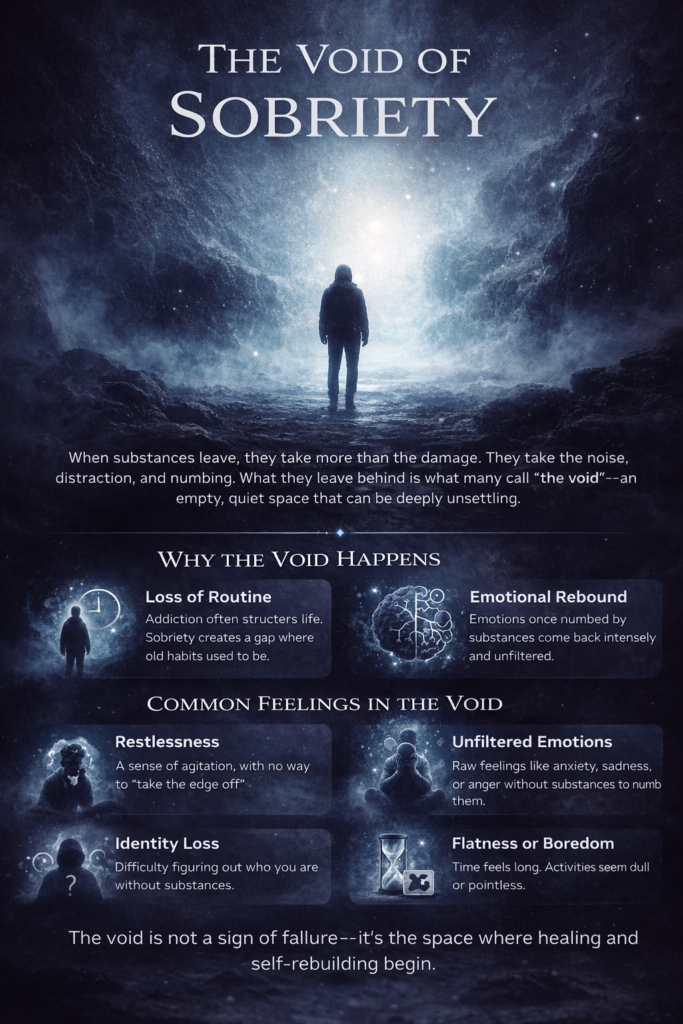
The transition into sobriety is often framed as a turning point toward clarity, stability, and control. While this is true, it also introduces a lesser-discussed experience: the void. This void represents the emotional, psychological, and behavioral space left behind when substances are removed. What once served as a coping mechanism, routine, or source of stimulation is suddenly absent, leaving individuals to confront unfiltered thoughts, emotions, and time. Understanding the void of sobriety is essential, not as a sign of failure or weakness, but as a natural and necessary phase in the process of recovery and self-redefinition.
The Void of Sobriety: Learning to Live in the Quiet
Sobriety is often described as freedom—and in many ways, it is. Freedom from chaos, from consequences, from the constant chase. But there’s a part of sobriety that doesn’t get talked about enough: the void.
When substances leave, they don’t just take the damage with them. They also take the noise, the distraction, the artificial highs and lows that once filled every corner of the day. What’s left can feel like an unsettling stillness. For many people, that silence isn’t peaceful at first—it’s loud in its own way.
The Shock of Emptiness
Addiction often structures life more than people realize. It dictates routines, social circles, emotional regulation—even identity. When it’s gone, there’s a gap where something constant used to be. Hours feel longer. Thoughts feel sharper. Emotions show up unfiltered.
This is the void of sobriety—not just the absence of substances, but the absence of what they once provided: escape, numbing, stimulation, or relief.
Why the Void Feels So Intense
From a psychological standpoint, substances often act as a coping mechanism. They dampen distress, elevate mood, or interrupt intrusive thoughts. Without them, the brain has to relearn how to regulate itself.
At the same time, the reward system—which had adapted to artificial stimulation—now has to recalibrate. Every day experiences can feel flat or underwhelming for a while. This isn’t failure; it’s neurobiology adjusting.
But beyond biology, there’s something more human: when you stop escaping, you start encountering yourself.
Sitting With What Was Avoided
Sobriety doesn’t just remove substances—it reveals what they were covering. That might include anxiety, unresolved trauma, loneliness, or even a simple discomfort with stillness.
The void can feel like:
- Restlessness with nowhere to put your energy
- Emotional swings that seem disproportionate
- A sense of identity loss (“Who am I without this?”)
- Boredom that feels heavier than it should
These experiences are common, but they’re also temporary states—not permanent traits.
Reframing the Void
What feels like emptiness is also space.
Space to rebuild routines that aren’t driven by urgency or craving.
Space to rediscover interests that weren’t filtered through substance use.
Space to develop emotional regulation in a way that actually lasts.
The void isn’t just something to endure—it’s something to shape.
Filling the Space Intentionally
Recovery isn’t about replacing one dependency with another; it’s about learning how to live without needing constant escape. That takes time, and it often looks like trial and error.
Some ways people begin to work with the void include:
- Creating structure (even simple daily routines)
- Finding grounding activities—exercise, journaling, or creative outlets
- Building connections that aren’t centered around substance use
- Developing tolerance for discomfort instead of avoiding it
None of these eliminates the void overnight. But they start to give it form.
The Shift Over Time
What begins as emptiness doesn’t stay empty forever. Slowly, the quiet becomes less threatening. The emotional intensity evens out. Moments of genuine satisfaction—subtle at first—start to return.
Eventually, the void transforms. It becomes less like a hollow space and more like open ground.
Not filled with chaos. Not crowded with noise. Just steady.
Conclusion
The void of sobriety isn’t a sign that something is missing—it’s a sign that something new hasn’t been built yet.
And while that space can feel uncomfortable, even unbearable at times, it’s also where real change begins.
Navigating the Void: Self-Management Strategies in Sobriety
Sobriety isn’t just about stopping substance use—it’s about learning how to live in the space that’s left behind. That space, often described as the void, can feel unfamiliar, uncomfortable, and at times overwhelming. It’s where old coping mechanisms no longer exist, but new ones haven’t fully formed yet.
Understanding how to manage this phase is essential. The void isn’t a failure of recovery—it’s a critical transition point.
Understanding the Void as a Transition
When substances are removed, the brain and body begin adjusting. Patterns that once revolved around use disappear, leaving gaps in routine, identity, and emotional regulation.
This can show up as:
- Restlessness or agitation
- Emotional intensity (irritability, sadness, anxiety)
- A sense of emptiness or lack of purpose
- Difficulty experiencing pleasure
These reactions are not random—they reflect both psychological adjustment and neurological recalibration. Recognizing this can reduce self-judgment and help you approach the experience more strategically.
Why Self-Management Matters
Without intentional strategies, the discomfort of the void can lead to relapse—not because someone wants to return to substance use, but because they want relief.
Self-management is about creating stability where there currently isn’t any. It helps shift you from reacting to discomfort → to responding with structure and awareness.
Core Self-Management Strategies
1. Build Structure Before You Feel Ready
One of the biggest challenges in sobriety is unstructured time. The brain, used to stimulation, interprets empty time as distress.
Start small:
- Set consistent wake/sleep times
- Plan 2–3 anchor activities per day
- Use simple routines (morning coffee, evening walk)
Structure reduces decision fatigue and gives the day a predictable rhythm—even when motivation is low.
2. Learn Emotional Regulation (Not Avoidance)
Substances often functioned as a fast way to regulate emotions. Without them, feelings can feel amplified.
Instead of escaping emotions, practice:
- Naming what you feel (“This is anxiety, not danger”)
- Using grounding techniques (breathing, cold water, movement)
- Letting emotions pass without immediate action
This builds tolerance—the ability to experience discomfort without needing to eliminate it instantly.
3. Rewire Reward Gradually
Early sobriety can feel “flat” because the brain’s reward system is recalibrating. Activities that once felt enjoyable may seem dull.
Focus on:
- Low-effort, repeatable activities (walking, music, simple hobbies)
- Consistency over intensity
- Celebrating small wins (showing up, completing tasks)
Over time, the brain begins responding to natural rewards again—but it requires repetition.
4. Replace, Don’t Just Remove
Eliminating substance use creates a gap—not just physically, but behaviorally.
Ask:
- What need was this meeting for? (escape, stimulation, connection)
- What healthier alternative can meet part of that need?
Examples:
- Stress → exercise or journaling
- Loneliness → structured social contact
- Boredom → skill-building or creative outlets
The goal isn’t a perfect replacement—it’s a functional one.
5. Redefine Identity
A common challenge in the void is the question: Who am I without this?
Instead of trying to answer it all at once:
- Focus on actions, not labels
- Build identity through repetition (“I’m someone who shows up”)
- Allow identity to evolve over time
Identity in recovery is built—not discovered overnight.
6. Manage Triggers Proactively
Triggers don’t disappear in sobriety—they become more visible.
Strategies include:
- Avoiding high-risk environments early on
- Planning responses before triggers happen
- Using “pause strategies” (delay, distract, reach out)
Preparation reduces impulsive decisions in high-emotion moments.
7. Use Support Systems Strategically
Self-management doesn’t mean doing everything alone.
Support can include:
- Therapy or counseling
- Peer recovery groups
- Trusted friends or accountability partners
External support provides perspective when internal regulation is still developing.
The Long-Term Shift
The void doesn’t stay empty. With consistent self-management:
- Emotional intensity stabilizes
- Natural motivation returns
- Daily life becomes less effortful
What once felt like emptiness becomes space—space that you’ve actively shaped.
Conclusion
The void of sobriety is not something to eliminate—it’s something to understand and work with.
Self-management turns that space from something that feels like a loss into something you can build on.
Holding Space: Family Support Strategies for the Void of Sobriety
When someone enters sobriety, the focus is often on stopping substance use. But what follows is less visible and often more complex: the void. This is the space left behind when substances—and the roles, routines, and coping they provided—are gone. For the person in recovery, that space can feel disorienting. For families, it can be confusing, even discouraging.
Understanding the void changes how support is given. It shifts the question from “Why aren’t things better yet?” to “How can we help them build something new?”
Understanding the Void as a Family
From the outside, sobriety can look like a clear improvement. But internally, your loved one may be dealing with:
- Emotional intensity that was previously numbed
- Boredom or restlessness that feels overwhelming
- A loss of identity tied to substance use
- Difficulty finding pleasure in everyday life
This isn’t a lack of effort—it’s a transition. The brain and behavior patterns are recalibrating, and that takes time.
Why Family Support Matters
The void is often where relapse risk is highest—not because of a desire to return to old habits, but because of the discomfort of nothingness. Families can play a key role in reducing that risk by helping create stability, connection, and understanding during this phase.
Support doesn’t mean controlling or fixing—it means being consistent, informed, and intentional.
Core Family Support Strategies
1. Normalize the Experience Without Minimizing It
Let your loved one know that what they’re feeling is common in early sobriety. At the same time, avoid dismissing their experience.
Instead of:
- “You should feel better by now.”
Try:
- “I know this phase can feel really empty. I’m here with you while you figure it out.”
Validation reduces isolation, which is a major trigger for relapse.
2. Support Structure, Not Pressure
Unstructured time can intensify the void. Families can help by encouraging routine—but not enforcing it rigidly.
Helpful approaches:
- Invite them into shared daily activities (meals, walks)
- Encourage small, manageable plans
- Avoid overwhelming them with expectations
Consistency creates a sense of safety without adding stress.
3. Shift from Monitoring to Connection
It’s natural to want to watch for signs of relapse. But constant monitoring can feel like mistrust and increase emotional distance.
Instead:
- Focus on regular, low-pressure check-ins
- Ask open-ended questions (“How has today been for you?”)
- Listen more than you advise
Connection builds trust, which is more protective than surveillance.
4. Learn Emotional Boundaries
Supporting someone in the void can be emotionally draining. Families may feel responsible for “fixing” the discomfort—but that’s not sustainable.
Healthy boundaries include:
- Recognizing what you can and cannot control
- Avoiding taking on their emotions as your own
- Maintaining your own routines and well-being
Support works best when it’s steady—not depleted.
5. Encourage Healthy Coping—Gently
Your loved one may not immediately know how to fill the void. You can help by offering options without forcing them.
Examples:
- Suggest activities: “Want to go for a walk together?”
- Share resources: therapy, support groups
- Model coping skills in your own behavior
The goal is exposure, not pressure.
6. Be Patient with Emotional Fluctuations
Early sobriety can come with mood swings, irritability, or withdrawal. This isn’t necessarily a setback—it’s part of the development of emotional regulation.
What helps:
- Not taking reactions personally
- Staying calm during emotional spikes
- Responding consistently rather than reactively
Over time, these fluctuations tend to stabilize.
7. Celebrate Progress That Isn’t Obvious
Progress in the void is often subtle. It may not look like happiness yet—it may look like persistence.
Acknowledge:
- Showing up each day without using
- Trying new coping strategies
- Being honest about struggles
Recognition reinforces effort, even when results are still forming.
The Family’s Role in the Long-Term Shift
As sobriety stabilizes, the void begins to change. What once felt empty starts to fill with routine, connection, and meaning.
Families who provide steady, nonjudgmental support help accelerate this shift—not by filling the space themselves, but by helping their loved one feel safe enough to build within it.
Conclusion
The void of sobriety isn’t just something your loved one experiences—it’s something the whole family learns to navigate.
You don’t have to have all the answers. What matters most is showing up with consistency, patience, and a willingness to understand that healing doesn’t happen all at once—but it does happen.
From Emptiness to Ecosystem: Community Resource Strategies for the Void of Sobriety
Sobriety creates space. At first, that space can feel like a void—quiet, unfamiliar, and hard to navigate. What used to fill the day—habits, routines, even social circles—may be gone. Community resources don’t just “add activities”; they create an ecosystem that supports stability, connection, and meaning while the brain and life structure recalibrate.
This isn’t about outsourcing recovery. It’s about building a network that makes it easier to live without constantly needing to escape.
Reframing the Void
The void isn’t a sign that something is missing—it’s a sign that something new hasn’t been built yet. Community resources help convert empty space into supported space:
- From isolation → connection
- From unstructured time → purposeful routine
- From overwhelm → guided coping
Core Community Resource Strategies
1. Recovery Groups: Structure + Shared Experience
Peer groups provide both routine and relatability. Whether it’s 12-step, SMART Recovery, or other peer-led formats, the value is twofold:
- Consistency: regular meeting times anchor the week
- Normalization: hearing others describe similar “void” experiences reduces shame
How to use them well:
- Start with 2–3 meetings per week for structure
- Try different formats to find a fit
- Focus on listening first; participation can come later
2. Outpatient Treatment & Counseling: Guided Skill-Building
Professional support helps translate the discomfort of the void into actionable skills:
- Emotional regulation (instead of avoidance)
- Trigger identification and planning
- Cognitive restructuring (challenging all-or-nothing thinking)
Options include individual therapy, group therapy, and intensive outpatient programs (IOPs).
Strategy tip: Treat sessions like “training,” not just talking—practice skills between visits.
3. Case Management & Social Services: Stabilize the Basics
Instability in housing, employment, or healthcare can intensify the void. Community services help secure the foundation:
- Housing assistance or sober living
- Job readiness programs
- Access to medical and mental health care
Why it matters: When basic needs are predictable, the nervous system has more capacity to handle emotional work.
4. Sober Living & Recovery Housing: Environment as Support
Living environments shape behavior. Recovery housing offers:
- Substance-free space
- Built-in accountability
- Daily structure (house meetings, curfews, responsibilities)
Best use: Consider this during early sobriety or after higher levels of care to bridge the transition back to independent living.
5. Community Centers & Skill Programs: Rebuilding Reward
Early sobriety can feel flat as the brain’s reward system recalibrates. Low-stakes activities help reintroduce natural reinforcement:
- Fitness classes, art workshops, music groups
- Adult education or certification programs
- Volunteering opportunities
Strategy tip: Prioritize consistency over intensity. Repetition is what retrains the reward system.
6. Faith-Based & Cultural Communities: Meaning + Belonging
For many, spiritual or cultural communities provide:
- A framework for meaning-making
- Rituals that replace old routines
- Intergenerational support and mentorship
Important: Fit matters—choose spaces that feel safe, not pressured.
7. Digital Resources: Support Between Appointments
When the void hits at 10 p.m., access matters. Online tools can fill gaps:
- Recovery apps (check-ins, tracking, coping prompts)
- Virtual meetings
- Crisis or peer support lines
Use intentionally: Set specific times or triggers for use (e.g., during cravings or late-night restlessness).
8. Peer Recovery Coaches: Practical Navigation
Coaches bridge the gap between clinical care and daily life:
- Help set realistic weekly plans
- Accompany to the first meetings or appointments
- Provide accountability without judgment
Think of it as having a guide while you learn the terrain.
Building Your Personal Resource Map
Not every resource fits every person. A simple way to start:
- Anchor (daily/weekly): 2–3 consistent commitments (e.g., meetings, class, therapy)
- Support (as-needed): hotline, coach, trusted group member
- Growth (weekly): one activity that builds skill or interest
- Stability (ongoing): housing, work, healthcare supports
Write it down. Treat it like a living plan you revise as your needs change.
Common Pitfalls (and How to Avoid Them)
- Overloading your schedule: Start small; add gradually
- Resource hopping: Give each option a fair trial (2–3 weeks)
- Passive participation: Engage just enough to feel connected
- All-or-nothing thinking: Missing a meeting isn’t failure—return next time
The Long-Term Shift
With time and repetition, the void changes:
- Routines become habits
- Connections become relationships
- Coping becomes automatic
What once felt like emptiness becomes a network you can rely on.
Conclusion
You don’t have to fill the void alone. Community resources don’t replace your effort—they multiply it. Used strategically, they turn empty space into supported ground, where stability, identity, and meaning can take root.
Frequently Asked Questions
Here are some common questions:
1. What is the “void of sobriety”?
The void of sobriety refers to the emotional, psychological, and behavioral emptiness that can occur after stopping substance use. It’s the space left behind when substances—along with the routines, coping mechanisms, and stimulation they provided—are removed.
2. Is it normal to feel empty after getting sober?
Yes, it is very common. Many people expect to feel immediately better in sobriety, but instead experience boredom, restlessness, or emotional intensity. This is a normal adjustment period, not a sign that recovery isn’t working.
3. Why does sobriety feel worse before it feels better?
Substances often suppress or artificially regulate emotions. Once they are removed, the brain and body must relearn how to manage emotions naturally. This can temporarily make feelings more intense or uncomfortable before stabilization occurs.
4. How long does the void last?
There is no fixed timeline. For some, it lasts weeks; for others, months. The duration depends on factors like length of substance use, mental health, environment, and access to support. However, the intensity typically decreases over time with consistent coping strategies.
5. Does feeling the void mean I’m at risk of relapse?
Not automatically—but it can increase vulnerability. The discomfort of the void can create urges to escape, which is why developing coping skills and support systems is important during this phase.
6. What emotions are common in the void?
People often experience:
- Anxiety or restlessness
- Irritability or anger
- Sadness or depression
- Boredom or lack of motivation
- A sense of identity confusion
These are part of emotional regulation, adjusting without substances.
7. Why do I feel bored all the time in sobriety?
Substances overstimulate the brain’s reward system. Without them, everyday activities may feel less rewarding at first. This is temporary—your brain is recalibrating to respond to natural sources of pleasure again.
8. How can I cope with the void?
Effective strategies include:
- Building daily structure and routine
- Practicing emotional regulation (not avoidance)
- Engaging in consistent, simple activities
- Seeking therapy or peer support
- Replacing old habits with healthier alternatives
The goal is not to eliminate the void instantly, but to learn how to function within it.
9. Why do I feel like I’ve lost part of my identity?
Substance use often becomes intertwined with identity, social life, and coping. When it’s removed, it can feel like a part of yourself is missing. Recovery involves gradually building a new identity based on values and actions rather than substances.
10. Can the void ever be a good thing?
Yes. While uncomfortable, the void creates space for growth. It allows you to rebuild routines, develop healthier coping skills, and form a more stable sense of self. Over time, it shifts from emptiness to opportunity.
11. Should I try to “fill” the void quickly?
Trying to fill it too quickly can lead to replacing one unhealthy behavior with another. Instead, focus on gradual, intentional changes. Let the space evolve rather than forcing it to disappear.
12. When should I seek professional help?
Consider seeking help if:
- The emptiness feels overwhelming or persistent
- You experience severe depression or anxiety
- You have strong urges to relapse
- You feel unable to function day-to-day
Professional support can provide tools and structure during this phase.
Conclusion
The void of sobriety is not an endpoint but a transition—a space where old patterns have been stripped away, and new ones have yet to fully take shape. Although it can feel uncomfortable, empty, or even overwhelming, it also holds the potential for growth, self-awareness, and lasting change. With time, support, and intentional coping strategies, this void begins to shift from something that feels like loss into something that offers possibility. Ultimately, learning to navigate this space is a critical step in building a stable, meaningful life beyond substance use.
Video: What sobriety actually feels like #truthtold #recovery