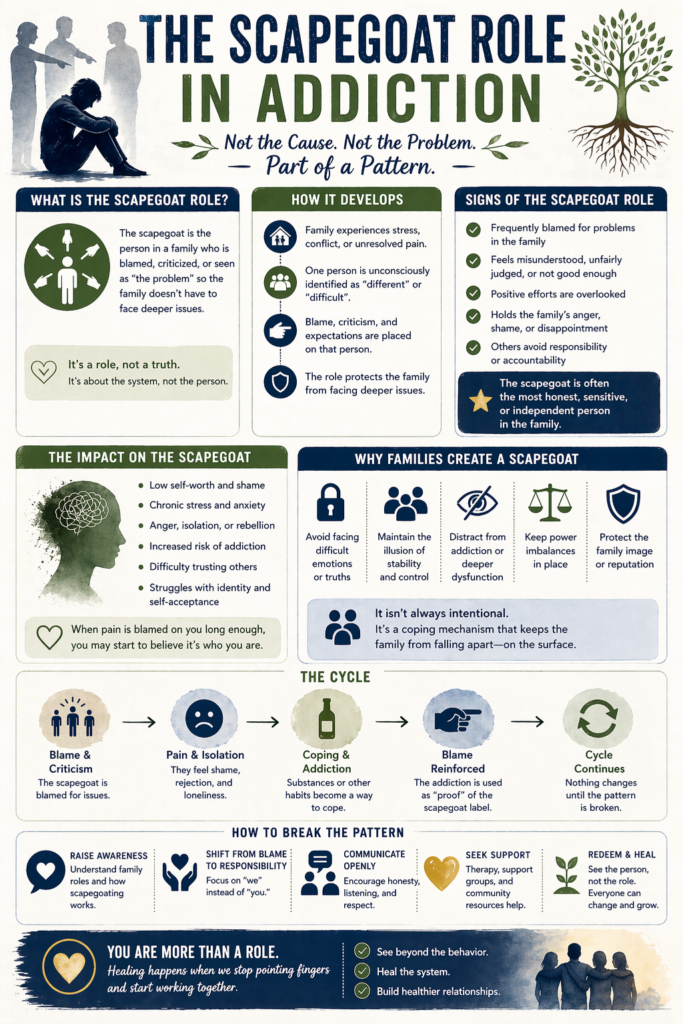
The scapegoat role in addiction is a powerful yet often misunderstood dynamic within families and social systems. It occurs when one individual is consistently blamed or labeled as “the problem,” while deeper, more complex issues—such as unresolved conflict, trauma, or patterns of substance use—remain unexamined. This role can shape not only how others perceive the individual, but also how they come to see themselves, often reinforcing cycles of shame, isolation, and unhealthy coping behaviors. Understanding this dynamic is essential for moving beyond surface-level blame and toward a more accurate and compassionate view of addiction.
The Scapegoat Role in Addiction: When One Person Carries the Family’s Pain
Addiction rarely exists in isolation. It often develops within a web of relationships, unspoken dynamics, and long-standing emotional patterns. One of the most misunderstood roles in this system is the scapegoat—the person who is blamed, labeled, or seen as “the problem,” while deeper issues within the family remain unaddressed.
Understanding the scapegoat role is not about assigning blame—it’s about uncovering how patterns form, and how they can be changed.
What Is the Scapegoat Role?
In family systems, the scapegoat is the individual who:
- Is frequently blamed for conflicts or dysfunction
- Becomes the focus of negative attention
- Is labeled as “difficult,” “rebellious,” or “the problem.”
This role often develops unconsciously. It serves a function: it allows the family to avoid confronting deeper emotional issues by projecting them onto one person.
How It Connects to Addiction
The scapegoat role and addiction are often closely linked.
This can show up in two main ways:
1. The scapegoat develops addiction
- Substance use becomes a coping mechanism for rejection, shame, or isolation
- The individual internalizes the belief: “I am the problem.”
- Addiction reinforces the family’s narrative, keeping the cycle going
2. The scapegoat is blamed for someone else’s addiction
- One person is held responsible for the tension in the family
- The focus shifts away from the actual addiction or underlying issues
- The real problem remains unaddressed
In both cases, the scapegoat carries more than their share of emotional weight.
Why Families Create a Scapegoat
This dynamic isn’t usually intentional—it’s protective.
Families may unconsciously:
- Avoid conflict by focusing on one person
- Maintain a sense of stability or control
- Deny deeper issues like trauma, dysfunction, or addiction
By labeling one person as “the issue,” the system avoids looking at itself.
The Emotional Impact on the Scapegoat
Being in this role can have long-term effects:
- Chronic shame or low self-worth
- Feeling misunderstood or isolated
- Anger, resentment, or emotional withdrawal
- Increased risk of substance use as a coping strategy
Over time, the identity of “the problem” can become deeply ingrained—even when it’s not accurate.
Signs of the Scapegoat Dynamic
- One person is consistently blamed, regardless of the situation
- Positive behaviors are overlooked or dismissed
- Family conflict centers around the same individual
- Other members avoid accountability
- The scapegoat feels like an outsider within their own family
These patterns are often subtle—but persistent.
Breaking the Pattern
Change begins with awareness.
For the individual:
- Recognize that the role was assigned—not earned
- Separate identity from family labels
- Seek support (therapy, recovery groups, trusted relationships)
For the family:
- Shift from blame to shared responsibility
- Address underlying issues (communication, trauma, addiction)
- Encourage open, honest conversations
- Avoid labeling or fixed roles
Breaking the pattern requires willingness from both sides—but even one person becoming aware can begin to shift the dynamic.
The Role of Recovery
In addiction recovery, addressing family roles is often essential. Without it:
- Old patterns can trigger relapse
- Shame and identity issues remain unresolved
With it:
- Individuals can rebuild a healthier sense of self
- Families can develop more balanced, supportive relationships
Recovery is not just about stopping substance use—it’s about changing the system that surrounds it.
Final Thought
The scapegoat role can make one person appear to carry all the problems—but in reality, they are often carrying the symptoms of a larger system.
When we move beyond blame and begin to understand the underlying dynamics, something important happens:
The focus shifts from “Who is the problem?” to “What needs to be healed?”
And that shift is where real change begins.
Breaking the Pattern Within: Self-Management Strategies to Understand the Scapegoat Role in Addiction
The scapegoat role in addiction is often deeply internalized. It’s not just about how others see you—it becomes how you see yourself. Over time, being labeled “the problem” can shape your thoughts, behaviors, and coping mechanisms, sometimes leading to or reinforcing substance use.
Self-management is a critical step in breaking this cycle. It helps you recognize the role, separate it from your identity, and begin responding to yourself—and your environment—differently.
Why Self-Management Matters
When you’ve been placed in the scapegoat role, your reactions are often automatic:
- Defensiveness
- Withdrawal
- Acting out or reinforcing the label
- Turning to substances to cope
Self-management helps you:
- Pause before reacting
- Understand what’s actually happening beneath the surface
- Make choices that align with your well-being—not the role
It shifts you from living the role → to understanding and stepping out of it.
1. Recognize the Role (Without Accepting It as Identity)
The first step is awareness.
Ask yourself:
- Am I consistently blamed, even when situations are complex?
- Do I feel labeled or misunderstood?
- Have I started to believe I’m “the problem”?
Important distinction:
- You may be in the scapegoat role
- You are not the scapegoat as a person
This separation is foundational.
2. Identify Emotional Triggers
The scapegoat role often comes with strong emotional reactions:
- Anger when blamed
- Shame or self-doubt
- Feeling isolated or rejected
Start noticing:
- What situations trigger these reactions?
- Who or what intensifies them?
- How do you usually respond?
Awareness reduces automatic behavior.
3. Interrupt Reactive Patterns
Without awareness, it’s easy to fall into predictable responses:
- Arguing or defending excessively
- Shutting down or withdrawing
- Using substances to cope
Try:
- Pausing before responding
- Taking a breath or stepping away
- Delaying your reaction, even briefly
Even small pauses create space for different choices.
4. Challenge Internalized Beliefs
The scapegoat role often leads to beliefs like:
- “I’m the problem.”
- “Nothing I do is enough.”
- “I’ll always be seen this way.”
Instead of accepting these as facts:
- Question them
- Look for evidence against them
- Replace them with more balanced perspectives
This isn’t about forced positivity—it’s about accuracy.
5. Separate Behavior from Identity
If substance use is involved, it can reinforce the scapegoat label.
Shift from:
- “I’m the problem.”
To:
- “I’m dealing with behaviors and patterns I can change.”
This creates room for growth instead of reinforcing shame.
6. Build Alternative Coping Micro-Habits
Substances are often used to cope with emotional pain tied to the role.
Replace with small, manageable alternatives:
- Writing down what you’re feeling
- Taking a short walk
- Talking to someone outside the family system
- Pausing and naming the emotion
These don’t eliminate pain—but they reduce reliance on harmful coping.
7. Set Internal Boundaries
You may not be able to change others immediately—but you can change how much you internalize.
Practice:
- Not absorbing every accusation
- Reminding yourself: “This is their perspective, not my identity.”
- Limiting emotional engagement in repeated blame cycles
Internal boundaries protect your sense of self.
8. Seek External Perspective
The scapegoat role is reinforced within a system, so it’s hard to see clearly from inside it.
Support can include:
- Therapy or counseling
- Recovery or support groups
- Trusted individuals outside the family
External perspectives help you reality-check what you’ve been told about yourself.
9. Focus on What You Can Control
You can’t control:
- Family narratives
- Others’ perceptions
- Past dynamics
You can control:
- Your responses
- Your coping strategies
- Your choices moving forward
This shift restores a sense of agency.
10. Redefine Your Identity Over Time
Stepping out of the scapegoat role is not immediate—it’s gradual.
It involves:
- Building new patterns
- Reinforcing healthier behaviors
- Creating experiences that contradict the old label
Identity changes through repeated action—not just insight.
Final Thought
The scapegoat role can feel permanent—but it isn’t. It’s a pattern shaped by systems, experiences, and repeated interactions—not a fixed truth about who you are.
Self-management is how you begin to break that pattern from the inside out.
It starts with awareness, grows through small changes, and strengthens with consistency.
Because you are not the role you were given.
You are the choices you begin to make beyond it.
From Blame to Balance: Family Support Strategies to Understand the Scapegoat Role in Addiction
Addiction within a family rarely affects just one person—it reshapes the entire system. One of the most common yet overlooked patterns is the scapegoat role, where one individual is blamed for the family’s struggles while deeper issues remain unaddressed. This dynamic can intensify shame, reinforce substance use, and prevent real healing from taking place.
Families play a critical role in either maintaining this pattern or breaking it. With awareness and intentional support, it’s possible to shift from blame to understanding—and from dysfunction to healthier connection.
Understanding the Scapegoat Role in the Family
The scapegoat is often:
- Labeled as “the problem.”
- Blamed for conflicts or tension
- Seen as the source of dysfunction
In the context of addiction, this can look like:
- One person is being blamed for all the family stress
- Substance use is being used as “proof” of the label
- Other underlying issues (communication, trauma, stress) are being ignored
This dynamic protects the system—but harms the individual.
Why Families Fall Into This Pattern
Scapegoating is rarely intentional. It often develops as a way to:
- Avoid difficult conversations
- Maintain a sense of control or stability
- Redirect attention away from shared issues
By focusing on one person, the family doesn’t have to confront the bigger picture.
1. Shift from Blame to Shared Responsibility
The most important change is moving away from:
- “Who caused this?”
Toward:
- “What’s happening in our system?”
Families can:
- Acknowledge that addiction is complex and multi-layered
- Recognize how each member contributes to the dynamic
- Avoid placing all responsibility on one person
This shift opens the door to real problem-solving.
2. Replace Labels with Curiosity
Labels like “addict,” “troublemaker,” or “the problem child” reinforce the scapegoat role.
Instead:
- Ask open-ended questions
- Try to understand the person’s experience
- Focus on behavior, not identity
Curiosity creates understanding—labels create distance.
3. Address the Whole System, Not Just the Individual
Focusing only on the scapegoated individual can keep the cycle going.
Families can:
- Explore communication patterns
- Identify sources of stress or conflict
- Recognize unspoken rules or roles
Healing happens when the system—not just the individual—changes.
4. Encourage Open and Safe Communication
In scapegoat dynamics, communication is often:
- Defensive
- Blame-focused
- Avoidant
Families can improve this by:
- Creating space for honest conversations
- Listening without interrupting or correcting
- Validating feelings even when addressing behavior
Safety in communication reduces the need for roles to persist.
5. Support Without Enabling
Supporting someone with addiction doesn’t mean ignoring harmful behavior.
Balance is key:
- Hold clear boundaries
- Avoid rescuing or covering up consequences
- Offer help that encourages accountability
This approach supports growth without reinforcing the role.
6. Recognize and Validate the Scapegoated Individual
Often, the scapegoated person feels:
- Misunderstood
- Isolated
- Defined by their mistakes
Families can:
- Acknowledge their strengths and efforts
- Recognize progress, even if small
- Separate the person from their behavior
Validation helps rebuild identity beyond the role.
7. Avoid Reinforcing Old Narratives
Even subtle comments can keep the role in place:
- “This always happens because of you.”
- “You’ve always been like this.”
Instead:
- Focus on present behavior
- Allow room for change
- Avoid bringing up past mistakes as identity markers
People can’t change if they’re constantly defined by the past.
8. Seek Family-Based Support
Breaking entrenched patterns is difficult without guidance.
Helpful options include:
- Family therapy
- Addiction recovery programs that include family involvement
- Support groups for families affected by addiction
These spaces provide tools for understanding and shifting dynamics.
9. Be Patient with the Process
Family roles don’t change overnight.
Expect:
- Resistance or discomfort
- Old patterns resurfacing
- Gradual progress rather than immediate transformation
Consistency matters more than speed.
10. Focus on Healing, Not Just Behavior
The ultimate goal isn’t just stopping substance use—it’s:
- Improving relationships
- Building trust
- Creating a healthier emotional environment
When the system heals, behavior often follows.
Final Thought
The scapegoat role can make it seem as though one person carries all the problems—but in reality, they often carry the symptoms of a larger family dynamic.
When families shift from blame to shared understanding, something powerful happens:
The focus moves from fixing a person to healing a system.
And that’s where lasting change begins—for everyone involved.
Beyond Blame: Community Resource Strategies to Understand the Scapegoat Role in Addiction
The scapegoat role in addiction is rarely created or maintained by one person alone—it is shaped by larger systems, including families, social environments, and communities. When one individual is consistently blamed or labeled as “the problem,” it can obscure deeper issues and delay meaningful recovery.
Community resources play a vital role in shifting this dynamic. They provide education, support, and alternative perspectives that help individuals and families move beyond blame toward understanding and healing.
Why Community Resources Matter
Scapegoating thrives in isolation and misunderstanding. Communities can interrupt this by:
- Offering education about addiction and family roles
- Providing neutral, outside perspectives
- Creating spaces where individuals feel seen beyond labels
These resources help reframe the narrative from “Who is the problem?” to “What patterns need to change?”
1. Community Education and Awareness Programs
Workshops and public health initiatives can help people understand:
- The concept of family roles in addiction (including the scapegoat)
- How blame-based thinking reinforces harmful cycles
- The emotional and psychological impact of labeling
These programs are often available through:
- Community centers
- Nonprofit organizations
- Local health departments
Education is often the first step in breaking unconscious patterns.
2. Peer Support and Recovery Groups
Support groups provide a powerful alternative to isolation.
They offer:
- Shared experiences that normalize feelings
- Insight into family dynamics from others who’ve lived it
- A space to rebuild identity outside of the scapegoat role
Groups such as recovery communities or family support networks help individuals realize:
- They are not alone
- Their role does not define them
3. Community Mental Health Services
Local clinics and counseling services can provide structured support for both individuals and families.
They help by:
- Identifying scapegoat dynamics within the family system
- Addressing underlying issues like trauma, communication breakdowns, or substance use
- Offering therapy that focuses on both individual healing and relational patterns
Professional guidance brings clarity to complex dynamics.
4. Family-Focused Programs and Workshops
Some community resources are designed specifically for families affected by addiction.
These programs:
- Teach healthier communication strategies
- Help redistribute responsibility within the family
- Encourage accountability without blame
They shift the focus from fixing one person to improving the entire system.
5. Faith-Based and Cultural Support Systems
For many individuals, healing happens within trusted cultural or spiritual communities.
These groups can:
- Provide mentorship and guidance
- Offer emotional and moral support
- Create a sense of belonging outside of family roles
When aligned with personal values, these supports can feel more accessible and meaningful.
6. Educational Resources for Professionals
Teachers, social workers, and community leaders often interact with individuals in scapegoat roles.
Training programs can help them:
- Recognize patterns of scapegoating
- Avoid reinforcing labels
- Respond with a more informed, trauma-aware approach
This broadens awareness beyond the family and into the wider community.
7. Safe Community Spaces for Identity Rebuilding
The scapegoat role often limits how a person sees themselves.
Community programs such as:
- Mentorship initiatives
- Skill-building workshops
- Recreational or creative groups
…allow individuals to:
- Explore new identities
- Build confidence outside of the “problem” label
- Experience acceptance and success in different environments
8. Coordinated Community Support
The most effective change happens when systems work together.
This can include collaboration between:
- Mental health services
- Recovery programs
- Schools or workplaces
- Family support networks
A coordinated approach ensures consistent messaging and reduces the chance of reinforcing old roles.
How to Use Community Resources Effectively
- Start with one trusted resource (support group, workshop, or counselor)
- Stay open to learning new perspectives
- Engage consistently, even in small ways
- Combine individual and family-focused supports when possible
You don’t need every resource—just the ones that help shift understanding and support growth.
Final Thought
The scapegoat role in addiction can make one person appear to carry all the blame—but in reality, they are often carrying the weight of a larger system.
Community resources help redistribute that weight by offering education, connection, and support beyond the family. They create opportunities to see the full picture—and to respond in ways that promote healing rather than reinforce harm.
Because lasting change doesn’t happen in isolation.
It happens when individuals, families, and communities begin to understand the system—and work together to change it.
Frequently Asked Questions
Here are some common questions:
1. What is the scapegoat role in addiction?
The scapegoat role refers to a family dynamic where one person is consistently blamed or labeled as “the problem,” often drawing attention away from deeper issues like addiction, conflict, or unresolved emotional pain.
2. Is the scapegoat always the person with the addiction?
No. Sometimes:
- The scapegoat develops the addiction as a way to cope
- Other times, the scapegoat is blamed for problems, even when someone else is struggling with addiction
The role is about blame, not necessarily behavior.
3. Why do families create a scapegoat?
Usually unconsciously, to:
- Avoid difficult conversations
- Maintain a sense of control or stability
- Shift focus away from deeper issues
It’s a coping mechanism for the system—not a conscious decision.
4. What are the signs someone is the scapegoat?
- Frequently blamed regardless of the situation
- Labeled as “difficult” or “the problem.”
- Positive efforts are ignored or minimized
- Feels isolated or misunderstood within the family
5. How does this role affect addiction?
It can:
- Increase shame and low self-worth
- Reinforce substance use as a coping strategy
- Prevent the family from addressing the real issues
- Create a cycle where behavior “confirms” the label
6. Is the scapegoat actually responsible for family problems?
No. While they may have their own challenges, scapegoats often carry the symptoms of a larger system rather than cause it.
7. Can someone become the scapegoat even if they didn’t do anything wrong?
Yes. The role is often assigned based on:
- Personality differences
- Sensitivity or emotional expression
- Being “different” from the family norm
It’s not always tied to actual behavior.
8. What emotional impact does this role have?
Common effects include:
- Shame and self-doubt
- Anger or resentment
- Isolation
- Difficulty trusting others
- Identity confusion
9. Can the scapegoat role change over time?
Yes, but it requires awareness. Without change, roles tend to stay fixed. With effort, individuals and families can shift patterns.
10. How can someone break out of the scapegoat role?
- Recognize the pattern
- Separate identity from the role
- Set boundaries
- Seek outside support (therapy, recovery groups)
- Build a sense of self outside the family narrative
11. What should families do to stop scapegoating?
- Shift from blame to shared responsibility
- Address underlying issues (addiction, communication, trauma)
- Avoid labels
- Encourage open, respectful communication
12. Can therapy help with this dynamic?
Yes. Family therapy or individual counseling can:
- Identify unhealthy roles
- Improve communication
- Help redistribute responsibility
- Support healthier relationship patterns
13. Why does the scapegoat often feel like an outsider?
Because they are:
- Treated differently
- Held to different standards
- Excluded emotionally
This creates a sense of not belonging, even within the family.
14. Is scapegoating always obvious?
No. It can be subtle, such as:
- Repeated small criticisms
- Jokes or comments that target one person
- Patterns of blame that go unnoticed over time
15. What’s the biggest misconception about the scapegoat role?
The scapegoat is the main problem.
In reality, they are often the most visible expression of deeper, unaddressed issues within the family.
16. Can multiple people be scapegoated?
Typically, there is one primary scapegoat, but roles can shift over time or under stress, especially in highly dysfunctional systems.
17. What’s the goal in addressing this role?
Not to assign new blame—but to:
- Understand the system
- Reduce harmful patterns
- Support healthier roles and relationships
- Promote recovery for everyone involved
Conclusion
Recognizing the scapegoat role in addiction allows individuals and families to shift from blame to awareness, and from isolation to shared responsibility. While it may be easier to focus on one person as the source of dysfunction, lasting change requires examining the broader system and the patterns that sustain it. By addressing underlying issues, improving communication, and supporting healthier roles within relationships, it becomes possible to break the cycle and foster genuine healing. Ultimately, understanding this role is not about assigning fault—it’s about creating space for growth, accountability, and recovery for everyone involved.
Video: The Scapegoat Never Fixes the Real Problem #toxicfamily