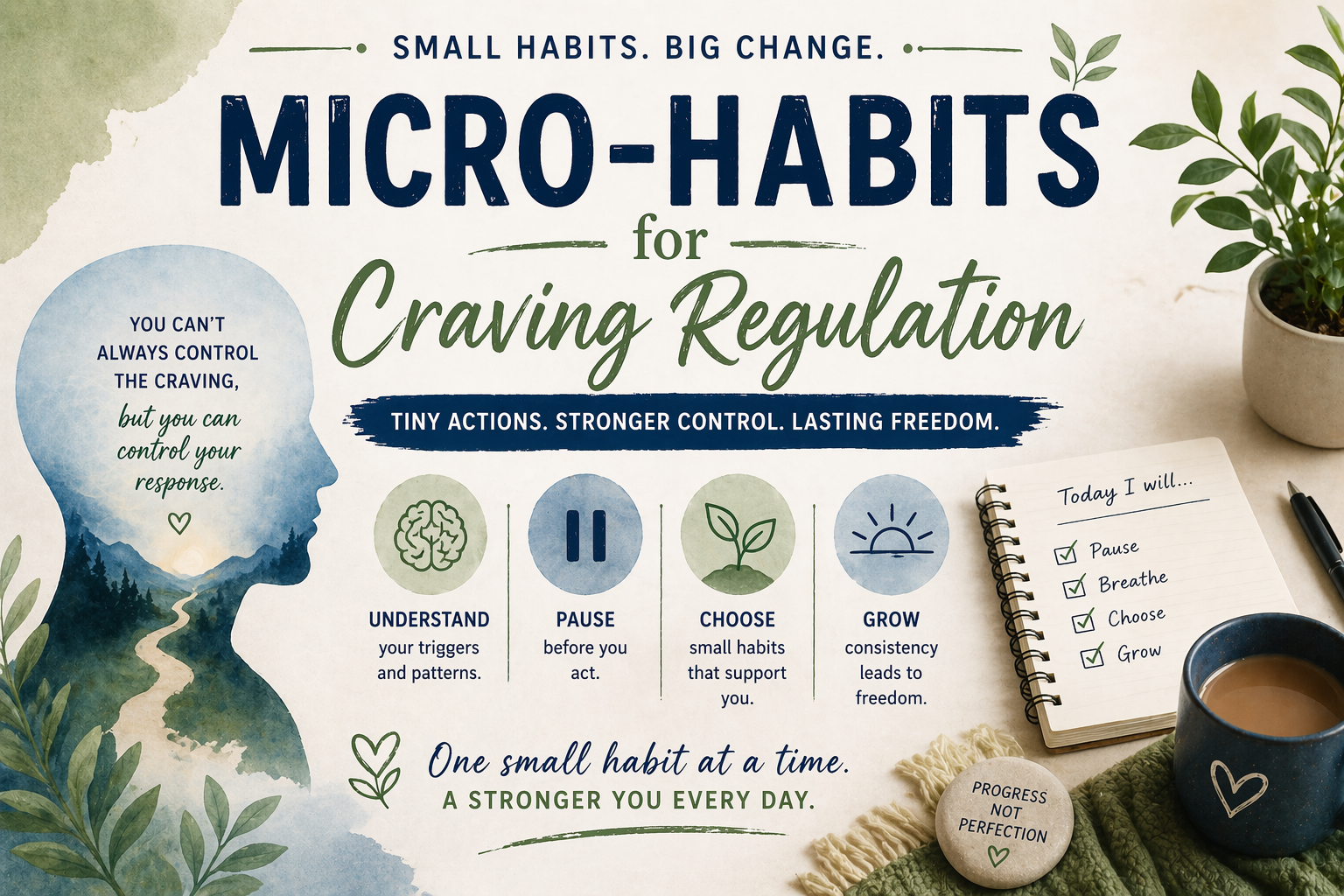
Cravings can feel immediate, intense, and difficult to control, often leading to impulsive decisions that don’t align with long-term goals. Rather than relying on willpower alone, micro-habits offer a more practical and sustainable approach to craving regulation. These small, intentional actions help interrupt automatic responses and create space for more thoughtful choices. By understanding how cravings develop—and how they can be influenced through consistent, manageable behaviors—individuals can begin to shift from reacting to urges toward actively regulating them.
Small Shifts, Stronger Control: Micro-Habits for Craving Regulation
Cravings can feel overwhelming—sudden, intense, and hard to ignore. Whether related to food, substances, or behaviors, they often seem to demand immediate action. But cravings aren’t commands—they’re signals. And how you respond to them can be shaped through small, consistent changes.
Micro-habits—tiny, manageable actions—are one of the most effective ways to regulate cravings. Instead of relying on willpower alone, they help you build automatic responses that gradually reduce intensity and improve control.
Understanding Cravings: What’s Really Happening?
Cravings are driven by a mix of:
- Brain reward systems
- Emotional triggers (stress, boredom, anxiety)
- Learned habits and routines
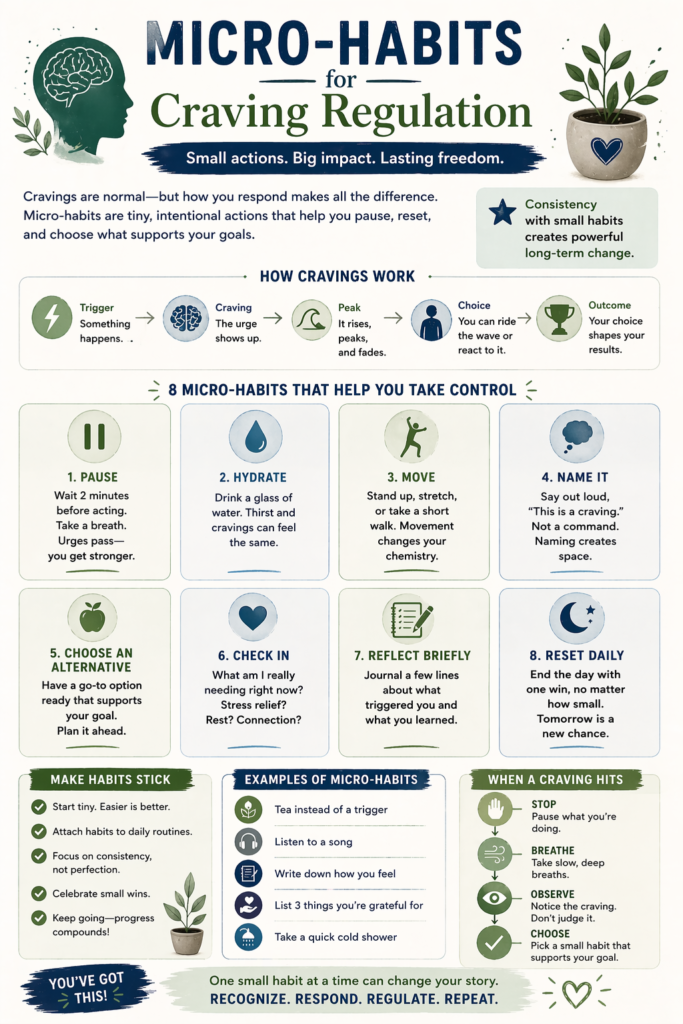
They often rise quickly, peak, and then pass—whether you act on them or not. The key is learning how to ride out that wave rather than react to it.
Why Micro-Habits Work
Large changes often fail because they’re overwhelming. Micro-habits work because they:
- Require minimal effort
- Are easier to repeat consistently
- Build momentum over time
- Reduce reliance on motivation
Instead of trying to eliminate cravings, you learn to manage your response to them.
1. The 2-Minute Pause
When a craving hits, your first instinct is usually to act immediately.
Try:
- Waiting just 2 minutes before acting
- Taking slow breaths during that time
- Observing the craving without judgment
This short pause weakens the automatic response and gives your brain time to regain control.
2. Change Your Physical State
Cravings are not just mental—they’re physical.
Small shifts can help:
- Drink a glass of water
- Stand up and stretch
- Take a short walk
- Splash cold water on your face
These actions interrupt the craving cycle and reset your nervous system.
3. Create a “Default Alternative.”
Instead of asking “How do I stop this?”, decide in advance what you’ll do instead.
Examples:
- Craving sugar → eat fruit or protein first
- Urge to scroll or use → step outside for 5 minutes
- Stress craving → write one sentence about how you feel
Having a pre-decided response removes decision fatigue in the moment.
4. Reduce Trigger Exposure
Not all cravings are internal—many are environmental.
Micro-adjustments:
- Keep triggering items out of immediate reach
- Change routines tied to cravings
- Limit exposure to cues (places, times, situations)
You’re not avoiding—you’re setting yourself up for success.
5. Name the Craving
Labeling reduces intensity.
Instead of:
- “I need this right now.”
Try:
- “This is a craving. It will pass.”
This creates distance between you and the urge.
6. Track Patterns (Lightly)
You don’t need a detailed system—just awareness.
Notice:
- Time of day cravings occur
- Emotional states linked to them
- Situations that trigger them
Patterns help you prepare rather than react.
7. Pair Habits with Existing Routines
Attach micro-habits to things you already do:
- After meals → short walk
- During stress → 3 deep breaths
- Before bed → quick reflection
This makes new habits easier to maintain.
8. Focus on Progress, Not Perfection
Cravings don’t disappear overnight.
What matters:
- Delaying instead of immediately acting
- Reducing frequency or intensity over time
- Recovering quickly after setbacks
Each small win strengthens long-term control.
When to Seek Additional Support
If cravings feel:
- Constant or escalating
- Tied to substance use or compulsive behaviors
- Difficult to manage despite effort
It may help to seek professional or community support. Micro-habits are powerful—but they work best when paired with the right level of care.
Final Thought
Cravings are part of being human—but being controlled by them doesn’t have to be.
You don’t need a massive change to regain control.
You need small, repeatable actions that shift your response—moment by moment.
Because in the end, it’s not one big decision that changes behavior.
It’s the tiny ones you make every day.
Mastering the Moment: Self-Management Strategies for Micro-Habits in Craving Regulation
Cravings don’t just test willpower—they test awareness, timing, and response. Most people try to fight cravings with force (“I just need more discipline”), but that approach often fails because cravings are fast, automatic, and emotionally driven.
Self-management is what turns micro-habits into real change. It’s not just about what you do—it’s about how you understand and guide your responses in the moment.
Why Self-Management Comes First
Micro-habits only work when you can recognize a craving as it’s happening. Without awareness, behavior stays automatic.
Self-management helps you:
- Notice cravings early (before they peak)
- Interrupt impulsive reactions
- Choose small, intentional responses
It shifts you from reacting → to responding.
1. Build Real-Time Awareness
Most cravings feel sudden, but they usually build in subtle ways.
Start noticing:
- Physical signals (restlessness, tension, hunger cues)
- Emotional triggers (stress, boredom, frustration)
- Situational patterns (time of day, environment)
The earlier you catch a craving, the easier it is to manage.
2. Separate Urge from Action
One of the most powerful mindset shifts:
Having a craving ≠ and acting on it
Instead of:
- “I need this.”
Reframe to:
- “I’m experiencing an urge.”
This creates psychological distance and reduces urgency.
3. Use the “Pause and Choose” Technique
Self-management lives in the pause.
When a craving hits:
- Pause for a few seconds
- Take a slow breath
- Ask: What do I actually need right now?
Even a short pause weakens automatic behavior and gives you back control.
4. Identify the Real Need Behind the Craving
Cravings are often signals, not just desires.
Common underlying needs:
- Stress → need for relief
- Boredom → need for stimulation
- Loneliness → need for connection
- Fatigue → need for rest
When you address the real need, the craving often loses intensity.
5. Create Micro-Responses (Not Big Fixes)
Trying to “solve everything” in the moment is overwhelming.
Instead, use small responses:
- Take 3 deep breaths
- Drink water
- Step outside for 2 minutes
- Delay the urge briefly
These micro-actions reduce intensity without requiring major effort.
6. Manage Your Internal Dialogue
What you tell yourself during a craving matters.
Unhelpful:
- “I have no control.”
- “I always give in.”
Helpful:
- “This will pass.”
- “I’ve handled this before.”
- “I can wait a minute.”
You’re not forcing positivity—just removing defeat-based thinking.
7. Reduce Decision Fatigue
In the middle of a craving, decision-making is harder.
Prepare in advance:
- Choose 2–3 go-to micro-habits
- Keep them simple and repeatable
- Make them easy to access
When the moment comes, you don’t think—you act.
8. Track Without Obsessing
Self-management improves with awareness, not perfection.
Light tracking helps you see:
- When cravings happen most
- What triggers them
- Which micro-habits actually work
Even brief reflection builds long-term insight.
9. Recover Quickly from Slip-Ups
Self-management includes how you respond after giving in.
Avoid:
- Shame or all-or-nothing thinking
Instead:
- Acknowledge it without judgment
- Reset at the next opportunity
- Learn from the moment
Progress comes from consistency, not perfection.
10. Strengthen Your Baseline State
Cravings are harder to manage when your baseline is off.
Support your system by:
- Getting enough sleep
- Eating regularly
- Managing stress proactively
- Building small daily routines
A regulated baseline reduces the intensity of cravings overall.
Final Thought
Micro-habits are powerful—but they don’t work on autopilot. They work when you do.
Self-management is what connects awareness to action. It’s the ability to pause, understand what’s happening, and choose a response—even if it’s small.
Because craving control isn’t about eliminating urges.
It’s about changing your relationship with them—one moment at a time.
Stronger Together: Family Support Strategies for Micro-Habits in Craving Regulation
Craving regulation is often seen as a personal battle—something someone should “handle on their own.” But in reality, the environment around a person plays a major role in how cravings are experienced and managed. Family support can either unintentionally reinforce habits… or become a powerful force for change.
Micro-habits—small, consistent actions used to manage cravings—are much easier to build and sustain when families understand how to support them.
Why Family Support Matters
Cravings are influenced by:
- Stress levels
- Environment
- Emotional safety
- Daily routines
Families are part of all of these. Support doesn’t mean controlling someone’s behavior—it means creating conditions where healthier responses are easier to choose.
1. Shift from Judgment to Understanding
One of the biggest barriers to craving regulation is feeling judged.
Avoid:
- “Why can’t you just stop?”
- “You need more self-control.”
Instead:
- Recognize cravings as real, not just a lack of discipline
- Understand that change happens gradually
This shift reduces shame, which often intensifies cravings rather than reduces them.
2. Learn the Micro-Habit Approach Together
Families don’t need to be experts—but understanding the basics helps.
Key ideas:
- Small changes are more effective than drastic ones
- Delaying a craving is progress
- Consistency matters more than perfection
When families understand this, they’re less likely to expect immediate, unrealistic results.
3. Support the Environment, Not Just the Person
Cravings are often triggered by surroundings.
Families can help by:
- Reducing visible triggers when possible
- Creating shared routines (e.g., walks, meals, downtime)
- Encouraging balanced schedules
You’re not removing responsibility—you’re removing unnecessary obstacles.
4. Encourage “Pause Moments.”
When a craving hits, the goal isn’t immediate control—it’s interruption.
Families can gently support by:
- Suggesting a short break (“Want to step outside for a minute?”)
- Redirecting attention without pressure
- Giving space instead of escalating the moment
These small pauses make micro-habits easier to apply.
5. Reinforce Effort, Not Just Outcomes
Progress in craving regulation is often invisible.
Instead of focusing only on success or failure:
- Acknowledge attempts (“I noticed you paused—that’s a big deal”)
- Recognize small wins
- Avoid all-or-nothing thinking
This builds motivation without pressure.
6. Model Healthy Coping Behaviors
Family members influence behavior through example.
You can model:
- Taking breaks when stressed
- Talking openly about emotions
- Using simple coping strategies (breathing, movement, stepping away)
This normalizes regulation instead of making it feel like a “problem to fix.”
7. Respect Autonomy
Support should not feel like control.
Avoid:
- Monitoring every action
- Constant reminders or pressure
- Taking over decision-making
Instead:
- Offer support when invited
- Ask, don’t assume (“How can I support you right now?”)
Autonomy increases the likelihood of lasting change.
8. Be Consistent, Not Intense
Support doesn’t need to be dramatic—it needs to be steady.
Small actions matter:
- Regular check-ins
- Predictable routines
- Calm responses during difficult moments
Consistency builds trust, which supports behavior change.
9. Handle Setbacks Carefully
Slip-ups are part of the process.
Unhelpful responses:
- Criticism
- Frustration
- “I knew this wouldn’t work.”
Helpful responses:
- Stay neutral and calm
- Encourage reset (“Tomorrow is another chance”)
- Focus on what can be learned
How families respond to setbacks often determines whether progress continues.
10. Know When Additional Support Is Needed
Family support is important—but not always enough on its own.
Consider outside support if:
- Cravings are intense or persistent
- They involve substance use or compulsive behaviors
- Progress feels stalled despite effort
Professional guidance can strengthen what families are already doing.
Final Thought
Micro-habits may be small, but they don’t develop in isolation. They grow in environments that support awareness, reduce pressure, and encourage steady progress.
Families don’t need perfect strategies—they need consistent, understanding ones.
Because when support feels safe instead of stressful,
change doesn’t just become possible—it becomes sustainable.
Stronger Systems, Smarter Habits: Community Resource Strategies for Micro-Habits in Craving Regulation
Craving regulation is often framed as a personal responsibility—but in reality, it’s deeply influenced by environment, access to support, and available resources. Micro-habits—small, repeatable actions that help manage urges—are powerful on their own, but they become far more effective when supported by the right community structures.
Communities don’t just provide help in moments of crisis—they shape the everyday conditions that make healthy habits easier to build and sustain.
Why Community Resources Matter
Cravings are not just internal—they are shaped by:
- Social environments
- Stress levels
- Accessibility of support
- Daily structure and routine
Community resources help by:
- Providing education and awareness
- Offering tools and accountability
- Reducing isolation
They shift the burden from “handle this alone” to “manage this with support.”
1. Community Education Programs
Workshops, seminars, and public health initiatives can help people understand:
- How cravings actually work (they rise, peak, and pass)
- Why small habits are more effective than extreme changes
- Practical micro-habit strategies for daily life
These programs are often offered through:
- Local health departments
- Community centers
- Nonprofit organizations
Education turns confusion into clarity—and clarity improves action.
2. Support Groups and Peer Networks
Peer support is one of the most effective ways to reinforce micro-habits.
Benefits include:
- Shared strategies that work in real life
- Accountability without pressure
- Reduced feelings of isolation
Whether in-person or online, support groups create a space where:
- Small wins are recognized
- Setbacks are normalized
- Progress feels possible
3. Community Mental Health Services
Local clinics and counseling services provide structured support for craving regulation.
They can help individuals:
- Identify triggers and patterns
- Develop personalized micro-habit plans
- Address underlying emotional drivers (stress, anxiety, trauma)
Professional guidance strengthens the effectiveness of small daily habits.
4. Wellness and Recreational Programs
Community-based activities can act as natural alternatives to craving-driven behaviors.
Examples include:
- Fitness classes
- Art or creative workshops
- Mindfulness or yoga sessions
- Outdoor group activities
These programs:
- Reduce stress (a major craving trigger)
- Provide healthy outlets for energy and emotion
- Replace old routines with new ones
5. Digital Community Resources
Online platforms expand access to support and tools.
These include:
- Habit-tracking apps
- Virtual support groups
- Educational content from professionals
- Guided exercises for stress and craving management
Digital tools are especially helpful for:
- Immediate access during cravings
- Flexible, self-paced engagement
6. Workplace and School Initiatives
Daily environments matter. Workplaces and schools can support craving regulation by:
- Promoting mental health awareness
- Encouraging breaks and balanced schedules
- Offering Employee Assistance Programs (EAPs) or counseling services
When these environments support well-being, micro-habits become easier to maintain consistently.
7. Faith-Based and Cultural Communities
For many, support is strongest within familiar cultural or spiritual spaces.
These communities can:
- Provide mentorship and guidance
- Offer group support rooted in shared values
- Create a sense of belonging and accountability
When aligned with personal beliefs, these supports can feel more natural and sustainable.
8. Creating a Supportive Local Environment
Communities can also influence behavior through accessibility:
- Availability of healthy food options
- Safe public spaces for movement and relaxation
- Reduced exposure to high-risk triggers
When environments support healthier choices, micro-habits require less effort to maintain.
How to Use Community Resources Effectively
- Start with one resource that feels accessible
- Combine supports (education + peer + professional guidance)
- Stay consistent, even with small engagement
- Focus on progress, not perfection
You don’t need every resource—just the ones that fit your needs and lifestyle.
Final Thought
Micro-habits may be small, but they don’t grow in isolation. They are shaped by the environments and communities around us.
When communities provide education, connection, and accessible support, they make it easier for individuals to manage cravings—not through force, but through sustainable change.
Because lasting behavior change isn’t just personal—it’s supported, reinforced, and strengthened by the world around you.
Frequently Asked Questions
Here are some common questions:
1. What are micro-habits?
Micro-habits are small, simple actions that are easy to repeat consistently. In craving regulation, they are used to interrupt urges and create space for better decisions.
2. How do micro-habits help with cravings?
They work by:
- Breaking automatic reactions
- Reducing the intensity of urges
- Giving you time to think before acting
- Building new, healthier response patterns over time
3. Are cravings normal?
Yes. Cravings are a natural part of how the brain works. They are signals driven by habit, emotion, and reward—not a sign of weakness.
4. Can micro-habits really make a difference?
Yes. Small actions, when repeated consistently, rewire behavior patterns. Over time, they can significantly reduce how often and how strongly cravings occur.
5. What are examples of micro-habits for cravings?
- Pausing for 1–2 minutes
- Drinking water
- Taking a short walk
- Naming the craving (“This is an urge”)
- Writing down what you’re feeling
6. How long do cravings usually last?
Most cravings rise, peak, and fade within minutes if not acted on. Micro-habits help you “ride out” that wave.
7. Do I need strong willpower for this to work?
No. Micro-habits reduce the need for willpower by making responses automatic and manageable rather than relying on willpower.
8. What if I forget to use my micro-habits?
That’s normal. Building awareness takes time. The goal is to:
- Catch it earlier next time
- Practice consistently
- Avoid self-criticism
9. How many micro-habits should I use?
Start with 1–3 simple ones. Too many can feel overwhelming and reduce consistency.
10. Should micro-habits replace bigger strategies or treatment?
No. They are tools, not complete solutions. For more intense or persistent cravings, combining micro-habits with professional or community support is often more effective.
11. Why do cravings feel so urgent?
Cravings activate the brain’s reward and survival systems, creating a sense of urgency—even when the need isn’t truly immediate.
12. Can micro-habits help with emotional cravings (stress, boredom)?
Yes. Many cravings are linked to emotions. Micro-habits help you pause and identify what you actually need (rest, connection, relief).
13. What if I give in to a craving?
It’s part of the process. What matters is:
- Noticing what triggered it
- Learning from it
- Returning to your micro-habits next time
Progress is not all-or-nothing.
14. How long does it take for micro-habits to work?
Some benefits are immediate (like reduced intensity), but lasting change comes with consistent practice over time.
15. What’s the biggest mistake people make?
Trying to make big changes too quickly.
Micro-habits work because they are small and repeatable—not overwhelming.
16. Can micro-habits be personalized?
Absolutely. The most effective micro-habits are:
- Easy for you to do
- Relevant to your triggers
- Realistic in your daily life
17. What’s the goal of craving regulation?
Not to eliminate cravings completely—but to:
- Respond with control
- Reduce intensity and frequency
- Build healthier patterns over time
Conclusion
Micro-habits demonstrate that meaningful change doesn’t require drastic action, but consistent, intentional effort over time. By focusing on small responses—such as pausing, redirecting attention, or addressing underlying needs—individuals can gradually reduce the intensity and frequency of cravings. This approach builds confidence, reinforces self-awareness, and supports long-term behavior change. Ultimately, craving regulation is not about eliminating urges entirely, but about developing the ability to respond to them with greater control, clarity, and resilience.
Video: This Simple Breath Technique Broke My Pattern #MicroHabits #CravingControl