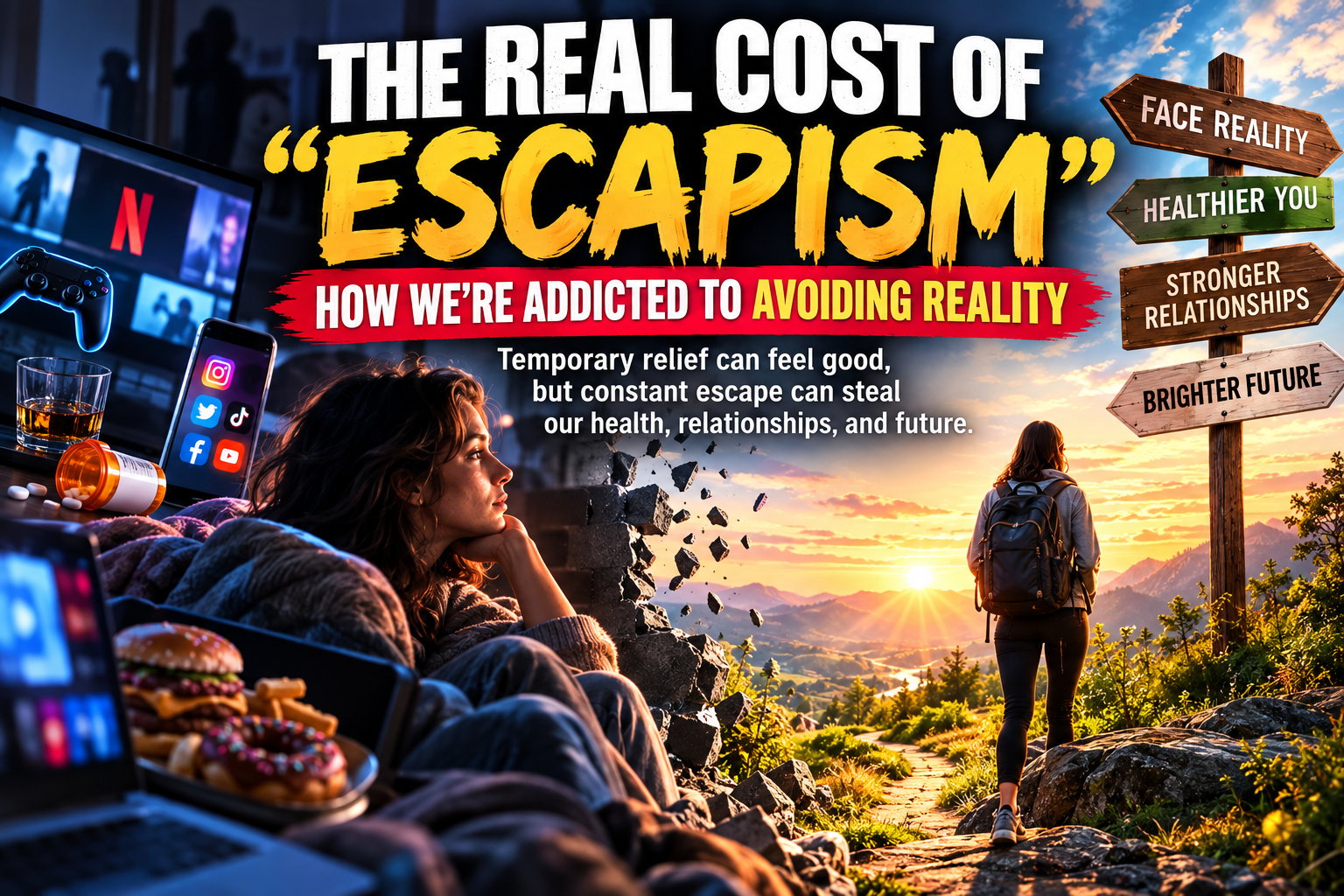
Life can be uncomfortable. Stress, grief, loneliness, financial problems, relationship conflict, trauma, boredom, and uncertainty can create emotions we would rather not experience. Everyone needs an occasional break, and healthy distractions can actually help us recover from stress. The problem begins when escaping becomes our primary coping mechanism. Instead of dealing with reality, we repeatedly turn toward alcohol, drugs, food, gambling, social media, gaming, shopping, pornography, streaming, work, or even excessive sleep to avoid what we feel.
People sometimes describe this pattern as being “addicted to escaping reality.” Escapism itself is not a formal addiction diagnosis. However, some substances and behaviors can become compulsive or develop into recognized disorders. Understanding the difference between healthy relaxation and chronic avoidance can help people recognize when temporary relief is creating long-term problems.
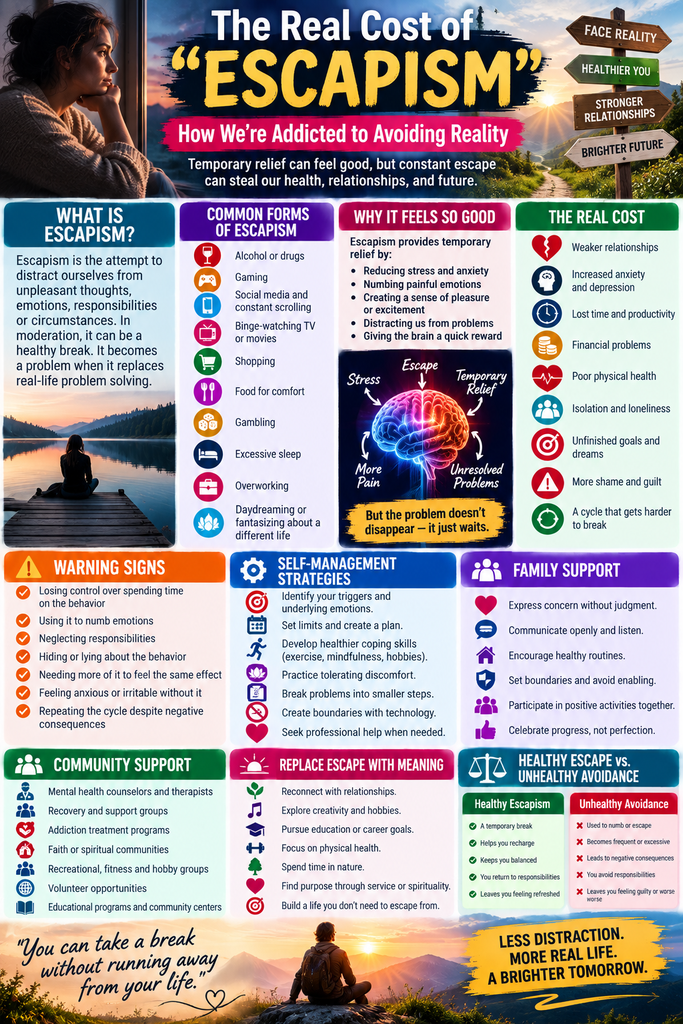
What Is Escapism?
Escapism is the attempt to temporarily distract ourselves from unpleasant thoughts, emotions, responsibilities, or circumstances. In moderation, it can be completely normal.
Watching a movie after a stressful day, playing a game with friends, reading a novel, taking a vacation, or spending time on a hobby can provide healthy emotional recovery.
Escapism becomes concerning when the purpose changes from “I am taking a break” to “I cannot tolerate my life unless I escape from it.”
Common forms of unhealthy escapism may include:
- Spending hours scrolling through social media to avoid uncomfortable thoughts.
- Using alcohol or drugs whenever stress occurs.
- Binge-watching television instead of addressing responsibilities.
- Gambling to experience excitement or temporarily forget financial or emotional problems.
- Using food for comfort whenever difficult emotions appear.
- Excessive gaming that interferes with work, school, sleep, or relationships.
- Compulsive shopping to temporarily improve mood.
- Working constantly to avoid relationships or emotional problems.
- Sleeping excessively to withdraw from everyday life.
- Constantly fantasizing about another life instead of taking steps to improve the current one.
The activity itself does not always determine whether it is unhealthy. The purpose, frequency, loss of control, and consequences matter.
Why Avoidance Feels So Good
Avoidance works—at least temporarily.
Imagine receiving a stressful bill. Looking at it creates anxiety. Instead of dealing with the bill, you open social media and scroll for an hour. Your anxiety decreases.
Your brain learns something important: avoiding the problem made the uncomfortable feeling disappear.
Unfortunately, the bill remains.
The next time anxiety appears, the brain may encourage the same escape. Over time, this creates a cycle:
Stress → uncomfortable emotion → escape → temporary relief → unresolved problem → greater stress → stronger desire to escape.
This is one reason avoidance can become so persistent. Immediate relief can feel more rewarding than confronting a problem whose solution may require effort, discomfort, or uncertainty.
When Escapism Becomes a Problem
Healthy recreation usually leaves us refreshed and better able to return to our responsibilities. Unhealthy escapism often does the opposite.
Warning signs can include:
- Losing control over how much time you spend escaping.
- Neglecting work, school, finances, relationships, or health.
- Feeling anxious or irritable when you cannot engage in the activity.
- Hiding or lying about the behavior.
- Increasing the amount of time or money devoted to it.
- Using the activity primarily to numb emotional pain.
- Continuing despite obvious negative consequences.
- Repeatedly promising yourself you will stop but returning to the behavior.
- Feeling ashamed afterward but repeating the pattern anyway.
- Becoming increasingly disconnected from real-world relationships and responsibilities.
One important question is: “Is this activity helping me recover from life, or helping me avoid living it?”
The Emotional Cost of Constant Escape
Avoiding painful emotions does not necessarily eliminate them. In many cases, avoidance simply postpones them.
Someone may use alcohol to temporarily reduce anxiety, social media to escape loneliness, gambling to escape boredom, or food to comfort sadness. When the distraction ends, the original emotion often remains.
Sometimes another emotion is added: shame.
A person may then feel guilty about drinking, embarrassed about spending money, frustrated about wasting hours online, or angry with themselves for neglecting responsibilities.
That shame can create another desire to escape.
The cycle becomes:
Pain → Escape → Relief → Consequences → Shame → More Pain → More Escape.
Breaking this cycle requires learning to tolerate uncomfortable emotions without immediately trying to eliminate them.
Self-Management: Learning to Face Reality Gradually
Stopping unhealthy escapism does not mean eliminating entertainment or forcing yourself to confront every problem immediately. The goal is to develop healthier ways to manage distress while gradually addressing the issues you’re avoiding.
Helpful self-management strategies include:
- Identify your escape behavior. Ask yourself what you automatically reach for when you feel stressed, lonely, angry, bored, or overwhelmed.
- Identify the emotion underneath it. Instead of simply saying, “I want a drink,” ask, “What am I trying not to feel right now?”
- Track your triggers. Keep a short record of what happened immediately before the urge to escape.
- Delay rather than immediately react. Give yourself 10 or 15 minutes before acting on an impulse.
- Break problems into smaller steps. Large problems encourage avoidance. Completing one manageable task can restore a sense of control.
- Create limits around technology. Schedule social media, gaming, or streaming periods to keep entertainment from consuming the entire day.
- Develop healthier coping skills. Exercise, mindfulness, journaling, music, gardening, hobbies, and relaxation techniques can provide relief without creating additional problems.
- Practice tolerating discomfort. Anxiety, sadness, boredom, and frustration do not always require immediate elimination.
- Seek professional treatment when needed. Persistent avoidance may be connected with depression, anxiety, trauma, substance use disorders, gambling disorder, or other mental health concerns.
Family Support Without Enabling
Families often recognize avoidance before the individual does. They may see missed responsibilities, financial problems, isolation, excessive screen use, substance use, or changes in relationships.
The natural reaction may be confrontation. However, constant criticism can increase shame and sometimes drive further avoidance.
Families can help by:
- Expressing concern without humiliation.
- Asking what the person may be struggling to cope with.
- Encouraging counseling or addiction treatment when appropriate.
- Establishing reasonable household and financial boundaries.
- Avoiding repeatedly rescuing the person from preventable consequences.
- Creating opportunities for screen-free family activities.
- Encouraging sleep, exercise, meals, and healthier routines.
- Recognizing improvements instead of focusing exclusively on mistakes.
- Seeking family counseling when unhealthy patterns affect the entire household.
Supporting someone does not mean removing every consequence of their behavior. Compassion and accountability can exist together.
Community Support: Connection Instead of Isolation
Escapism often thrives in isolation. Community connection provides opportunities to discuss problems, receive support, develop accountability, and participate in meaningful activities.
Helpful resources may include:
- Mental health counselors and therapists.
- Addiction treatment professionals.
- Peer recovery specialists.
- Substance-use recovery groups.
- Gambling recovery programs.
- Support groups for families.
- Faith or spiritual communities when desired.
- Recreation and fitness groups.
- Volunteer organizations.
- Educational programs and community centers.
- Healthy online communities that encourage real-world improvement rather than endless avoidance.
People are often more willing to face difficult realities when they know they do not have to face them alone.
Replacing Escape With Meaning
One of the most effective alternatives to unhealthy escapism is not simply removing the behavior—it is building something meaningful in its place.
If someone spends six hours gaming every night and simply removes the game, six empty hours remain. Without something meaningful to replace it, returning to gaming becomes much more likely.
Recovery may involve rediscovering:
- Relationships.
- Creativity.
- Education.
- Career goals.
- Exercise.
- Nature.
- Spirituality.
- Volunteering.
- Parenting.
- Hobbies.
- Personal growth.
- Community involvement.
The goal is not to make life constantly productive. Rest and entertainment remain important. The goal is to create a life you don’t constantly need to escape.
Healthy Escape vs. Unhealthy Avoidance
There is an important difference between giving yourself relief and abandoning reality.
Healthy escapism says:
“Life has been difficult today. I am going to relax for a while, recharge, and return to it.”
Unhealthy avoidance says:
“I cannot deal with this, so I am going to keep distracting myself and hope it disappears.”
One restores energy.
The other postpones problems.
The Real Cost of Avoiding Reality
The greatest cost of escapism may not be the hours spent scrolling, drinking, gaming, shopping, gambling, eating, or watching television.
It may be the life we leave unattended while we escape.
Relationships weaken. Bills accumulate. Health deteriorates. Opportunities disappear. Emotional problems remain untreated. Goals remain unfinished. Eventually, the reality someone was trying to avoid can become even harder to face.
But avoidance is a learned coping pattern, and healthier coping patterns can be learned, too.
Self-management teaches people to recognize triggers, tolerate uncomfortable emotions, and take manageable action. Family support provides encouragement and accountability without enabling. Community support provides professional help, meaningful relationships, and opportunities for connection.
Recovery does not require giving up every distraction or pleasure. It means developing the ability to take a break from reality without permanently running away from it.
Sometimes the most powerful step is simply asking: “What am I avoiding—and what is one small thing I can do about it today?”
Frequently Asked Questions and Answers
1. What is escapism?
Escapism is using activities, entertainment, substances, fantasy, or other distractions to temporarily avoid unpleasant emotions, stressful circumstances, or responsibilities. Escapism is not automatically unhealthy. Taking a break can help people relax and recover from stress.
2. Can someone actually become addicted to escapism?
“Escapism addiction” is not a formal medical diagnosis. However, people can develop compulsive patterns involving substances or behaviors they use to escape uncomfortable feelings. Some may develop recognized conditions such as substance use disorder or gambling disorder, while other behaviors may become problematic without meeting criteria for an addiction.
3. What are common forms of unhealthy escapism?
People may escape through alcohol or drugs, excessive gaming, social-media scrolling, binge-watching television, gambling, shopping, overeating, pornography, overworking, excessive sleeping, or persistent fantasizing. The behavior becomes concerning when it repeatedly interferes with health, relationships, finances, work, school, or responsibilities.
4. Why does escaping from reality feel good?
Avoidance can produce immediate relief. If a person feels anxious and then distracts themselves until the anxiety decreases, the brain can learn that avoidance provides relief. This can reinforce the behavior even though the original problem remains unresolved.
5. What is the escapism cycle?
A common pattern is:
Stress → Emotional discomfort → Escape → Temporary relief → Unresolved problems → More stress → Stronger desire to escape.
Over time, the person may spend more and more time avoiding problems rather than addressing them.
6. What are warning signs that escapism is becoming unhealthy?
Warning signs include losing control of the behavior, neglecting responsibilities, hiding how much time or money is involved, experiencing relationship problems, repeatedly trying unsuccessfully to cut back, and continuing despite negative consequences.
7. Is watching television or playing video games considered escapism?
It can be, but that does not automatically make it unhealthy. Watching a movie or gaming after a difficult day may provide healthy relaxation. Concern increases when the activity consistently replaces sleep, relationships, work, school, exercise, or necessary responsibilities.
8. How is healthy relaxation different from unhealthy avoidance?
Healthy relaxation helps you recharge so you can return to your life. Unhealthy avoidance repeatedly postpones dealing with your life. A useful question is: “After this activity, am I better prepared to face my responsibilities—or am I continuing to run from them?”
9. Can trauma contribute to escapism?
Yes. Some people use substances or repetitive behaviors to cope with painful memories, anxiety, grief, or other trauma-related symptoms. However, trauma does not automatically cause addiction or unhealthy escapism, and people respond to traumatic experiences differently.
10. Can social media become a form of escapism?
Yes. Social media can provide entertainment and connection, but constant scrolling may also become a way of avoiding boredom, loneliness, anxiety, responsibilities, or uncomfortable thoughts. Setting limits and scheduling screen-free periods can help restore balance.
11. Why can escapism make anxiety worse?
Avoidance may reduce anxiety temporarily while preventing someone from learning that they can tolerate and manage difficult situations. Meanwhile, postponed responsibilities can accumulate, creating additional stress and reinforcing the urge to escape again.
12. What self-management strategies can reduce unhealthy escapism?
Helpful strategies include identifying triggers, recognizing the emotions underneath the urge to escape, limiting screen time, breaking overwhelming problems into smaller tasks, exercising, practicing mindfulness, developing hobbies, improving sleep routines, and seeking professional treatment when necessary.
13. How can families help someone who constantly escapes from reality?
Families can express concern without humiliation, listen to what the person is experiencing, encourage professional help, establish healthy boundaries, avoid enabling harmful behaviors, and invite the person into meaningful family activities. Compassion works best when combined with accountability.
14. What community resources can help?
Depending on the underlying problem, resources may include mental health therapists, addiction professionals, peer recovery programs, support groups, gambling treatment services, community centers, recreational groups, faith communities, and volunteer organizations. Meaningful social connection can help reduce isolation.
15. Should people eliminate all forms of escapism?
No. Entertainment, hobbies, imagination, vacations, reading, gaming, movies, and other enjoyable activities can be healthy parts of life. The goal is balance—not eliminating pleasure. A break becomes problematic when it repeatedly replaces necessary action.
16. What can replace unhealthy escapism?
Simply removing an escape behavior can leave an emotional and practical void. Recovery may involve replacing it with relationships, exercise, creativity, education, hobbies, nature, volunteering, spirituality, career goals, therapy, or other meaningful activities.
17. When should someone seek professional help?
Consider professional help when avoidance interferes with everyday functioning, relationships, employment, finances, physical health, or emotional well-being. Help is particularly important when escapism involves problematic alcohol or drug use, gambling, severe depression, trauma symptoms, or other significant mental health concerns.
18. What is the biggest lesson about escapism?
Escaping provides relief without necessarily providing a solution. The real cost may be the relationships, opportunities, health, time, and goals that are neglected while someone tries to avoid uncomfortable reality.
The goal is not to never escape. It is to develop the ability to rest, enjoy life, and temporarily disconnect while still returning to responsibilities and difficult emotions when necessary. Healthy coping ultimately means creating a life that requires less running away and more meaningful living.
Video: