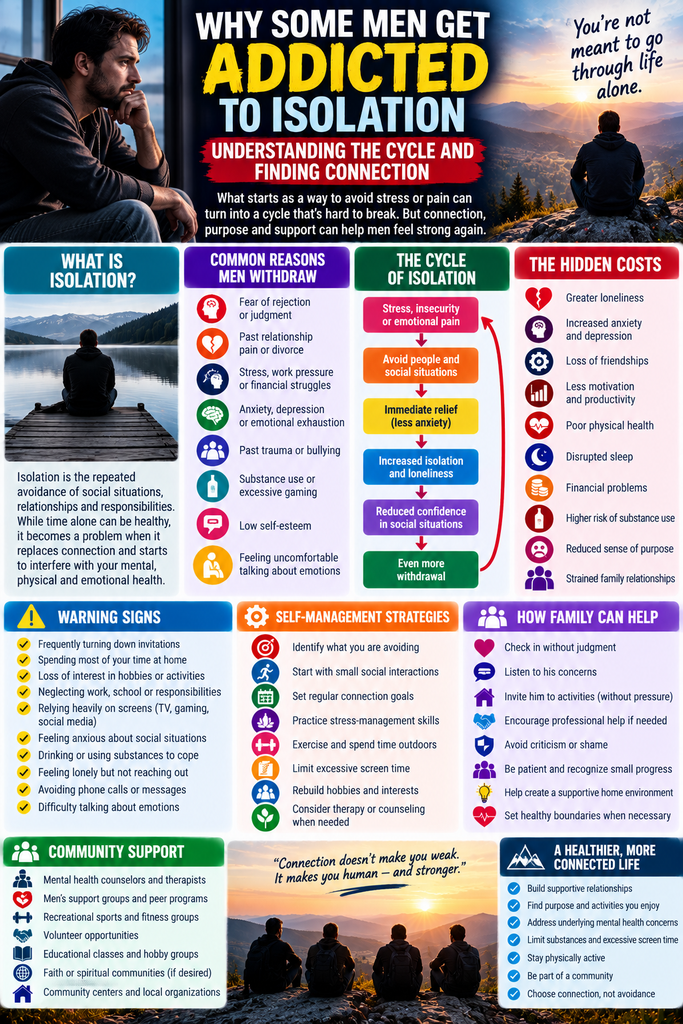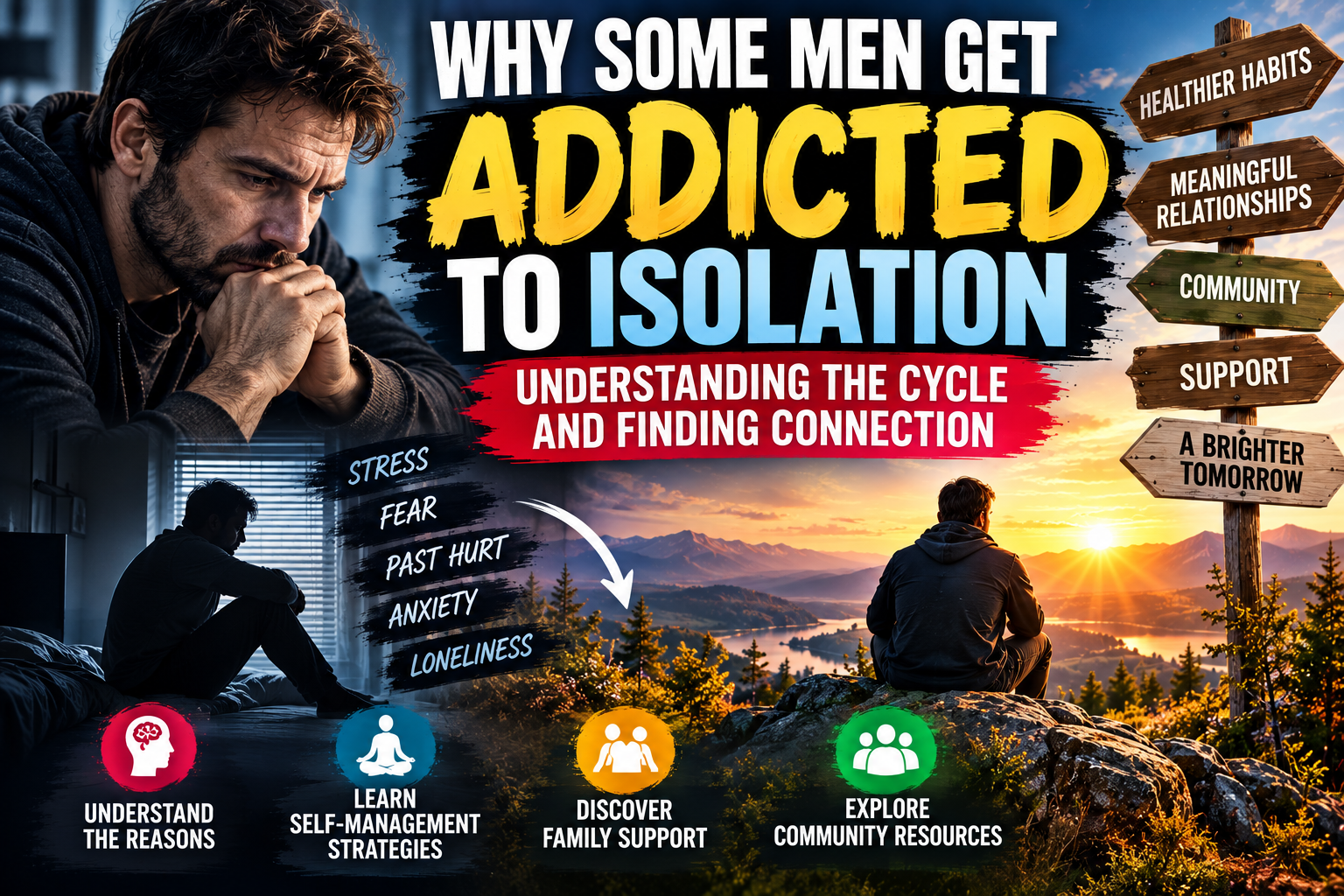
Everyone needs time alone. Solitude can provide space to think, recover from stress, enjoy hobbies, and regain emotional energy. But for some men, being alone gradually changes from a healthy choice into a pattern of avoidance. They may stop answering calls, decline invitations, withdraw from relationships, spend most of their free time at home, and convince themselves that isolation is easier than dealing with other people.
People sometimes describe this experience as being “addicted to isolation.” Social isolation itself is not generally considered an addiction in the clinical sense. However, withdrawal can become a strongly reinforced coping pattern because avoiding people may temporarily reduce anxiety, conflict, embarrassment, rejection, or emotional vulnerability.
Understanding this cycle can help men and their families replace avoidance with healthier forms of independence, connection, and support.
Why Isolation Can Feel Safe
Social relationships involve uncertainty. People can disappoint us, criticize us, misunderstand us, reject us, or expect things from us. For someone who has experienced painful relationships, isolation may initially feel peaceful.
When a man stays home instead of attending an uncomfortable social event, his anxiety may immediately decrease. That relief teaches the brain something: avoiding people feels safer than facing discomfort.
The problem is that repeated avoidance can make social situations feel even harder.
A cycle can develop:
Stress or insecurity → Avoid people → Immediate relief → Increased isolation → Reduced confidence → More discomfort around people → Further withdrawal.
What began as protection can eventually become a prison.
Why Some Men Withdraw
There is rarely one explanation for chronic isolation. Personality, relationships, life experiences, mental health, work, finances, culture, and social expectations can all contribute.
Possible factors include:
- Fear of rejection or embarrassment.
- Relationship breakdowns or divorce.
- Grief and significant losses.
- Workplace stress or unemployment.
- Financial difficulties.
- Social anxiety.
- Depression or emotional exhaustion.
- Previous bullying or humiliation.
- Trauma or difficult relationships.
- Low self-esteem.
- Substance misuse.
- Excessive gaming or internet use.
- Feeling uncomfortable discussing emotions.
- Losing friendships as responsibilities increase with age.
For some men, isolation may seem preferable to admitting that they are lonely or struggling.
The Difference Between Solitude and Isolation
Solitude and isolation are not the same.
Healthy solitude is usually intentional. Someone spends time alone because it feels restorative, then reconnects with others when they want to.
Unhealthy isolation often feels different. The person may want friendship and connection but repeatedly avoid opportunities to experience them.
A helpful question is:
“Am I alone because I enjoy solitude, or because connecting with people has become uncomfortable?”
A person can enjoy independence while still maintaining meaningful relationships.
When Isolation Becomes a Coping Mechanism
Avoidance can be surprisingly rewarding because it removes immediate discomfort.
Imagine someone experiencing social anxiety. Friends invite him to dinner, but he worries that he will have nothing interesting to say. He cancels.
Immediately, the anxiety disappears.
That relief reinforces the cancellation. The next invitation becomes easier to decline.
Eventually, months may pass without meaningful social contact. Because the person has fewer opportunities to practice conversation, tolerate awkward moments, or experience positive interactions, his confidence may decline further.
This is how avoidance can strengthen itself even when the person genuinely wants relationships.
The Hidden Costs of Chronic Isolation
Isolation may initially reduce stress, but prolonged social withdrawal can create new difficulties.
Possible consequences include:
- Increasing loneliness.
- Reduced confidence in social situations.
- Loss of friendships.
- Greater dependence on screens or online entertainment.
- Less physical activity.
- Disrupted sleep routines.
- Increased alcohol or drug use for some people.
- Difficulty asking for help.
- Reduced sense of purpose and belonging.
- Greater emotional distress.
- Strained family relationships.
Isolation can also make problems appear larger because there are fewer opportunities to receive another person’s perspective.
Self-Management: Rebuilding Connection Gradually
Someone who has spent months or years withdrawing socially does not need to suddenly become extremely outgoing. Small, repeated interactions are often more realistic.
Helpful self-management strategies include:
- Identify what you are avoiding. Ask whether you fear rejection, judgment, conflict, vulnerability, or simply feel emotionally exhausted.
- Start with small interactions. A short conversation with a coworker or neighbor can be more manageable than a large social gathering.
- Schedule connection. Put a weekly coffee, walk, phone call, class, or activity on the calendar.
- Reduce automatic cancellations. Before declining an invitation, ask whether you genuinely need rest or are avoiding discomfort.
- Limit excessive screen-based isolation. Gaming, streaming, and social media can provide entertainment without fully replacing face-to-face relationships.
- Exercise regularly. Gyms, walking groups, recreational sports, and outdoor activities can combine physical health with low-pressure social contact.
- Reconnect with old interests. Music, sports, woodworking, cooking, cars, volunteering, or other hobbies can provide natural opportunities for connection.
- Practice emotional communication. Start by telling a trusted person something simple and genuine about how life has been going.
- Consider therapy. Persistent isolation may be associated with depression, social anxiety, grief, trauma, substance use, or other concerns that deserve professional attention.
The objective is not to eliminate alone time. The goal is to ensure isolation remains a choice rather than the only situation that feels safe.
Family Support Without Pressure
Watching a husband, father, brother, or son become increasingly isolated can be frustrating and frightening. Family members may respond by repeatedly telling him to “get out of the house” or “make some friends.”
Although well-intended, pressure and criticism may increase defensiveness.
Families can provide healthier support by:
- Checking in consistently without interrogating.
- Inviting him to activities without creating guilt when he declines.
- Listening before immediately offering solutions.
- Encouraging professional help when withdrawal becomes severe.
- Participating in simple activities together, such as walking, cooking, or watching a sporting event.
- Avoiding ridicule about loneliness or emotional vulnerability.
- Encouraging relationships outside the immediate family.
- Setting boundaries when isolation is accompanied by harmful behavior.
- Recognizing small attempts to reconnect.
Family support works best when connection feels like an invitation rather than a punishment.
Why Male Friendship Matters
Some men have plenty of acquaintances but few people they can talk to about fear, grief, relationships, health, or uncertainty.
Friendship does not have to revolve around deeply emotional conversations. Connection often develops while people are doing something together.
Men may build relationships through:
- Sports and recreational leagues.
- Fitness groups.
- Fishing, hiking, or outdoor activities.
- Music and creative groups.
- Volunteer work.
- Professional organizations.
- Recovery communities.
- Faith communities.
- Veterans’ organizations.
- Community classes.
- Regular meals or coffee with friends.
Repeated contact is important. Friendship often grows through ordinary interactions rather than one dramatic conversation.
Community Support: Creating Places to Belong
Loneliness cannot always be solved through individual effort alone. Communities also need spaces where adults can develop relationships without feeling awkward for arriving alone.
Community support may include:
- Mental health counseling.
- Men’s support groups.
- Peer recovery programs.
- Community recreation centers.
- Sports leagues and fitness programs.
- Volunteer organizations.
- Libraries and educational programs.
- Hobby and interest groups.
- Faith or spiritual communities when desired.
- Addiction recovery meetings.
- Grief-support groups.
- Veterans’ organizations.
The best community is not necessarily the largest one. A few dependable relationships can be more meaningful than dozens of superficial connections.
Isolation and Substance Use
Isolation and addiction can sometimes reinforce each other.
Someone may drink or use drugs because he feels lonely. Substance use may then cause arguments, missed responsibilities, financial problems, or embarrassment. Those consequences encourage him to withdraw further.
Another cycle develops:
Loneliness → Substance use → Temporary relief → Consequences → Shame → Isolation → Greater loneliness.
Breaking this pattern may require addressing both substance use and social disconnection. Treating one while ignoring the other can leave an important trigger unresolved.
When Professional Help Is Important
Occasional solitude is normal. Concern increases when someone withdraws for an extended period and begins losing interest in relationships, work, hobbies, hygiene, responsibilities, or everyday activities.
Professional evaluation may be particularly important when isolation occurs alongside severe depression, intense anxiety, problematic substance use, major personality changes, or an inability to function normally.
Social withdrawal can be a symptom rather than the underlying problem. Identifying what is driving it can make treatment considerably more effective.
From Isolation to Connection
A man who has become deeply isolated does not need twenty new friends tomorrow.
He may need one phone call.
One walk.
One counseling appointment.
One recovery meeting.
One conversation where he says, “I haven’t been doing very well lately.”
Small actions matter because avoidance grows through repetition—and connection can grow the same way.
Self-management helps identify avoidance patterns and rebuild confidence gradually. Family support provides consistent connection without shame or excessive pressure. Community support creates opportunities for friendship, treatment, accountability, and belonging.
Being comfortable alone can be a strength. Feeling unable to connect with anyone is different.
Recovery from chronic isolation is not about becoming the most social person in the room. It is about reaching the point where solitude is something you can choose, rather than somewhere you feel forced to hide.
Frequently Asked Questions and Answers
1. Can someone actually become addicted to isolation?
“Addiction to isolation” is not a formal medical diagnosis. However, social withdrawal can become a strongly reinforced coping pattern. If avoiding people reduces anxiety, stress, conflict, or fear of rejection, a person may increasingly rely on isolation whenever uncomfortable emotions arise.
2. Why do some men isolate themselves?
There is rarely one cause. Men may withdraw because of relationship problems, grief, social anxiety, depression, trauma, financial stress, unemployment, low self-esteem, burnout, substance use, or previous experiences of rejection or humiliation.
3. Why can isolation feel comfortable?
Being alone gives you greater control over your environment. It reduces the risk of criticism, disagreement, embarrassment, or rejection. That immediate relief can make withdrawal attractive, even when prolonged isolation eventually creates loneliness.
4. What is the cycle of isolation?
A common pattern looks like this:
Stress or emotional pain → Avoid social situations → Immediate relief → Increased isolation → Reduced social confidence → More anxiety about connecting → Further withdrawal.
Breaking the cycle usually requires gradually rebuilding connection rather than waiting until socializing feels completely comfortable.
5. Is spending time alone unhealthy?
No. Solitude can be healthy and restorative. The important difference is whether being alone is a choice. Healthy solitude lets you recharge and reconnect later, while problematic isolation repeatedly replaces relationships and responsibilities.
6. What are warning signs that isolation is becoming unhealthy?
Possible signs include repeatedly declining invitations, ignoring calls or messages, losing friendships, abandoning hobbies, spending most free time alone, becoming heavily dependent on screens, neglecting responsibilities, and feeling lonely while continuing to avoid people.
7. Why might men have difficulty admitting they are lonely?
Some men have learned that vulnerability, sadness, fear, or asking for emotional support represents weakness. These expectations can make it difficult to acknowledge loneliness or seek help. Emotional openness, however, is a skill, not a sign of weakness.
8. Can depression cause social isolation?
Yes. Depression can reduce energy, motivation, pleasure, and interest in social activities. At the same time, prolonged isolation may worsen loneliness and emotional distress, potentially creating a self-reinforcing cycle.
9. Can anxiety lead to isolation?
Yes. Someone with social anxiety may avoid situations because they fear embarrassment, rejection, or negative judgment. Avoidance reduces anxiety temporarily but can prevent the person from developing confidence through positive social experiences.
10. What role can addiction play in isolation?
Substance use and isolation can reinforce each other. Someone may drink or use drugs because they feel lonely, while substance-related consequences may create shame, conflict, or financial problems that cause further withdrawal.
11. Can gaming and social media contribute to isolation?
They can when they consistently replace sleep, exercise, responsibilities, or meaningful relationships. However, gaming and online communities can also provide genuine social connection. The key questions are how the technology is used and whether it improves or interferes with everyday functioning.
12. What self-management strategies can help reduce isolation?
Helpful strategies include identifying what you are avoiding, scheduling regular social contact, responding to messages instead of postponing them, exercising, reducing excessive screen time, returning to hobbies, and setting small social goals.
13. Should someone force themselves to attend large social events?
Not necessarily. Smaller steps may be more sustainable. Calling one friend, having coffee with a relative, attending a small class, walking with a coworker, or joining a hobby group can gradually rebuild social confidence.
14. How can families support an isolated man?
Family members can check in regularly, listen without immediately trying to solve everything, invite him to activities without excessive pressure, encourage professional help when appropriate, and avoid shaming him for being withdrawn.
15. What should family members avoid doing?
Repeated criticism, ridicule, guilt, interrogation, or statements such as “just get over it” can increase defensiveness. Families should also avoid enabling harmful behaviors that accompany isolation, such as severe substance misuse or persistent neglect of responsibilities.
16. How can community support help?
Men’s groups, recreational sports, gyms, volunteer organizations, community centers, recovery groups, faith communities, hobby clubs, and educational programs can provide structured opportunities to interact with others. Shared activities often make forming relationships feel more natural.
17. When should someone consider professional help?
Professional support may be appropriate when isolation persists for weeks or months, significantly affects work or relationships, or occurs alongside depression, severe anxiety, substance misuse, major changes in behavior, or difficulty managing everyday responsibilities.
18. Can therapy help with chronic isolation?
Yes. Therapy can help identify what is driving the withdrawal and develop strategies for managing anxiety, depression, grief, trauma, low self-esteem, or relationship difficulties. Treatment can also help someone gradually practice healthier social behaviors.
19. How can men rebuild friendships after years of isolation?
Start small and consistently. Reconnect with an old friend, join a regular activity, volunteer, participate in recreational sports, attend a recovery or support group, or schedule a recurring coffee or walk. Friendship usually develops through repeated contact rather than a single intense conversation.
20. What is the biggest lesson about isolation?
Being comfortable alone can be healthy. Feeling unable to connect is different. Recovery from chronic isolation does not require becoming extremely social—it means developing enough confidence, support, and meaningful relationships that being alone becomes a choice rather than the only place that feels safe.
Video: