Social isolation—defined as a lack of meaningful relationships and supportive connections—is a key factor that increases the risk of relapse across all age groups. Recovery from addiction or unhealthy behaviors is not just an internal process; it is strongly influenced by relationships and the surrounding social environment. When individuals become disconnected from support systems, they are more likely to experience loneliness, heightened stress, and negative emotions, all of which can increase vulnerability to relapse. As modern lifestyles, major life changes, and ongoing stigma continue to contribute to social disconnection, understanding the relationship between isolation and relapse is essential for creating effective prevention and intervention strategies.
Alone and at Risk: How Social Isolation Contributes to Relapse at Any Age
🌍 Understanding the Connection
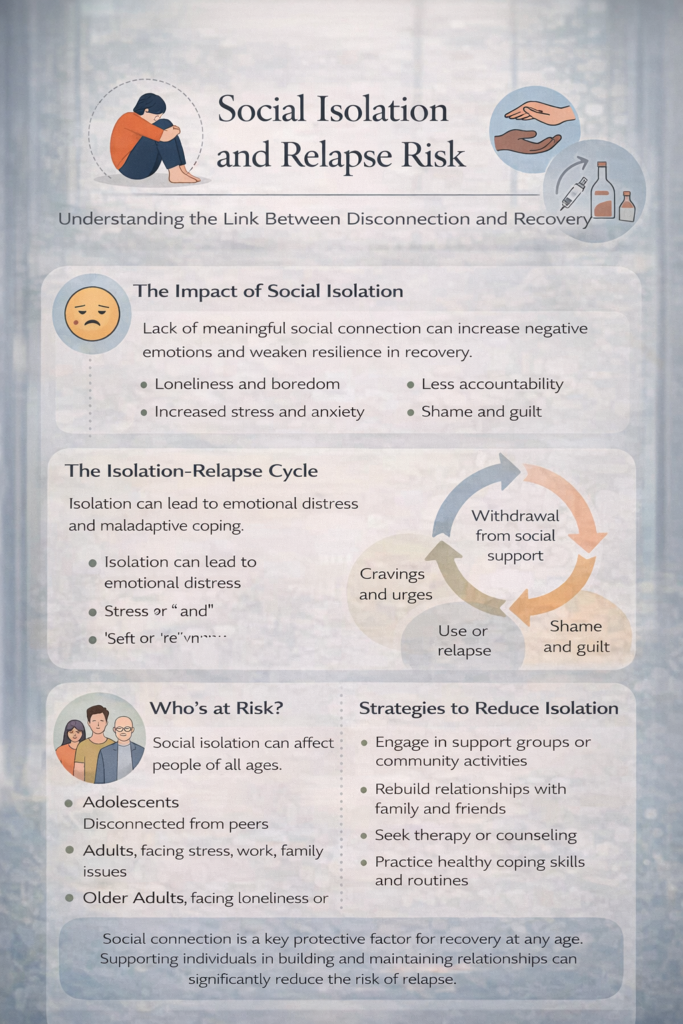
Social isolation—feeling disconnected, unsupported, or alone—can significantly increase the risk of relapse for individuals in recovery from addiction. While relapse is often associated with personal struggle, it is deeply influenced by social and environmental factors, making isolation a critical issue across all age groups.
Recovery thrives in connection. When that connection is missing, vulnerability increases.
🧠 Why Isolation Increases Relapse Risk
Human beings are inherently social. Connection plays a major role in emotional regulation and mental well-being. When isolation occurs, several risk factors emerge:
- Increased stress and anxiety without emotional outlets
- Loneliness, which can trigger cravings or urges
- Lack of accountability, making it easier to return to old behaviors
- Negative thinking patterns, such as hopelessness or self-doubt
Without support, individuals may turn back to substances or behaviors as a way to cope.
🔄 The Isolation–Relapse Cycle
Isolation and relapse often reinforce each other in a cycle:
- Withdrawal or disconnection from others
- Emotional distress (loneliness, depression, stress)
- Craving or urge to use as a coping mechanism
- Relapse or return to behavior
- Shame or guilt, leading to further isolation
Breaking this cycle requires addressing both the behavior and the social disconnection behind it.
👥 Why It Affects All Ages
Social isolation is not limited to one group—it can impact anyone:
- Adolescents may feel disconnected due to peer pressure or identity struggles
- Adults may experience isolation from work stress, family conflict, or life transitions
- Older adults may face loneliness due to loss, health issues, or reduced social networks
At any age, isolation can weaken resilience and increase relapse risk.
⚠️ Signs of Isolation That May Lead to Relapse
- Withdrawing from friends, family, or support groups
- Avoiding social situations or activities
- Increased time alone with negative thoughts
- Loss of motivation to maintain recovery routines
- Feeling misunderstood or disconnected
Recognizing these signs early can help prevent a setback.
🌱 Strategies to Reduce Isolation and Support Recovery
1. Rebuild Social Connections
- Reach out to trusted friends or family
- Participate in group activities or community programs
2. Engage in Support Groups
- Peer support provides shared understanding and accountability
3. Create Routine and Structure
- Regular schedules reduce idle time and increase stability
4. Use Healthy Coping Skills
- Exercise, hobbies, or mindfulness practices can replace harmful behaviors
5. Seek Professional Support
- Therapists and counselors can help address both isolation and relapse triggers
❤️ The Role of Connection in Healing
Connection is not just helpful in recovery—it’s essential. Positive relationships provide:
- Emotional support
- Encouragement and accountability
- A sense of belonging and purpose
Even small steps toward connection can have a powerful impact.
💬 Final Thoughts
Social isolation is a significant but often overlooked factor in relapse. At any age, disconnection can increase emotional vulnerability and weaken recovery efforts. However, the opposite is also true: connection strengthens resilience and supports long-term healing.
Recovery is not meant to happen alone. Reaching out, staying connected, and building supportive relationships can make the difference between relapse and sustained progress.
Staying Connected: Self-Management Strategies to Understand How Social Isolation Is Linked to Relapse
🌍 Why Self-Management Matters
Social isolation can quietly increase the risk of relapse by weakening emotional support, increasing stress, and reinforcing negative thought patterns. Understanding this connection is a key part of recovery. Self-management strategies empower individuals to recognize isolation early, respond intentionally, and build habits that support connection and stability.
The goal isn’t to eliminate alone time—it’s to prevent unhealthy isolation from turning into relapse risk.
🧠 Step 1: Recognize Your Personal Isolation Triggers
Isolation doesn’t always look obvious. It can develop gradually.
Common triggers include:
- Stress or emotional overwhelm
- Conflict in relationships
- Major life changes (loss, transitions, relocation)
- Feelings of shame or low self-worth
Try this:
Reflect on when you tend to withdraw. Ask:
- What usually happens before I isolate myself?
- What emotions am I trying to avoid?
Awareness helps you catch the pattern early.
🔄 Step 2: Identify the Isolation–Relapse Connection
Understanding how isolation affects your behavior is essential.
Ask yourself:
- Do my cravings increase when I’m alone for long periods?
- Do I think more negatively when I’m isolated?
- Have past relapses been linked to disconnection?
Recognizing this pattern turns isolation from a vague feeling into a clear warning sign.
⏸️ Step 3: Interrupt the Withdrawal Pattern
Isolation often becomes automatic. Creating small interruptions can prevent it from deepening.
Strategies:
- Set a timer to check in with someone daily
- Schedule regular activities, even when you don’t feel like it
- Leave your environment (go outside, visit a public space)
Even brief moments of connection can reduce emotional intensity.
💡 Step 4: Challenge Thoughts That Reinforce Isolation
Isolation is often maintained by internal thoughts like:
- “No one understands me.”
- “I’ll just be a burden.”
- “It’s easier to be alone.”
Reframe them:
- “Reaching out might feel uncomfortable, but it can help.”
- “Support exists, even if I don’t feel it right now.”
This helps break the mental barriers that perpetuate isolation.
🌱 Step 5: Build a Personal Connection Plan
Instead of waiting until you feel isolated, create a plan in advance.
Include:
- 2–3 people you can contact
- Regular group activities or meetings
- Safe spaces where you feel comfortable
Having a plan reduces hesitation when you need support.
📅 Step 6: Create Structure and Routine
Unstructured time can increase isolation and risk.
Helpful habits:
- Maintain a consistent daily schedule
- Include social or community interaction regularly
- Balance alone time with connection
Routine builds stability and reduces vulnerability.
🤝 Step 7: Practice Intentional Connection
Connection doesn’t have to be overwhelming—it can be simple and consistent.
Examples:
- Sending a text or making a quick call
- Attending a support group
- Engaging in shared activities (exercise, hobbies)
Small, repeated actions are more effective than occasional large efforts.
🚫 Step 8: Monitor Early Warning Signs
Catch isolation before it leads to relapse.
Watch for:
- Canceling plans repeatedly
- Avoiding communication
- Increased negative thinking
- Loss of motivation in recovery
Early awareness allows for quicker intervention.
❤️ Step 9: Balance Independence and Support
Healthy recovery includes both self-reliance and connection.
- Alone time can be restorative
- Isolation becomes harmful when it replaces support
Learning the difference is a key part of self-management.
💬 Final Thoughts
Understanding how social isolation is linked to relapse allows individuals to take proactive control of their recovery. Through self-awareness, structured habits, and intentional connection, it is possible to reduce isolation and strengthen resilience.
Recovery is not about avoiding being alone—it’s about ensuring you’re not disconnected when it matters most. Small, consistent steps toward connection can make a powerful difference in maintaining long-term progress.
Supporting Connection: Family Strategies to Understand How Social Isolation Is Linked to Relapse
🏠 Why Family Support Matters
Social isolation is one of the strongest risk factors for relapse, and families are often the first line of connection. When individuals feel supported, understood, and included, their resilience increases. When they feel disconnected or misunderstood, the risk of withdrawal—and eventually relapse—can grow.
Family support is not about forcing interaction; it’s about creating a safe, consistent sense of connection that helps reduce isolation.
🧠 Understanding the Isolation–Relapse Link as a Family
Before taking action, families need to recognize that isolation is often:
- A response to stress, shame, or emotional overwhelm
- A warning sign—not just a personal choice
- A pattern that can gradually increase relapse risk
Understanding this helps families respond with empathy instead of frustration.
💬 Strategy 1: Create Open and Safe Communication
Isolation often grows when individuals feel they can’t talk openly.
Helpful approaches:
- Ask gentle questions: “How have you been feeling lately?”
- Listen without interrupting or immediately giving advice
- Validate feelings, even if you don’t fully understand them
Avoid:
- Criticism or judgment (“You’re shutting everyone out again”)
- Pressuring someone to talk before they’re ready
A safe space encourages connection instead of withdrawal.
👀 Strategy 2: Recognize Early Signs of Isolation
Families can help by noticing changes before they escalate.
Watch for:
- Spending excessive time alone
- Avoiding family or social interactions
- Mood changes (irritability, sadness, withdrawal)
- Disengagement from recovery routines
Early recognition allows families to intervene supportively, not reactively.
🤝 Strategy 3: Encourage Gentle Reconnection
Forcing social interaction can backfire. Instead, focus on a low-pressure connection.
Examples:
- Inviting (not demanding) participation in activities
- Spending quiet time together (watching a movie, sharing a meal)
- Checking in regularly without overwhelming
Consistency matters more than intensity.
🌱 Strategy 4: Promote Healthy Social Environments
Families can help expand supportive connections beyond the home.
Encourage:
- Participation in support groups
- Involvement in hobbies or community activities
- Maintaining friendships that support recovery
A broader support network reduces dependence on isolation.
⚖️ Strategy 5: Balance Support with Boundaries
While connection is important, boundaries maintain stability.
- Avoid enabling behaviors that contribute to relapse
- Set clear expectations around communication and engagement
- Be consistent in both support and limits
Healthy boundaries create structure without disconnection.
🧩 Strategy 6: Address Emotional Barriers to Connection
Isolation is often tied to deeper emotional experiences such as:
- Shame about past behavior
- Fear of judgment
- Low self-worth
Families can help by:
- Reinforcing acceptance and nonjudgment
- Acknowledging effort, not just outcomes
- Encouraging professional support when needed
Reducing emotional barriers makes connection easier.
🚫 Strategy 7: Avoid Common Mistakes
Well-meaning actions can sometimes increase isolation.
Avoid:
- Minimizing feelings (“You’ll be fine”)
- Taking withdrawal personally
- Overreacting or becoming controlling
These responses can push individuals further away rather than drawing them in.
❤️ Strategy 8: Be a Consistent Source of Connection
Recovery is a long-term process, and consistency is key.
Families can:
- Maintain regular routines (meals, check-ins)
- Show up even during setbacks
- Reinforce that support is ongoing—not conditional
Reliability builds trust and reduces the need to withdraw.
💬 Final Thoughts
Social isolation is a powerful contributor to relapse, but family support can act as a strong protective factor. By fostering open communication, recognizing early signs of withdrawal, and encouraging meaningful connection, families can help break the isolation–relapse cycle.
The goal is not to eliminate alone time, but to ensure that individuals never feel truly alone in their recovery. With patience, empathy, and consistency, families can play a vital role in strengthening connections and supporting long-term healing.
Connected Communities: Resource Strategies to Address Social Isolation and Reduce Relapse Risk at Any Age
🌍 Why Community Resources Matter
Social isolation is a major contributor to relapse, but it is not just an individual issue—it is a community-level challenge. Communities shape opportunities for connection, access to support, and the overall environment in which recovery takes place. When community resources are strong and accessible, they help individuals feel seen, supported, and less alone, which directly lowers relapse risk.
Recovery is more sustainable when the connection extends beyond the individual and family into the broader community.
🧠 Understanding Isolation Through a Community Lens
Isolation is often influenced by:
- Lack of accessible support services
- Limited social opportunities
- Stigma surrounding addiction and recovery
- Barriers such as transportation, cost, or awareness
Community resources work to remove these barriers and create pathways to connection, making it easier for individuals to stay engaged in recovery.
🤝 Strategy 1: Peer Support and Recovery Groups
Community-based support groups are one of the most effective tools for reducing isolation.
Examples include:
- 12-step programs
- Recovery-focused peer groups
- Age-specific or population-specific support meetings
Benefits:
- Shared experiences and understanding
- Accountability and encouragement
- A sense of belonging
These groups remind individuals that they are not alone in their struggles.
🧩 Strategy 2: Accessible Mental Health Services
Community mental health resources help address both isolation and relapse risk.
Services may include:
- Counseling and therapy
- Substance use treatment programs
- Crisis support services
These resources provide:
- Professional guidance
- Emotional support
- Tools for managing triggers and loneliness
🌱 Strategy 3: Social and Recreational Programs
Communities can offer structured opportunities for connection that don’t revolve around substance use.
Examples:
- Fitness classes and recreational sports
- Art, music, or creative workshops
- Community centers and social events
These activities:
- Reduce idle time
- Promote positive social interaction
- Improve mental well-being
📚 Strategy 4: Education and Awareness Campaigns
Reducing stigma is essential to addressing isolation.
Community efforts may include:
- Public education about addiction and recovery
- Workshops on mental health and coping strategies
- Campaigns promoting connection and support
When stigma decreases, individuals are more likely to seek help and stay connected.
🚍 Strategy 5: Reducing Barriers to Access
Even the best resources are ineffective if they are not accessible.
Communities can improve access by:
- Providing low-cost or free services
- Offering transportation options
- Expanding virtual or online support
Accessibility ensures that support is available to all age groups and backgrounds.
🤲 Strategy 6: Volunteer and Purpose-Driven Opportunities
Engagement in meaningful activities helps combat isolation.
Examples:
- Volunteer programs
- Mentorship opportunities
- Community service projects
These opportunities:
- Build a sense of purpose
- Strengthen social bonds
- Reinforce positive identity in recovery
⚖️ Strategy 7: Integrated Community Support Systems
The most effective approach combines multiple resources into a cohesive system:
- Peer support for connection
- Mental health services for treatment
- Recreational programs for engagement
- Education efforts for awareness
This integrated model creates a network of support that reduces isolation and strengthens recovery outcomes.
❤️ The Power of Community Connection
Community connection provides:
- A sense of belonging
- Emotional and social support
- Opportunities for growth and engagement
These factors are critical in breaking the isolation–relapse cycle.
💬 Final Thoughts
Social isolation can increase relapse risk at any age, but strong community resources can significantly reduce that risk. By creating accessible, inclusive, and supportive environments, communities help individuals move from isolation to connection.
Recovery is not just an individual journey—it is a shared responsibility. When communities invest in connection, they create conditions in which long-term healing is not only possible but also sustainable.
Frequently Asked Questions
Here are some common questions:
What is social isolation?
Answer:
Social isolation refers to a lack of meaningful social connections, relationships, or interactions. It can be physical (being alone) or emotional (feeling disconnected even around others).
How is social isolation linked to relapse?
Answer:
Isolation increases relapse risk by:
- Reducing emotional support
- Increasing stress, loneliness, and negative emotions
- Removing accountability and encouragement
These factors can make it easier to return to substance use or harmful behaviors.
Why does loneliness trigger relapse?
Answer:
Loneliness can lead to emotional distress, such as sadness, anxiety, or hopelessness. Individuals may turn to substances or behaviors as a way to cope or escape these feelings, increasing the risk of relapse.
Is social isolation the same as being alone?
Answer:
No. Being alone can be healthy and restorative. Social isolation becomes harmful when it involves disconnection, lack of support, and negative emotional impact.
Who is most at risk for isolation-related relapse?
Answer:
People at higher risk include:
- Individuals in early recovery
- Those with limited social support
- People experiencing major life changes or stress
- Individuals with mental health challenges
However, anyone at any age can be affected.
What are the signs that isolation may be increasing relapse risk?
Answer:
- Withdrawing from friends, family, or support groups
- Avoiding communication or social interaction
- Increased negative thinking or mood changes
- Loss of interest in recovery routines
These are often early warning signs.
How does isolation affect mental health in recovery?
Answer:
Isolation can worsen:
- Depression and anxiety
- Stress levels
- Feelings of shame or low self-worth
This creates a cycle that can weaken coping skills and increase vulnerability to relapse.
Can relapse lead to more isolation?
Answer:
Yes. After relapse, individuals may feel guilt or shame, leading them to withdraw further. This creates a cycle of isolation → relapse → more isolation.
How can someone reduce isolation to prevent relapse?
Answer:
- Stay connected with supportive people
- Attend support groups or therapy
- Engage in community or social activities
- Maintain a structured routine
Even small steps toward connection can make a difference.
What role do support groups play?
Answer:
Support groups provide:
- Shared understanding and experiences
- Accountability
- Encouragement and motivation
They are one of the most effective ways to reduce isolation in recovery.
How can family and friends help?
Answer:
- Offer nonjudgmental support
- Encourage open communication
- Stay consistent and available
- Help reconnect the individual with others
Supportive relationships reduce feelings of isolation.
Why is connection important in recovery?
Answer:
Connection provides:
- Emotional support
- A sense of belonging
- Accountability and encouragement
These factors strengthen resilience and help maintain long-term recovery.
Conclusion
The relationship between social isolation and relapse risk highlights the critical role of connection in sustaining recovery and overall well-being. Isolation can weaken coping mechanisms, intensify emotional distress, and reduce accountability, making it easier for individuals to return to harmful behaviors. However, this risk can be mitigated through intentional efforts to build and maintain supportive relationships, engage in community resources, and foster a sense of belonging. By addressing social isolation as a key component of relapse prevention, individuals, families, and communities can work together to create environments that promote resilience, stability, and long-term recovery.
Video: Why Addicts Relapse When They’re Alone #psychology #recovery