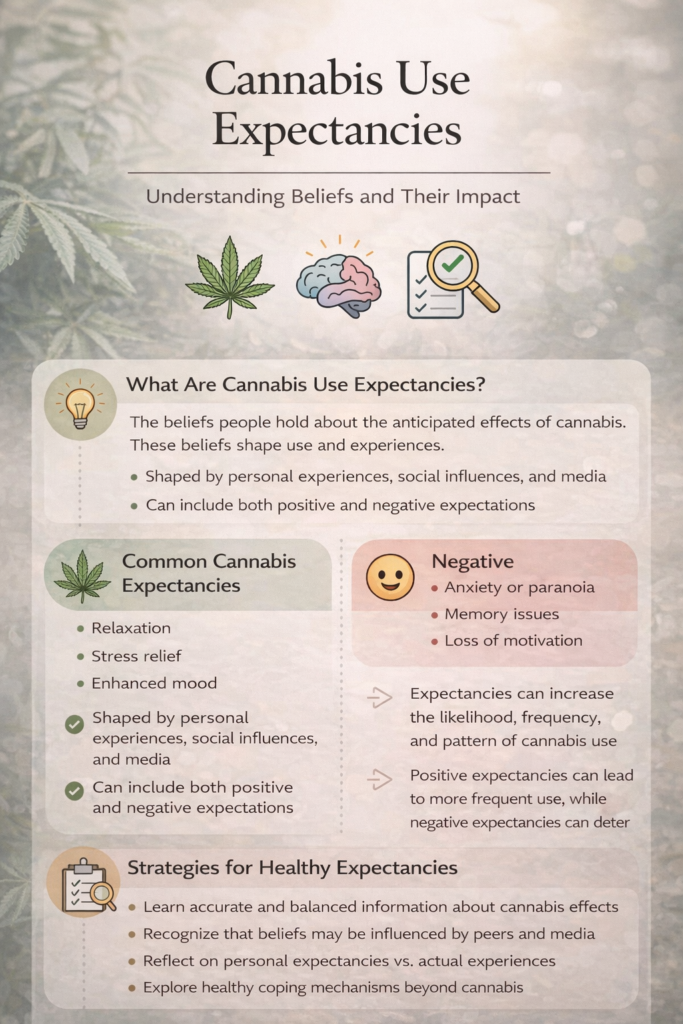
Cannabis use expectancies refer to the beliefs individuals hold about the anticipated effects of cannabis, such as relaxation, stress relief, enhanced social experiences, or potential negative outcomes like anxiety or impaired thinking. These expectations are shaped by personal experiences, peer influence, cultural norms, and media portrayals. Importantly, expectancies play a significant role in influencing whether a person chooses to use cannabis, how often they use it, and how they interpret its effects. As cannabis becomes more socially accepted and accessible, understanding the cognitive and psychological factors behind these expectancies is essential for promoting informed decision-making and reducing potential risks associated with use.
Cannabis Use Expectancies: How Beliefs Shape the Experience
🌿 What Are Cannabis Use Expectancies?
Cannabis use expectancies refer to the beliefs and assumptions people have about the effects of cannabis before they use it. These expectations can include ideas like feeling relaxed, becoming more social, reducing stress, or even enhancing creativity. Importantly, these beliefs are not just passive thoughts—they actively influence how a person experiences cannabis.
In simple terms, what someone expects to happen often shapes what they actually feel.
🧠 The Psychology Behind Expectancies
Expectancies are rooted in learning, experience, and social influence. They develop over time through:
- Personal experiences with cannabis
- Observing others (friends, family, media portrayals)
- Cultural messages about cannabis use
- Peer expectations and social norms
These beliefs act like a mental “script,” guiding both behavior and perception. For example, someone who expects relaxation is more likely to interpret their experience as calming—even if the physical effects are subtle.
🔄 How Expectancies Influence Behavior
Cannabis expectancies play a major role in why, when, and how people use:
- Initiation: Positive expectations (e.g., “it will help me unwind”) increase the likelihood of trying cannabis
- Frequency of use: Strong beliefs in benefits can lead to more regular use
- Coping: Some individuals use cannabis based on the expectation that it will reduce anxiety or emotional distress
On the other hand, negative expectancies (e.g., fear of paranoia or loss of control) can reduce use or lead to avoidance.
⚖️ Positive vs. Negative Expectancies
Positive Expectancies:
- Relaxation and stress relief
- Increased sociability
- Enhanced mood or pleasure
- Improved sleep
Negative Expectancies:
- Anxiety or paranoia
- Cognitive impairment (memory, attention)
- Loss of motivation
- Risk of dependence
Most users hold a mix of both, and the balance between them often shapes overall behavior.
⚠️ Expectancies and Risk
While expectations can guide behavior, they can also distort reality:
- Overestimating benefits may lead to overuse or dependence
- Underestimating risks can reduce caution
- Using cannabis as a coping tool may prevent healthier emotional regulation strategies
In some cases, expectancies contribute to a cycle where the person continues using cannabis to achieve expected outcomes that may not fully materialize.
🌱 Changing Expectancies in Prevention and Treatment
One important strategy in addressing problematic cannabis use is challenging and reshaping expectancies.
Approaches include:
- Cognitive Behavioral Therapy (CBT): identifying and questioning unrealistic beliefs
- Psychoeducation: providing accurate information about effects and risks
- Self-monitoring: comparing expected vs. actual experiences
By aligning expectations with reality, individuals can make more informed and intentional choices.
💬 Final Thoughts
Cannabis use is not driven by effects alone—it is strongly influenced by what people believe those effects will be. Cannabis use expectancies shape decisions, experiences, and long-term patterns of use.
Understanding these expectancies allows individuals, families, and professionals to move beyond assumptions and toward greater awareness, balanced decision-making, and healthier outcomes.
Taking Control: Self-Management Strategies for Understanding Cannabis Use Expectancies
🌿 Why Self-Management Matters
Cannabis use expectancies—the beliefs about what cannabis will do—play a powerful role in shaping behavior and experience. Whether someone expects relaxation, escape, or social ease, those expectations can influence both the decision to use and the outcome.
Self-management strategies help individuals become aware of these beliefs, evaluate their accuracy, and make more intentional choices. The goal is not necessarily abstinence, but informed, controlled, and mindful behavior.
🧠 Step 1: Identify Your Personal Expectancies
Everyone has unique beliefs about cannabis.
Ask yourself:
- What do I expect cannabis to do for me?
- Do I use it to relax, cope, or escape?
Common expectancies include:
- “It will help me feel less anxious.”
- “It makes me more social.”
- “It helps me forget stress.”
Try this:
Write down your expectations before use. This builds awareness of your internal “script.”
🔍 Step 2: Compare Expectations vs. Reality
Expectancies are not always accurate.
After using (or choosing not to), reflect:
- Did the experience match what I expected?
- Were there any negative or unexpected effects?
This process helps identify cognitive distortions—beliefs that may be exaggerated or misleading.
⏸️ Step 3: Pause Before Acting on the Urge
Expectancies can trigger automatic behavior. Creating a pause allows for conscious decision-making.
Strategies:
- Wait 10–15 minutes before using
- Ask: “Why do I want to use right now?”
- Rate your urge from 1–10 and watch it change
Often, urges decrease when given time.
💡 Step 4: Challenge Thought Patterns
Many cannabis-related beliefs are habitual and go unexamined.
Reframe common thoughts:
- “I need this to relax.” → “There are other ways to relax that may work just as well.”
- “This will fix my mood.” → “This might change my mood temporarily, but not solve the cause.”
This approach is based on cognitive-behavioral principles.
🌱 Step 5: Develop Alternative Coping Strategies
If cannabis is used to manage emotions, replacing it with healthier options is key.
Try:
- Exercise or movement for stress relief
- Social connection to reduce loneliness
- Mindfulness or breathing techniques for anxiety
- Creative activities for emotional expression
These alternatives help meet the same needs without relying solely on cannabis.
📓 Step 6: Track Patterns Over Time
Keeping a simple log can reveal important insights.
Track:
- When you feel the urge to use
- What you expected to feel
- What actually happened
Over time, this builds a clearer picture of how expectancies influence behavior.
🚫 Step 7: Manage Environmental Triggers
External cues often reinforce expectancies.
Helpful steps:
- Limit exposure to situations associated with use
- Be mindful of social settings and peer influence
- Reduce media or messaging that glamorizes cannabis
Awareness of the environment helps reduce automatic responses.
🤝 Step 8: Seek Support When Needed
Self-management is powerful, but support strengthens it.
Consider:
- Talking with a counselor or therapist
- Joining a support group
- Discussing patterns with a trusted person
Support adds accountability and perspective.
💬 Final Thoughts
Understanding cannabis use expectancies is about recognizing that beliefs shape behavior and experience. By becoming aware of these beliefs and actively managing them, individuals can move from automatic use to intentional decision-making.
Self-management is not about perfection—it’s about:
- questioning assumptions
- learning from experience
- choosing responses that align with your goals
With practice, awareness becomes control—and control leads to healthier outcomes.
Stronger Together: Family Support Strategies for Understanding Cannabis Use Expectancies
🏠 Why Family Support Matters
Cannabis use expectancies—the beliefs individuals hold about the effects of cannabis—are often shaped within social environments, especially the family. Family attitudes, communication styles, and behaviors can strongly influence how someone perceives cannabis and whether they choose to use it.
Family support is not about control or punishment—it’s about guidance, understanding, and creating a space where healthy beliefs can develop.
🧠 Understanding Expectancies in a Family Context
Expectancies don’t form in isolation. Within families, they are influenced by:
- Conversations about substance use
- Observing family members’ behaviors
- Implicit messages (e.g., normalization or disapproval)
- Emotional climate in the household
For example, if cannabis is framed as a way to “relax” or “escape stress,” those beliefs may become internalized and guide future behavior.
💬 Strategy 1: Open and Nonjudgmental Communication
Honest conversations are essential for shaping realistic expectations.
Helpful approaches:
- Ask open-ended questions: “What do you think cannabis does?”
- Listen without interrupting or reacting harshly
- Share accurate information without exaggeration
Avoid:
- Fear-based or overly dramatic warnings
- Dismissing the person’s beliefs or experiences
When communication feels safe, individuals are more likely to reflect on their own expectancies.
🔍 Strategy 2: Explore and Challenge Beliefs Together
Families can help individuals examine their assumptions about cannabis.
Try discussing:
- “What do you expect to feel when using?”
- “Has that always been your experience?”
- “Are there any downsides you’ve noticed?”
This encourages critical thinking, helping separate myths from reality.
🌱 Strategy 3: Model Healthy Coping Behaviors
Family members influence expectancies through their own actions.
Demonstrate:
- Stress management without substances
- Healthy emotional expression
- Balanced decision-making
When families model alternative coping strategies, it challenges the belief that cannabis is the only way to manage emotions.
⚖️ Strategy 4: Set Clear and Consistent Boundaries
Boundaries help reinforce expectations around behavior.
Examples:
- Clear rules about substance use in the home
- Consistent consequences when boundaries are crossed
- Respectful explanations of why rules exist
Boundaries should be firm but supportive, not punitive or shaming.
🤝 Strategy 5: Encourage Informed Decision-Making
Rather than dictating choices, families can guide individuals toward informed decisions.
Supported by:
- Providing evidence-based information about effects and risks
- Discussing both short-term and long-term consequences
- Encouraging reflection before use
This approach builds internal control, not just external compliance.
🧩 Strategy 6: Address Emotional Needs Directly
If cannabis use is expected to relieve stress or emotional discomfort, it’s important to address those needs at the source.
Families can:
- Create a supportive emotional environment
- Encourage talking about stress, anxiety, or peer pressure
- Help identify healthier coping tools
Meeting emotional needs reduces reliance on substance-based expectations.
🚫 Strategy 7: Be Aware of Mixed Messages
Inconsistent messages can reinforce unrealistic expectancies.
Examples of mixed signals:
- Saying cannabis is harmful but joking about its use
- Discouraging use while modeling substance reliance
- Ignoring the topic altogether
Consistency strengthens credibility and clarity.
❤️ Strategy 8: Support Without Enabling
Support means being present and understanding—but not encouraging harmful patterns.
- Avoid minimizing risks
- Don’t ignore problematic use
- Offer help while maintaining boundaries
Balanced support helps individuals feel cared for while still being accountable.
💬 Final Thoughts
Cannabis use expectancies are shaped not only by individual beliefs but also by family influence and interaction. Through open communication, modeling, and supportive guidance, families can help individuals develop more realistic and balanced expectations.
The goal isn’t to control behavior—it’s to empower informed, thoughtful choices. With strong family support, individuals are better equipped to question assumptions, understand their motivations, and make decisions that support their long-term well-being.
Building Awareness: Community Resource Strategies for Understanding Cannabis Use Expectancies
🌍 Why Community Matters
Cannabis use expectancies—the beliefs people hold about the effects of cannabis—are not formed in isolation. They are shaped by social environments, cultural messages, peer groups, and access to information. Community resources play a critical role in helping individuals develop accurate, balanced, and informed expectations.
When communities provide education, support, and healthy alternatives, they reduce misinformation and promote safer decision-making.
🧠 Understanding Expectancies Through a Community Lens
Communities influence expectancies through:
- Media and public messaging
- Peer norms and social acceptance
- Accessibility and legalization context
- Education systems and public health efforts
For example, if a community normalizes cannabis as harmless, individuals may develop overly positive expectancies, while fear-based messaging can create unrealistic negative beliefs. Community strategies aim to bring balance and accuracy.
📚 Strategy 1: Public Education and Awareness Programs
Accurate information is the foundation of realistic expectancies.
Community efforts may include:
- Public health campaigns about cannabis effects
- School-based education programs
- Workshops or seminars on substance use
These programs help individuals:
- Understand both benefits and risks
- Recognize how expectations influence experiences
- Make informed choices rather than assumption-based decisions
🤝 Strategy 2: Peer Support and Discussion Spaces
Open dialogue helps challenge misconceptions.
Examples:
- Youth or adult discussion groups
- Peer-led workshops
- Online moderated forums
Benefits:
- Sharing real experiences vs. assumptions
- Reducing stigma around discussing cannabis use
- Encouraging critical thinking about beliefs
Hearing diverse perspectives helps individuals re-evaluate their own expectancies.
🧩 Strategy 3: Community Mental Health Services
Expectancies are often tied to emotional needs, such as stress relief or coping with anxiety.
Community mental health resources provide:
- Counseling services
- Substance use education
- Cognitive Behavioral Therapy (CBT)
These services help individuals:
- Identify why they expect cannabis to help
- Develop healthier coping strategies
- Reduce reliance on substance-based beliefs
🌱 Strategy 4: Alternative Recreational and Social Opportunities
Communities can offer healthy alternatives that reshape expectations about coping and enjoyment.
Examples:
- Recreational sports and fitness programs
- Arts, music, and creative workshops
- Volunteer and community engagement opportunities
These activities:
- Promote natural mood regulation
- Build social connection
- Reduce the belief that cannabis is necessary for relaxation or fun
📱 Strategy 5: Digital and Media Literacy Programs
In today’s environment, cannabis messaging is heavily influenced by social media and advertising.
Community initiatives can teach:
- How marketing shapes perceptions of cannabis
- How to critically evaluate online content
- Awareness of targeted advertising and normalization
This helps individuals question unrealistic or one-sided portrayals.
⚖️ Strategy 6: Policy and Environmental Approaches
Community-level policies can also influence expectancies.
Examples include:
- Regulations on advertising and promotion
- Age restrictions and access control
- Clear public health messaging
These efforts create an environment where expectations are shaped by evidence rather than hype or misinformation.
🤲 Strategy 7: Integrated Community Support Systems
The most effective approach combines multiple resources:
- Education for accurate knowledge
- Peer support for shared experiences
- Mental health services for a deeper understanding
- Recreational programs for healthy alternatives
Together, these create a supportive environment that encourages informed and intentional decision-making.
💬 Final Thoughts
Cannabis use expectancies are shaped by more than individual beliefs—they are influenced by the community context in which a person lives. By providing education, support, and balanced messaging, communities can help individuals develop realistic expectations and healthier behaviors.
When communities prioritize awareness over stigma and information over assumption, they empower individuals to move from automatic beliefs to informed choices—a key step toward long-term well-being.
Frequently Asked Questions
Here are some common questions:
What are cannabis use expectancies?
Answer:
Cannabis use expectancies are the beliefs or assumptions people have about what will happen when they use cannabis. These can include expectations of relaxation, stress relief, or social ease, as well as negative effects such as anxiety or impaired thinking.
Why are cannabis use expectancies important?
Answer:
Expectancies influence whether someone uses cannabis, how often they use it, and how they interpret their experience. In many cases, what a person expects can shape what they actually feel.
How do expectancies develop?
Answer:
Expectancies are learned through:
- Personal experiences
- Observing others (friends, family)
- Media and social messaging
- Cultural norms and peer influence
Over time, these sources create a mental “framework” about cannabis use.
Can expectations really change the experience of cannabis?
Answer:
Yes. Expectancies can influence perception through psychological processes. For example, if someone expects to feel relaxed, they are more likely to interpret their experience that way—even if the actual effects are mixed.
What are examples of positive cannabis expectancies?
Answer:
- Relaxation and stress relief
- Improved mood
- Increased sociability
- Better sleep
These beliefs often increase the likelihood of use.
What are examples of negative cannabis expectancies?
Answer:
- Anxiety or paranoia
- Memory or concentration problems
- Loss of motivation
- Feeling out of control
These expectations can discourage use or create caution.
Do expectancies affect how often someone uses cannabis?
Answer:
Yes. Strong positive expectancies are associated with more frequent and consistent use, whereas negative expectancies tend to reduce or limit use.
Can expectancies lead to problematic use?
Answer:
They can. If someone believes cannabis is the best way to cope with stress or emotions, they may rely on it more heavily, increasing the risk of dependence or unhealthy patterns.
How can someone identify their own expectancies?
Answer:
- Reflect on why they choose to use cannabis
- Ask what they expect to feel before using
- Compare expectations with actual experiences afterward
Self-awareness is key to understanding these beliefs.
Can cannabis expectancies be changed?
Answer:
Yes. Through:
- Education about actual effects and risks
- Cognitive Behavioral Therapy (CBT)
- Self-reflection and tracking experiences
Changing expectancies can lead to healthier decision-making.
What role do peers and social environments play?
Answer:
Peers and social settings strongly influence expectancies by shaping what is considered “normal” or desirable. Social approval can reinforce positive beliefs about cannabis.
How can families or communities help?
Answer:
- Provide accurate, balanced information
- Encourage open discussions
- Challenge myths and unrealistic beliefs
- Promote healthy coping alternatives
Supportive environments help individuals form more realistic expectations.
Conclusion
Cannabis use expectancies highlight the powerful role that beliefs play in shaping behavior and experience. Rather than being driven solely by the pharmacological effects of the substance, individuals’ expectations can influence both their motivations for use and their perceived outcomes. By increasing awareness of these expectancies and examining their accuracy, individuals can make more intentional and informed choices. Educational efforts, supportive environments, and evidence-based interventions can help reshape unrealistic or harmful beliefs, ultimately promoting healthier behavioral patterns and improved overall well-being.
Video: Cannabis Expectancies: How Your Brain Gets Addicted #psychology #behavior #cannabis