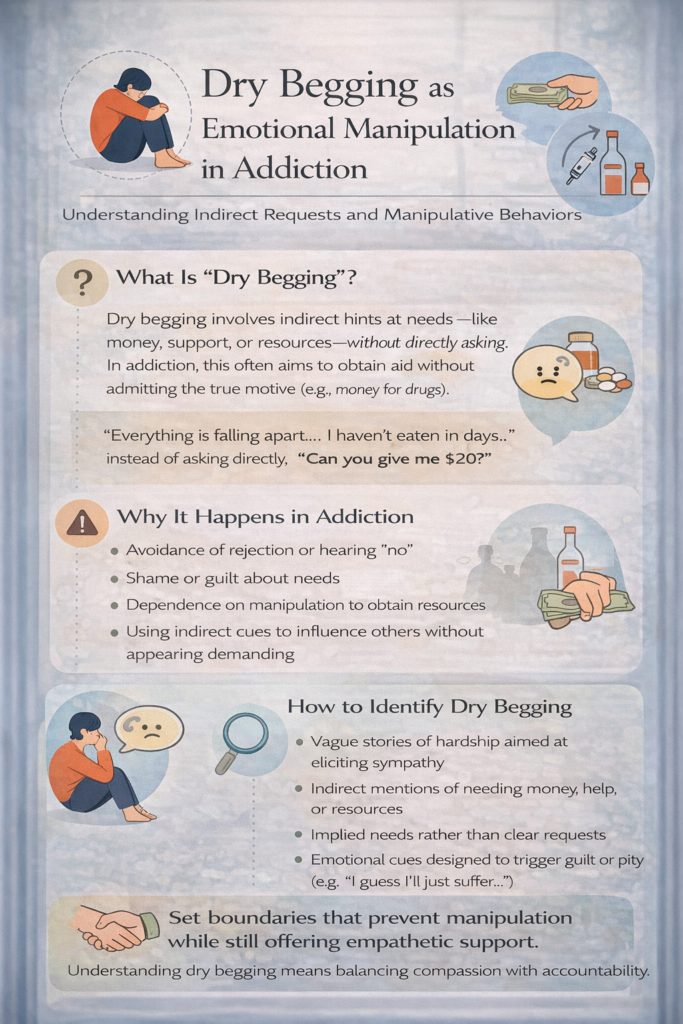
Dry begging, a form of indirect communication where individuals hint at their needs without explicitly stating them, can take on a more complex role within the context of addiction. Often driven by shame, fear of rejection, or dependency, this behavior may be used to obtain money, support, or resources without full transparency. While it can reflect genuine emotional distress, dry begging may also function as emotional manipulation, placing unspoken pressure on others to respond. In addiction, where communication patterns are often shaped by survival and substance-seeking behaviors, understanding dry begging is essential for recognizing how indirect strategies can impact relationships, enable harmful cycles, and hinder recovery.
Unspoken Needs: Dry Begging as Emotional Manipulation in Addiction
🧠 What Is “Dry Begging” in Addiction?
In the context of addiction, dry begging refers to indirectly expressing needs—often for money, substances, or support—without making a clear request. Instead of asking directly, individuals may hint, complain, or express distress in ways that invite others to offer help.
For example, someone might say, “I haven’t eaten all day, and everything is falling apart…” rather than directly asking for assistance. While this can sometimes stem from genuine distress, it can also function as a manipulative communication pattern, especially when tied to substance use.
🔍 Why It Happens in Addiction
Dry begging in addiction is often driven by a mix of emotional, psychological, and behavioral factors:
- Avoidance of rejection – Indirect hints feel safer than hearing “no.”
- Shame and guilt – Difficulty admitting needs openly
- Dependency patterns – Relying on others to meet needs indirectly
- Substance-seeking behavior – Attempting to obtain money or resources without being transparent
- Learned coping mechanisms – Past reinforcement of indirect communication
Addiction can intensify these patterns by prioritizing immediate needs over honest communication.
⚠️ Common Signs of Dry Begging in Addiction
Recognizing this behavior can help families and individuals respond more effectively.
- Vague statements about a crisis or need without clear requests
- Repeated stories of hardship aimed at eliciting sympathy
- Indirect references to needing money, food, or help
- Emotional cues designed to trigger guilt (“I guess I’ll just suffer…”)
- Expectation that others will “figure it out” and offer support
The pattern centers on implied need with emotional pressure.
🔄 How It Becomes Manipulative
While not always intentional, dry begging can become manipulative when it:
- Creates guilt-driven responses from others
- Avoids accountability or honesty about needs
- Reinforces dependency without addressing the root issue
- Enables continued substance use or harmful behavior
This dynamic often places others in a position where they feel responsible for solving problems that were never directly stated.
💔 Impact on Relationships
Dry begging in addiction can strain relationships in several ways:
- Confusion and frustration – Others are unsure how to respond
- Resentment – Feeling emotionally pressured or used
- Erosion of trust – Lack of honesty damages credibility
- Enabling cycles – Support may unintentionally sustain addiction
Over time, relationships can become imbalanced and emotionally exhausting.
🌱 Moving Toward Healthier Communication
Breaking the pattern of dry begging requires developing direct, honest communication skills.
For the individual:
- Practice clearly stating needs (“I need help with…”)
- Acknowledge underlying emotions like fear or shame
- Accept that others may say no
- Seek professional support (therapy, recovery programs)
For others (family/friends):
- Ask direct questions: “Are you asking for help?”
- Avoid responding to hints with automatic solutions
- Encourage honest communication
- Set clear, consistent boundaries
⚖️ The Role of Boundaries in Recovery
Boundaries are essential in addressing dry begging:
- They reduce enabling behaviors
- Encourage accountability
- Promote healthier interaction patterns
Boundaries are not about punishment—they are about protecting both parties and supporting recovery.
❤️ Final Thoughts
Dry begging in addiction reflects deeper struggles with communication, shame, and dependency. While it may appear manipulative, it is often rooted in unmet emotional needs and maladaptive coping strategies.
Addressing this behavior requires a balance of empathy and accountability. By encouraging direct communication and setting healthy boundaries, individuals and their support systems can move toward more honest, respectful, and recovery-focused relationships.
Clear Boundaries, Clear Communication: Self-Management Strategies to Understand Dry Begging as Emotional Manipulation
🧠 Why Self-Management Matters
Dry begging—indirectly hinting at needs to prompt others to respond—can be confusing for both the person using it and those around them. While it may come from discomfort, fear, or unmet emotional needs, it can still function as emotional manipulation when it places pressure on others without clear communication.
Self-management strategies help individuals recognize this pattern, understand its roots, and replace it with healthier communication and coping skills.
🔍 Step 1: Recognize the Behavior in Yourself
The first step is awareness.
Ask yourself:
- Do I hint at my needs instead of asking directly?
- Do I expect others to “figure out” what I need?
- Do I feel disappointed when they don’t respond?
Common signs:
- Vague complaints instead of clear requests
- Hoping others will offer help without asking
- Feeling resentful when needs aren’t met
Recognizing the pattern reduces automatic behavior.
🧠 Step 2: Identify the Underlying Emotions
Dry begging is often driven by deeper emotional experiences.
Common roots include:
- Fear of rejection (“What if they say no?”)
- Shame about needing help
- Low self-confidence in expressing needs
- Desire to avoid vulnerability
Try this:
Pause and ask: “What am I actually needing right now—support, reassurance, money, attention?”
Understanding the emotion helps you address the real need, not just the behavior.
⏸️ Step 3: Pause Before Communicating
Dry begging often happens automatically. Creating a pause allows for intentional choice.
Simple strategy:
- Stop before speaking or texting
- Ask: “Am I being clear, or am I hinting?”
This moment of awareness helps shift communication from indirect to direct.
💬 Step 4: Practice Direct and Honest Communication
Replacing hints with clarity is key.
Instead of:
- “I don’t know how I’m going to get through this…”
Try:
- “I’m struggling right now. Can you help me with ___?”
Direct communication:
- Reduces confusion
- Builds trust
- Allows others to respond honestly
It may feel uncomfortable at first—but it’s more effective and respectful.
💡 Step 5: Challenge Fear-Based Thinking
Fear often drives indirect communication.
Common thoughts:
- “They’ll say no.”
- “I’ll seem needy.”
Reframe:
- “It’s okay to ask clearly—even if the answer is no.”
- “Honest communication is healthier than guessing.”
Learning to tolerate rejection is part of emotional growth.
🌱 Step 6: Build Self-Reliance and Coping Skills
If dry begging is used to meet emotional needs, it is important to develop alternatives.
Healthy strategies:
- Journaling or self-reflection
- Stress management (exercise, breathing techniques)
- Problem-solving before seeking help
- Building confidence in handling challenges
This reduces overdependence on others.
🚫 Step 7: Accept Responsibility for Your Needs
A key shift is moving from expectation to responsibility.
- Others are not responsible for guessing your needs
- You are responsible for expressing them clearly
- Not all needs will be met—and that’s okay
This mindset builds independence and healthier relationships.
🤝 Step 8: Seek Feedback and Support
Changing communication patterns takes practice.
- Ask trusted people for honest feedback
- Work with a therapist or counselor if needed
- Reflect on interactions and learn from them
Support helps reinforce new habits.
❤️ Step 9: Practice Self-Compassion
Dry begging often comes from vulnerability—not manipulation alone.
- Avoid harsh self-judgment
- Recognize that change takes time
- Focus on progress, not perfection
Self-compassion makes growth sustainable.
💬 Final Thoughts
Understanding dry begging as emotional manipulation is not about labeling yourself negatively—it’s about gaining awareness and improving communication. By recognizing patterns, addressing underlying emotions, and practicing direct expression, individuals can replace indirect pressure with honest, respectful interaction.
Self-management is about taking control of how you communicate your needs. When needs are expressed clearly and responsibly, relationships become healthier, more balanced, and more authentic.
From Hints to Honesty: Family Support Strategies for Understanding Dry Begging as Emotional Manipulation
🏠 Why Family Support Matters
Dry begging—indirectly hinting at needs instead of expressing them clearly—can create confusion, frustration, and emotional strain within families. While it may stem from vulnerability, fear, or unmet needs, it can also function as emotional manipulation when it pressures others to respond without direct communication.
Families play a key role in recognizing this pattern, responding effectively, and encouraging healthier communication.
🧠 Understanding the Behavior, Not Just the Action
Before reacting, it’s important for families to understand that dry begging is often rooted in:
- Fear of rejection or being told “no.”
- Shame about needing help
- Difficulty expressing emotions or needs directly
- Learned patterns from past interactions
Recognizing these underlying factors helps families respond with empathy rather than frustration while still addressing the behavior.
💬 Strategy 1: Encourage Direct Communication
The goal is to shift from hints to clarity.
Helpful responses:
- “Can you tell me directly what you need?”
- “I want to help, but I need you to be clear with me.”
This:
- Reduces confusion
- Promotes honesty
- Teaches healthier communication habits
Avoid immediately responding to vague statements—this reinforces the pattern.
🔍 Strategy 2: Ask Clarifying Questions
When dry begging occurs, families can guide the conversation toward clarity.
Examples:
- “Are you asking for help right now?”
- “What specifically do you need from me?”
This approach:
- Removes guesswork
- Encourages accountability
- Keeps communication respectful
⚖️ Strategy 3: Set Clear and Consistent Boundaries
Boundaries prevent emotional pressure and reduce enabling.
Examples:
- Not responding to indirect requests
- Only helping when needs are clearly stated
- Setting limits on what support can be given
Important:
Boundaries should be firm but calm—not punitive or reactive.
🚫 Strategy 4: Avoid Reinforcing the Behavior
Responding to hints with immediate help can unintentionally reinforce dry begging.
Instead:
- Wait for a direct request
- Encourage the person to express themselves clearly
- Avoid “rescuing” based on assumptions
This helps break the cycle of indirect communication.
🌱 Strategy 5: Model Healthy Communication
Families influence behavior through example.
Demonstrate:
- Clear expression of needs and feelings
- Respectful requests for help
- Acceptance of “no” as a valid response
Modeling shows that direct communication is safe and effective.
❤️ Strategy 6: Address Emotional Needs with Empathy
Even when the behavior is problematic, the emotions behind it are real.
- Acknowledge feelings: “It sounds like you’re really struggling.”
- Separate emotion from behavior
- Offer support without reinforcing manipulation
This balances compassion with accountability.
🤝 Strategy 7: Encourage Personal Responsibility
Healthy relationships require individuals to take responsibility for their needs.
Families can reinforce:
- The importance of asking clearly
- That others are not responsible for guessing needs
- That not every request will be met—and that’s okay
This builds independence and emotional maturity.
🧩 Strategy 8: Seek Support if Patterns Persist
If dry begging becomes frequent or harmful:
- Consider family counseling
- Encourage individual therapy
- Work on communication skills together
Professional guidance can help address deeper patterns.
💬 Final Thoughts
Dry begging may appear subtle, but it can significantly impact family dynamics when it replaces clear communication with emotional pressure. Families can make a meaningful difference by encouraging honesty, setting boundaries, and responding with both empathy and clarity.
The goal is not to criticize—but to help shift from indirect, confusing interactions to open, respectful, and healthy communication. When families support this change, relationships become more balanced, transparent, and emotionally secure.
Building Awareness: Community Strategies to Understand Dry Begging as Emotional Manipulation
🌍 Why Community Strategies Matter
Dry begging—indirectly hinting at needs rather than clearly expressing them—doesn’t just affect individuals and families; it is also shaped by broader social and community contexts. Communities influence communication norms, emotional expression, and access to support systems.
By promoting awareness and healthy communication, communities can help individuals move from indirect, pressure-based interactions to clear, respectful dialogue.
🧠 Understanding Dry Begging in a Community Context
Dry begging often develops and persists due to:
- Social discomfort with expressing needs openly
- Cultural norms around avoiding vulnerability
- Lack of communication skill development
- Reinforcement through social media or peer interactions
Community strategies aim to normalize direct communication and reduce reliance on indirect emotional cues.
📚 Strategy 1: Communication Skills Education
Communities can provide education that teaches healthy, direct communication.
Examples:
- Workshops on assertiveness and self-expression
- School-based programs on emotional intelligence
- Public seminars on healthy relationships
These programs help individuals:
- Express needs clearly
- Understand boundaries
- Reduce manipulative communication patterns
🤝 Strategy 2: Support Groups and Peer Discussions
Open discussion spaces allow people to reflect on communication behaviors.
Benefits:
- Increased self-awareness
- Shared experiences and feedback
- Learning healthier interaction patterns
Peer environments help individuals recognize dry begging and practice more direct communication.
🧩 Strategy 3: Access to Mental Health Services
Dry begging is often tied to deeper emotional challenges, such as:
- Anxiety or fear of rejection
- Low self-esteem
- Difficulty with vulnerability
Community mental health resources provide:
- Counseling and therapy
- Communication skill-building
- Support for underlying emotional needs
Addressing root causes reduces reliance on indirect behaviors.
🌱 Strategy 4: Promoting Healthy Social Norms
Communities shape what is considered “normal” communication.
Efforts can include:
- Encouraging openness and honesty in relationships
- Reducing stigma around asking for help directly
- Promoting accountability and respect in interactions
When direct communication is normalized, dry begging becomes less common.
📱 Strategy 5: Digital and Social Media Awareness
Online environments can reinforce indirect communication styles.
Community initiatives can teach:
- How vague a posting can function as an indirect request
- The impact of “attention-seeking” behaviors
- Healthier ways to communicate needs online
This is especially important for younger populations.
⚖️ Strategy 6: Boundary Awareness Campaigns
Understanding boundaries is essential in reducing manipulation.
Communities can promote:
- Respect for personal limits
- The difference between support and obligation
- Healthy responses to indirect requests
This empowers individuals to respond without feeling pressured.
🤲 Strategy 7: Creating Supportive Environments
When people feel safe expressing needs, they are less likely to rely on indirect communication.
Communities can foster:
- Inclusive and supportive spaces
- Opportunities for connection and belonging
- Nonjudgmental environments for sharing concerns
Safety encourages honesty.
🔄 Strategy 8: Integrated Community Approach
The most effective strategy combines multiple elements:
- Education for awareness
- Mental health services for deeper support
- Peer groups for practice and feedback
- Public messaging to shift norms
Together, these create a culture that values clarity, respect, and emotional honesty.
💬 Final Thoughts
Dry begging as emotional manipulation is often a reflection of unmet needs and difficulty with direct communication. While it can create strain in relationships, it is also a behavior that can be understood and changed with the right support.
Communities play a vital role in this process by promoting awareness, teaching communication skills, and creating environments where individuals feel safe to express their needs openly.
When communities encourage honesty over hints and clarity over pressure, they help build healthier, more balanced relationships for everyone.
Frequently Asked Questions
Here are some common questions:
What is dry begging in the context of addiction?
Answer:
Dry begging is an indirect way of expressing needs—such as money, help, or resources—without making a direct request. In addiction, it is often used to obtain support while avoiding honesty about the true purpose, such as funding substance use.
Why do individuals in addiction use dry begging?
Answer:
Common reasons include:
- Fear of rejection or hearing “no.”
- Shame or guilt about their situation
- Desire to avoid accountability
- Learned behavior from past success using indirect requests
- Substance-seeking urgency overrides honest communication
Is dry begging always intentional manipulation?
Answer:
Not always. It can be both conscious and unconscious. Some individuals may not realize they are manipulating, while others may use it intentionally to influence others’ responses.
How is dry begging different from asking for help?
Answer:
- Dry begging: indirect, vague, and relies on others to “figure it out.”
- Direct asking: clear, honest, and respectful of the other person’s choice to say yes or no
The key difference is clarity and accountability.
What are common signs of dry begging in addiction?
Answer:
- Vague statements about hardship (“I don’t know how I’ll survive…”)
- Repeated emotional appeals without direct requests
- Hints about needing money or help
- Expecting others to offer assistance without asking
- Guilt-inducing language
How can dry begging impact relationships?
Answer:
It can lead to:
- Confusion and frustration
- Loss of trust
- Emotional exhaustion
- Resentment from feeling pressured
Over time, it damages communication and relationship stability.
Can dry begging contribute to enabling addiction?
Answer:
Yes. When others respond to indirect requests by giving money or resources, it can unintentionally support ongoing substance use, reinforcing the behavior.
How should someone respond to dry begging?
Answer:
- Ask directly: “Are you asking me for something?”
- Avoid assuming responsibility for unspoken needs
- Offer support without immediately providing resources
- Set clear and consistent boundaries
What role do boundaries play in this situation?
Answer:
Boundaries:
- Prevent manipulation and enable
- Encourage honest communication
- Protect emotional and financial well-being
They are essential for both the individual and their support system.
Can people change this behavior?
Answer:
Yes. With:
- Self-awareness
- Therapy (e.g., Cognitive Behavioral Therapy)
- Communication skill development
- Accountability and support
Individuals can learn to express needs directly and honestly.
What underlying issues are often connected to dry begging?
Answer:
- Low self-esteem
- Fear of vulnerability
- Poor communication skills
- Emotional dependence
- Unresolved trauma or stress
Addressing these issues is key to long-term change.
How can families support change without enabling?
Answer:
- Encourage direct communication
- Set firm but respectful boundaries
- Avoid responding to indirect hints
- Offer emotional support instead of financial rescue
- Suggest professional help
Why is honest communication important in recovery?
Answer:
Honest communication:
- Builds trust
- Promotes accountability
- Supports healthier relationships
- Reduces manipulation and misunderstanding
It is a core skill for sustainable recovery.
Conclusion
Dry begging as emotional manipulation in addiction highlights the intersection between unmet emotional needs and maladaptive communication patterns. Although it may stem from vulnerability and internal struggle, its indirect nature can create confusion, strain relationships, and contribute to enabling behaviors that sustain addiction. Addressing this pattern requires a balance of empathy and accountability—encouraging honest, direct communication while setting healthy boundaries. Through increased awareness, supportive interventions, and the development of clear communication skills, individuals and their support systems can move toward more transparent, respectful interactions that support long-term recovery and healthier relationships.
Video: This Begging Behavior Is More Dangerous Than Direct Asks #psychology #relationships