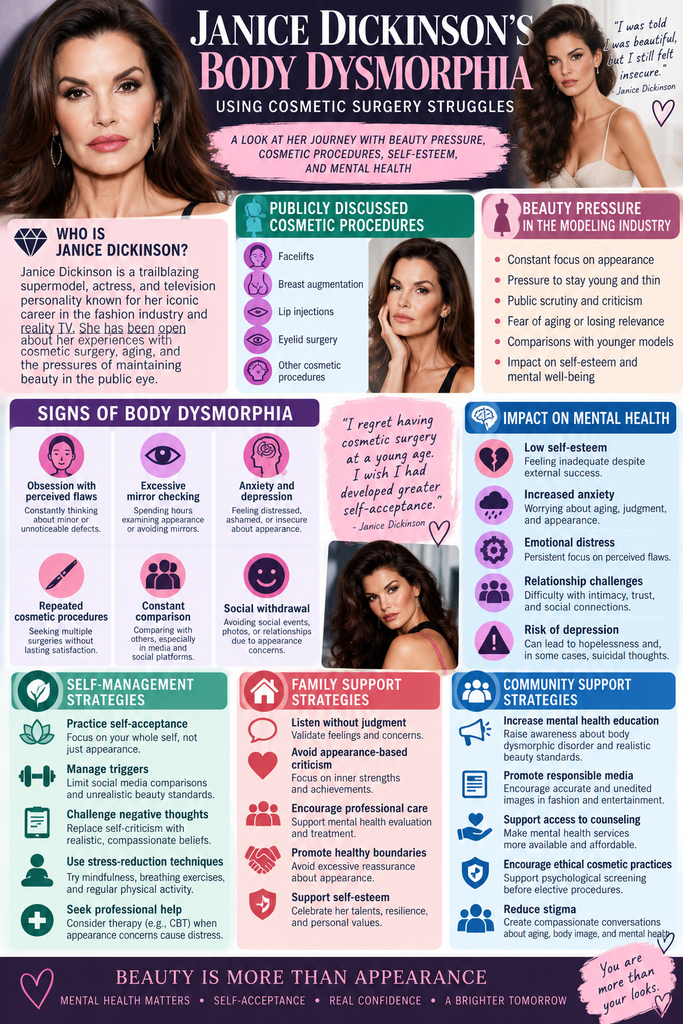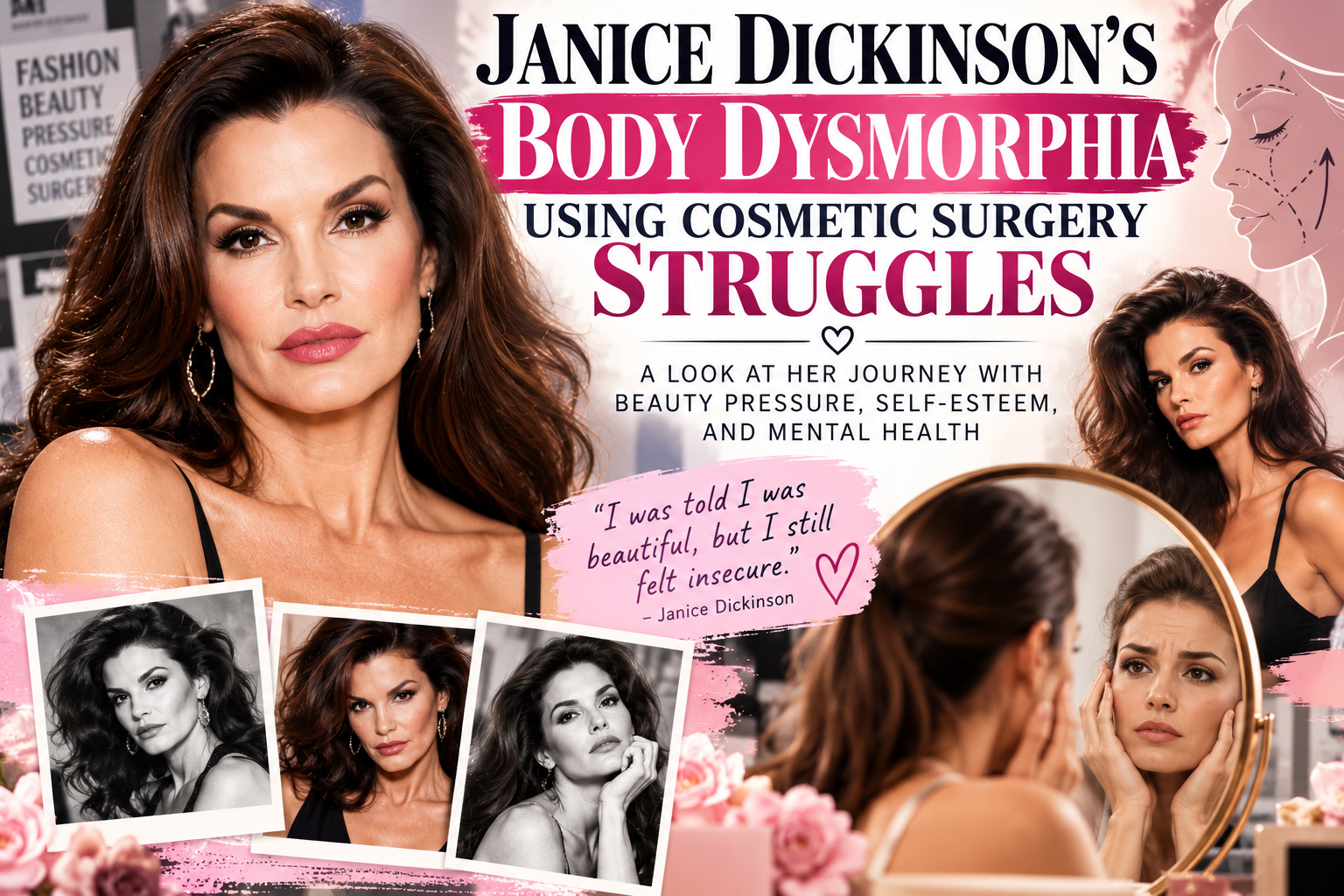
Janice Dickinson, often recognized as one of the world’s first supermodels, built a successful career in fashion, television, and entertainment. Known for her outspoken personality and striking appearance, Dickinson has publicly discussed her experiences with cosmetic surgery, aging, and the pressure to maintain beauty standards in an appearance-focused industry.
Her journey raises important questions about the psychological effects of beauty expectations, self-esteem, and the desire to maintain a youthful appearance. While Dickinson has openly acknowledged undergoing cosmetic procedures, her cosmetic surgery history alone does not establish that she has body dysmorphic disorder (BDD). A formal diagnosis requires a comprehensive mental health assessment.
Her experiences nevertheless provide an opportunity to explore how unrealistic beauty standards, public scrutiny, and emotional vulnerability can influence body image and decisions about cosmetic surgery.
Through self-management strategies, family support, and community resources, individuals experiencing body-image distress can develop healthier self-perceptions and make informed decisions about their physical and emotional well-being.
Janice Dickinson’s Journey Through Modeling and Cosmetic Surgery
1. Early Modeling Career and Beauty Expectations
Janice Dickinson rose to prominence in the 1970s and 1980s and became a recognizable figure in the international fashion industry.
Modeling environments often emphasize physical appearance, body proportions, facial symmetry, and youthfulness. Professionals may face intense pressure to meet shifting beauty standards while competing for jobs.
In these environments, appearance can become closely tied to professional identity and financial security.
Potential psychological challenges include:
- Fear of aging or losing professional relevance.
- Pressure to maintain a particular body shape.
- Constant comparison with younger models.
- Anxiety about physical imperfections.
- Difficulty separating self-worth from appearance.
- Stress related to criticism and public expectations.
These pressures can affect emotional well-being, although not everyone exposed to them develops a mental health disorder.
2. Janice Dickinson’s Publicly Discussed Cosmetic Procedures
Dickinson has spoken publicly about undergoing cosmetic surgery and other appearance-enhancing procedures during her career.
Her comments have contributed to broader conversations about cosmetic surgery, aging, and the expectations placed on women in entertainment.
People may pursue cosmetic procedures for many reasons, including personal preference, aesthetic goals, or a desire to address age-related changes.
However, when someone becomes excessively preoccupied with perceived physical imperfections, repeated procedures may fail to provide lasting emotional satisfaction.
It is important to distinguish between choosing cosmetic surgery and experiencing body dysmorphic disorder. The two are not synonymous.
3. Aging, Public Scrutiny, and Emotional Pressure
For public figures such as Dickinson, aging occurs under intense public scrutiny.
Media commentary frequently focuses on changes in facial appearance, weight, cosmetic procedures, and comparisons with earlier photographs.
This scrutiny can reinforce unrealistic expectations that women should look youthful indefinitely.
Potential emotional consequences include:
- Anxiety about visible signs of aging.
- Increased self-consciousness.
- Fear of negative public judgment.
- Pressure to pursue additional cosmetic procedures.
- Difficulty accepting normal physical changes.
- Emotional distress related to appearance-based criticism.
Recognizing these pressures can help society develop more compassionate attitudes toward aging and personal appearance.
4. Childhood Criticism and Its Influence on Self-Esteem
In a 2006 CNN interview, Dickinson discussed how her father’s criticism shaped her self-image. Despite being repeatedly told she was attractive by people in the modeling industry, she described feeling insecure and inadequate.
She also reflected on her cosmetic surgery decisions and wished she had developed greater self-acceptance when she was younger.
These disclosures demonstrate how early negative messages about appearance can persist even when an individual receives external validation.
Potential long-term consequences of appearance-related criticism include:
- Negative beliefs about personal attractiveness.
- Difficulty accepting compliments.
- Excessive concern about others’ opinions.
- Perfectionism and fear of rejection.
- Seeking external changes to address internal insecurity.
- Difficulty developing stable self-esteem.
5. Changing Perspectives on Cosmetic Surgery
Dickinson’s views about cosmetic surgery have evolved and sometimes differed across interviews.
In 2006, she expressed reservations about undergoing procedures at a young age and emphasized the importance of self-acceptance. However, in a June 2024 podcast interview, she stated that she did not regret her cosmetic procedures and discussed their benefits from her perspective.
This distinction matters. Dickinson’s experiences should not be characterized as a confirmed diagnosis of body dysmorphic disorder or as continuous dissatisfaction with her surgical outcomes.
Instead, her public statements illustrate the complex relationship between appearance, personal choice, emotional well-being, and social expectations.
Understanding the Psychological Signs of Body Dysmorphia
Body dysmorphic disorder is a psychiatric condition characterized by persistent preoccupation with perceived physical imperfections, often accompanied by repetitive behaviors and significant emotional distress.
Although Dickinson has discussed insecurities and cosmetic procedures, there is insufficient verified public information to conclude that she has BDD.
Nevertheless, her experiences provide an opportunity to educate readers about its warning signs.
Common psychological signs include:
- Obsessive appearance concerns: Spending excessive time thinking about minor or perceived physical flaws.
- Repeated mirror checking: Constantly examining facial features or avoiding mirrors because of distress.
- Excessive reassurance seeking: Frequently asking others for opinions about physical appearance.
- Unrealistic cosmetic expectations: Believing that surgery will resolve broader emotional or relationship problems.
- Persistent dissatisfaction: Continuing to feel distressed about appearance despite cosmetic changes.
- Social withdrawal: Avoiding relationships, photographs, or public activities because of perceived imperfections.
- Anxiety and depression: Experiencing emotional distress associated with negative body-image beliefs.
These symptoms warrant professional evaluation when they interfere with daily functioning.
The Connection Between Cosmetic Surgery and Emotional Well-Being
Cosmetic surgery can be a personal choice made for many legitimate reasons.
However, when procedures are pursued primarily to relieve persistent psychological distress, individuals may discover that physical changes do not resolve underlying insecurities.
For some people with BDD, the following cycle can develop:
- A perceived physical flaw becomes a source of distress.
- Anxiety and negative self-image increase.
- People pursue cosmetic surgery to feel better
- Temporary satisfaction or reassurance follows.
- Appearance-related anxiety returns or shifts to another feature.
- Additional procedures are considered.
This cycle does not describe everyone who undergoes multiple cosmetic procedures, nor should it automatically be applied to Dickinson.
Self-Management Strategies: Developing Healthy Body Image and Self-Esteem
Individuals experiencing appearance-related anxiety can benefit from strategies that strengthen emotional awareness and reduce excessive focus on physical imperfections.
The goal is not to discourage all cosmetic procedures but to help individuals make informed decisions without relying exclusively on physical changes for emotional satisfaction.
Helpful self-management strategies include:
- Identify emotional triggers: Recognize situations, memories, or social interactions that increase appearance-related anxiety.
- Challenge negative self-talk: Replace harsh self-criticism with realistic, compassionate statements.
- Reduce excessive mirror checking: Build healthier habits around checking your appearance.
- Limit social media comparisons: Reduce exposure to unrealistic beauty standards and digitally altered photographs.
- Practice mindfulness: Use meditation, breathing exercises, and grounding techniques to manage anxiety.
- Develop interests beyond appearance: Participate in hobbies, education, volunteering, and meaningful relationships.
- Practice self-acceptance: Recognize that aging and physical changes are normal parts of life.
- Consider psychological counseling: Seek CBT or other appropriate psychotherapy when appearance concerns cause significant distress.
- Evaluate cosmetic surgery motivations: Reflect on whether a procedure addresses a specific aesthetic preference or is expected to resolve broader emotional problems.
Individuals with suspected BDD should receive professional evaluation before pursuing additional elective cosmetic procedures.
Family Support Strategies: Encouraging Confidence Beyond Appearance
Family relationships can strongly influence how individuals perceive themselves.
Dickinson’s public discussion of childhood criticism highlights the importance of positive communication and emotional support, particularly during childhood and adolescence.
Families can help loved ones develop self-esteem that doesn’t depend on appearance or external approval.
Helpful family support strategies include:
- Encourage open communication: Create opportunities to discuss insecurity, aging, and appearance-related stress without judgment.
- Avoid appearance-based criticism: Refrain from negative comments about weight, facial features, or normal physical changes.
- Validate emotional distress: Acknowledge feelings without reinforcing distorted beliefs about perceived flaws.
- Promote realistic beauty expectations: Discuss the effects of photo editing, cosmetic enhancements, and media pressure.
- Encourage professional counseling: Support mental health evaluation when appearance concerns interfere with daily life.
- Avoid excessive reassurance: Repeatedly reassuring someone about their appearance can unintentionally reinforce compulsive behaviors in BDD.
- Celebrate nonphysical strengths: Recognize kindness, creativity, intelligence, resilience, and personal accomplishments.
- Respect individual autonomy: Support informed personal decisions while encouraging realistic expectations and emotional well-being.
Family members should remember that lasting confidence develops through emotional security, healthy relationships, and a sense of personal worth.
Community Support Strategies: Challenging Unrealistic Beauty Standards
Communities can help reduce body-image distress by promoting mental health education and challenging unrealistic appearance expectations.
The fashion and entertainment industries strongly influence how society defines attractiveness, aging, and physical perfection.
Greater awareness can help individuals distinguish between healthy cosmetic choices and appearance-related behaviors driven by psychological distress.
Recommended community strategies include:
- Promote body-image education: Teach individuals about healthy self-esteem and the psychological effects of unrealistic beauty standards.
- Encourage media literacy: Help people recognize photo editing, filters, and misleading beauty advertising.
- Expand access to mental health care: Provide affordable counseling and specialized BDD treatment.
- Support ethical cosmetic surgery practices: Encourage psychological screening and realistic informed consent before elective procedures.
- Reduce age-related stigma: Challenge the belief that physical aging diminishes personal worth.
- Create peer support opportunities: Connect individuals experiencing body-image concerns with reputable mental health organizations.
- Educate healthcare professionals: Improve recognition of BDD symptoms among primary care providers, dermatologists, and cosmetic surgeons.
- Encourage compassionate public conversations: Avoid ridiculing celebrities or others for their appearance or cosmetic surgery decisions.
The Role of Healthcare Professionals
Healthcare professionals play an important role in distinguishing cosmetic preferences from clinically significant body-image distress.
Before elective procedures, clinicians should consider whether patients have realistic expectations and whether appearance concerns are associated with obsessive thoughts, compulsive behaviors, or functional impairment.
Important clinical considerations include:
- Assessing appearance-related preoccupation and associated distress.
- Screening for body dysmorphic disorder when clinically indicated.
- Evaluating anxiety, depression, and suicide risk.
- Reviewing motivations for cosmetic procedures.
- Identifying unrealistic expectations regarding surgical outcomes.
- Considering referral to mental health professionals.
- Encouraging coordinated care between cosmetic surgeons and behavioral health providers.
BDD-focused cognitive behavioral therapy and serotonin reuptake inhibitor medications are evidence-based treatment options for individuals diagnosed with BDD.
Important Lessons From Janice Dickinson’s Experiences
Dickinson’s public discussions about modeling, aging, cosmetic surgery, and self-esteem offer several lessons.
First, external success and public admiration do not guarantee confidence or emotional security. Someone may receive considerable praise for their appearance while privately experiencing insecurity.
Second, childhood experiences can influence self-perception well into adulthood. Negative messages about physical appearance may become deeply ingrained beliefs that require emotional reflection and professional support.
Third, cosmetic surgery and mental health should not be treated as opposing choices. People can make informed decisions about their appearance while also prioritizing psychological well-being.
Finally, personal perspectives can change over time. Dickinson’s differing statements about cosmetic surgery demonstrate that decisions involving appearance, identity, and aging are complex and individual.
Conclusion: Looking Beyond Beauty to Understand Emotional Well-Being
Janice Dickinson’s experiences provide insight into the pressures of the modeling industry, the challenges of aging in the public eye, and the complicated relationship between physical appearance and emotional well-being.
Although her cosmetic surgery history does not establish a diagnosis of body dysmorphic disorder, her public reflections about insecurity and self-acceptance offer valuable lessons about mental health.
Her story encourages individuals to examine the emotional motivations behind cosmetic decisions and recognize that confidence cannot always be achieved through changes in physical appearance.
Through healthy self-management, compassionate family support, community education, and appropriate mental health care, individuals struggling with body-image concerns can develop greater emotional resilience and healthier self-perceptions.
Ultimately, a person’s value extends beyond physical appearance, professional success, or society’s expectations of beauty.
True confidence develops when self-worth is built on personal values, meaningful relationships, emotional well-being, and self-acceptance—not solely on physical appearance.
Mental Health Resources
- International OCD Foundation: iocdf.org — Information about body dysmorphic disorder and treatment.
- National Alliance on Mental Illness: nami.org — Mental health education and family support.
- SAMHSA: samhsa.gov — Behavioral health treatment resources.
- 988 Suicide & Crisis Lifeline: Call or text 988 for immediate emotional crisis support in the United States.
Frequently Asked Questions and Answers
1. Who is Janice Dickinson, and why is her cosmetic surgery history significant?
Janice Dickinson is an American supermodel, television personality, and author who rose to prominence in the fashion industry in the 1970s and 1980s. She has publicly discussed undergoing cosmetic procedures and the pressure to maintain her appearance. Her experiences highlight the relationship between beauty expectations, aging, self-esteem, and emotional well-being.
2. Has Janice Dickinson been diagnosed with body dysmorphic disorder?
There is no sufficiently verified public documentation establishing that Dickinson has received a formal diagnosis of BDD. Although she has discussed insecurities and cosmetic surgery, these experiences alone do not indicate a psychiatric disorder. Diagnosing BDD requires evaluating appearance-related preoccupation, repetitive behaviors, emotional distress, and functional impairment.
3. What cosmetic procedures has Janice Dickinson publicly discussed?
Dickinson has discussed procedures such as facelifts, breast augmentation, and other cosmetic enhancements. Her openness about cosmetic surgery has contributed to public conversations about aging, personal appearance, and beauty expectations. However, undergoing multiple procedures does not necessarily indicate body dysmorphia.
4. Why has Janice Dickinson pursued cosmetic surgery?
Dickinson has discussed cosmetic surgery in relation to appearance, aging, and personal preferences. Her statements have varied over time, including expressions of regret about undergoing procedures at a younger age and later comments indicating satisfaction with her choices. We should not assume her precise motivations beyond what she has publicly disclosed.
5. Did Janice Dickinson experience childhood insecurities about her appearance?
Yes. Dickinson has publicly described childhood criticism and the influence of her father’s negative comments on her self-esteem. Such experiences can contribute to persistent insecurity and difficulties developing a positive body image. However, childhood criticism does not automatically lead to BDD.
6. Has Janice Dickinson expressed regret about cosmetic surgery?
Dickinson has expressed different perspectives over the years. In some earlier interviews, she questioned undergoing cosmetic procedures at a young age and emphasized the importance of self-acceptance. In later interviews, she said she was satisfied with her cosmetic surgery decisions. These shifting perspectives show the complexity of personal choices about appearance and aging.
7. How did the modeling industry influence Janice Dickinson’s body image?
The modeling industry places considerable emphasis on appearance, youthfulness, and physical presentation. Dickinson’s career developed within an environment where beauty standards influenced professional opportunities. Such pressures can contribute to appearance-related anxiety and self-comparison, although their precise psychological effects on Dickinson cannot be independently established.
8. Did Janice Dickinson’s cosmetic surgery improve her self-esteem?
Dickinson has expressed satisfaction with cosmetic procedures in some interviews, but insufficient information exists to determine their overall effect on her long-term self-esteem. Cosmetic surgery may improve satisfaction with particular physical features, but it is not an established treatment for underlying psychological disorders.
Understanding Body Dysmorphia and Cosmetic Surgery
9. What is body dysmorphic disorder?
Body dysmorphic disorder is a mental health condition characterized by excessive preoccupation with perceived physical imperfections that are minor or not noticeable to others. Individuals often engage in repetitive behaviors such as mirror checking, excessive grooming, reassurance seeking, or comparing themselves with others. These concerns cause significant emotional distress or interfere with daily functioning.
10. What are the psychological signs of body dysmorphia?
Common psychological warning signs include:
- Persistent preoccupation with perceived physical flaws.
- Excessive mirror checking or mirror avoidance.
- Repeated comparisons with other people’s appearances.
- Seeking constant reassurance about physical features.
- Anxiety or depression related to appearance.
- Social withdrawal because of embarrassment.
- Unrealistic expectations about cosmetic procedures.
- Persistent dissatisfaction despite physical changes.
These symptoms require professional evaluation to determine whether BDD or another condition is present.
11. Can repeated cosmetic surgery indicate body dysmorphia?
Repeated cosmetic procedures may raise concern when accompanied by obsessive appearance-related thoughts, severe distress, and persistent dissatisfaction. However, multiple surgeries alone do not establish BDD. Clinicians must evaluate the individual’s motivations, expectations, behaviors, and emotional functioning.
12. Can cosmetic surgery cure body dysmorphic disorder?
No. Cosmetic surgery is not an evidence-based treatment for BDD. Although physical changes may provide temporary satisfaction, individuals with BDD often continue experiencing obsessive thoughts and appearance-related anxiety. Cognitive behavioral therapy and appropriate medications are more effective treatments for the underlying disorder.
13. Why do some people remain dissatisfied after cosmetic surgery?
Some individuals have unrealistic expectations about how surgery will affect their confidence, relationships, or happiness. Others may continue focusing on minor imperfections or develop concerns about different physical features. When BDD is present, persistent dissatisfaction may reflect underlying psychological symptoms rather than surgical outcomes alone.
14. Is cosmetic surgery addiction the same as body dysmorphia?
No. The term cosmetic surgery addiction is sometimes used informally to describe repeated procedures, but it is not a recognized psychiatric diagnosis. BDD is classified among obsessive-compulsive and related disorders. Repetitive cosmetic surgery may occur for various reasons and should not automatically be labeled an addiction.
Psychological and Emotional Effects
15. Can childhood criticism contribute to body-image problems?
Yes. Repeated criticism, teasing, bullying, or unrealistic appearance expectations during childhood may contribute to negative self-image and emotional insecurity. These experiences can shape beliefs about attractiveness and self-worth into adulthood. Supportive relationships and psychotherapy may help individuals challenge harmful beliefs.
16. How does aging affect body image in the entertainment industry?
Aging can add pressure in industries that emphasize youth and appearance. Public figures may experience criticism about wrinkles, weight changes, and cosmetic procedures. Such scrutiny can contribute to anxiety, self-consciousness, and concerns about professional relevance.
17. Can body dysmorphia lead to depression and anxiety?
Yes. BDD frequently occurs alongside depression and anxiety disorders. Individuals may experience persistent shame, social isolation, low self-esteem, and impaired functioning. BDD is also associated with increased suicidal thoughts and behaviors, making early recognition and professional treatment essential.
18. How does social media influence cosmetic surgery decisions?
Social media can expose individuals to digitally altered photographs, beauty filters, celebrity comparisons, and unrealistic physical standards. For some people, repeated exposure may increase dissatisfaction with their appearance and interest in cosmetic procedures. Developing media literacy and limiting harmful comparisons can support healthier body-image attitudes.
Self-Management Strategies
19. What self-management strategies can help someone experiencing body-image insecurity?
Helpful strategies include:
- Identifying emotional triggers related to appearance.
- Challenging negative self-talk and unrealistic beauty expectations.
- Limiting excessive social media comparisons.
- Practicing mindfulness and stress reduction.
- Building self-esteem through meaningful activities.
- Reducing compulsive mirror checking.
- Maintaining supportive relationships.
- Seeking professional counseling when appearance concerns cause distress.
These approaches can complement professional treatment when BDD is present.
20. How can someone develop self-confidence without cosmetic surgery?
Self-confidence can be strengthened by recognizing personal achievements, developing meaningful relationships, practicing self-compassion, and focusing on values beyond physical appearance. Hobbies, volunteering, education, and professional development can also reinforce a broader sense of identity.
21. Should someone experiencing body dysmorphia undergo cosmetic surgery?
When active BDD is suspected, elective cosmetic surgery should generally be postponed until a qualified mental health professional evaluates the individual’s symptoms and expectations. Treatment should first address the underlying psychological distress. Decisions about future procedures should be individualized.
22. What treatments are effective for body dysmorphic disorder?
BDD-focused cognitive behavioral therapy is a first-line psychological treatment. It helps individuals challenge distorted appearance-related beliefs and reduce repetitive behaviors. Selective serotonin reuptake inhibitors (SSRIs) are also evidence-based medication options. Some individuals benefit from combining psychotherapy and medication.
Family and Community Support
23. How can family members support someone struggling with body-image concerns?
Family members can help by listening without judgment, validating emotional distress, encouraging professional treatment, and avoiding appearance-based criticism. They should also recognize that excessive reassurance may unintentionally reinforce compulsive behaviors in individuals with BDD.
24. What should families avoid when discussing cosmetic surgery and appearance?
Families should avoid shaming individuals for cosmetic procedures, criticizing physical features, or dismissing emotional concerns as vanity. Instead, conversations should emphasize informed decisions, realistic expectations, emotional well-being, and personal autonomy.
25. How can communities reduce unrealistic beauty pressures?
Communities can promote body-image education, challenge age-related stereotypes, improve mental health literacy, and encourage responsible media representation. Schools, healthcare organizations, and entertainment industries can help by supporting diverse appearances and reducing appearance-based discrimination.
26. What role should cosmetic surgeons play in identifying body dysmorphia?
Cosmetic surgeons should assess patient expectations, appearance-related distress, and potential psychological warning signs before elective procedures. Validated screening tools may help identify individuals who require additional evaluation. When BDD is suspected, referral to a qualified mental health professional is appropriate.
27. What mental health resources are available for individuals experiencing body dysmorphia?
Individuals can seek assistance through licensed therapists, psychiatrists, community mental health clinics, and reputable support organizations. The International OCD Foundation provides educational resources about BDD, while NAMI and SAMHSA offer broader mental health information and treatment resources.
Lessons From Janice Dickinson’s Journey
28. What can Janice Dickinson’s experiences teach us about beauty and mental health?
Dickinson’s public discussions about cosmetic surgery, childhood insecurity, and aging illustrate how personal appearance can become closely connected with identity and self-esteem. Her experiences encourage greater awareness of beauty pressures while emphasizing the importance of distinguishing cosmetic preferences from psychiatric symptoms.
29. Does having cosmetic surgery mean someone has low self-esteem?
No. Individuals pursue cosmetic procedures for many reasons, including personal preference, aesthetic goals, or reconstructive needs. Cosmetic surgery does not automatically indicate low self-esteem, emotional instability, or body dysmorphia. Psychological concerns arise when appearance-related thoughts become excessive, distressing, or impair everyday functioning.
30. What is the most important lesson from Janice Dickinson’s cosmetic surgery journey?
One important lesson is that physical appearance and emotional well-being are interconnected but not identical. Cosmetic surgery can be a personal choice, while lasting psychological health depends on broader factors such as self-acceptance, supportive relationships, realistic expectations, and appropriate mental health care.
Video: