Most people occasionally return to make sure they locked the door, turned off the stove, or unplugged an appliance. With obsessive-compulsive disorder (OCD), however, checking can become an exhausting cycle. A person may check the same lock repeatedly and still walk away thinking, “But what if I didn’t check it correctly?”
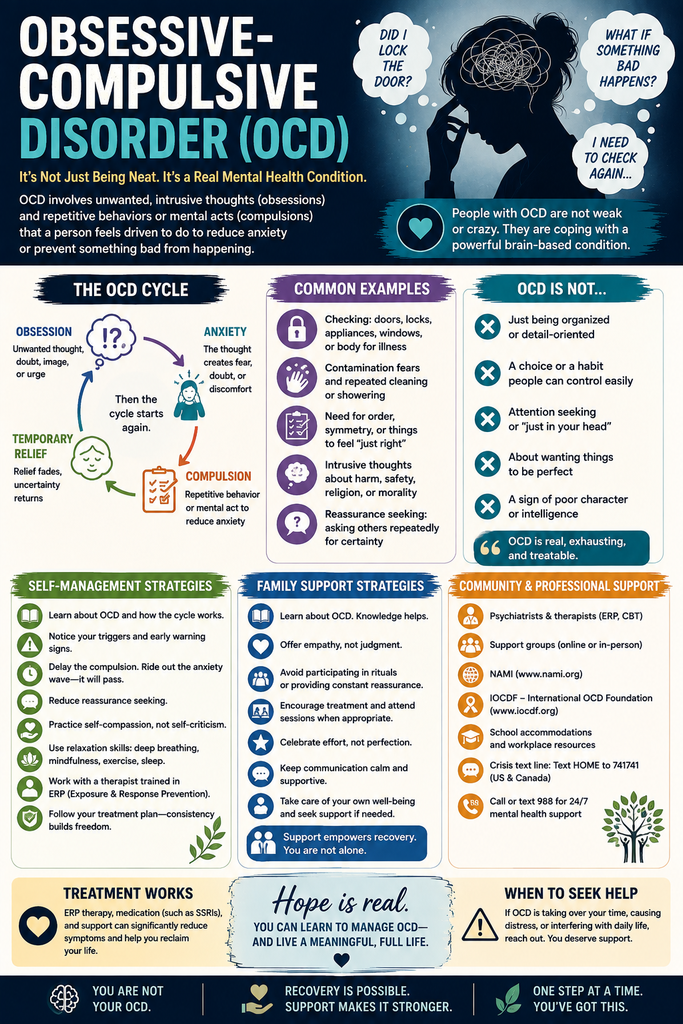
OCD is not simply being organized, particular, or cautious. It is a mental health disorder involving obsessions—recurrent, unwanted thoughts, images, urges, or doubts—and compulsions, which are repetitive behaviors or mental acts performed in an attempt to reduce distress or prevent something feared from happening.
The temporary relief produced by checking is one reason the cycle can become so powerful. Understanding this pattern can help individuals and families respond in ways that support recovery rather than unintentionally strengthening OCD.
Why Doesn’t One Check Feel Like Enough?
Imagine locking your front door before going to bed.
You pull the handle once and see that it is locked. Logically, you know you checked it. But then a thought appears:
“What if I only thought I locked it?”
You check again.
For a moment, anxiety decreases. Then another doubt appears:
“What if I didn’t pull hard enough?”
You return for another check.
This illustrates an important feature of OCD: the problem is often not the person’s ability to check. The problem is that checking does not produce lasting certainty.
Understanding the OCD Cycle
The cycle often begins with an intrusive thought or doubt.
For example:
Obsession: “What if I left the stove on and the house catches fire?”
This produces anxiety, guilt, or a sense of responsibility.
Compulsion: The person checks the stove.
Anxiety temporarily decreases.
Then uncertainty returns:
“But what if I checked the wrong burner?”
The person checks again.
The temporary relief teaches the brain that checking was necessary to feel safe. Over time, the urge to perform the compulsion can become stronger.
The cycle can look like:
Intrusive thought → Anxiety → Compulsion → Temporary relief → More doubt → Repeat
Breaking this cycle is an important goal of OCD treatment.
Common Checking Compulsions
Checking OCD can involve much more than doors and appliances.
Someone might repeatedly:
- Check locks, windows, faucets, or appliances
- Return home to make sure something was turned off
- Check their body for signs of illness
- Review emails or messages repeatedly before sending them
- Check work repeatedly for possible mistakes
- Ask other people whether something is safe
- Replay conversations to determine whether they said something offensive
- Check whether they accidentally harmed someone
- Search online repeatedly for reassurance
- Review memories to determine whether something bad happened
- Repeatedly confess thoughts or minor mistakes
Some compulsions are visible, while others occur entirely within a person’s mind.
Reassurance Can Become Another Compulsion
A person with OCD may repeatedly ask:
“Are you sure I locked the door?”
“Do you think I’m a bad person?”
“Are you sure I’m not sick?”
“Did I hurt anyone?”
A family member naturally wants to reduce the person’s anxiety and may repeatedly respond, “Everything is fine.”
This can provide immediate relief.
Unfortunately, repeated reassurance can sometimes become part of the OCD cycle. The person learns to depend on another person for certainty rather than to tolerate uncertainty.
This does not mean families should become cold or dismissive. The goal is to provide emotional support without repeatedly participating in compulsions.
OCD Is Not About Wanting Attention
People with OCD usually do not enjoy their compulsions.
They may recognize that repeatedly checking something seems excessive but still experience overwhelming discomfort when trying to resist the behavior.
Some individuals spend significant time performing rituals before leaving home, going to sleep, completing assignments, or making everyday decisions.
This can interfere with:
- Work
- School
- Relationships
- Sleep
- Parenting
- Social activities
- Independence
- Daily responsibilities
Severe OCD can consume hours of a person’s day.
Self-Management Strategies for OCD
Self-management can complement professional treatment. The goal is not to eliminate every unwanted thought. Instead, people can learn to change how they respond to those thoughts.
Recognize the OCD Pattern
Practice identifying the sequence:
“I am experiencing uncertainty, and my urge is telling me to check again.”
Recognizing the pattern creates space between the thought and the response.
Reduce Reassurance Seeking
Notice when you repeatedly ask other people to confirm that everything is okay.
Before asking, consider whether you are seeking useful information or temporary relief from anxiety.
Delay the Compulsion
When appropriate within a treatment plan, practice waiting before performing a ritual. Even a small delay can help you recognize that anxiety can change without immediately responding to it.
Stop Chasing Perfect Certainty
Everyday life contains uncertainty. OCD often demands a level of certainty that reality cannot provide.
Recovery involves learning:
“I cannot have 100% certainty, and I can tolerate that uncertainty.”
Track Your Triggers
Keep notes about situations that trigger obsessions, compulsions, avoidance, or reassurance seeking. This information can be useful when working with a therapist.
Practice Healthy Routines
Regular sleep, physical activity, balanced nutrition, stress management, and supportive relationships cannot cure OCD, but they can support overall mental health during treatment.
Family Support Strategies
Family members can become deeply involved in OCD rituals without realizing it. They may check locks for the person, answer the same reassurance question repeatedly, change household routines, or help the individual avoid triggers.
This is sometimes called family accommodation.
Families can help by:
- Learning how OCD obsessions and compulsions operate
- Encouraging evidence-based professional treatment
- Listening without criticizing or mocking fears
- Avoiding arguments about whether an intrusive thought is “ridiculous”
- Gradually reducing participation in rituals with professional guidance
- Establishing consistent responses to repeated reassurance seeking
- Praising efforts to resist compulsions rather than demanding perfection
- Recognizing small improvements
- Maintaining appropriate household boundaries
- Participating in family therapy or OCD education when recommended
Instead of saying, “That’s ridiculous. You already checked it,” a family member might say:
“I know the uncertainty feels uncomfortable. I don’t want to help OCD by checking again, but I’ll support you while you work through the anxiety.”
This approach separates the person from the disorder.
Community Support Strategies
People with OCD benefit when communities recognize the disorder as a legitimate mental health condition rather than a personality quirk.
Helpful community resources may include:
- Mental health professionals experienced in treating OCD
- Cognitive behavioral therapy programs
- Exposure and response prevention specialists
- Psychiatry services when medication evaluation is appropriate
- OCD support groups
- Peer-support communities
- School counselors and disability services
- Workplace mental health resources
- Family education programs
- Telehealth services when specialized treatment is unavailable locally
Schools and workplaces can also help by recognizing that severe OCD may interfere with concentration, punctuality, productivity, and completing tasks.
Exposure and Response Prevention (ERP)
One of the most established psychological treatments for OCD is exposure and response prevention, commonly called ERP.
During ERP, a person gradually encounters situations that trigger obsessive fears while practicing not performing the usual compulsion.
For someone with checking OCD, treatment might eventually involve checking a door appropriately once and then leaving without returning to check again.
The goal is not to convince the person that nothing bad could ever happen.
Instead, the person learns:
“I can experience uncertainty without performing the ritual.”
ERP should be individualized, particularly when symptoms are severe or when it is difficult to distinguish reasonable safety behavior from compulsive checking.
Medication Can Also Help
Medication may be recommended for some people with OCD. Selective serotonin reuptake inhibitors (SSRIs) are commonly used, often at treatment approaches specifically tailored for OCD.
Medication and psychotherapy are not competing forms of treatment. Some people benefit from ERP alone, while others may benefit from medication combined with therapy.
Treatment decisions should be made with an appropriately qualified healthcare professional.
Intrusive Thoughts Do Not Define Character
OCD can involve disturbing intrusive thoughts about violence, sexuality, religion, relationships, contamination, mistakes, or causing harm.
Having an unwanted intrusive thought does not mean a person wants to act on it.
In fact, OCD thoughts are often distressing precisely because they conflict with the person’s values.
Misunderstanding intrusive thoughts can create enormous shame and prevent people from seeking treatment.
Recovery Is About Responding Differently
Successful OCD treatment does not necessarily mean never experiencing another intrusive thought.
Everyone experiences unwanted thoughts occasionally.
Recovery is more about learning that a thought does not require an investigation, ritual, reassurance, or immediate response.
The person begins moving from:
“I must be completely certain.”
to:
“I can live my life even when certainty isn’t available.”
Conclusion
For someone with OCD, checking once may not feel sufficient because the disorder continually creates another possibility to investigate: What if I missed something? What if my memory is wrong? What if this time is different?
Checking temporarily reduces anxiety, but that relief can reinforce the cycle and make another check feel necessary.
Treatment helps interrupt this pattern. Exposure and response prevention, cognitive behavioral approaches, medication when appropriate, family education, and community support can help people regain control over their time and daily lives.
Families can contribute by offering compassion without repeatedly feeding reassurance rituals. Communities can improve access to specialized OCD treatment and challenge the misconception that OCD simply means being neat or particular.
The goal of OCD recovery is not perfect certainty. It is developing the ability to experience uncertainty without allowing compulsions to control your life.
Frequently Asked Questions
Here are some common questions:
1. What is obsessive-compulsive disorder (OCD)?
OCD is a mental health disorder characterized by obsessions—recurrent, unwanted thoughts, images, urges, or doubts—and compulsions, repetitive behaviors or mental rituals performed to reduce distress or prevent a feared outcome.
2. Is OCD just about being extremely clean or organized?
No. This is a common misconception. OCD can involve contamination, checking, harm, religion, relationships, symmetry, health concerns, unwanted sexual thoughts, or fears about making mistakes. Some people with OCD have no unusual concern about cleanliness at all.
3. Why does someone with OCD keep checking the same thing?
Checking can temporarily reduce anxiety but may not provide lasting certainty. A person might check a locked door and then think, “What if I didn’t check correctly?” Checking again brings temporary relief, which can reinforce the behavior and keep the OCD cycle going.
4. What is the OCD cycle?
A common pattern is:
Obsession → Anxiety or distress → Compulsion → Temporary relief → Doubt returns → Compulsion repeats
Treatment often focuses on interrupting this cycle rather than trying to eliminate every unwanted thought.
5. What are common obsessions in OCD?
Obsessions can include fears about contamination, accidentally harming someone, making a serious mistake, illness, morality, relationships, religion, losing control, or something terrible happening because a task was not performed correctly.
6. What are common compulsions?
Compulsions can include excessive washing, checking locks or appliances, arranging objects, counting, repeating words, reviewing memories, mentally repeating phrases, confessing, researching fears online, or repeatedly asking others for reassurance.
7. Can compulsions happen entirely inside someone’s mind?
Yes. Mental compulsions can include silently counting, reviewing past events, analyzing thoughts, repeating certain phrases, praying excessively, or mentally trying to “cancel out” an unwanted thought. Because these behaviors are invisible, OCD may sometimes go unnoticed.
8. Why doesn’t reassurance permanently calm someone with OCD?
Reassurance may temporarily decrease anxiety, but uncertainty often returns. The person may then seek reassurance again. Over time, repeated reassurance can unintentionally become another compulsion.
9. Does a disturbing intrusive thought mean someone secretly wants it to happen?
No. Unwanted intrusive thoughts can be extremely disturbing precisely because they conflict with the person’s values. Experiencing an intrusive thought is not the same as intending to act on it.
10. Does everyone who double-checks something have OCD?
No. Occasional checking is normal. OCD becomes a concern when obsessions and compulsions are time-consuming, cause significant distress, or interfere with work, school, relationships, sleep, or everyday functioning.
11. What causes OCD?
There is no single cause. Research suggests that OCD develops through a combination of biological, genetic, psychological, and environmental factors. It is not caused by weak character, poor parenting, or simply “thinking too much.”
12. Can stress make OCD worse?
Yes. Stress, major life changes, sleep disruption, illness, relationship difficulties, and other challenges may intensify symptoms in some people. Stress management can be helpful, although reducing stress alone does not necessarily treat OCD.
13. What is exposure and response prevention (ERP)?
ERP is an evidence-based psychological treatment for OCD. A person gradually encounters situations that trigger obsessive fears while practicing not performing the usual compulsion. Over time, this helps the person develop a different relationship with anxiety and uncertainty.
14. Is ERP the same as forcing someone to face their biggest fear immediately?
No. Proper ERP is individualized and typically planned collaboratively with the person. Treatment can progress gradually rather than unexpectedly forcing someone into an overwhelming situation.
15. Can medication help OCD?
Yes. Certain medications, particularly selective serotonin reuptake inhibitors (SSRIs), can reduce OCD symptoms for some people. Medication may be used alone or with psychotherapy depending on individual circumstances.
16. How can family members help someone with OCD?
Families can learn about OCD, encourage appropriate treatment, listen without judgment, recognize progress, and work toward reducing participation in compulsions or repeated reassurance. Changes in family accommodation may be easier with guidance from an OCD-trained professional.
17. What should family members avoid saying?
Statements such as “Just stop thinking about it,” “You’re being ridiculous,” or “You know that doesn’t make sense” can increase shame without addressing the disorder. Compassion combined with appropriate boundaries is generally more helpful.
18. Can children and teenagers develop OCD?
Yes. OCD can occur in children and adolescents as well as adults. Young people may have difficulty explaining why they perform rituals, so symptoms can sometimes be mistaken for stubbornness, excessive perfectionism, or behavioral problems.
19. Can OCD go away completely?
Experiences vary. Many people achieve substantial symptom improvement with appropriate treatment and learn skills that allow OCD to interfere much less with their lives. Symptoms may fluctuate, particularly during stressful periods.
20. When should someone seek professional help?
Consider professional evaluation when intrusive thoughts or repetitive behaviors cause significant distress, consume substantial time, interfere with normal activities, or become difficult to control. A clinician experienced in OCD and ERP can help determine an appropriate treatment approach.
Video: Why one check is never enough #OCD #mentalhealth #shorts