Distinguishing between childhood trauma and indiscipline is one of the most important—and often most misunderstood—aspects of understanding a child’s behavior. Actions that appear defiant, disruptive, or disrespectful may not always be intentional choices; in many cases, they can be expressions of stress, fear, or unresolved experiences. Because children often lack the language to explain what they’re feeling, their behavior becomes their primary form of communication. Recognizing whether a child is reacting out of emotional distress or testing boundaries is essential for responding in ways that support both their development and well-being.
Childhood Trauma vs. Indiscipline: Understanding the Difference Behind a Child’s Behavior
Children don’t always have the words to explain what they’re feeling—so they show it through behavior. What looks like defiance, disrespect, or “bad attitude” can sometimes be something much deeper. The challenge for parents, caregivers, and educators is knowing when a child needs discipline—and when they actually need support.
Understanding the difference between childhood trauma and indiscipline isn’t about excusing behavior. It’s about responding in a way that actually helps the child grow.
What Is Childhood Trauma?
Childhood trauma refers to distressing experiences that overwhelm a child’s ability to cope. These can include:
- Abuse (physical, emotional, or sexual)
- Neglect
- Loss of a caregiver
- Exposure to violence
- Chronic instability or fear
Trauma affects how a child’s brain processes stress, emotions, and relationships. Instead of feeling safe and regulated, they may stay in a constant state of alert or shutdown.
What Is Indiscipline?
Indiscipline typically refers to behavior where a child knowingly breaks rules or boundaries. It may involve:
- Testing limits
- Seeking attention
- Avoiding responsibility
- Acting out for control or independence
In these cases, the child usually has the capacity to regulate their behavior but chooses not to in that moment.
Why the Confusion Happens
Trauma and indiscipline can look very similar on the surface.
A child who:
- Refuses to listen
- Has emotional outbursts
- Appears oppositional
- Struggles with authority
…might be labeled as “difficult” or “disrespectful.”
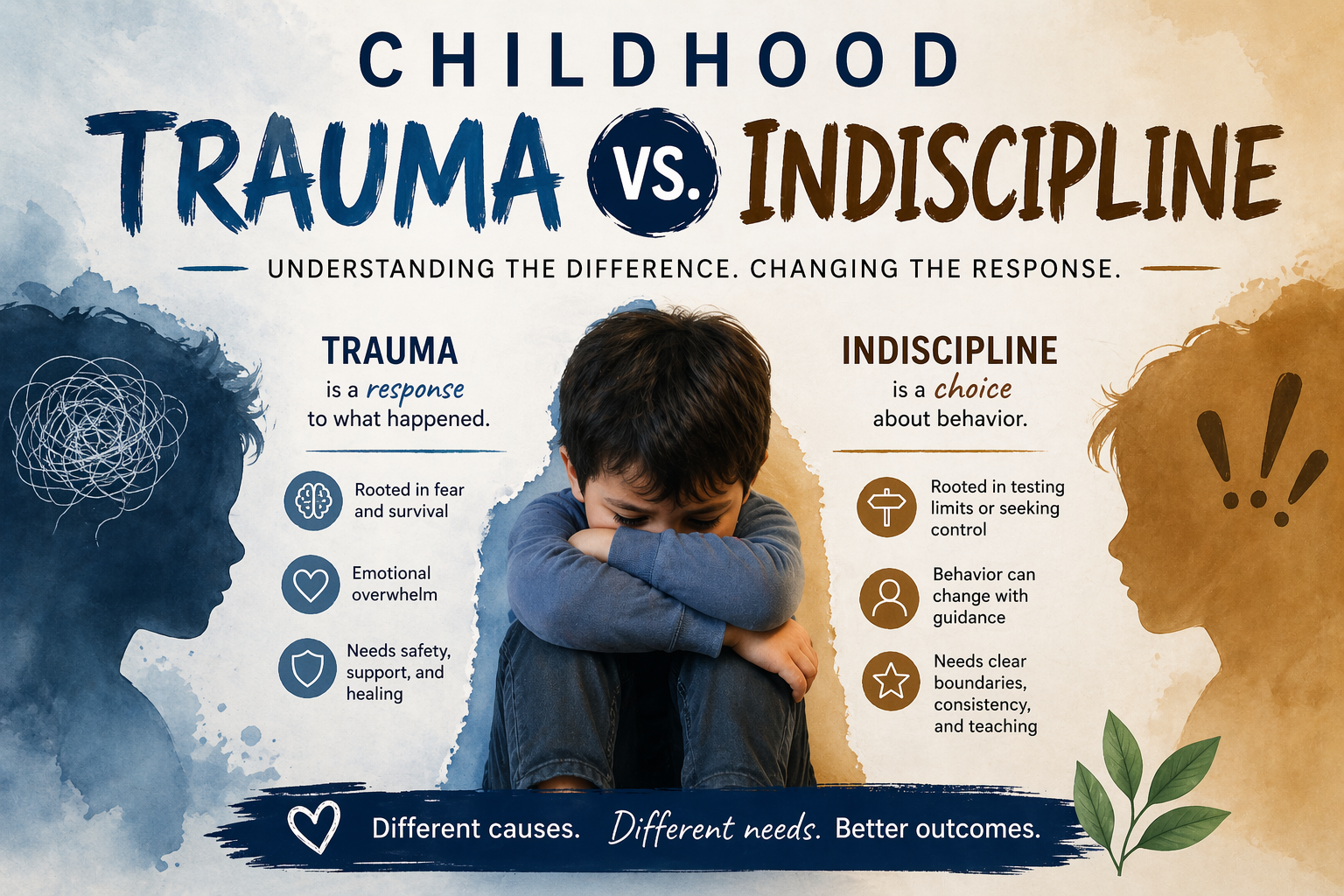
But trauma-driven behavior is often not a choice—it’s a response. The child’s nervous system is reacting, not calculating.
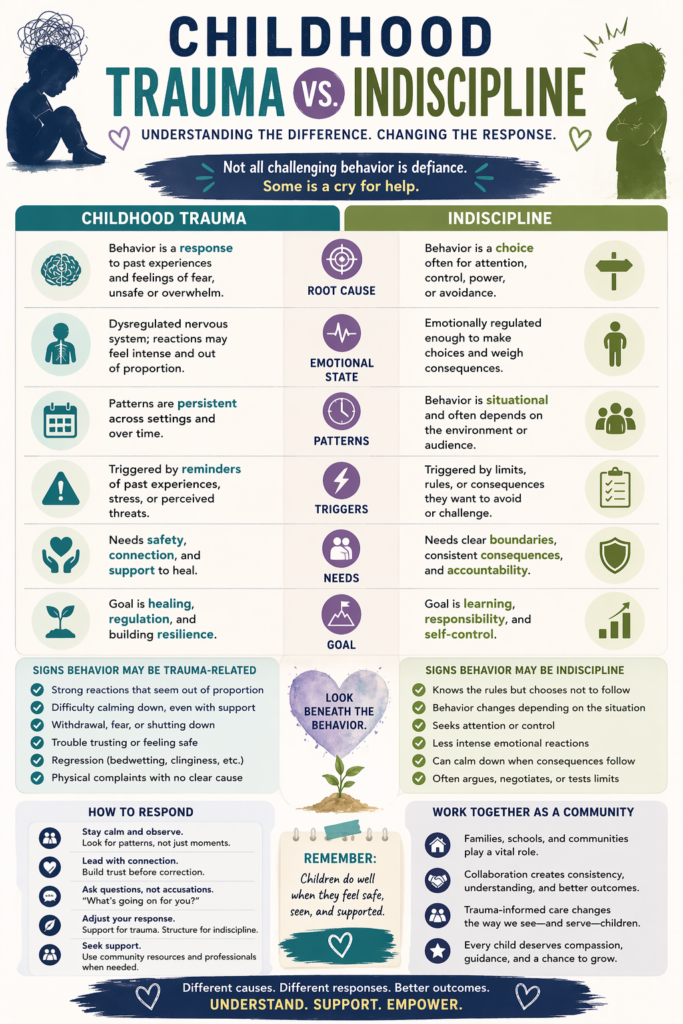
Key Differences to Look For
1. Intent vs. Reaction
- Indiscipline: Often involves choice or testing boundaries
- Trauma: Behavior feels automatic, intense, or out of proportion
2. Emotional Regulation
- Indiscipline: The child can calm down with guidance
- Trauma: The child struggles to self-regulate even with support
3. Consistency
- Indiscipline: Behavior may be situational (e.g., only at school or only at home)
- Trauma: Patterns tend to be persistent across environments
4. Triggers
- Indiscipline: Linked to rules, limits, or consequences
- Trauma: Linked to perceived threats, stress, or reminders of past experiences
Common Trauma Responses That Get Misinterpreted
- Aggression: A defense mechanism, not just “bad behavior.”
- Withdrawal: Often mistaken for laziness or disinterest
- Hyperactivity: May be a sign of anxiety or hypervigilance
- Defiance: Can stem from a need for control or safety
When viewed through a trauma lens, the question shifts from “What’s wrong with this child?” to “What happened to this child?”
Why It Matters
Mislabeling trauma as indiscipline can lead to:
- Punishments that worsen the child’s distress
- Missed opportunities for emotional support
- Reinforcement of shame or fear
On the other hand, ignoring true behavioral boundaries can also be unhelpful. Children need both structure and understanding.
A Balanced Approach: Discipline + Support
The goal isn’t to eliminate discipline—it’s to make it informed.
Helpful strategies include:
- Stay calm and consistent: Regulation starts with the adult
- Focus on connection first: A child can’t learn when overwhelmed
- Teach emotional skills: Help them name and manage feelings
- Set clear boundaries: Safety and structure still matter
- Look for patterns: Repeated behaviors often point to deeper needs
When to Seek Extra Support
If a child shows:
- Frequent intense outbursts
- Ongoing withdrawal or fear
- Difficulty trusting others
- Sudden behavioral changes
…it may be helpful to involve a mental health professional trained in trauma-informed care.
Final Thought
Not all difficult behavior is defiance—and not all defiance is trauma. The key is learning to tell the difference.
When adults respond with both clarity and compassion, children are more likely to feel safe enough to change—not just behave better, but heal and grow.
Responding, Not Reacting: Self-Management Strategies to Understand Childhood Trauma vs. Indiscipline
When a child’s behavior becomes challenging, the instinct is often to correct it quickly. But not all behavior is the same. Some actions come from testing limits (indiscipline), while others come from deeper emotional wounds (trauma). The difficulty is that they can look almost identical at the moment.
Self-management—how you regulate, interpret, and respond—is one of the most powerful tools in telling the difference. Before guiding a child, you have to steady your own reaction.
Why Self-Management Matters First
Children, especially those affected by trauma, are highly responsive to adult reactions. If you respond with frustration, urgency, or a sense of control, it can escalate the situation—regardless of the root cause.
Self-management helps you:
- Pause instead of reacting impulsively
- Interpret behavior more accurately
- Choose responses that teach rather than punish
It shifts the focus from “How do I stop this behavior?” to “What does this behavior need from me?”
1. Pause Before You Label the Behavior
The quickest mistake is labeling behavior as “bad” without understanding it.
Instead of:
- “They’re being disrespectful.”
Try:
- “What might be driving this reaction?”
This pause creates space to consider whether the behavior is:
- A choice (indiscipline), or
- A response (trauma-related)
2. Regulate Your Own Emotions First
A dysregulated adult cannot regulate a child.
Before responding:
- Take a breath
- Lower your tone
- Slow your body language
If you feel triggered, it’s often a sign to step back briefly. Your calm presence communicates safety—especially to a child experiencing trauma.
3. Look for Patterns, Not Just Moments
One incident doesn’t tell the full story.
Ask yourself:
- Does this happen across different settings?
- Are there specific triggers (stress, transitions, certain people)?
- Is the reaction intense or out of proportion?
Patterns often reveal whether behavior is rooted in emotional distress rather than simple rule-breaking.
4. Separate the Child from the Behavior
Self-management includes how you think—not just how you act.
Avoid internal narratives like:
- “This child is difficult.”
Shift to:
- “This behavior is difficult.”
This subtle change helps you stay compassionate while still addressing the issue.
5. Ask “What Does This Child Need Right Now?”
This question is a powerful reset.
- If it’s indiscipline, the need might be:
- Clear boundaries
- Consistent consequences
- Guidance on expectations
- If it’s trauma, the need might be:
- Safety and reassurance
- Emotional support
- Help calming down
Same behavior—different response.
6. Avoid Power Struggles
Power struggles often escalate both trauma responses and indiscipline.
Instead:
- Offer choices where appropriate
- Stay firm but calm
- Focus on cooperation, not control
Children learn more from connection than confrontation.
7. Reflect After the Situation (Not Just During It)
Self-management continues after the moment passes.
Ask yourself:
- What triggered me?
- How did I respond?
- What might I try differently next time?
This builds awareness over time and improves future responses.
8. Build Emotional Awareness (Yours and Theirs)
Children often act out what they can’t express.
You can support this by:
- Naming emotions (“It seems like you’re frustrated”)
- Modeling calm communication
- Encouraging expression without judgment
Over time, this reduces both reactive behavior and misunderstandings.
9. Know When You Need Support Too
Understanding trauma vs. indiscipline is complex. You don’t have to figure it out alone.
Consider:
- Parenting support groups
- Trauma-informed education resources
- Guidance from counselors or child specialists
Self-management improves when you feel supported rather than overwhelmed.
Final Thought
Not every challenging behavior is defiance—and not every moment requires discipline. The difference often depends on how we interpret and respond in real time.
Self-management is the bridge between reaction and understanding. When you slow down, regulate yourself, and look more deeply, you create the conditions for children not just to behave differently but to feel safe enough to be different.
And that’s where real change begins.
Seeing the Whole Child: Family Support Strategies to Understand Trauma vs. Indiscipline
Families are often the first to respond when a child’s behavior becomes difficult—but also the first to misinterpret it. What looks like defiance, disrespect, or stubbornness can sometimes be a child’s way of expressing stress, fear, or unresolved experiences. The challenge isn’t just managing behavior—it’s understanding why it’s happening.
Distinguishing between childhood trauma and indiscipline requires more than rules or consequences. It requires a shift in how families observe, interpret, and respond to behavior.
Why Family Understanding Matters
Children don’t exist in isolation—their behavior is shaped and influenced by their environment. Families who understand the difference between trauma responses and indiscipline are better equipped to:
- Respond in ways that reduce escalation
- Build trust and emotional safety
- Teach healthy behavior more effectively
Without this understanding, well-intended discipline can sometimes intensify underlying distress.
1. Shift from “What’s Wrong?” to “What Happened?”
This is one of the most important mindset changes.
Instead of:
- “Why are they acting like this?”
Try:
- “What might be driving this behavior?”
- Indiscipline often comes from testing limits or seeking control
- Trauma often comes from feeling unsafe, overwhelmed, or triggered
This question doesn’t excuse behavior—it deepens your understanding of it.
2. Recognize Emotional Signals Behind Behavior
Children rarely explain their emotions directly. They show them.
Family members can look for:
- Sudden mood changes
- Overreactions to small situations
- Withdrawal or avoidance
- Intense fear, anger, or sadness
Trauma-related behaviors tend to feel bigger and less controlled than typical misbehavior.
3. Stay Consistent—but Flexible
Structure is important for all children—but how it’s applied matters.
- For indiscipline, consistency in rules and consequences helps teach responsibility
- For trauma, consistency in emotional safety and reassurance is just as important
Families can balance both by:
- Keeping clear expectations
- Adjusting responses based on emotional state
- Avoiding rigid, one-size-fits-all reactions
4. Lead with Connection Before Correction
Children are more receptive to guidance when they feel safe.
Before correcting behavior:
- Get on their level (physically and emotionally)
- Use a calm tone
- Acknowledge their feelings
Connection doesn’t remove boundaries—it makes them more effective.
5. Avoid Labels That Limit Understanding
Labels like “lazy,” “difficult,” or “disrespectful” can oversimplify complex behavior.
Instead:
- Describe the behavior, not the child
- Stay curious rather than judgmental
- Recognize that repeated patterns often signal unmet needs
Labels can close the door to understanding; curiosity keeps it open.
6. Watch for Triggers and Patterns
Trauma-related behaviors are often tied to specific triggers.
Families can observe:
- When behavior escalates (time of day, environment, interactions)
- Situations that consistently lead to emotional reactions
- Changes after stressful events
Patterns provide clues that help differentiate reaction from choice.
7. Model Emotional Regulation
Children learn how to handle emotions by watching adults.
Family members can:
- Stay calm during conflict
- Express emotions in healthy ways
- Take breaks when overwhelmed
A regulated adult helps create a regulated environment.
8. Balance Accountability with Compassion
Understanding trauma doesn’t mean removing all consequences.
It means:
- Holding boundaries without harshness
- Teaching behavior instead of just punishing it
- Explaining expectations clearly
For example:
- “That behavior isn’t okay—but I understand you’re upset. Let’s figure this out.”
This approach builds both responsibility and trust.
9. Encourage Open Communication
Children are more likely to share when they feel safe from judgment.
Families can:
- Create regular check-in moments
- Listen without interrupting or correcting immediately
- Validate feelings, even when addressing behavior
Over time, this reduces the need for behavior to “speak” for them.
10. Seek Support When Needed
If a child shows:
- Persistent emotional outbursts
- Ongoing fear or withdrawal
- Sudden behavioral changes
…it may be helpful to involve a professional trained in trauma-informed care.
Support strengthens—not replaces—the role of the family.
Final Thought
Not all challenging behavior is defiance—and not all defiance is rooted in trauma. The difference often lies in how families choose to see and respond to what’s happening beneath the surface.
When families combine structure with empathy, and discipline with understanding, they create an environment where children don’t just learn to behave—they learn to feel safe, understood, and capable of change.
It Takes a Community: Resource Strategies to Understand Childhood Trauma vs. Indiscipline
When a child’s behavior becomes challenging, families and educators often carry the responsibility of figuring it out alone. But understanding the difference between childhood trauma and indiscipline is not something that has to happen in isolation. Community resources—when used effectively—can provide the knowledge, perspective, and support needed to respond to children in more informed and compassionate ways.
The goal isn’t just to manage behavior. It’s to understand what’s behind it—and communities play a critical role in making that possible.
Why Community Resources Matter
Children exist within larger systems—schools, neighborhoods, healthcare settings, and social environments. These systems can either reinforce misunderstanding or promote deeper awareness.
Community resources help:
- Educate caregivers and professionals on trauma-informed care
- Provide tools to distinguish behavior from emotional distress
- Offer support beyond the immediate family
They expand the lens from “this child’s behavior” to “this child’s experience within a broader context.”
1. Parenting Workshops and Education Programs
Many communities offer classes or workshops focused on child development and behavior.
These programs can:
- Teach the difference between trauma responses and typical misbehavior
- Provide practical discipline strategies that don’t escalate distress
- Help caregivers understand emotional regulation in children
Look for:
- Local community centers
- Schools or early childhood programs
- Nonprofit family services organizations
Education reduces guesswork and builds confidence in responding effectively.
2. School-Based Support Systems
Schools are often where behavioral concerns become most visible.
Key resources include:
- School counselors or psychologists
- Behavioral intervention programs
- Social-emotional learning (SEL) initiatives
These professionals can:
- Observe patterns across environments
- Identify whether the behavior is consistent with trauma responses
- Collaborate with families to create supportive strategies
Partnership between home and school is essential for an accurate understanding.
3. Community Mental Health Services
Local mental health clinics and child specialists provide deeper evaluation and guidance.
They can help:
- Assess whether behavior is linked to trauma
- Offer therapy or trauma-informed interventions
- Guide families on appropriate discipline approaches
These services are especially important when behavior is persistent, intense, or worsening over time.
4. Support Groups for Caregivers
Connecting with other parents or caregivers can provide both emotional support and practical insight.
Benefits include:
- Sharing real-life experiences
- Learning how others navigate similar challenges
- Reducing feelings of isolation or self-doubt
Hearing different perspectives can help caregivers rethink assumptions about behavior.
5. Youth Programs and Safe Spaces
After-school programs, mentoring initiatives, and recreational groups offer structured, supportive environments for children.
These settings can:
- Promote emotional expression and social skills
- Provide stability and routine
- Allow trained adults to observe behavior in different contexts
For children affected by trauma, safe environments outside the home can be especially impactful.
6. Faith-Based and Cultural Organizations
For many families, community support is rooted in shared values and cultural understanding.
These organizations may offer:
- Counseling or mentorship programs
- Family support services
- Safe spaces for open discussion
When aligned with a family’s beliefs, these resources can feel more approachable and trusted.
7. Training in Trauma-Informed Care
Many communities now offer training for caregivers, educators, and professionals.
These programs focus on:
- Recognizing trauma triggers
- Responding without escalating behavior
- Building emotional safety and trust
This type of training helps shift responses from punishment-focused to understanding-focused.
8. Coordinated Community Approach
The most effective support happens when systems work together.
This includes collaboration between:
- Families
- Schools
- Mental health professionals
- Community organizations
When everyone shares a common understanding, children receive consistent and supportive responses across environments.
How to Use Community Resources Effectively
- Start with one point of support (school, clinic, or workshop)
- Stay open to learning—understanding evolves over time
- Communicate across systems (e.g., share insights between school and home)
- Focus on patterns, not isolated incidents
You don’t need every resource—just the right ones for your situation.
Final Thought
Understanding whether a child’s behavior stems from trauma or indiscipline is not always straightforward. But with the support of informed communities, it becomes more manageable—and more accurate.
When communities invest in awareness, education, and collaboration, they create environments where children are not just corrected, but understood. And when children feel understood, they are far more capable of learning, healing, and growing.
Frequently Asked Questions
Here are some common questions:
1. What is the difference between childhood trauma and indiscipline?
- Childhood trauma is a response to overwhelming or distressing experiences. Behavior is often reactive and driven by emotional or physiological stress.
- Indiscipline involves behavior in which a child tests limits or breaks rules, usually with some degree of choice or awareness.
2. Can trauma look like bad behavior?
Yes. Trauma often shows up as:
- Aggression
- Defiance
- Withdrawal
- Emotional outbursts
These can easily be mistaken for disobedience when they are, in fact, stress responses.
3. How can I tell if a child’s behavior is trauma-related?
Look for:
- Reactions that seem intense or out of proportion
- Difficulty calming down, even with support
- Consistent patterns across different settings
- Triggers linked to stress, fear, or reminders of past events
4. What does indiscipline usually look like?
- Testing boundaries
- Ignoring rules
- Acting out for attention or control
- Behavior that changes depending on consequences or the environment
5. Why is it important to know the difference?
Because the response should be different:
- Trauma needs safety, support, and emotional regulation
- Indiscipline needs structure, boundaries, and guidance
Misunderstanding can lead to ineffective or even harmful responses.
6. Can a child show both trauma and indiscipline?
Yes. A child can:
- Have trauma-related emotional responses
- Also, test limits like any child
This is why looking at patterns—not just single behaviors—is important.
7. Should trauma-related behavior still have consequences?
Yes—but handled differently:
- Focus on teaching, not punishing
- Stay calm and supportive
- Pair accountability with understanding
The goal is learning and safety, not fear.
8. Why do trauma responses seem so extreme?
Trauma affects the nervous system. A child may feel:
- Unsafe even when they are safe
- Overwhelmed by small triggers
- Unable to regulate emotions
Their reaction is not calculated—it’s automatic.
9. Can discipline make trauma worse?
Harsh or inconsistent discipline can:
- Increase fear and anxiety
- Reinforce negative beliefs (e.g., “I’m bad”)
- Escalate behavior
Trauma-informed responses reduce these risks.
10. What are common trauma triggers in children?
- Loud voices or conflict
- Sudden changes or unpredictability
- Authority figures
- Situations that resemble past experiences
Triggers vary by child and experience.
11. How should adults respond in the moment?
- Stay calm
- Lower your voice and body language
- Focus on safety first
- Address behavior after the child is regulated
Connection comes before correction.
12. When is behavior more likely to be indisciplined?
- The child understands the rules
- Behavior changes when consequences are applied
- Actions are situation-specific
- The child can calm down relatively quickly
13. What role do routines and structure play?
They help both:
- Trauma: creates predictability and safety
- Indiscipline: reinforces expectations and consistency
Structure is beneficial in both cases—how it’s applied differs.
14. When should professional help be considered?
If a child shows:
- Persistent intense emotional reactions
- Ongoing fear, withdrawal, or anxiety
- Sudden or drastic behavior changes
- Difficulty functioning at home or school
A trauma-informed professional can help assess and guide.
15. What’s the biggest misconception?
That all challenging behavior is intentional.
In reality, some behavior is a child’s way of coping with experiences they don’t yet understand or know how to express.
Conclusion
Understanding the difference between childhood trauma and indiscipline allows caregivers, educators, and communities to move beyond surface-level reactions and respond with greater clarity and compassion. While discipline remains important for teaching structure and responsibility, it is most effective when paired with awareness of a child’s emotional needs. By looking beneath the behavior, identifying patterns, and responding thoughtfully, adults can create environments where children feel safe, understood, and capable of positive change. Ultimately, it’s not just about correcting behavior—it’s about guiding children toward healthier ways of coping, learning, and growing.
Video: Trauma vs indiscipline: why parents get this wrong #parenting #traumaresponse #childpsychology