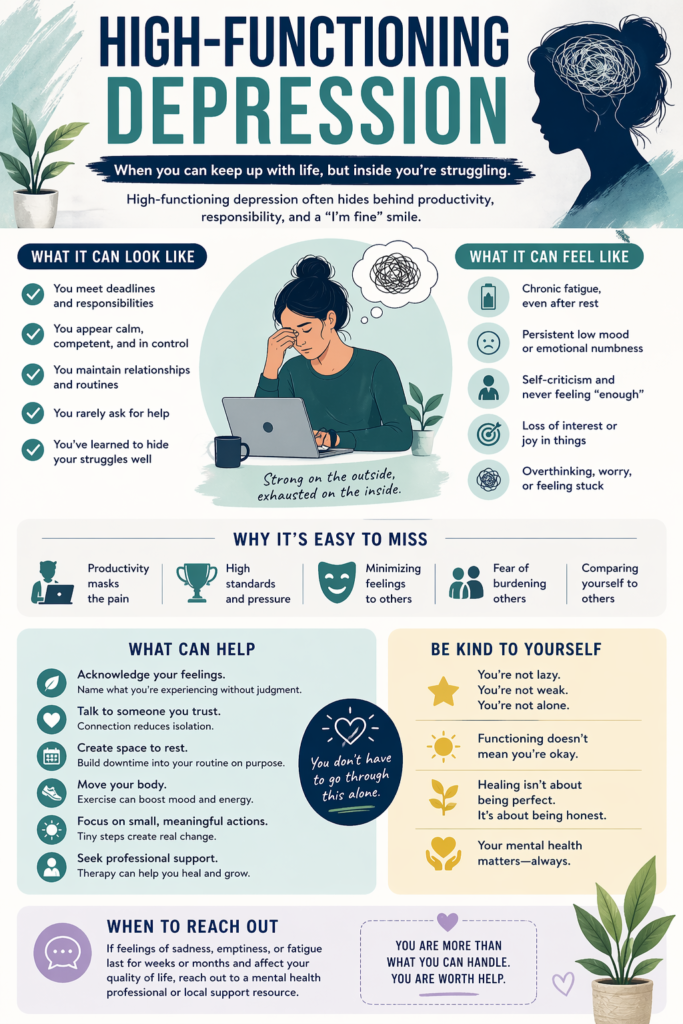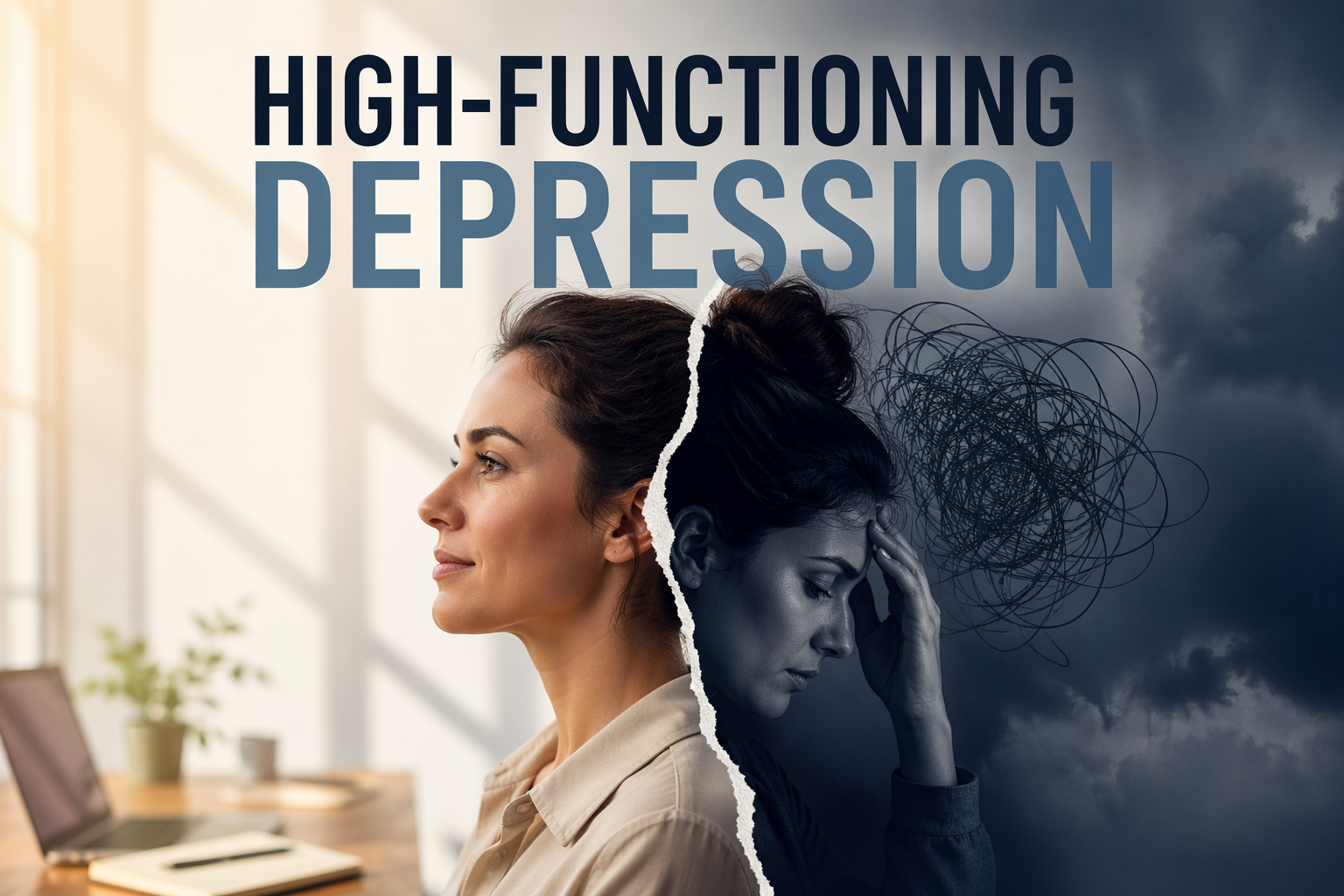
High-functioning depression is often overlooked because it doesn’t fit the typical image of what depression “should” look like. Individuals continue to meet responsibilities, maintain relationships, and appear composed, yet internally experience persistent low mood, fatigue, or emotional disconnection. This pattern is often associated with Persistent Depressive Disorder, where symptoms are chronic but subtle enough to go unnoticed. The disconnect between outward functioning and inner experience can make it difficult for both the individual and those around them to recognize when support may be needed.
High-Functioning Depression: When “Doing Fine” Hides What You’re Really Feeling
High-functioning depression doesn’t always look like what people expect. There are no obvious breakdowns, no missed responsibilities, no clear outward signs that something is wrong. On the surface, life appears intact—work gets done, relationships are maintained, goals are pursued. But underneath, there’s often a persistent sense of emptiness, exhaustion, or quiet struggle that rarely gets seen.
What Is High-Functioning Depression?
While not a formal clinical diagnosis, high-functioning depression is commonly used to describe individuals who meet many criteria of depression—often similar to Persistent Depressive Disorder—but continue to function in daily life at a relatively high level.
This means you might:
- Show up to work every day
- Maintain social relationships
- Meet deadlines and responsibilities
…and still feel:
- Chronically tired, even after rest
- Emotionally numb or disconnected
- Self-critical or “not good enough.”
- Unable to fully enjoy things that used to matter
Because everything “looks fine,” it often goes unnoticed—by others and even by the person experiencing it.
Why It’s Easy to Miss
High-functioning depression is often hidden behind competence. People who experience it may be high achievers, caregivers, or individuals who’ve learned to push through discomfort.
A few factors that make it harder to recognize:
- Normalization of stress: Constant pressure and burnout can mask depressive symptoms
- Internalized expectations: “I should be grateful” or “others have it worse.”
- Emotional suppression: Avoiding vulnerability to stay productive
- Positive external feedback: Praise for performance can reinforce the idea that nothing is wrong
The result is a quiet contradiction: functioning well externally while struggling internally.
Common Signs That Get Overlooked
Instead of obvious sadness, high-functioning depression often shows up in subtler ways:
- Low-grade but persistent sadness
- Loss of interest that’s explained away as “just being busy.”
- Irritability or emotional flatness
- Overworking or staying constantly occupied to avoid feelings
- Difficulty relaxing without guilt
- Feeling like you’re “going through the motions.”
These signs are easy to dismiss because they don’t disrupt daily life in dramatic ways.
The Cost of “Holding It Together”
Being able to function doesn’t mean you’re okay. Over time, carrying this internal weight can lead to:
- Emotional burnout
- Increased risk of more severe depressive episodes
- Strained relationships due to emotional distance
- Physical symptoms like fatigue, sleep issues, or tension
There’s also a deeper cost: feeling unseen—even by yourself.
Why Acknowledging It Matters
One of the biggest barriers is the belief that you don’t “qualify” for help because you’re still managing life. But mental health isn’t defined by how much you can endure—it’s about how you actually feel.
Recognizing high-functioning depression allows you to:
- Name your experience accurately
- Reduce self-judgment
- Seek appropriate support
- Start making changes that go beyond just coping
What Helps
Support doesn’t have to mean everything stops. It can begin in small, realistic ways:
- Therapy: Especially approaches like cognitive-behavioral therapy (CBT) or psychodynamic therapy
- Honest check-ins: Asking yourself how you feel—not just what you’ve accomplished
- Reducing overextension: Creating space instead of filling every moment
- Connection: Letting at least one person see the real version of how you’re doing
- Routine care: Sleep, nutrition, and movement as foundations—not afterthoughts
If symptoms are persistent or worsening, professional guidance becomes especially important.
Final Thought
High-functioning depression challenges a common myth: that if you’re productive, you must be okay. But functioning is not the same as feeling well.
You can be capable and struggling at the same time. And both deserve attention.
Understanding High-Functioning Depression: Practical Self-Management Strategies That Actually Help
High-functioning depression is often invisible—not because it isn’t serious, but because it hides behind productivity, responsibility, and outward success. You may be meeting deadlines, maintaining relationships, and showing up every day… while quietly feeling drained, disconnected, or stuck in a low emotional baseline.
Understanding what’s happening internally—and learning how to manage it—can make a meaningful difference.
What You’re Managing (Even If It Doesn’t Look Like It)
Many people experiencing high-functioning depression relate to patterns seen in Persistent Depressive Disorder, where symptoms are chronic but not always severe enough to stop daily functioning.
Instead of obvious impairment, it often shows up as:
- A constant sense of “just getting through the day.”
- Emotional flatness or muted joy
- Harsh self-talk despite external success
- Mental fatigue that doesn’t match your workload
Self-management starts with recognizing that these experiences are valid—not something to dismiss because you’re still “doing fine.”
1. Build Awareness Without Overanalyzing
Understanding your patterns is more helpful than judging them.
Try:
- Brief daily check-ins: What did I feel today—not just what did I do?
- Noticing energy dips (when do you feel most drained?)
- Identifying triggers like overwork, social pressure, or lack of rest
The goal isn’t to dissect every emotion—it’s to notice trends over time.
2. Redefine Productivity
High-functioning depression often coexists with overachievement. You might rely on productivity to maintain a sense of worth.
Shift the framework:
- “Did I complete everything?” → “Did I take care of myself at all?”
- Allow “good enough” to replace perfection
- Build in intentional pauses, not just collapse at the end of the day
Sustainable functioning requires energy—not just discipline.
3. Interrupt Autopilot Living
A common experience is moving through life mechanically—meeting expectations without feeling engaged.
Small disruptions can help:
- Change one routine (walk a different route, rearrange your workspace)
- Schedule one activity for enjoyment—not utility
- Practice being present for short moments (even 2–3 minutes)
These shifts reconnect you with experience rather than just obligation.
4. Challenge Quiet Negative Narratives
High-functioning depression often includes subtle but persistent self-criticism:
- “I should be doing better.”
- “This isn’t enough.”
- “Other people have it worse, so I shouldn’t feel this way.”
Instead of forcing positivity, try:
- Questioning the thought: Is this objectively true?
- Replacing extremes with neutral statements
- Writing thoughts down to create distance from them
You’re not trying to “win” against your thoughts—just loosen their grip.
5. Manage Energy, Not Just Time
Time management won’t fix emotional exhaustion.
Focus on:
- Protecting sleep as a non-negotiable
- Noticing what drains vs. restores you
- Spacing out demanding tasks instead of stacking them
Think of energy like a limited resource—because it is.
6. Let Someone See the Real Version of You
Because you’re functioning, people may assume you’re fine. That can make it harder to open up.
Start small:
- Share honestly with one trusted person
- Replace “I’m good” with something slightly more real
- Allow conversations that aren’t performance-based
Being seen reduces the sense of carrying everything alone.
7. Know When Self-Management Isn’t Enough
Self-management is helpful—but it has limits.
Consider professional support if you notice:
- Symptoms lasting for months or years
- Increasing numbness or detachment
- Loss of interest in things that used to matter
- Difficulty maintaining even your usual level of functioning
Therapy isn’t only for crisis—it’s also for clarity and prevention.
Final Thought
High-functioning depression creates a unique tension: your life keeps moving, but something inside feels stalled or heavy. That can make it easy to ignore—but ignoring it doesn’t make it disappear.
Self-management isn’t about fixing yourself—it’s about understanding your internal experience well enough to respond to it with intention instead of autopilot.
You don’t have to stop functioning to start feeling better.
Supporting What You Can’t See: Family Strategies for Understanding High-Functioning Depression
High-functioning depression can be confusing for families. From the outside, everything may look fine—responsibilities are handled, routines are intact, and there are no obvious signs of crisis. But internally, the person may be dealing with persistent low mood, emotional fatigue, or a sense of disconnection that rarely shows.
Because it’s less visible, family support often requires a different approach—one based on awareness, subtlety, and consistency rather than reacting to obvious distress.
Understanding the Experience Beneath the Surface
Many individuals with high-functioning depression experience patterns similar to Persistent Depressive Disorder—a long-term, low-grade form of depression that doesn’t always disrupt daily functioning but still impacts emotional well-being.
They may:
- Keep up with work or school
- Maintain relationships
- Appear “put together.”
…but still feel:
- Chronically tired or mentally drained
- Emotionally flat or disconnected
- Self-critical despite external success
For families, the key shift is recognizing that functioning does not equal feeling okay.
1. Look Beyond Performance
It’s easy to assume that if someone is meeting expectations, they’re doing well. But high-functioning depression often thrives under that assumption.
Instead of focusing only on what they’re accomplishing:
- Pay attention to changes in mood, tone, or energy
- Notice withdrawal that isn’t obvious (less enthusiasm, less engagement)
- Be mindful of subtle signs like irritability or constant fatigue
Support starts with seeing the whole person—not just their output.
2. Create Space for Honest Conversations
People with high-functioning depression often minimize their feelings or avoid sharing to prevent concern.
You can help by:
- Asking open-ended, low-pressure questions (“How have you been feeling lately?”)
- Avoiding immediate problem-solving or advice
- Allowing pauses—silence can make space for honesty
Consistency matters more than intensity. One safe conversation is more helpful than many surface-level ones.
3. Validate Without Dismissing
A common (but unintentional) response is:
- “But you’re doing so well.”
- “Everyone feels like that sometimes.”
- “At least things aren’t worse.”
While meant to reassure, these can feel invalidating.
Instead:
- Acknowledge their experience (“That sounds exhausting”)
- Reflect what you hear without correcting it
- Resist comparing their struggles to others
Validation helps reduce the pressure to “prove” their distress.
4. Don’t Mistake Independence for Resilience
High-functioning individuals are often seen as the “strong ones” in the family. This can lead to less support being offered.
Be intentional about:
- Checking in even when they don’t ask for help
- Offering support proactively (“Want company?” “Need a break?”)
- Recognizing that capability doesn’t eliminate the need
Sometimes the most independent person is the least likely to ask.
5. Encourage Balance Without Forcing Change
Families may notice overworking, overcommitting, or constant busyness—often used to avoid difficult emotions.
You can gently support balance by:
- Modeling healthy boundaries yourself
- Encouraging rest without framing it as laziness
- Suggesting small breaks or shared downtime
Avoid pushing drastic changes. Subtle encouragement is more sustainable.
6. Support Professional Help Without Pressure
Because high-functioning depression doesn’t always disrupt life, individuals may feel they don’t “need” help.
You can:
- Normalize therapy as a resource, not a last resort
- Frame it as support for clarity, not just crisis
- Offer help with logistics (finding providers, scheduling)
The goal is to reduce barriers—not force decisions.
7. Take Care of Your Own Emotional Role
Supporting someone with an invisible struggle can be challenging. You might feel unsure, concerned, or even frustrated at times.
It’s important to:
- Recognize your limits—you can support, but not fix
- Avoid taking their emotional state personally
- Seek your own support or guidance if needed
Healthy support comes from a place of steadiness, not burnout.
Final Thought
High-functioning depression often goes unnoticed, not because it’s rare, but because it’s quiet. Families play a crucial role in bringing awareness to what isn’t immediately visible.
You don’t need perfect words or solutions. What matters most is consistent presence, genuine curiosity, and the willingness to see beyond “they’re doing fine.”
Sometimes the most meaningful support is simply this: I see you, even when it doesn’t look like anything is wrong.
Beyond “I’m Fine”: Using Community Resources to Understand and Support High-Functioning Depression
High-functioning depression often hides in plain sight. People keep up with work, relationships, and daily responsibilities—yet carry a persistent sense of fatigue, low mood, or emotional disconnection. Because it doesn’t always disrupt life in obvious ways, it’s frequently misunderstood or overlooked.
Community resources can play a powerful role—not just in treatment, but in helping individuals and those around them recognize and understand what’s happening.
Why Community Support Matters
Experiences similar to Persistent Depressive Disorder can feel isolating, especially when others assume you’re “doing fine.” Community resources bridge that gap by offering validation, education, and connection outside of immediate family or personal circles.
They also reduce the burden of managing everything on your own.
1. Mental Health Education Programs
Many communities offer workshops, seminars, or online webinars focused on mental health awareness.
These programs help:
- Clarify what high-functioning depression actually looks like
- Break common myths (e.g., “If you’re productive, you can’t be depressed”)
- Teach early warning signs and coping strategies
Look for programs hosted by:
- Local health departments
- Universities or community colleges
- Nonprofit mental health organizations
Understanding often begins with exposure to accurate information.
2. Support Groups (In-Person & Online)
Support groups provide something many people with high-functioning depression lack: a space where they don’t have to appear “fine.”
Benefits include:
- Hearing similar experiences from others
- Reducing feelings of isolation
- Learning practical coping strategies from peers
- Practicing honest expression without judgment
Options can include:
- Local peer-led groups
- Therapist-facilitated groups
- Online communities with structured discussions
Even occasional participation can shift perspective.
3. Community Mental Health Centers
Community clinics and mental health centers often provide accessible services, including:
- Low-cost or sliding-scale therapy
- Initial mental health screenings
- Referrals to specialized care
These centers are especially valuable if:
- You’re unsure whether what you’re experiencing “counts” as depression
- You want a professional perspective without committing to long-term therapy immediately
They make support more approachable and less intimidating.
4. Workplace & School Resources
Because high-functioning depression often coexists with productivity, workplaces and schools are key environments for support.
Available resources may include:
- Employee Assistance Programs (EAPs)
- Counseling services through universities
- Mental health days or wellness initiatives
Encouraging awareness in these spaces helps normalize conversations and reduces stigma.
5. Faith-Based and Cultural Organizations
For many people, community isn’t just clinical—it’s cultural or spiritual.
Faith-based or cultural groups can:
- Provide emotional support grounded in shared values
- Offer counseling or mentorship programs
- Create safe spaces for discussion that feel more familiar
When aligned with the individual’s beliefs, these supports can feel more accessible and less clinical.
6. Digital Mental Health Platforms
Online tools have expanded access to support, especially for those who feel hesitant to seek in-person help.
Examples include:
- Mental health apps for mood tracking or guided exercises
- Online therapy platforms
- Educational content from licensed professionals
These can serve as entry points for understanding patterns and exploring next steps.
7. Crisis and Helpline Resources (Even If It Doesn’t Feel Like a Crisis)
High-functioning depression may not feel urgent—but support lines are still valuable.
They offer:
- Immediate, confidential conversation
- Emotional grounding during difficult moments
- Guidance toward local resources
Reaching out doesn’t require a breaking point—it’s simply a way to not carry everything alone.
How to Use These Resources Effectively
Access alone isn’t enough—how you engage matters.
- Start small: one resource is enough to begin
- Stay consistent: occasional use can still be meaningful
- Combine supports: education + connection + professional input often works best
- Be patient: understanding your experience takes time
You don’t need to use everything—just what feels relevant and manageable.
Final Thought
High-functioning depression challenges the idea that struggle has to be visible to be real. Community resources help bring that hidden experience into clearer focus—offering language, connection, and support where there was once uncertainty.
You don’t have to wait until things fall apart to reach out.
Sometimes understanding begins the moment you realize you’re not the only one feeling this way.
Frequently Asked Questions
Here are some common questions:
1. What is high-functioning depression?
High-functioning depression refers to a pattern where someone experiences ongoing depressive symptoms but continues to manage daily responsibilities. It’s often associated with Persistent Depressive Disorder, a chronic, lower-grade form of depression.
2. Is high-functioning depression a real diagnosis?
Not exactly. It’s not a formal clinical diagnosis, but a widely used term to describe people who appear “fine” on the outside while struggling internally with depressive symptoms.
3. How is it different from major depression?
Major depression tends to be more intense and disruptive, often interfering with daily functioning. High-functioning depression is typically more subtle and long-lasting, allowing the person to continue functioning—though often at an emotional cost.
4. What are common signs?
- Persistent low mood
- Chronic fatigue
- Loss of interest or enjoyment
- Self-criticism or perfectionism
- Feeling emotionally numb
- “Going through the motions.”
These symptoms may be mild individually but consistent over time.
5. Why is it hard to recognize?
Because people with high-functioning depression:
- Still go to work or school
- Maintain relationships
- Appear responsible and capable
This can lead others—and even the individual—to overlook what’s happening internally.
6. Can someone be successful and still be depressed?
Yes. Success and depression are not mutually exclusive. External achievement doesn’t protect against internal struggles.
7. Is it just stress or burnout?
Not always. While stress and burnout can overlap, high-functioning depression involves persistent emotional symptoms that don’t fully resolve with rest or reduced workload.
8. Why don’t people ask for help?
Common reasons include:
- Believing their struggles aren’t “serious enough.”
- Fear of being misunderstood
- Pressure to maintain their image
- Habit of self-reliance
9. Can it get worse over time?
Yes. Without awareness or support, it can develop into more severe depression or lead to increased emotional exhaustion and disconnection.
10. What helps manage it?
- Therapy (e.g., CBT, talk therapy)
- Honest self-reflection
- Reducing overcommitment
- Building emotional awareness
- Connecting with supportive people
Small, consistent changes tend to be more effective than drastic ones.
11. Do medications help?
In some cases, yes. A mental health professional can determine whether medication is appropriate based on symptoms and severity.
12. When should someone seek professional help?
- Symptoms last for weeks or months
- Emotional numbness increases
- Daily life starts to feel harder to manage
- Loss of interest in previously meaningful activities
You don’t need to reach a crisis point to seek help.
13. How can you support someone with it?
- Don’t assume they’re okay just because they’re functioning
- Listen without minimizing their experience
- Encourage support without forcing it
- Be consistent and patient
14. Is recovery possible?
Yes. With the right combination of awareness, support, and treatment, people can move from just functioning to actually feeling better and more engaged in life.
15. What’s the biggest misconception?
If someone is “handling life,” they must be fine.
In reality, functioning and well-being are not the same thing.
Conclusion
Understanding high-functioning depression requires shifting focus from visible performance to internal well-being. Functioning effectively does not necessarily mean feeling well, and overlooking this distinction can delay awareness and support. By recognizing the quieter signs—such as persistent fatigue, diminished enjoyment, and self-critical thinking—it becomes possible to respond earlier and more intentionally. Greater awareness, open conversations, and appropriate support systems can help bridge the gap between “appearing fine” and actually feeling well, allowing individuals to move beyond simply coping toward genuine improvement in their mental health.
Video: They’re Falling Apart on the Inside #depressionhelp #psychology