Anxiety attacks and withdrawal symptoms are often confused due to their strikingly similar physical and emotional effects. Symptoms such as rapid heartbeat, restlessness, sweating, and feelings of panic are commonly associated with Anxiety Disorders, but they can also occur during Substance Withdrawal. This overlap can make it difficult for individuals—and even professionals—to accurately identify the root cause of distress. Misunderstanding these experiences may lead to ineffective coping strategies or delays in receiving appropriate care. Therefore, distinguishing between anxiety attacks and withdrawal symptoms is essential for accurate diagnosis and effective treatment.
Anxiety Attacks vs. Withdrawal Symptoms: Understanding the Difference for Better Recovery
Anxiety attacks and withdrawal symptoms can feel strikingly similar—racing heart, restlessness, sweating, and an overwhelming sense of unease. Because of this overlap, many people assume they are experiencing Anxiety Disorders when, in reality, their symptoms may be linked to Substance Withdrawal. Misunderstanding the difference can lead to ineffective coping strategies and delay the right kind of support. Learning to distinguish between the two is a critical step toward accurate treatment and lasting recovery.
What Is an Anxiety Attack?
An anxiety attack typically refers to an intense surge of fear or worry. It may be associated with conditions like Generalized Anxiety Disorder or Panic Disorder.
Common symptoms include:
- Rapid heartbeat
- Shortness of breath
- Chest tightness
- Feelings of dread or panic
- Difficulty concentrating
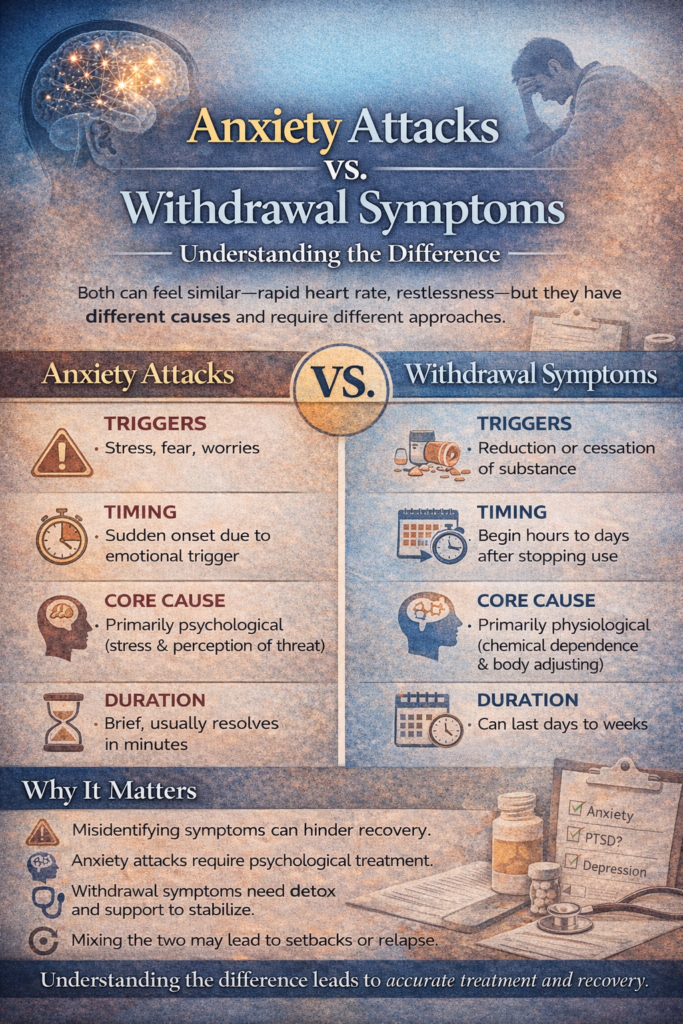
These episodes are often triggered by stress, fear, or perceived threats—even if those threats are not immediate or physical.
What Are Withdrawal Symptoms?
Withdrawal symptoms occur when the body reacts to the absence or reduction of a substance it has become dependent on, often related to Substance Use Disorder.
Common symptoms include:
- Anxiety-like feelings (restlessness, irritability)
- Sweating and shaking
- Nausea or physical discomfort
- Insomnia
- Mood swings
Unlike anxiety attacks, withdrawal symptoms are tied to biological changes in the brain and body as they adjust to functioning without the substance.
Why They’re Often Confused
The confusion happens because both experiences activate the body’s stress response. In both cases, the nervous system is in a heightened state, producing similar physical and emotional sensations.
However, the cause is different:
- Anxiety attacks are primarily psychological (though they have physical effects)
- Withdrawal symptoms are physiological reactions to changes in substance use
Key Differences to Look For
⏱️ Timing
- Anxiety attacks may come on suddenly and be tied to stress or triggers
- Withdrawal symptoms often follow a pattern after reducing or stopping substance use
🔁 Duration
- Anxiety attacks are usually short-lived (minutes to an hour)
- Withdrawal symptoms can last days or weeks, depending on the substance
🧩 Triggers
- Anxiety: stress, thoughts, fears
- Withdrawal: substance reduction or cessation
🧠 Underlying Cause
- Anxiety: emotional and cognitive processes
- Withdrawal: chemical imbalance and physical dependence
Why the Difference Matters
Misinterpreting withdrawal as anxiety can lead to:
- Using the substance again to “relieve anxiety.”
- Avoiding proper detox or recovery support
- Delaying treatment for Substance Use Disorder
On the other hand, assuming anxiety is withdrawal may prevent someone from addressing underlying mental health needs.
How to Respond Effectively
🧠 Increase Awareness
Pay attention to patterns—when symptoms occur and what might be triggering them.
🧑⚕️ Seek Professional Guidance
A clinician can help determine whether symptoms align more with anxiety or withdrawal.
📓 Track Your Symptoms
Document timing, intensity, and possible triggers to identify patterns.
🤝 Use the Right Support
- Anxiety: therapy, stress management, coping skills
- Withdrawal: medical supervision, detox programs, recovery support
The Connection Between the Two
It’s important to note that anxiety and withdrawal can coexist. Someone in recovery may have both an anxiety disorder and experience withdrawal symptoms. This makes accurate assessment even more important.
Final Thoughts
Anxiety attacks and withdrawal symptoms may feel the same, but they are not the same. Understanding the difference is key to getting the right help and avoiding setbacks. When you identify the true source of your symptoms, you can take steps that support real healing rather than temporary relief.
Clarity leads to better decisions—and better outcomes in recovery.
Anxiety Attacks vs. Withdrawal Symptoms: Self-Management Strategies for Understanding and Control
Anxiety attacks and withdrawal symptoms can feel nearly identical—racing heart, restlessness, sweating, and a sense of panic. Because of this overlap, many individuals misinterpret their experiences, often assuming they are dealing with Anxiety Disorders when the symptoms may actually be related to Substance Withdrawal. This confusion can lead to ineffective coping strategies and setbacks in recovery.
Self-management strategies can help you better understand your symptoms, recognize patterns, and respond in ways that support long-term healing.
Why Self-Management Matters
Understanding your own body and mind is one of the most powerful tools in recovery. Self-management allows you to:
- Identify whether symptoms are emotionally or physically driven
- Reduce panic and confusion
- Make informed decisions about care
- Prevent relapse by responding appropriately
Self-Management Strategies for Clarity
🧠 1. Track Your Symptoms and Timing
Pay close attention to when symptoms occur.
Ask yourself:
- Did symptoms begin after reducing or stopping substance use?
- Do they appear during stress or specific emotional triggers?
Patterns that follow substance changes often point to Substance Withdrawal, while stress-triggered episodes may align more with anxiety.
📓 2. Keep a Daily Journal
Document:
- Physical symptoms (heart rate, sweating, nausea)
- Emotional states (fear, worry, irritability)
- Substance use or changes
Over time, this helps you see whether symptoms are situational (anxiety) or physiological (withdrawal).
🔍 3. Identify Triggers
Understanding triggers is key.
- Anxiety triggers: stress, fear, overthinking
- Withdrawal triggers: stopping or reducing substance use
Recognizing these differences helps you respond appropriately.
⏱️ 4. Observe Duration and Intensity
- Anxiety attacks are usually brief (minutes to an hour)
- Withdrawal symptoms may last days or weeks
Tracking duration gives you insight into the root cause.
🌬️ 5. Practice Grounding and Regulation Techniques
Use techniques like:
- Deep breathing
- Mindfulness
- Progressive muscle relaxation
If symptoms improve quickly with calming strategies, they may be anxiety-related. If not, they may be linked to withdrawal.
⚖️ 6. Evaluate What Helps (and What Doesn’t)
Pay attention to your response to coping strategies:
- Do relaxation techniques reduce symptoms?
- Do symptoms persist regardless of emotional state?
This can help differentiate between psychological and physiological causes.
🧑⚕️ 7. Combine Self-Awareness with Professional Support
Self-management is most effective when paired with professional guidance.
Bring your observations to a clinician to help determine whether symptoms align with:
- Anxiety Disorders
- Substance Withdrawal
- Or both
A Key Insight: Symptoms Are Signals, Not Just Problems
Instead of asking, “How do I stop this feeling?” try asking:
- “What is my body telling me?”
This shift helps you move from reacting to understanding.
What This Means for Recovery
When you use self-management strategies:
- You reduce confusion and fear
- You respond more effectively to symptoms
- You avoid mistaking withdrawal for anxiety (or vice versa)
- You stay more engaged in recovery
Clarity leads to better decisions—and better outcomes.
Final Thoughts
Anxiety attacks and withdrawal symptoms may feel the same, but understanding the difference is essential for healing. By tracking patterns, recognizing triggers, and staying aware of your body’s signals, you can take control of your experience.
You don’t have to guess what’s happening—you can learn to understand it. And that understanding is a powerful step toward recovery.
Self-Talk in Addiction Recovery: Family Support Strategies for Building a Healthier Inner Voice
Recovery from addiction is not just about changing behaviors—it’s also about changing how individuals speak to themselves. Self-talk, the internal dialogue that shapes thoughts and emotions, plays a critical role in recovery from Substance Use Disorder. While self-talk happens internally, it is deeply influenced by relationships—especially family.
Families have a powerful opportunity to help reshape negative self-talk into something more supportive, compassionate, and growth-oriented.
Why Family Support Matters in Self-Talk
Many individuals in recovery struggle with internal messages like:
- “I’m a failure.”
- “I’ll never change.”
- “I’ve ruined everything.”
These thoughts are often reinforced by past experiences, stigma, or criticism. Family interactions can either reinforce these beliefs or help challenge and replace them.
Supportive families can:
- Model healthier ways of thinking
- Reduce shame and self-criticism
- Encourage confidence and resilience
Family Support Strategies for Improving Self-Talk
👂 1. Use Encouraging and Supportive Language
What families say externally often becomes what individuals say internally.
Instead of:
- “Why can’t you just stop?”
Try:
- “I see you’re trying, and that matters.”
Consistent encouragement helps reshape negative self-talk over time.
🧠 2. Help Challenge Negative Thinking
When a loved one expresses negative self-talk, gently question it:
- “Is that really true?”
- “What would you say to someone else in your situation?”
This helps them recognize that thoughts are not always facts.
💬 3. Model Positive Self-Talk
Family members can demonstrate healthy thinking by:
- Speaking kindly about themselves
- Avoiding harsh self-criticism
- Expressing balanced perspectives during challenges
This creates an environment where positive self-talk feels normal and achievable.
🤝 4. Reinforce Effort, Not Just Outcomes
Recovery is a process, not perfection.
Acknowledge:
- Small steps forward
- Effort and persistence
- Attempts to cope in healthier ways
This helps shift internal dialogue from “I failed” to “I’m improving.”
🛑 5. Avoid Shaming or Blaming Language
Statements that focus on blame can reinforce harmful self-talk.
Avoid:
- “You always mess things up.”
- “This is your fault.”
Instead, focus on understanding and solutions.
❤️ 6. Encourage Self-Compassion
Remind your loved one to treat themselves with kindness.
You can say:
- “You deserve patience while you’re healing.”
- “It’s okay to struggle—you’re still moving forward.”
This helps replace harsh inner criticism with compassion.
🧩 7. Support Professional Help
Therapies like cognitive-behavioral therapy (CBT) can help individuals change negative thinking patterns.
Families can:
- Encourage therapy participation
- Support skill-building outside sessions
- Reinforce what is learned in treatment
🔄 8. Keep Communication Open and Ongoing
Self-talk doesn’t change overnight. Regular, supportive conversations help reinforce progress.
Ask:
- “What’s been going through your mind lately?”
- “How can I support you right now?”
A Key Insight: External Voices Shape Internal Voices
Over time, the way others speak to us becomes the way we speak to ourselves. Family support can help transform an inner voice that is critical and discouraging into one that is supportive and resilient.
What This Means for Recovery
When families actively support healthier self-talk:
- Shame and self-doubt decrease
- Motivation and confidence increase
- Coping skills improve
- Recovery becomes more sustainable
The internal voice shifts from a barrier to a source of strength.
Final Thoughts
You don’t need to control someone’s thoughts to help them—you just need to influence the environment those thoughts grow in. Through encouragement, empathy, and patience, families can play a powerful role in reshaping self-talk during recovery.
Small, supportive words can create lasting internal change—and that change can make all the difference in the journey toward healing.
Anxiety Attacks vs. Withdrawal Symptoms: How Community Resources Support Understanding and Recovery
Anxiety attacks and withdrawal symptoms can feel almost identical—racing heart, restlessness, sweating, and a sense of panic. Because of this overlap, many individuals misinterpret what they’re experiencing as Anxiety Disorders when it may actually be related to Substance Withdrawal. This confusion can delay proper treatment and make recovery more challenging.
Community resources play a vital role in helping individuals and families better understand these differences. By offering education, shared experiences, and access to specialized care, communities provide the support needed to move from confusion to clarity.
Why Community Support Matters
Understanding whether symptoms are anxiety-related or withdrawal-related often requires more than personal observation. Community resources provide:
- Access to professional guidance
- Exposure to shared lived experiences
- Education on symptom patterns
- Support during vulnerable stages of recovery
This broader support system helps individuals avoid misinterpretation and get the right help.
Community Resource Strategies for Better Understanding
🏥 1. Utilize Local Treatment Centers and Clinics
Community mental health and addiction centers often offer:
- Comprehensive evaluations
- Detox and recovery programs
- Dual-diagnosis treatment (for both anxiety and Substance Use Disorder)
These services can help determine whether symptoms are rooted in anxiety, withdrawal, or both.
👥 2. Join Peer Support and Recovery Groups
Groups like recovery meetings or mental health support groups provide real-life insights.
In these spaces, individuals often learn:
- How withdrawal symptoms can mimic anxiety
- How others distinguish between emotional triggers and physical withdrawal
- What coping strategies actually work
Hearing others’ experiences can help you recognize patterns in your own symptoms.
📚 3. Attend Community Education Programs
Workshops and classes offered through community organizations can teach:
- The biological basis of withdrawal
- The psychological nature of anxiety attacks
- How symptoms overlap and differ
Education reduces fear and empowers individuals to make informed decisions.
🧑⚕️ 4. Seek Specialized Support Through Referrals
Community networks often connect individuals with:
- Addiction specialists
- Trauma-informed therapists
- Mental health professionals experienced in dual diagnoses
This is especially important when symptoms don’t respond to standard anxiety treatments.
🤝 5. Engage with Recovery and Advocacy Organizations
Nonprofit organizations and advocacy groups provide:
- Helplines and guidance
- Resource directories
- Educational materials
They emphasize accurate diagnosis and encourage individuals to explore whether symptoms relate to anxiety or Substance Withdrawal.
🌐 6. Use Online Communities with Caution
Online forums and recovery communities can be helpful for:
- Sharing experiences
- Learning from others
- Gaining emotional support
However, they should not replace professional guidance. Use them to ask questions—not to self-diagnose.
📓 7. Combine Community Insight with Personal Tracking
Community input becomes more effective when paired with self-awareness.
Track:
- When symptoms occur
- Substance use patterns
- Emotional triggers
Then discuss these observations with community members or professionals to refine your understanding.
A Key Insight: You Don’t Have to Figure It Out Alone
One of the biggest challenges in distinguishing anxiety attacks from withdrawal symptoms is isolation. Community resources help break that isolation by offering:
- Validation without judgment
- Shared knowledge and experience
- Access to accurate information
- Encouragement to seek appropriate care
What This Means for Recovery
When community resources are part of the process:
- Misinterpretation of symptoms decreases
- Treatment becomes more targeted
- Relapse risk may be reduced
- Individuals feel more supported and informed
Recovery becomes more sustainable when it is guided by both knowledge and connection.
Final Thoughts
Anxiety attacks and withdrawal symptoms may feel the same, but understanding their differences is essential for healing. Community resources provide the tools, support, and perspective needed to make that distinction.
You don’t have to navigate this alone. With the right support system, clarity becomes possible—and with clarity comes the ability to take the next right step in recovery.
Frequently Asked Questions
Here are some common questions:
What is the difference between an anxiety attack and withdrawal symptoms?
An anxiety attack is an intense episode of fear or worry often linked to Anxiety Disorders, while withdrawal symptoms occur when the body reacts to reducing or stopping a substance, known as Substance Withdrawal. The key difference lies in the cause—psychological vs. physiological.
Why do anxiety attacks and withdrawal feel so similar?
Both activate the body’s stress response system, leading to similar symptoms, such as:
- Rapid heartbeat
- Sweating
- Restlessness
- Panic or unease
This overlap is why many people confuse the two experiences.
What are common symptoms of an anxiety attack?
Symptoms often include:
- Sudden intense fear or panic
- Shortness of breath
- Chest tightness
- Racing thoughts
- Feeling out of control
These are commonly associated with conditions like Panic Disorder.
What are common withdrawal symptoms?
Withdrawal symptoms can include:
- Anxiety-like feelings
- Irritability
- Shaking or sweating
- Nausea
- Sleep disturbances
These occur as the body adjusts after substance use related to Substance Use Disorder.
How can I tell if I’m experiencing anxiety or withdrawal?
Consider these questions:
- Did symptoms begin after reducing or stopping a substance? (likely withdrawal)
- Are symptoms tied to stress or specific fears? (likely anxiety)
- Do symptoms follow a predictable timeline after substance use? (withdrawal)
Tracking patterns over time can help clarify the cause.
How long do anxiety attacks last compared to withdrawal symptoms?
- Anxiety attacks: usually last minutes to about an hour
- Withdrawal symptoms: can last days to weeks, depending on the substance
Can you have both anxiety and withdrawal at the same time?
Yes. It’s common for individuals to experience both, especially during recovery from Substance Use Disorder. This is why careful assessment is important.
Why is it important to know the difference?
Misidentifying symptoms can lead to:
- Using substances again to relieve “anxiety” (when it’s actually withdrawal)
- Ignoring underlying anxiety disorders
- Delayed or ineffective treatment
What treatments are used for each?
- Anxiety attacks: therapy (like CBT), stress management, and sometimes medication
- Withdrawal symptoms: medical detox, monitoring, and recovery support
Each requires a different approach for effective care.
Should I seek professional help?
Yes—especially if:
- Symptoms are severe or worsening
- You’re unsure of the cause
- You’re in early recovery
- Symptoms interfere with daily life
A professional can help determine whether symptoms align more with anxiety or Substance Withdrawal.
Can withdrawal symptoms be dangerous?
Yes, depending on the substance. Withdrawal from substances like alcohol or benzodiazepines can be medically serious and should be supervised by professionals.
Conclusion
Recognizing the difference between anxiety attacks and Substance Withdrawal is a critical step in achieving meaningful recovery. While both experiences can feel intense and overwhelming, they stem from different underlying causes—one primarily psychological and the other physiological. Misinterpretation can lead to inappropriate treatment approaches or setbacks in recovery, particularly for individuals dealing with Substance Use Disorder. By developing a clearer understanding of symptom patterns, triggers, and timing, individuals can seek more targeted support and interventions. Ultimately, accurate awareness empowers better decision-making, leading to more effective healing and long-term stability.
Video: Racing Heart, Sweating, Shaking—But Which One Is It? #AnxietyVsWithdrawal