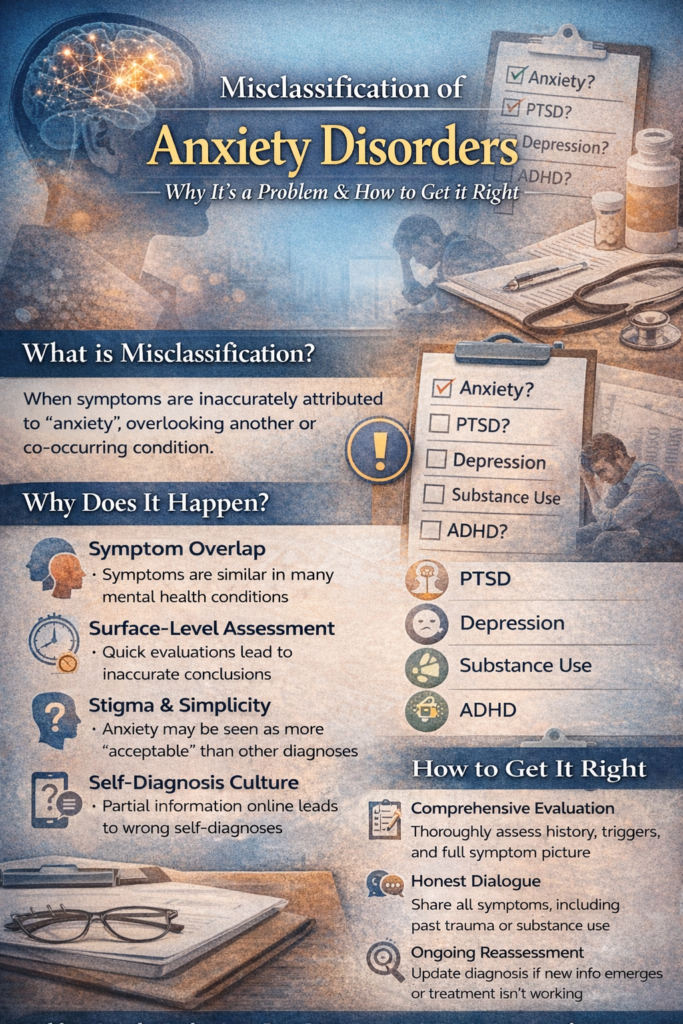
The misclassification of Anxiety Disorders is an increasingly important issue in mental health care, particularly as awareness and diagnosis rates continue to rise. While anxiety is a legitimate and often debilitating condition, it is also frequently used as a broad label for symptoms that may stem from other underlying causes. Because many psychological and physiological conditions share overlapping features—such as restlessness, irritability, and difficulty concentrating—individuals may be inaccurately diagnosed with anxiety when they are actually experiencing conditions like Post-Traumatic Stress Disorder, Substance Use Disorder, or Major Depressive Disorder. This misclassification can lead to ineffective treatment approaches and prolonged distress, making it critical to examine how and why these diagnostic errors occur.
Misclassification of Anxiety Disorders: When the Diagnosis Misses the Mark
Anxiety is one of the most commonly reported mental health concerns today—but that doesn’t mean it’s always correctly identified. In fact, what is often labeled as “anxiety” may be something more complex, entirely different, or rooted in another underlying condition. This misclassification can delay proper treatment, reinforce ineffective coping strategies, and ultimately slow the healing process.
What Does Misclassification Mean?
Misclassification occurs when symptoms are attributed to the wrong condition. In mental health, this often happens because many disorders share overlapping features—such as restlessness, irritability, sleep disturbances, and difficulty concentrating. While these symptoms are commonly associated with Anxiety Disorders, they are not exclusive to them.
For example, symptoms of anxiety may actually stem from:
- Post-Traumatic Stress Disorder (PTSD)
- Major Depressive Disorder
- Substance Use Disorder
- Attention-Deficit/Hyperactivity Disorder (ADHD)
- Bipolar Disorder
When clinicians—or individuals—default to “anxiety” as a catch-all explanation, the real issue may go unaddressed.
Why Misclassification Happens
1. Symptom Overlap
Many mental health conditions share similar outward signs. A racing heart, for instance, could indicate anxiety—but it could also be withdrawal, trauma response, or even a medical issue.
2. Surface-Level Assessment
Short appointments or limited mental health access can lead to quick labeling rather than deeper evaluation.
3. Stigma and Simplicity
“Anxiety” is often seen as more socially acceptable than diagnoses like substance use disorder or trauma-related conditions. This can lead both patients and providers to gravitate toward it.
4. Self-Diagnosis Culture
With widespread mental health content online, people may label themselves based on partial understanding, reinforcing inaccurate conclusions.
The Consequences of Getting It Wrong
Misclassification is not just a technical error—it has real consequences:
- Ineffective Treatment: Treating anxiety alone won’t resolve trauma, addiction, or mood instability.
- Delayed Recovery: Time spent on the wrong approach can prolong suffering.
- Frustration and Hopelessness: When treatments don’t work, individuals may feel “broken” or resistant to help.
- Increased Risk: Conditions like Substance Use Disorder or Bipolar Disorder can worsen without proper intervention.
Anxiety vs. Underlying Causes
A key issue is that anxiety is often a symptom, not always the root problem.
- Someone experiencing trauma may feel constant hypervigilance—labeled as anxiety but actually rooted in Post-Traumatic Stress Disorder.
- A person in early recovery may feel intense restlessness and panic due to Substance Withdrawal, not a primary anxiety disorder.
- Difficulty focusing and overwhelm may be attributed to anxiety when it aligns more with Attention-Deficit/Hyperactivity Disorder.
Understanding the source of symptoms is essential for effective care.
How to Improve Diagnostic Accuracy
🧩 Comprehensive Assessment
A thorough evaluation—including personal history, substance use, trauma exposure, and mood patterns—is critical.
🗣️ Honest Communication
Being open about all symptoms (including substance use or past trauma) helps providers make accurate diagnoses.
🔄 Ongoing Reassessment
Diagnoses are not static. As new information emerges, they should be revisited and refined.
🧠 Integrated Treatment Approaches
Therapies like cognitive-behavioral therapy (CBT), trauma-informed care, and addiction treatment often need to work together.
What This Means for Recovery
If you’ve been told you have anxiety but something doesn’t feel quite right, it’s worth exploring further. Misclassification doesn’t mean failure—it means there’s more to uncover.
Recovery becomes more effective when treatment matches the real underlying issue. Whether that involves trauma processing, addressing substance use, or managing mood instability, clarity is a powerful first step.
Final Thoughts
Anxiety is real—but it’s not always the full story. Mislabeling symptoms can keep people stuck, while an accurate understanding opens the door to meaningful change. The goal isn’t just to reduce symptoms—it’s to understand why they exist in the first place.
If we shift from quick labels to deeper insight, we move closer to care that truly heals.
Understanding Misclassification of Anxiety Disorders: Self-Management Strategies for Clarity and Recovery
Anxiety is often the first label people—and even professionals—use to explain distress. But what if that label doesn’t fully capture what’s really going on? Misclassification of anxiety can lead to confusion, ineffective coping strategies, and stalled progress in recovery. The good news is that you can play an active role in better understanding your symptoms.
This isn’t about diagnosing yourself—it’s about becoming more aware, informed, and empowered in your own mental health journey.
Why Misclassification Happens
Symptoms like racing thoughts, restlessness, irritability, and sleep issues are commonly linked to Anxiety Disorders. However, these same symptoms can also appear in:
- Post-Traumatic Stress Disorder (trauma-related hypervigilance)
- Substance Withdrawal (physical and psychological symptoms during detox)
- Major Depressive Disorder (agitation and rumination)
- Attention-Deficit/Hyperactivity Disorder (overwhelm and difficulty focusing)
- Bipolar Disorder (restlessness during mood episodes)
Because of this overlap, it’s easy to treat the symptom (anxiety) instead of identifying the root cause.
Why Self-Management Matters
Self-management doesn’t replace professional help—but it strengthens it. When you understand your patterns, triggers, and experiences, you provide clearer information to clinicians and make more informed decisions about your care.
Self-Management Strategies to Improve Understanding
🧠 1. Track Your Symptoms with Context
Instead of just noting what you feel, explore when and why.
Ask yourself:
- When do symptoms appear?
- What happened before they started?
- Are they tied to stress, memories, substance use, or mood shifts?
For example, anxiety that spikes after reminders of past events may point toward Post-Traumatic Stress Disorder, while symptoms that follow substance reduction may relate to Substance Withdrawal.
🧩 2. Look for Patterns, Not Isolated Moments
One bad day doesn’t define a disorder. Patterns over time do.
- Do your symptoms come in cycles?
- Do they intensify during certain life events?
- Are they constant or situational?
Cyclical highs and lows, for instance, may signal something beyond anxiety, such as Bipolar Disorder.
🗣️ 3. Get Specific with Your Language
Instead of saying “I feel anxious,” try to break it down:
- Is it fear?
- Restlessness?
- Racing thoughts?
- Physical tension?
Clear descriptions help differentiate between conditions like Attention-Deficit/Hyperactivity Disorder (mental overwhelm) and anxiety disorders (fear-based responses).
📓 4. Keep a Mental Health Journal
Writing things down creates a record you can reflect on.
Include:
- Emotional states
- Sleep patterns
- Substance use (if applicable)
- Stressors or triggers
Over time, this can reveal whether your symptoms align more with anxiety or something else, like Major Depressive Disorder.
⚖️ 5. Notice What Helps—and What Doesn’t
Pay attention to how you respond to coping strategies or treatments.
- Do relaxation techniques help, or do symptoms persist?
- Does addressing trauma reduce your “anxiety”?
- Do symptoms change with sobriety or medication adjustments?
If typical anxiety treatments aren’t effective, it may signal misclassification.
🧑⚕️ 6. Advocate for Comprehensive Evaluation
Bring your observations to a professional and ask deeper questions.
You might say:
- “Could something else be contributing to these symptoms?”
- “Should we explore trauma, mood patterns, or substance-related factors?”
This encourages a more accurate assessment beyond just labeling symptoms as anxiety.
A Key Insight: Anxiety Is Often a Signal, Not the Source
One of the most important shifts you can make is seeing anxiety as information, not just a problem.
- It may signal unresolved trauma
- It may reflect neurological differences
- It may be tied to chemical changes during withdrawal
- It may coexist with other mental health conditions
Understanding this helps you move from managing symptoms to addressing causes.
What This Means for Recovery
When you gain clarity about your symptoms, everything changes:
- Treatment becomes more targeted
- Coping strategies become more effective
- You feel less stuck and more in control
Misclassification can delay progress—but awareness can correct it.
Final Thoughts
You don’t need to have all the answers—but asking better questions can make a powerful difference. By observing your patterns, tracking your experiences, and communicating clearly, you become an active participant in your healing.
Anxiety might be part of your story—but it may not be the whole story. Understanding that distinction is where real recovery begins.
Misclassification of Anxiety Disorders: How Family Support Can Lead to Better Understanding and Healing
When someone you love is struggling, it’s natural to want quick answers—and often, that answer becomes “anxiety.” While Anxiety Disorders are common and real, they are also frequently misunderstood or misapplied as a catch-all label. For families, this can create confusion, frustration, and even unintentional harm if the real issue goes unrecognized.
The role of family is powerful. With the right approach, families can help uncover whether anxiety is the root problem—or a signal pointing to something deeper.
Why Misclassification Matters for Families
Many mental health conditions share overlapping symptoms like restlessness, irritability, sleep problems, and difficulty concentrating. Because of this, what appears to be anxiety may actually be related to:
- Post-Traumatic Stress Disorder
- Substance Use Disorder
- Major Depressive Disorder
- Attention-Deficit/Hyperactivity Disorder
- Bipolar Disorder
If families assume “it’s just anxiety,” they may unintentionally overlook key signs that point to a different or co-occurring condition.
The Unique Role of Family in Recognizing Patterns
Families often see what clinicians cannot:
- Long-term behavior patterns
- Changes over time
- Triggers tied to the environment or relationships
- Substance use or withdrawal cycles
This broader perspective makes family input incredibly valuable in identifying whether symptoms truly align with anxiety—or something else.
Family Support Strategies for Better Understanding
👂 1. Practice Active, Non-Judgmental Listening
Create a space where your loved one feels safe sharing openly.
Instead of:
- “You’re just anxious, try to relax.”
Try:
- “Can you tell me what it feels like when this happens?”
This helps uncover whether the experience is fear-based (common in anxiety) or linked to trauma, mood shifts, or Substance Withdrawal.
🧩 2. Focus on Patterns, Not Labels
Avoid rushing to define the problem. Instead, observe:
- When do symptoms appear?
- What seems to trigger them?
- Are they constant, or do they come in waves?
For example:
- Symptoms after reminders of past events may suggest Post-Traumatic Stress Disorder
- Cyclical highs and lows may indicate Bipolar Disorder
🗣️ 3. Encourage Clear Communication
Help your loved one describe their experience more precisely.
Ask questions like:
- “Is it more like fear, or more like restlessness?”
- “Do your thoughts feel fast, stuck, or overwhelming?”
This can help differentiate between anxiety and conditions like Attention-Deficit/Hyperactivity Disorder or depression.
📓 4. Support Tracking and Reflection
Encourage journaling or shared tracking of:
- Mood changes
- Sleep patterns
- Stressors
- Substance use (if relevant)
Families can gently help notice connections, such as symptoms worsening during periods related to Substance Use Disorder or improving with certain interventions.
⚖️ 5. Avoid Minimizing or Oversimplifying
Phrases like “everyone has anxiety” or “just calm down” can invalidate the experience and reinforce misclassification.
Instead, acknowledge complexity:
- “There might be more going on here, and that’s okay—we’ll figure it out together.”
🧑⚕️ 6. Advocate for Comprehensive Assessment
Families can play a key role in encouraging deeper evaluation.
You can:
- Share observed patterns with clinicians
- Ask about co-occurring conditions
- Encourage screening beyond anxiety
This is especially important when symptoms don’t improve with standard anxiety treatments.
🤝 7. Support, Don’t Diagnose
While families provide valuable insight, it’s important not to assign labels. Focus on supporting the process of understanding rather than defining it.
A Key Perspective: Anxiety May Be a Symptom, Not the Cause
One of the most helpful shifts for families is recognizing that anxiety is often a signal:
- A trauma response
- A reaction to withdrawal or substance use
- A feature of mood instability
- A response to chronic stress or unmet needs
By staying curious rather than certain, families help create space for accurate understanding.
What This Means for Healing
When families move beyond assumptions and toward understanding:
- Treatment becomes more targeted
- Communication improves
- Frustration decreases
- Recovery becomes more effective and sustainable
Your support doesn’t just comfort—it can guide you toward the right care.
Final Thoughts
Misclassification of anxiety is common—but it’s not permanent. With patience, observation, and open communication, families can help uncover what’s really going on beneath the surface.
You don’t need to have all the answers. What matters most is your willingness to listen, learn, and walk alongside your loved one as they find themselves.
Misclassification of Anxiety Disorders: Using Community Resources to Find the Right Understanding
Anxiety is one of the most recognized mental health concerns—but it’s also one of the most commonly misapplied labels. While Anxiety Disorders are real and impactful, they are often used as a default explanation for a wide range of symptoms. This can lead to misclassification, in which the underlying issue goes unrecognized.
Community resources can play a powerful role in correcting this. They offer access to broader perspectives, specialized knowledge, and support systems that help individuals and families better understand what’s really going on.
Why Community Resources Matter
No single provider or perspective has all the answers—especially when symptoms overlap across conditions like:
- Post-Traumatic Stress Disorder
- Substance Use Disorder
- Major Depressive Disorder
- Attention-Deficit/Hyperactivity Disorder
- Bipolar Disorder
Community-based support expands understanding by bringing together lived experience, education, and access to different types of care.
Community Resource Strategies for Better Understanding
🏥 1. Utilize Local Mental Health Clinics and Centers
Community mental health centers often provide:
- Comprehensive assessments
- Sliding-scale or low-cost services
- Access to multidisciplinary teams
These settings are more likely to explore co-occurring conditions rather than stopping at an anxiety diagnosis.
👥 2. Join Peer Support Groups
Support groups—especially those focused on recovery or specific conditions—offer real-world insight.
For example:
- Someone in a recovery group may recognize symptoms of Substance Withdrawal that feel like anxiety
- Trauma-focused groups may help identify patterns linked to Post-Traumatic Stress Disorder
Hearing others’ experiences can help you reframe your own.
📚 3. Access Psychoeducational Workshops
Many communities offer classes or workshops on:
- Mental health awareness
- Trauma-informed care
- Addiction and recovery
These programs help you understand how symptoms overlap and why misclassification happens.
🧑⚕️ 4. Seek Second Opinions Through Community Networks
If something doesn’t feel right about a diagnosis, community resources can help you find:
- Different providers
- Specialists in trauma, addiction, or mood disorders
- Integrated care programs
A second opinion can reveal whether symptoms align more with something like Bipolar Disorder or Attention-Deficit/Hyperactivity Disorder rather than anxiety alone.
🤝 5. Engage with Recovery and Advocacy Organizations
Organizations focused on mental health and addiction often provide:
- Educational materials
- Helplines
- Referrals to appropriate care
They also emphasize the importance of accurate diagnosis and individualized treatment.
📓 6. Combine Community Input with Personal Tracking
Community insight is most powerful when paired with self-awareness.
Track:
- Symptom patterns
- Triggers
- Responses to treatment
Then bring this information into community discussions or professional settings to refine understanding.
🌐 7. Use Online Communities Carefully
Online forums and social platforms can provide support—but they can also reinforce mislabeling.
Use them to:
- Gather perspectives
- Learn questions to ask
But avoid relying on them for diagnosis. Always verify insights with qualified professionals.
A Key Insight: Community Helps You See the Bigger Picture
One of the biggest risks of misclassification is isolation—trying to understand complex symptoms on one’s own. Community resources counter this by offering:
- Multiple viewpoints
- Shared experiences
- Access to specialized knowledge
- Validation without oversimplification
They help shift the question from “What label fits?” to “What’s really causing this?”
What This Means for Recovery
When you engage with community resources:
- You’re more likely to identify root causes
- You gain access to appropriate treatment options
- You feel less alone in the process
- You build a support network that reinforces an accurate understanding
Recovery becomes more effective when it’s informed by both professional guidance and community insight.
Final Thoughts
Misclassification of anxiety disorders is common—but it’s not something you have to navigate alone. Community resources provide the tools, perspectives, and support needed to look beyond surface-level labels.
The more connections you build—with people, services, and knowledge—the clearer your understanding becomes. And with that clarity comes the ability to pursue care that truly fits your needs.
Frequently Asked Questions
Here are some common questions:
What is the misclassification of anxiety disorders?
Misclassification happens when symptoms are incorrectly labeled as Anxiety Disorders when they actually stem from a different condition. This can lead to a misunderstanding of the root cause and the use of treatments that don’t fully address the issue.
Why is anxiety so often misclassified?
Anxiety shares many symptoms with other conditions—such as restlessness, racing thoughts, and sleep problems. These overlaps make it easy to confuse anxiety with disorders like Post-Traumatic Stress Disorder or Major Depressive Disorder.
What conditions are commonly mistaken for anxiety?
Several conditions can be misidentified as anxiety, including:
- Post-Traumatic Stress Disorder (trauma-related symptoms)
- Substance Use Disorder (especially during early recovery)
- Attention-Deficit/Hyperactivity Disorder (overwhelm and focus issues)
- Bipolar Disorder (restlessness during mood episodes)
How can I tell if my anxiety is misclassified?
Some signs include:
- Treatments for anxiety don’t seem to help
- Symptoms change based on triggers like trauma reminders or substance use
- You experience patterns (cycles, highs/lows) that don’t fit typical anxiety
- You feel like something deeper is being overlooked
Can anxiety be a symptom rather than a disorder?
Yes. Anxiety can often be a symptom of another issue rather than the primary condition. For example:
- Hypervigilance in Post-Traumatic Stress Disorder
- Agitation in Major Depressive Disorder
- Physical Distress During Substance Withdrawal
What are the risks of misclassification?
Misclassification can lead to:
- Ineffective or incomplete treatment
- Delayed recovery
- Increased frustration or hopelessness
- Worsening of the actual underlying condition
How do professionals avoid misclassification?
Accurate diagnosis usually involves:
- Comprehensive mental health assessments
- Reviewing personal history (trauma, substance use, mood patterns)
- Ongoing evaluation rather than a one-time diagnosis
- Considering co-occurring conditions
What can I do to help ensure an accurate diagnosis?
You can:
- Track your symptoms and triggers
- Be honest about all experiences, including substance use or past trauma
- Ask questions about alternative explanations
- Seek a second opinion if needed
Can someone have both anxiety and another condition?
Absolutely. Many people experience co-occurring conditions, meaning anxiety exists alongside disorders like Substance Use Disorder or Bipolar Disorder. This is why careful evaluation is so important.
Does misclassification mean a misdiagnosis forever?
No. Diagnoses can evolve over time. As more information becomes available, clinicians can adjust and refine their understanding to better match your experiences.
Why is understanding this important for recovery?
Because the right treatment depends on the right diagnosis. When you understand what’s truly driving your symptoms, you can:
- Choose more effective therapies
- Address root causes instead of just symptoms
- Make meaningful progress in recovery
Conclusion
Understanding the misclassification of Anxiety Disorders is essential for improving both diagnosis and treatment outcomes. When symptoms are inaccurately labeled, individuals may receive care that addresses only surface-level experiences rather than the root cause of their distress. Recognizing the potential overlap with conditions such as Bipolar Disorder, Attention-Deficit/Hyperactivity Disorder, or Substance Withdrawal highlights the importance of comprehensive assessment and ongoing evaluation. Moving forward, a more nuanced and individualized approach—one that prioritizes understanding over quick labeling—can lead to more effective interventions, greater clarity, and ultimately, more meaningful progress in mental health recovery.
Video: Anxiety Disorders Misclassification When the Diagnosis Gets It Wrong