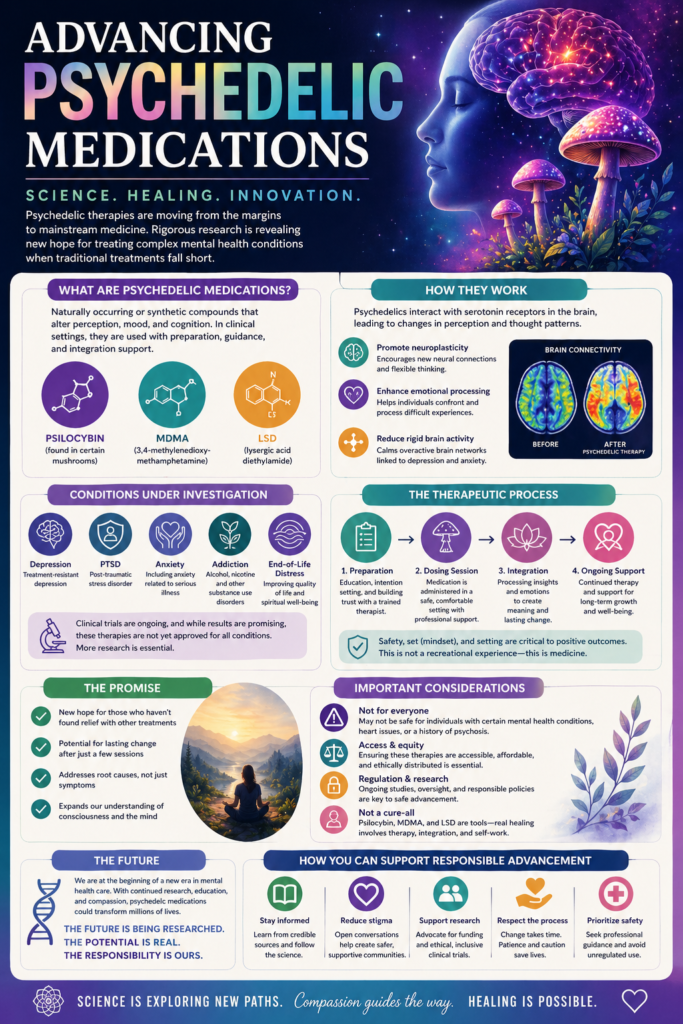
Advancing research into psychedelic compounds such as Psilocybin, MDMA, and LSD is reshaping conversations around mental health treatment. Once highly restricted, these substances are now being studied for their potential to address complex conditions like Post-Traumatic Stress Disorder, depression, and addiction—particularly in cases where traditional therapies have been less effective. This renewed scientific interest reflects a broader shift toward innovative, integrative approaches that focus not only on symptom reduction but also on deeper psychological healing.
Advancing Psychedelic Medications: Bridging Science, Healing, and Innovation
A new era in mental health treatment
In recent years, there has been renewed scientific and clinical interest in psychedelic compounds such as Psilocybin, MDMA, and LSD. Once sidelined due to regulatory restrictions, these substances are now being carefully studied for their potential to treat complex mental health conditions, including Post-Traumatic Stress Disorder, depression, and addiction. This shift marks a significant turning point in how the medical field approaches treatment-resistant conditions.
🔬 What makes psychedelic medications different?
Unlike traditional medications that are taken daily, psychedelic therapies are often:
- Administered in controlled clinical settings
- Combined with psychotherapy or guided support
- Focused on producing meaningful psychological experiences
These experiences may help individuals:
- Process unresolved trauma
- Reframe negative thought patterns
- Increase emotional openness and insight
🧠 How they may work
Research suggests psychedelic medications can:
- Temporarily disrupt rigid brain networks linked to depression and anxiety
- Promote neuroplasticity, allowing new thought patterns to form
- Enhance emotional processing and memory integration
This creates a window where therapeutic interventions may be more effective.
⚖️ Balancing promise with caution
While early findings are promising, advancement requires careful consideration:
- Ensuring safety and proper screening
- Establishing standardized treatment protocols
- Addressing ethical and accessibility concerns
- Navigating evolving regulatory frameworks
These medications are not a universal solution and must be used responsibly within structured care systems.
🌐 The role of research and policy
Organizations like Multidisciplinary Association for Psychedelic Studies have played a key role in advancing clinical trials and public awareness. Ongoing research is helping to:
- Define appropriate dosing and therapeutic models
- Identify which conditions benefit most
- Support potential regulatory approvals
💡 Implications for the future
Advancing psychedelic medications could:
- Expand options for individuals who have not responded to traditional treatments
- Shift mental health care toward more integrative and personalized approaches
- Reduce long-term reliance on daily medications for some conditions
✍️ Conclusion
The advancement of psychedelic medications represents a convergence of science, psychology, and innovation. While challenges remain, the growing body of research offers a hopeful direction for addressing some of the most difficult mental health conditions. With careful development, ethical oversight, and continued study, these therapies may become a transformative part of modern medicine—reshaping how healing is understood and delivered.
Informed and Intentional: Self-Management Strategies for Understanding Advancing Psychedelic Medications
Navigating a rapidly evolving field
As interest grows in psychedelic compounds like Psilocybin, MDMA, and LSD, individuals are increasingly seeking to understand their potential role in mental health care. While research into conditions such as Post-Traumatic Stress Disorder and depression is promising, navigating this space requires informed, thoughtful self-management—especially given the complexity, risks, and evolving evidence.
🧠 Building awareness before action
Self-management starts with understanding—not assumptions. This includes:
- Learning the difference between clinical use and recreational use
- Recognizing that most treatments are still under research or controlled settings
- Understanding that outcomes depend heavily on context, support, and mental state
Being informed reduces risk and improves decision-making.
🔍 Strategy 1: Evaluate sources of information
Not all information is equal. Focus on:
- Peer-reviewed research and clinical trial data
- Reputable organizations like the Multidisciplinary Association for Psychedelic Studies
- Avoiding misinformation from unverified online sources
Critical thinking is key in a field that is both promising and widely discussed.
⚖️ Strategy 2: Understand your personal motivations
Ask yourself:
- Why am I interested in psychedelic treatments?
- Am I seeking relief, curiosity, or a solution to ongoing distress?
- Are there underlying issues (trauma, anxiety, depression) that need structured care?
Clarity about your “why” helps guide safer and more appropriate decisions.
🧩 Strategy 3: Prioritize mental and emotional readiness
Psychedelic experiences can be intense and emotionally revealing. Consider:
- Your current mental health stability
- History of trauma or psychiatric conditions
- Ability to process strong emotions
Preparation and readiness are essential, especially in therapeutic contexts.
👥 Strategy 4: Seek professional guidance
Self-management doesn’t mean doing it alone:
- Consult licensed mental health professionals
- Explore legal, supervised treatment options where available
- Avoid unsupervised or unsafe environments
Professional support provides structure, safety, and integration.
🔄 Strategy 5: Focus on integration and reflection
Understanding doesn’t end with the experience. Growth comes from:
- Reflecting on insights gained
- Applying changes to daily life
- Continuing therapy or support afterward
Integration is often considered as important as the experience itself.
🚨 Strategy 6: Recognize risks and limitations
Even with promising research:
- Psychedelics are not a cure-all
- They may not be appropriate for everyone
- Risks include psychological distress, especially without proper support
Balanced awareness prevents unrealistic expectations.
💡 A grounded approach to innovation
Advancing psychedelic medications represents an exciting shift in mental health care—but self-management requires patience, education, and responsibility. Being informed allows individuals to engage with this emerging field in ways that prioritize safety, insight, and long-term well-being.
✍️ Conclusion
Understanding psychedelic medications is not just about their potential benefits—it’s about making intentional, well-informed choices. With the right balance of curiosity and caution, individuals can navigate this evolving space thoughtfully, aligning new possibilities with personal health, safety, and meaningful growth.
Supporting Understanding: Family Strategies for Navigating Advancing Psychedelic Medications
Why family understanding matters
As research expands around psychedelic compounds like Psilocybin, MDMA, and LSD, families are increasingly part of the conversation. These treatments—being studied for conditions such as Post-Traumatic Stress Disorder, depression, and addiction—can feel both promising and unfamiliar. For families, the goal isn’t just to form an opinion, but to develop an informed, balanced understanding that supports safe and thoughtful decision-making.
🧠 What families may be noticing
Families often encounter:
- Curiosity or interest from a loved one in psychedelic treatments
- Mixed information from media, social platforms, and news
- Concerns about safety, legality, and long-term effects
- Questions about whether these treatments are “real medicine.”
These reactions are normal in an evolving field.
💬 Strategy 1: Start with open, informed conversations
Create space for discussion without immediate judgment:
- Ask questions like “What have you learned about this?”
- Listen to understand, not just respond
- Acknowledge both hope and concern
Open dialogue builds trust and prevents secrecy or misinformation.
🔍 Strategy 2: Learn together from credible sources
Rather than relying on headlines or anecdotes:
- Explore research from organizations like the Multidisciplinary Association for Psychedelic Studies
- Review clinical trial findings and medical guidance
- Distinguish between clinical use and recreational use
Shared learning helps families form a grounded perspective.
⚖️ Strategy 3: Balance optimism with caution
While early research is promising:
- Psychedelic treatments are often still in controlled or emerging stages
- Not all individuals are appropriate candidates
- Outcomes depend on the set (mindset), the setting (environment), and support
Families can support by maintaining a realistic, informed outlook.
👥 Strategy 4: Encourage professional guidance
If a loved one is considering treatment:
- Support consultation with licensed mental health or medical professionals
- Explore legal, supervised options where available
- Discourage unsupervised or unsafe experimentation
Professional involvement adds safety and structure.
🧩 Strategy 5: Support emotional readiness and integration
These therapies are not just medical—they are deeply psychological:
- Encourage reflection on emotional readiness
- Be available for support after experiences (integration phase)
- Normalize the need for ongoing therapy or processing
Family support can play a key role in making insights meaningful and lasting.
🚨 Strategy 6: Address fears and misconceptions
Families may worry about:
- Loss of control
- Addiction or harm
- Social or legal consequences
Address these concerns with facts, not assumptions, and keep communication ongoing.
💡 A collaborative approach
Families don’t need to have all the answers—they need to be:
- Open-minded enough to consider new information
- Cautious enough to prioritize safety
- Supportive enough to stay engaged in the process
✍️ Conclusion
Advancing psychedelic medications represents a shift in how mental health may be treated, but understanding them takes time and thoughtful discussion. Families who engage with curiosity, education, and empathy can help their loved ones navigate this evolving space safely—turning uncertainty into an informed, supportive partnership.
Building Understanding Together: Community Resource Strategies for Advancing Psychedelic Medications
Why community resources matter in a changing landscape
As research expands around psychedelic compounds like Psilocybin, MDMA, and LSD, communities are becoming key players in how this information is understood and applied. These substances are being studied for conditions such as Post-Traumatic Stress Disorder, depression, and addiction—but public understanding often lags behind scientific progress. Community resources help bridge that gap by turning complex research into accessible, informed, and safe guidance.
🌐 What communities are navigating
Across communities, there is often:
- Growing curiosity about psychedelic therapies
- Mixed or conflicting information from media and online sources
- Uncertainty about legality, safety, and effectiveness
- A need for trustworthy, evidence-based education
Community strategies help organize and clarify these conversations.
🏥 Strategy 1: Strengthen public health education
Community health organizations can:
- Provide clear, evidence-based information about psychedelic research
- Explain the differences between clinical treatment and recreational use
- Host workshops, seminars, and educational campaigns
This ensures that people are making decisions based on facts, not myths.
👥 Strategy 2: Develop peer and support networks
Peer-based resources can:
- Offer shared experiences and practical insights
- Reduce stigma around discussing mental health and new treatments
- Provide a space for open, nonjudgmental dialogue
These networks help translate complex ideas into real-life understanding.
🧠 Strategy 3: Integrate mental health and community services
Communities can support understanding by:
- Connecting individuals to licensed therapists and counselors
- Offering trauma-informed and addiction-informed care
- Creating pathways between research settings and community care
Integration ensures that interest in psychedelics is supported by professional guidance.
🔍 Strategy 4: Promote credible research access
Reliable information is essential. Communities should:
- Highlight work from organizations like the Multidisciplinary Association for Psychedelic Studies
- Share updates from clinical trials and medical research
- Teach people how to evaluate sources critically
Access to accurate information empowers safer decision-making.
⚖️ Strategy 5: Address ethics, safety, and accessibility
Community discussions should include:
- Who is an appropriate candidate for treatment
- The importance of controlled, supervised environments
- Ethical concerns such as access, equity, and misuse
Balanced conversations prevent both over-enthusiasm and unnecessary fear.
🔗 Strategy 6: Encourage collaboration across systems
Effective community strategies involve:
- Healthcare providers, educators, policymakers, and support groups
- Shared messaging and consistent education
- Coordinated efforts to guide individuals toward safe, legal options
Collaboration strengthens trust and reduces confusion.
🚨 Recognizing limits of community resources
While community education is valuable:
- Psychedelic treatments are still evolving
- Not all individuals should pursue them
- Medical and psychological supervision remains essential
Communities should guide—not replace—professional care.
✍️ Conclusion
Advancing psychedelic medications is not just a scientific effort—it’s a community learning process. When communities provide accurate information, supportive dialogue, and access to resources, they create a foundation for informed, safe, and responsible engagement. In this way, innovation becomes not just accessible—but understood and thoughtfully integrated into real-world care.
Frequently Asked Questions
Here are some common questions:
1. What are psychedelic medications?
Psychedelic medications are compounds such as Psilocybin, MDMA, and LSD that are being studied for their potential to treat mental health conditions. In clinical settings, they are used alongside structured therapy and professional support.
2. What conditions are they being studied for?
Research is exploring their use in treating:
- Post-Traumatic Stress Disorder
- Depression (especially treatment-resistant)
- Anxiety disorders
- Substance use disorders
- End-of-life distress
3. How are these medications different from traditional treatments?
Unlike daily medications, psychedelic therapies are typically:
- Given in controlled sessions
- Combined with psychotherapy
- Focused on producing deep psychological insights rather than just symptom control
4. How do psychedelic medications work in the brain?
They are thought to:
- Interact with serotonin receptors
- Increase neuroplasticity (the brain’s ability to form new connections)
- Temporarily reduce rigid thinking patterns linked to depression and anxiety
5. Are these treatments currently legal?
Legality varies:
- Some are approved for limited or research use
- Others are still under clinical investigation
- Access is usually restricted to clinical trials or regulated settings
6. Are psychedelic medications safe?
When used in controlled, clinical environments, they can be safe for certain individuals. However:
- They are not appropriate for everyone
- Risks include psychological distress, especially without proper support
- Screening and supervision are essential
7. What is “set and setting,” and why does it matter?
- Set = mindset (emotions, expectations)
- Setting = environment (safe, supportive space)
Both strongly influence the outcome of psychedelic therapy and are carefully managed in clinical settings.
8. What does a typical treatment process look like?
Most clinical models include:
- Preparation (education and goal-setting)
- Dosing session (guided experience with professionals)
- Integration (processing insights in therapy)
9. Are these medications a cure for mental health conditions?
No. They are tools, not cures. Their effectiveness depends on:
- Proper therapeutic support
- Integration of insights into daily life
- Ongoing care and follow-up
10. Why is there so much renewed interest now?
Recent research has shown promising results, leading organizations like Multidisciplinary Association for Psychedelic Studies to expand clinical trials and advocacy efforts.
11. Can people use psychedelics on their own for treatment?
Self-directed use is not recommended:
- It lacks medical screening and safety measures
- There is a higher risk of adverse psychological effects
- Clinical settings provide structure and support that improve outcomes
12. Who should avoid psychedelic treatments?
They may not be suitable for individuals with:
- Certain psychiatric conditions (e.g., psychosis)
- Unstable medical conditions
- Lack of support or a safe environment
A professional evaluation is essential.
13. What are the biggest challenges in advancing these medications?
- Regulatory and legal barriers
- Need for more large-scale research
- Ensuring safe, ethical, and equitable access
- Public misconceptions and stigma
14. What role do therapists play in these treatments?
Therapists are central to:
- Preparing individuals for the experience
- Providing support during sessions
- Helping integrate insights afterward
The therapy component is often as important as the medication itself.
15. What does the future look like for psychedelic medicine?
If research continues to show positive outcomes, psychedelic medications may:
- Become more widely available in regulated clinical settings
- Expand treatment options for difficult-to-treat conditions
- Shift mental health care toward more holistic, integrative approaches
Conclusion
The advancement of psychedelic medications represents a significant and evolving frontier in modern medicine. While early findings are promising, continued progress depends on rigorous research, ethical oversight, and responsible clinical application. As understanding grows, these therapies may offer new pathways for individuals seeking relief from persistent mental health challenges. Ultimately, the future of psychedelic medicine lies in balancing innovation with caution—ensuring that emerging treatments are both effective and safe, while expanding access to care in a thoughtful and evidence-based way.
Video: Your Doctor Might Prescribe Psilocybin Soon #Science #MentalWellness