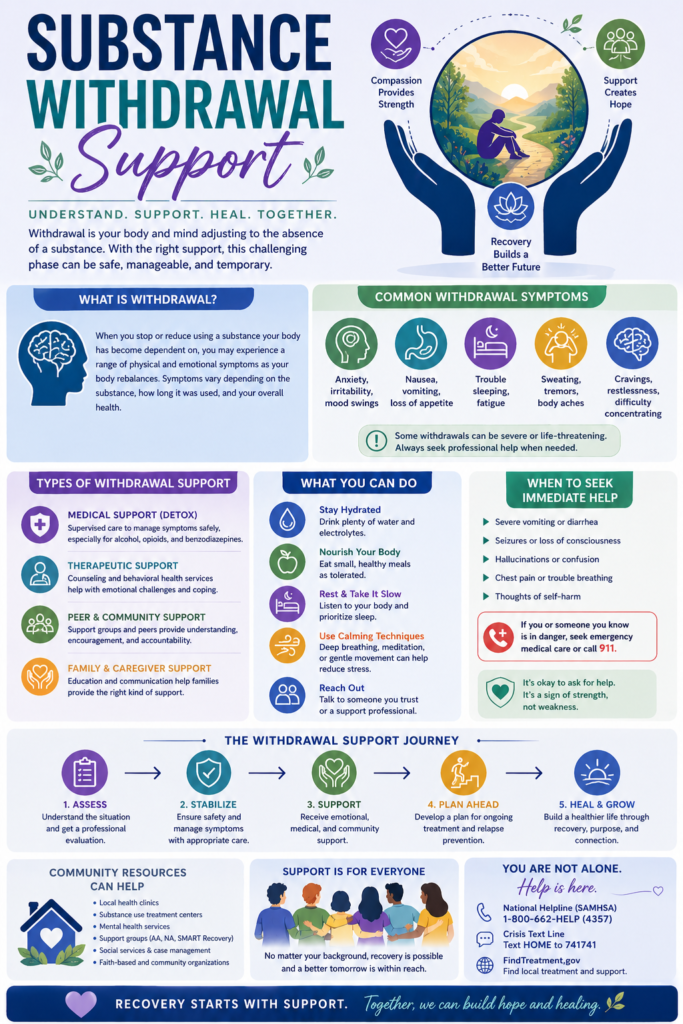
Substance withdrawal support is a critical component in the early stages of recovery from Substance Use Disorder. When individuals reduce or stop using a substance their body has become dependent on, they may experience a range of physical and emotional symptoms that can be uncomfortable, distressing, and in some cases medically serious. Understanding withdrawal as a biological and psychological adjustment process—rather than a lack of willpower—helps reduce stigma and encourages safer, more compassionate care. Effective withdrawal support focuses on stabilization, symptom management, and creating a foundation for ongoing recovery.
Substance Withdrawal Support: Guiding the First Steps Toward Recovery
Understanding withdrawal and why support matters
Substance withdrawal is often the first and most physically and emotionally intense stage of recovery from Substance Use Disorder. When the body has adapted to regular substance use, stopping or reducing use can trigger a range of symptoms—from mild discomfort to severe medical complications. These symptoms are not simply a matter of willpower; they reflect real physiological and neurological changes. Effective withdrawal support focuses on safety, stabilization, and compassionate care, helping individuals navigate this critical phase without unnecessary risk.
🔍 What withdrawal can look like
Withdrawal experiences vary depending on the substance, but may include:
- Nausea, vomiting, or sweating
- Anxiety, irritability, or mood swings
- Sleep disturbances or fatigue
- Physical pain or tremors
- In some cases, serious complications (e.g., seizures, dehydration)
Understanding these symptoms helps normalize the experience and reduces fear.
🧠 Why support is essential
Withdrawal can be overwhelming, and without proper support:
- Symptoms may become medically dangerous
- Individuals are more likely to relapse to relieve discomfort
- Emotional distress can intensify feelings of hopelessness or isolation
Support systems—medical, emotional, and social—play a key role in stabilizing both body and mind.
⚖️ Types of withdrawal support
Effective support can take different forms depending on need:
- Medical supervision (detox programs)
Ensures safety, especially for high-risk withdrawals (e.g., alcohol, opioids) - Outpatient support
Allows individuals to receive care while remaining at home - Peer and recovery support
Provides encouragement, shared experience, and accountability - Behavioral health services
Addresses anxiety, cravings, and underlying mental health needs
💧 Key elements of supportive care
Regardless of the setting, withdrawal support often includes:
- Hydration and nutrition to restore physical balance
- Symptom management (medications when appropriate)
- Rest and a calm environment
- Monitoring for complications or worsening symptoms
These foundational elements can significantly improve comfort and outcomes.
🧩 Beyond withdrawal: preparing for the next step
Withdrawal support is not the end of recovery—it’s the beginning. Long-term success often requires:
- Ongoing treatment or counseling
- Developing coping strategies for stress and triggers
- Building a support network
- Addressing the underlying causes of substance use
Without follow-up care, the risk of relapse remains high.
❤️ A compassionate approach
It’s important to view withdrawal through a nonjudgmental, medical lens. People going through withdrawal are not “failing”—they are healing from a condition that affects both brain and body. Compassion, patience, and informed care make a meaningful difference.
✍️ Conclusion
Substance withdrawal is a challenging but crucial step toward recovery. With the right support—medical guidance, emotional care, and ongoing resources—individuals can move through this phase safely and begin building a healthier, more stable future. Recovery doesn’t start after withdrawal—it starts within it.
Taking Control of the First Step: Self-Management Strategies for Understanding Substance Withdrawal Support
Why self-management matters in withdrawal
Withdrawal is often the most immediate and physically intense phase of recovery from Substance Use Disorder. While professional care is critical—especially for moderate-to-severe cases—self-management plays an important role in recognizing symptoms, responding safely, and building awareness. Understanding what your body and mind are going through can reduce fear and help you make more informed, safer decisions during this phase.
🔍 Recognizing your personal withdrawal pattern
Self-management begins with awareness. Pay attention to:
- When symptoms start after reducing or stopping use
- The type and intensity of symptoms (physical vs. emotional)
- Triggers that worsen discomfort (stress, lack of sleep, environment)
Tracking patterns helps you anticipate what’s coming instead of reacting blindly.
🧠 Strategy 1: Understand what your body is doing
Withdrawal symptoms are your body adjusting to the absence of a substance to which it has adapted. This may include:
- Nervous system overactivity (anxiety, restlessness)
- Physical imbalance (nausea, sweating, fatigue)
- Emotional fluctuations (irritability, low mood)
Knowing this can shift your mindset from “something is wrong” to “my body is recalibrating.”
💧 Strategy 2: Support your physical stability
Basic care can significantly reduce discomfort:
- Stay hydrated (water, electrolyte drinks)
- Eat small, nutritious meals when possible
- Prioritize rest and sleep
- Avoid additional stressors when you can
Simple physical support helps your body recover more efficiently.
⚖️ Strategy 3: Manage symptoms safely
Use practical coping strategies:
- Deep breathing or grounding for anxiety
- Light movement (walking, stretching) if tolerated
- Distraction techniques (music, low-effort activities)
Avoid trying to “push through” severe symptoms without support—listen to your limits.
🧩 Strategy 4: Prepare for cravings and urges
Cravings are a normal part of withdrawal. Try:
- The delay technique (wait 10–15 minutes before acting)
- Changing your environment
- Reaching out to someone for support
Understanding that urges rise and fall like waves makes them easier to manage.
👥 Strategy 5: Build a support check-in system
Even in self-management, connection matters:
- Let someone you trust know what you’re going through
- Schedule regular check-ins (text, call, or in person)
- Have a plan for when symptoms worsen
Support increases both safety and accountability.
🚨 Strategy 6: Know when self-management is not enough
Self-management is helpful, but not always sufficient. Seek medical care if you experience:
- Severe vomiting or dehydration
- Confusion, hallucinations, or seizures
- Intense, worsening symptoms
Certain withdrawals (e.g., alcohol, benzodiazepines) can be life-threatening without supervision.
💡 Shifting perspective: from survival to strategy
Self-management is not about handling everything alone—it’s about understanding your experience and responding intentionally. The more you understand your symptoms, triggers, and needs, the more control you gain during a phase that can feel unpredictable.
✍️ Conclusion
Withdrawal is a temporary but critical stage in recovery. With awareness, basic care strategies, and the willingness to seek help when needed, individuals can move through it more safely and confidently. Self-management doesn’t replace professional care—it strengthens it, turning a difficult experience into a structured step toward long-term healing.
Standing Together: Family Support Strategies for Understanding Substance Withdrawal Support
Why family support matters in withdrawal
Withdrawal is often the most physically and emotionally intense stage of recovery from Substance Use Disorder. For individuals going through it, the experience can feel overwhelming, unpredictable, and isolating. Families play a critical role—not by “fixing” the situation, but by providing stability, understanding, and safe support during a time when both the body and mind are under stress. When families understand withdrawal, they can respond with confidence instead of fear.
🔍 What families may observe
Loved ones may notice:
- Physical symptoms like nausea, sweating, shaking, or fatigue
- Emotional changes such as irritability, anxiety, or mood swings
- Difficulty sleeping or resting
- Periods of distress followed by brief improvement
Recognizing these as withdrawal symptoms—not personal behavior—helps families respond more effectively.
💬 Strategy 1: Respond with understanding, not judgment
Withdrawal can cause behavior that feels confusing or frustrating. Families can:
- Avoid blaming or criticizing
- Remind themselves that symptoms are physiological and temporary
- Use supportive language (“I’m here with you,” “This will pass”)
Empathy helps reduce shame and builds trust.
🧠 Strategy 2: Learn the basics of withdrawal
Understanding what’s happening reduces fear:
- Symptoms are part of the body re-adjusting without the substance
- The intensity and duration vary depending on the substance and the person
- Some withdrawals require medical supervision
Knowledge allows families to respond calmly and appropriately.
💧 Strategy 3: Support physical comfort and care
Families can help with simple but important needs:
- Encourage hydration and small meals
- Provide a quiet, low-stress environment
- Support rest and minimize unnecessary stimulation
These basics can make a significant difference in comfort and safety.
⚖️ Strategy 4: Maintain healthy boundaries
Support does not mean removing all responsibility:
- Avoid enabling behaviors (e.g., providing substances)
- Set clear, calm boundaries around safety and expectations
- Balance compassion with consistency and structure
Boundaries protect both the individual and the family.
👥 Strategy 5: Encourage professional support
Families should not manage withdrawal alone when risk is present:
- Encourage medical evaluation for moderate to severe symptoms
- Support access to detox programs or healthcare providers
- Help coordinate follow-up care after withdrawal
Professional care ensures safety, especially in high-risk cases.
🚨 Strategy 6: Know warning signs that require urgent help
Seek immediate medical care if your loved one experiences:
- Seizures or severe shaking
- Confusion, hallucinations, or disorientation
- Inability to keep fluids down
- Signs of severe dehydration
Recognizing these signs can be life-saving.
🧩 Strategy 7: Prepare for what comes next
Withdrawal is only the first step. Families can:
- Encourage ongoing treatment or counseling
- Support the development of healthy coping strategies
- Stay involved in recovery planning
Recovery is a long-term process, not a single event.
❤️ A balanced approach to support
Effective family support includes:
- Empathy (understanding the experience)
- Awareness (recognizing symptoms and risks)
- Boundaries (maintaining safety and structure)
This balance creates a stable environment for recovery.
✍️ Conclusion
Family support can be a powerful stabilizing force during withdrawal. When loved ones shift from confusion or frustration to informed, compassionate involvement, they help transform a difficult and vulnerable phase into a safer, more manageable step toward recovery. In many cases, healing begins not just with the individual but with the support system around them.
Stronger Together: Community Resource Strategies for Understanding Substance Withdrawal Support
Why community support matters
Withdrawal is often the first and most challenging step in recovery from Substance Use Disorder, and it rarely happens in isolation. Individuals may struggle with physical symptoms, emotional distress, and uncertainty about what to do next. Community resources play a critical role in bridging gaps in care, increasing awareness, and providing accessible support systems. When communities are informed and connected, they can help transform withdrawal from a crisis into a supported transition toward recovery.
🔍 What communities often encounter
Across community settings, common patterns include:
- Individuals experiencing withdrawal without clear guidance
- Repeated emergency visits without long-term solutions
- Limited awareness of available detox or recovery services
- Stigma prevents people from seeking help
Community strategies aim to connect these gaps.
🏥 Strategy 1: Expand access to local healthcare services
Community health systems can:
- Provide screening and early identification of withdrawal symptoms
- Offer outpatient or inpatient detoxification programs
- Ensure follow-up care to reduce relapse risk
Accessible care reduces delays and improves safety.
👥 Strategy 2: Strengthen peer and recovery support networks
Peer-based programs can:
- Offer shared lived experiences that normalize withdrawal
- Provide encouragement during difficult phases
- Help individuals stay connected and accountable
Support groups create a sense of belonging and understanding.
🧠 Strategy 3: Integrate behavioral health services
Withdrawal is not just physical—it’s emotional and psychological. Communities can:
- Provide counseling for anxiety, cravings, and stress
- Address underlying mental health conditions
- Offer trauma-informed care
Integration ensures a whole-person approach.
🌐 Strategy 4: Improve public education and awareness
Communities can reduce confusion by:
- Offering clear, evidence-based information about withdrawal
- Teaching when withdrawal requires medical supervision
- Providing guidance on where and how to seek help
Education empowers individuals and families to act early.
⚖️ Strategy 5: Reduce stigma and barriers to care
Stigma often prevents people from accessing support. Community efforts should:
- Normalize substance use disorders as medical conditions
- Promote nonjudgmental language and services
- Encourage early help-seeking without fear
Reducing stigma increases engagement and recovery outcomes.
🔗 Strategy 6: Coordinate services across systems
Effective support requires collaboration:
- Healthcare providers, social services, and community organizations working together
- Shared referral systems and communication (with consent)
- Continuity of care from withdrawal to long-term recovery
Coordination prevents individuals from falling through the cracks.
🚨 Recognizing limits of community resources
While community support is essential:
- Severe withdrawal may require hospital-level care
- Some cases need specialized detox programs
- Community resources should guide individuals to appropriate medical services
Knowing these limits ensures safety.
✍️ Conclusion
Community resource strategies are a vital foundation for understanding and supporting substance withdrawal. When communities provide accessible care, education, and connection, they help individuals move through withdrawal more safely and with greater confidence. Recovery doesn’t happen in isolation—it grows within informed, compassionate, and coordinated communities.
Frequently Asked Questions
Here are some common questions:
1. What is substance withdrawal?
Substance withdrawal occurs when a person reduces or stops using a substance their body has become dependent on, often as part of recovery from Substance Use Disorder. It involves physical and emotional symptoms as the body adjusts to functioning without the substance.
2. Why does withdrawal happen?
Over time, the body adapts to the presence of a substance. When it’s removed, the body must rebalance its systems, which can lead to discomfort and symptoms during the adjustment process.
3. What are common withdrawal symptoms?
Symptoms vary but may include:
- Anxiety, irritability, or mood swings
- Nausea, vomiting, or sweating
- Trouble sleeping or fatigue
- Muscle aches or tremors
- Cravings for the substance
4. Are all withdrawals the same?
No. Withdrawal depends on:
- The type of substance used
- How long and how often it was used
- Individual health and biology
Some withdrawals are mild, while others can be serious or life-threatening.
5. When is withdrawal dangerous?
Withdrawal can be dangerous—especially with substances like alcohol or certain medications—if symptoms include:
- Seizures
- Hallucinations or confusion
- Severe dehydration
- Chest pain or difficulty breathing
These situations require immediate medical care.
6. What is withdrawal support?
Withdrawal support refers to the medical, emotional, and practical care provided to help someone safely manage symptoms during this phase. It can include detox programs, medications, counseling, and support systems.
7. Can withdrawal be managed at home?
Some mild cases can be managed at home with proper support. However:
- Moderate to severe withdrawal should be medically supervised
- It’s important to consult a healthcare provider before deciding
Safety should always come first.
8. What is a detox program?
A detox (detoxification) program is a medically supervised setting where professionals monitor symptoms, provide medications if needed, and ensure safety during withdrawal.
9. How long does withdrawal last?
It varies:
- Some symptoms begin within hours
- Most acute symptoms last days to a week
- Some emotional or psychological symptoms may last longer
10. What helps ease withdrawal symptoms?
Helpful strategies include:
- Staying hydrated
- Eating light, nutritious foods
- Getting rest and sleep
- Using prescribed medications if needed
- Having emotional support
11. Why is relapse common during withdrawal?
Withdrawal symptoms can be uncomfortable, leading individuals to use substances again to relieve discomfort quickly. This is why structured support is so important during this phase.
12. What happens after withdrawal?
Withdrawal is just the first step. Ongoing recovery often includes:
- Therapy or counseling
- Support groups
- Relapse prevention strategies
- Lifestyle changes
13. How can family or friends help?
They can:
- Provide emotional support and encouragement
- Help monitor symptoms
- Assist with accessing medical care
- Maintain a calm, supportive environment
14. Is withdrawal a sign of weakness?
No. Withdrawal is a biological response, not a lack of willpower. It reflects how the body has adapted to substance use.
15. Is recovery possible after withdrawal?
Yes. With the right support and follow-up care, individuals can move beyond withdrawal and achieve long-term recovery and improved well-being.
Conclusion
Substance withdrawal support is more than managing symptoms—it is about ensuring safety, dignity, and a pathway forward. With the right combination of medical care, emotional support, and informed strategies, individuals can move through withdrawal with reduced risk and greater confidence. Recognizing withdrawal as a temporary but essential phase allows both individuals and support systems to approach it with patience and purpose. Ultimately, strong withdrawal support sets the stage for long-term recovery, helping individuals transition from immediate stabilization to sustained healing and well-being.
Video: The Brutal Truth About Getting Clean #addiction #recovery