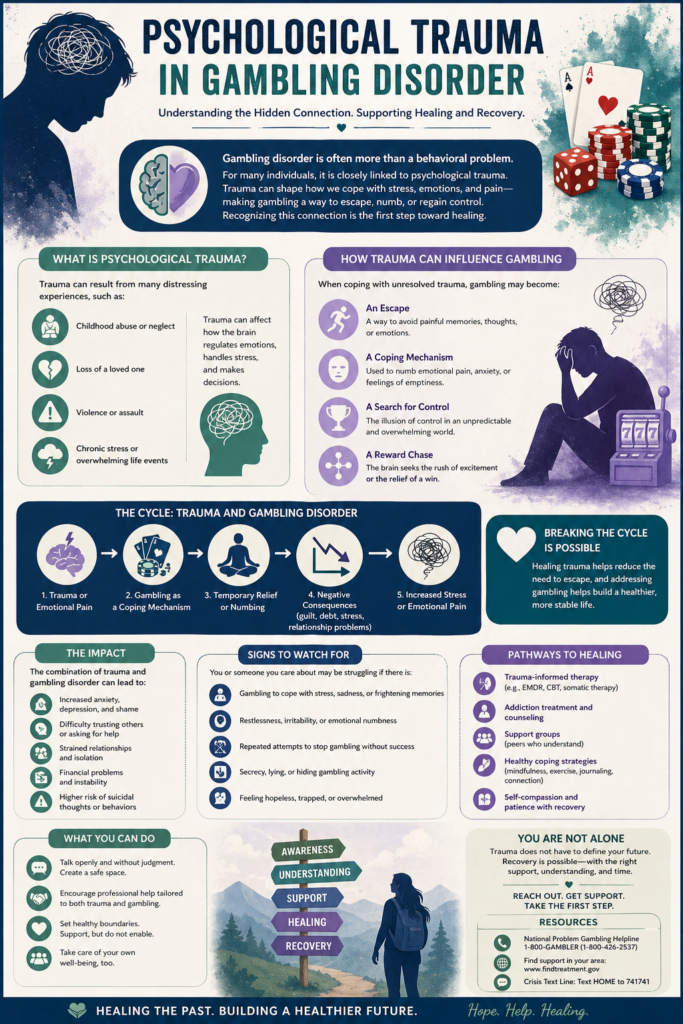
Gambling Disorder is increasingly understood as more than a problem of risky decision-making or financial loss. For many individuals, it is closely linked to psychological trauma, including experiences such as childhood adversity, loss, chronic stress, or unresolved emotional pain. Trauma can shape how the brain processes reward, stress, and coping, making gambling a temporary escape or form of relief. This connection often goes unrecognized, leading to repeated cycles of behavior without addressing the underlying cause. Understanding the role of trauma provides a more complete and compassionate framework for both awareness and intervention.
Hidden Wounds, Risky Bets: Psychological Trauma in Gambling Disorder
Understanding the connection
Gambling Disorder is often viewed through the lens of financial loss and risky behavior—but beneath the surface, there is frequently a deeper psychological story. For many individuals, gambling is not just about excitement or reward; it can serve as a way to cope with unresolved psychological trauma. Trauma—whether from childhood adversity, loss, abuse, or chronic stress—can shape how the brain processes emotions, risk, and reward, making some individuals more vulnerable to addictive behaviors like gambling.
🧠 How trauma influences gambling behavior
Trauma can affect both emotional regulation and decision-making. Individuals may:
- Use gambling as an escape from distressing thoughts or memories
- Seek the temporary relief or “numbing” effect that gambling provides
- Become drawn to the high-risk, high-reward cycle as a distraction from emotional pain
Over time, this pattern can evolve into a cycle where trauma fuels gambling, and gambling creates additional stress, guilt, and consequences.
🔄 The cycle of trauma and addiction
Psychological trauma and gambling disorder often reinforce each other:
- Emotional distress or trauma triggers
- Gambling used as a coping mechanism
- Temporary relief or distraction
- Negative consequences (financial loss, shame, relationship strain)
- Increased stress → return to gambling
This cycle can be difficult to break without addressing both the behavior and the underlying trauma.
⚠️ Why trauma often goes unrecognized
Many people do not immediately connect their gambling behavior to trauma because:
- The focus is often on financial consequences rather than emotional roots
- Trauma may be unprocessed or normalized over time
- Gambling can feel like a solution, not a symptom
This can delay effective treatment and keep individuals stuck in the cycle.
💡 Moving toward recovery
Addressing gambling disorder effectively often requires a trauma-informed approach, which may include:
- Therapy (such as trauma-focused cognitive behavioral therapy)
- Developing healthier coping strategies for stress and emotional pain
- Support groups and peer connections
- Building awareness of triggers and behavioral patterns
Recovery is not just about stopping gambling—it’s about healing the underlying emotional wounds that drive it.
🧠 A broader perspective
Understanding the role of trauma shifts the narrative from “lack of control” to adaptation and coping. Gambling may begin as a way to survive emotional pain, but over time, it becomes a source of additional harm. Recognizing this allows for more compassionate, effective interventions.
✍️ Conclusion
Psychological trauma and gambling disorder are deeply interconnected. When the focus expands beyond the behavior to include the emotional context, it opens the door to meaningful, lasting recovery. Healing becomes not just about avoiding risk—but about reclaiming stability, safety, and well-being.
Understanding Yourself to Regain Control: Self-Management Strategies for Psychological Trauma in Gambling Disorder
Seeing the connection clearly
Gambling Disorder is often driven by more than the pursuit of money or excitement. For many individuals, it is closely tied to unresolved psychological trauma—experiences that shape emotional responses, stress tolerance, and coping behaviors. Self-management begins with recognizing that gambling may be less about risk-taking and more about relief from emotional pain.
🧠 Recognizing personal patterns
The first step is awareness. Ask yourself:
- When do I feel the urge to gamble? (stress, boredom, loneliness)
- What emotions am I trying to avoid or change?
- What happens right before and after I gamble?
Tracking these patterns helps shift behavior from automatic to intentional and observable.
🔍 Strategy 1: Identify trauma triggers
Trauma doesn’t always show up as obvious memories—it can appear as:
- Sudden anxiety or irritability
- Emotional numbness
- A need to escape or distract
Learning your triggers allows you to anticipate urges rather than react to them.
⚖️ Strategy 2: Pause the impulse cycle
Gambling urges are often intense but temporary. Try:
- The “10-minute rule”: delay acting on the urge
- Grounding techniques (deep breathing, sensory awareness)
- Redirecting attention (walking, calling someone, changing environments)
Creating space between urge and action weakens the automatic cycle.
🧩 Strategy 3: Replace the function, not just the behavior
Gambling often serves a purpose, such as:
- Escaping distress
- Feeling excitement or control
- Numbing emotional pain
Identify what gambling does for you, then replace it with healthier alternatives:
- Stress → exercise, breathing, structured routines
- Emotional pain → journaling, therapy, connection
- Boredom → engaging activities or hobbies
🧠 Strategy 4: Build emotional regulation skills
Trauma can make emotions feel overwhelming. Strengthen your ability to manage them by:
- Practicing mindfulness or meditation
- Using structured coping tools (like naming emotions or rating intensity)
- Developing tolerance for discomfort without immediate escape
Over time, this reduces reliance on gambling as a coping mechanism.
👥 Strategy 5: Create accountability and support
Self-management doesn’t mean doing it alone:
- Share goals with a trusted person
- Use self-exclusion tools or financial limits
- Join peer support groups
External structure supports internal change.
🚨 When to seek additional help
If you notice:
- Loss of control over gambling
- Increasing emotional distress
- Financial or relationship harm
Professional support—especially trauma-informed therapy—can provide deeper tools and guidance.
✍️ Conclusion
Self-management is about understanding, not blaming. Gambling may have developed as a way to cope with trauma, but it doesn’t have to remain the solution. By recognizing patterns, building healthier responses, and addressing underlying emotional needs, it’s possible to move from reactive behavior to intentional, sustainable recovery.
Healing Together: Family Support Strategies for Psychological Trauma in Gambling Disorder
Understanding what’s beneath the behavior
Gambling Disorder is often seen as a problem of impulse or financial decision-making—but for many individuals, it is deeply connected to psychological trauma. Experiences such as loss, neglect, chronic stress, or past abuse can shape how a person copes with emotional pain. Gambling may become a way to escape, numb, or regain a sense of control, even if it ultimately creates more harm. For families, understanding this connection is the first step toward meaningful support.
🧠 What families may notice
Loved ones often observe:
- Gambling during times of stress, conflict, or emotional distress
- Withdrawal, irritability, or secrecy
- Repeated attempts to stop without success
- Emotional ups and downs tied to wins, losses, or life events
These patterns often reflect underlying emotional struggles, not just poor choices.
💬 Strategy 1: Lead with understanding, not judgment
Families may feel frustration, fear, or anger—but how support is offered matters:
- Avoid labeling the person as irresponsible or careless
- Recognize that gambling may be a coping response to deeper pain
- Approach conversations with curiosity: “What’s been going on for you lately?”
Empathy builds trust, which is essential for change.
🔍 Strategy 2: Help connect emotions to behavior
Many individuals are not fully aware of how trauma influences their actions. Families can:
- Gently point out patterns (“I notice gambling increases when you’re stressed”)
- Encourage reflection on triggers and emotional states
- Support journaling or self-awareness exercises
The goal is to shift from “What’s wrong?” to “What’s driving this?”
⚖️ Strategy 3: Set healthy boundaries
Support does not mean enabling:
- Avoid covering financial losses or debts
- Set clear limits around money and shared responsibilities
- Communicate boundaries calmly and consistently
Boundaries protect both the family and the individual, while reinforcing accountability.
🧩 Strategy 4: Encourage trauma-informed help
Because trauma is often a root factor, treatment should address more than gambling alone:
- Encourage therapy that focuses on both trauma and addiction
- Support attendance at counseling or peer support groups
- Normalize seeking help as a strength, not a weakness
Professional support can help process underlying experiences safely.
👥 Strategy 5: Strengthen connection and support systems
Isolation often worsens both trauma and addiction. Families can:
- Spend intentional, quality time together
- Encourage social support outside the family
- Reinforce positive behaviors and small steps toward change
Connection can reduce the need to escape through gambling.
🚨 Strategy 6: Recognize when more support is needed
Families should seek additional help if:
- Gambling behavior escalates or becomes uncontrollable
- There is significant financial, emotional, or relational harm
- Trauma symptoms (anxiety, depression, distress) intensify
Early intervention can prevent deeper consequences.
❤️ A balanced approach to support
Supporting someone with a gambling disorder linked to trauma requires:
- Empathy (understanding the emotional roots)
- Clarity (recognizing harmful patterns)
- Consistency (maintaining boundaries and support)
It’s a balance between compassion and accountability.
✍️ Conclusion
When families shift from focusing only on the behavior to understanding the emotional story behind it, support becomes more effective and less conflict-driven. Gambling may be a response to unresolved trauma—but with awareness, communication, and the right support, individuals and families can move toward healing, stability, and long-term recovery—together.
Stronger Together: Community Resource Strategies for Understanding Psychological Trauma in Gambling Disorder
Looking beyond the surface
Gambling Disorder is often addressed as a financial or behavioral issue, but many individuals struggling with it are also coping with psychological trauma. Community resources play a critical role in helping people move from misunderstanding to awareness—by connecting the dots between emotional pain, coping strategies, and addictive behaviors. No single system can address this alone; it takes a coordinated, community-wide approach.
🧠 What communities can help reveal
Across different community settings, patterns often become clearer:
- Gambling increases during stress, trauma reminders, or life disruptions
- Individuals seek escape, relief, or emotional numbness through gambling
- Repeated cycles of harm without understanding the root cause
When multiple touchpoints recognize these patterns, understanding deepens.
🏥 Strategy 1: Integrate healthcare and behavioral services
Community health systems can:
- Screen for both gambling behaviors and trauma history
- Provide integrated care that treats mental health and addiction together
- Offer continuity of care so patterns are recognized over time
This shifts the focus from isolated symptoms to whole-person care.
👥 Strategy 2: Leverage peer and recovery networks
Peer support groups provide:
- Shared lived experiences that validate struggles
- Insight into how trauma and gambling are connected
- Practical strategies for managing urges and triggers
Hearing similar stories can help individuals recognize their own patterns more clearly.
🧩 Strategy 3: Expand access to trauma-informed services
Community programs should prioritize:
- Trauma-informed counseling and therapy
- Education on how trauma impacts behavior and decision-making
- Safe environments where individuals feel understood, not judged
This helps address the root causes rather than just the symptoms.
🌐 Strategy 4: Provide accurate public education
Awareness is key to early recognition:
- Public health campaigns can explain the trauma–addiction connection
- Educational materials can reduce misconceptions about gambling
- Workshops and seminars can equip families and individuals with knowledge
Informed communities are better equipped to respond effectively.
⚖️ Strategy 5: Reduce stigma and barriers to care
Stigma often prevents people from seeking help. Communities can:
- Normalize conversations about mental health and addiction
- Emphasize that gambling disorder is a treatable condition
- Promote nonjudgmental support environments
Reducing shame increases access to care and recovery resources.
🔗 Strategy 6: Coordinate services across systems
Effective community support requires collaboration:
- Healthcare providers, counselors, and social services sharing information (with consent)
- Financial counseling integrated with mental health support
- Community organizations working together rather than in isolation
Coordination prevents individuals from “falling through the cracks.”
🚨 When additional intervention is needed
Community resources should guide individuals to higher levels of care when:
- Gambling becomes uncontrollable
- Trauma symptoms intensify (e.g., anxiety, depression, distress)
- There are serious financial or relational consequences
Timely referrals can prevent escalation.
✍️ Conclusion
Understanding psychological trauma in gambling disorder doesn’t happen in isolation—it emerges through community awareness, shared knowledge, and coordinated support. When communities align resources to address both emotional and behavioral aspects, they create pathways not just for managing gambling—but for healing the deeper wounds that sustain it.
Frequently Asked Questions
Here are some common questions:
1. What is the connection between trauma and gambling disorder?
Gambling Disorder is often linked to psychological trauma, where gambling becomes a way to cope with emotional pain, stress, or unresolved experiences. Instead of just seeking money or excitement, individuals may be seeking relief, escape, or control.
2. What counts as psychological trauma?
Psychological trauma can include:
- Childhood abuse or neglect
- Loss of a loved one
- Violence or assault
- Chronic stress or instability
Trauma doesn’t have to be a single major event—it can also be ongoing emotional strain.
3. How does trauma influence gambling behavior?
Trauma can affect:
- Emotional regulation (difficulty managing feelings)
- Impulse control
- Stress response
As a result, gambling may be used to:
- Escape painful thoughts
- Numb emotions
- Feel excitement or temporary relief
4. Does gambling always cause trauma?
No. Not everyone with a gambling disorder has a trauma history. However, trauma is a significant risk factor and is common among many individuals with gambling problems.
5. Why do people keep gambling even after negative consequences?
Gambling can create:
- Temporary emotional relief
- A sense of control or distraction
When trauma is involved, the brain may prioritize short-term relief over long-term consequences, reinforcing the cycle.
6. What is the cycle of trauma and gambling?
A common cycle includes:
- Emotional pain or trauma trigger
- Gambling as a coping mechanism
- Temporary relief
- Negative consequences (financial, emotional)
- Increased stress → return to gambling
7. What are the signs that trauma may be involved?
- Gambling during times of stress or emotional distress
- Feelings of numbness, anxiety, or overwhelm
- Using gambling to “escape” thoughts or memories
- Difficulty stopping despite wanting to
8. How is this different from recreational gambling?
Recreational gambling:
- Is controlled and occasional
- Doesn’t interfere with daily life
Trauma-related gambling:
- Is often compulsive or emotionally driven
- Serves as a coping mechanism rather than entertainment
9. Can someone recover without addressing trauma?
Recovery is possible, but long-term success is more likely when trauma is addressed. Ignoring the underlying cause may lead to relapse or replacing gambling with another coping behavior.
10. What types of treatment help?
Effective approaches often include:
- Trauma-informed therapy (e.g., CBT, EMDR)
- Addiction counseling
- Support groups
- Coping and emotional regulation skills
11. How can families support someone with this issue?
- Approach with empathy, not blame
- Encourage professional help
- Set healthy boundaries
- Learn about trauma and addiction
Support works best when it balances understanding and accountability.
12. Why is trauma often overlooked?
- Focus is usually on financial loss
- Trauma may be hidden or unrecognized
- Gambling can appear as the main problem rather than a symptom
13. Is gambling disorder a mental health condition?
Yes. It is recognized as a behavioral addiction and often co-occurs with:
- Anxiety
- Depression
- Trauma-related conditions
14. Can self-help strategies work?
Yes, especially when combined with support:
- Identifying triggers
- Delaying urges
- Replacing gambling with healthier coping strategies
- Building awareness of emotional patterns
15. Is recovery possible?
Absolutely. With the right support and by addressing both trauma and gambling behavior, individuals can achieve long-term recovery and improved well-being.
Conclusion
Recognizing psychological trauma in gambling disorder shifts the focus from simply stopping the behavior to understanding and healing its roots. When trauma is acknowledged, treatment can become more effective, addressing both emotional regulation and addictive patterns. Recovery is not just about avoiding gambling—it is about developing healthier coping strategies, rebuilding stability, and processing past experiences in a meaningful way. By integrating trauma-informed perspectives into care and support systems, individuals are better positioned to achieve sustainable recovery and long-term well-being.
Video: How Trauma Becomes a Gambling Addiction #AddictionRecovery #Psychology