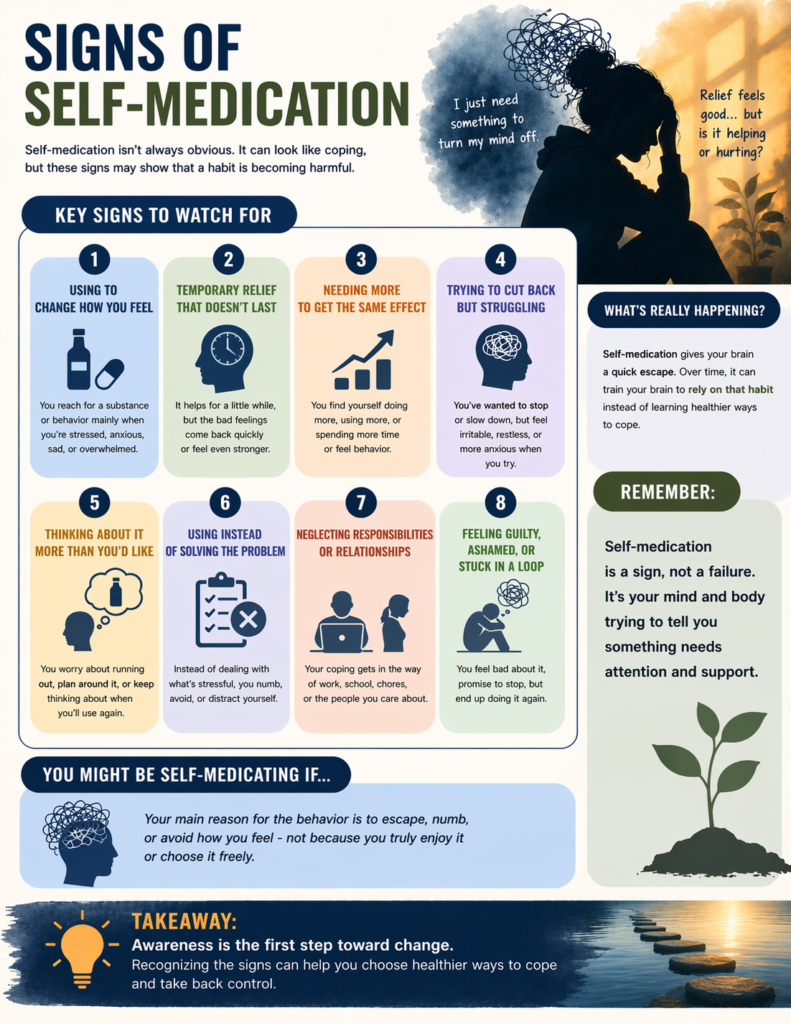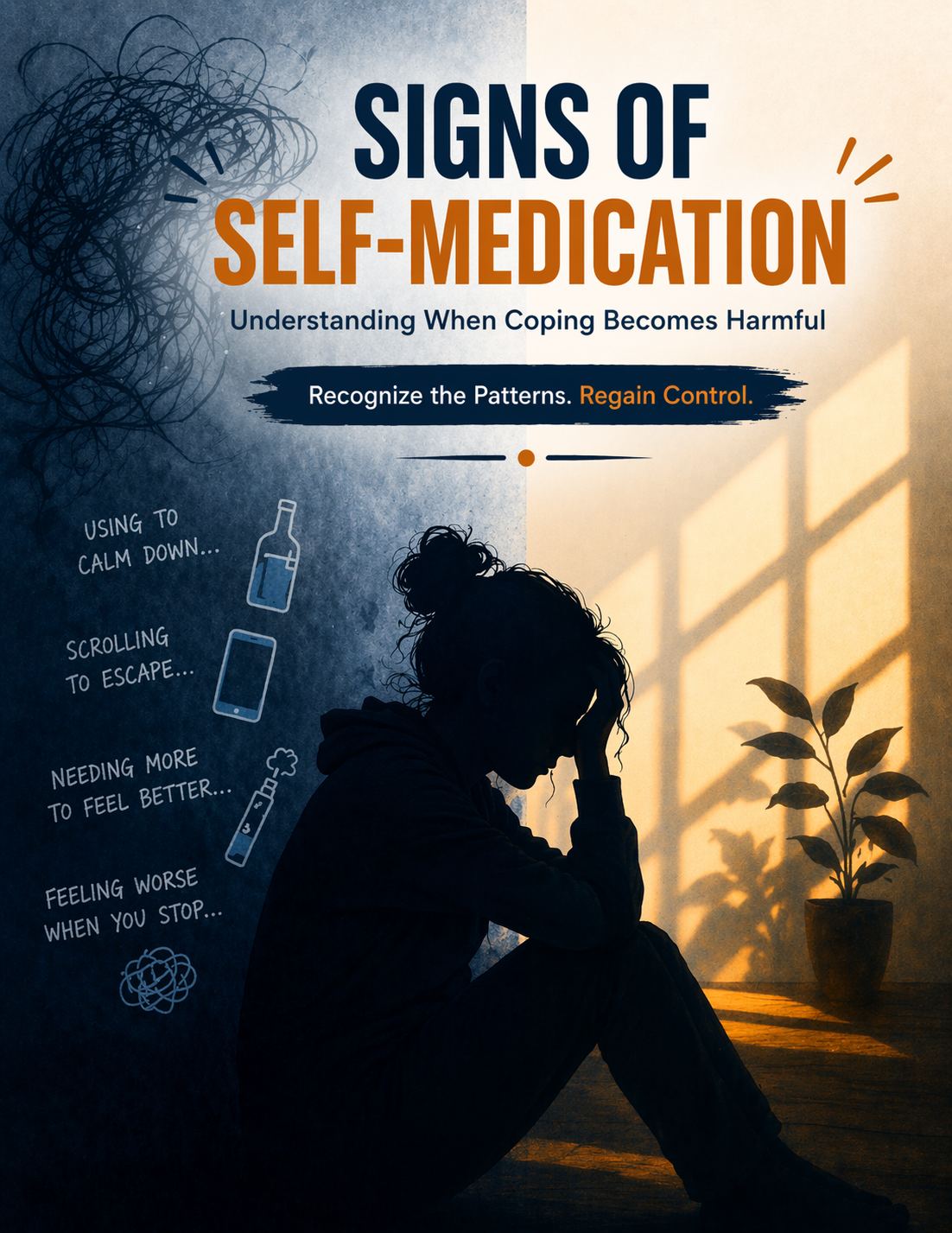
Self-medication often begins quietly, disguised as normal coping. Whether it’s reaching for a drink after a stressful day, vaping to ease nerves, or distracting yourself to avoid difficult thoughts, these behaviors can feel harmless at first. The challenge is that self-medication is not defined by what you use, but by why you use it. When the primary goal becomes escaping or numbing emotional discomfort, a pattern can begin to form. Recognizing the signs of self-medication is important because it brings awareness to behaviors that may otherwise go unnoticed until they become more difficult to manage.
When Coping Turns Risky: Signs of Self-Medication
Not all harmful habits start with the intention to cause harm. In fact, many begin as attempts to cope. Self-medication is one of the most common—and often unnoticed—ways people manage stress, anxiety, and emotional discomfort. What starts as a way to take the edge off can slowly become harder to control.
Understanding the signs of self-medication is important because it helps you recognize when coping strategies are no longer helping and are instead creating new problems.
What Is Self-Medication?
Self-medication happens when a person uses substances or behaviors to manage emotional or psychological distress without addressing the underlying cause. This can include alcohol, nicotine, drugs, overeating, excessive screen use, or even overworking.
The key factor isn’t the substance or behavior itself—it’s the reason behind it. When the primary goal is to escape or numb a feeling, self-medication may be at play.
Sign 1: You Use Something to Change How You Feel
One of the clearest signs is turning to a substance or behavior, specifically when you feel anxious, stressed, or overwhelmed.
For example:
- Reaching for a drink after a difficult day
- Vaping or smoking when feeling nervous
- Scrolling endlessly to avoid uncomfortable thoughts
Over time, the brain begins to associate relief with that behavior, reinforcing the pattern.
Sign 2: The Relief Is Temporary—But the Urge Returns Stronger
Self-medication often works at first. It reduces discomfort, which makes it feel effective. But the relief doesn’t last.
Instead, you may notice:
- Needing more of the same behavior to feel relief
- The feeling returns quickly after stopping
- Increased reliance on the behavior during stress
This creates a cycle where the solution becomes part of the problem.
Sign 3: You Feel Worse When You Try to Stop
Another major sign is increased discomfort when you try to cut back or stop.
This might look like:
- Heightened anxiety or irritability
- Restlessness or difficulty focusing
- Strong urges to return to the behavior
This doesn’t mean you’re weak—it means your brain has learned to depend on that behavior for regulation.
Why Self-Medication Happens
Self-medication is often driven by anxiety and emotional distress. When those feelings feel overwhelming, the brain looks for fast relief. If something works—even temporarily—it becomes the go-to response.
The problem is that this bypasses learning healthier ways to cope, making long-term regulation harder.
What You Can Do Instead
Recognizing self-medication is the first step. From there, the goal is not to remove coping—but to improve it.
Healthier strategies include:
- Identifying and naming what you’re feeling
- Using grounding or breathing techniques
- Replacing the behavior with something less harmful
- Talking to someone or seeking professional support
These approaches may not feel as immediate, but they build lasting control rather than dependence.
Final Thought
Self-medication doesn’t mean something is wrong with you—it means you’re trying to manage something difficult. But when the coping method starts to take control, it’s a signal to pause and reassess.
The goal isn’t just to stop the behavior. It’s to understand what’s driving it—and to find better ways to respond.
From Awareness to Action: Managing the Signs of Self-Medication
Recognizing the signs of self-medication is an important first step—but awareness alone doesn’t change behavior. The real shift happens when you begin to respond differently in the moments when the urge to cope appears. Self-management strategies help bridge that gap, turning insight into action.
Self-medication often operates automatically. You feel anxious, overwhelmed, or uncomfortable, and without much thought, you reach for something that provides relief. To change this pattern, you need to slow it down, understand it, and replace it with more effective coping strategies.
Step One: Identify Your Personal Triggers
Self-medication doesn’t happen randomly—it follows patterns.
Start by asking:
- When do I feel the urge to use or escape?
- What emotions show up right before it?
- Are there specific situations, people, or times of day that trigger it?
Tracking these patterns helps you move from reacting automatically to responding intentionally.
Step Two: Pause Before Acting
One of the most powerful tools is also one of the simplest: pause.
When you feel the urge:
- Wait 60–90 seconds
- Take slow, controlled breaths
- Delay the behavior, even briefly
This interrupts the automatic cycle and gives your brain time to re-engage with more rational decision-making.
Step Three: Name the Feeling
Self-medication thrives on vague discomfort. When you can’t define what you’re feeling, it feels more overwhelming.
Instead, get specific:
- “I feel anxious about this situation.”
- “I feel overwhelmed and mentally exhausted.”
- “I feel restless and need a release.”
Putting feelings into words reduces their intensity and helps you understand what you actually need.
Step Four: Replace the Behavior
You can’t just remove a coping strategy—you need to replace it.
Try alternatives that match the need behind the urge:
- If you need relief → try deep breathing or grounding
- If you need a distraction → engage in a focused activity
- If you need release → use movement or exercise
- If you need a connection → talk to someone
The goal is not perfection—it’s progress.
Step Five: Build Awareness of Consequences
In the moment, self-medication feels helpful. But it’s important to remind yourself of the full picture.
Ask:
- How do I feel after this, not just during?
- Does this actually solve the problem?
- What happens if this pattern continues?
This helps shift focus from short-term relief to long-term impact.
Step Six: Strengthen Daily Regulation
If your overall stress or anxiety level is high, you’ll be more likely to self-medicate.
Support your baseline by:
- Getting consistent sleep
- Maintaining routines
- Staying physically active
- Limiting substances that increase anxiety
These habits make it easier to manage urges when they arise.
Final Thought
Self-medication is not a failure—it’s a signal. It shows that something inside needs attention, relief, or support.
Self-management is about learning to respond to that signal differently. By recognizing the signs, pausing the pattern, and choosing healthier alternatives, you begin to take back control—not just over the behavior, but over the underlying need driving it.
Change doesn’t happen all at once. But every moment you choose awareness over autopilot is a step in the right direction.
Helping Without Harm: Family Strategies to Recognize Self-Medication
When someone you care about is struggling, it’s natural to focus on what they’re doing—drinking more, vaping, isolating, or constantly distracting themselves. But these behaviors are often symptoms of something deeper. Self-medication is not just about the behavior; it’s about the attempt to cope with emotional distress.
For families, understanding the signs of self-medication can make the difference between reacting in ways that escalate the problem and responding in ways that actually help.
Look Beyond the Behavior
It’s easy to interpret self-medication as laziness, poor choices, or a lack of discipline. In reality, it is often an attempt to manage stress, anxiety, or overwhelming emotions.
Instead of asking:
- “Why are you doing this?”
Shift to:
- “What might you be trying to cope with?”
This perspective reduces judgment and opens the door to more meaningful support.
Recognize the Early Signs
Families are often the first to notice patterns, even before the person does.
Common signs include:
- Using substances or behaviors mainly during stress
- Needing more to feel the same level of relief
- Becoming irritable or anxious when unable to engage in the behavior
- Increased secrecy, avoidance, or withdrawal
Recognizing these signs early allows for earlier, more effective intervention.
Create a Safe Space for Conversation
If someone feels judged or attacked, they are more likely to shut down or hide their behavior.
To encourage openness:
- Choose calm, non-confrontational moments to talk
- Use “I” statements instead of accusations
- Focus on concern, not control
For example:
- “I’ve noticed you seem really stressed lately, and I’m concerned about how you’re coping.”
This approach lowers defensiveness and increases the chance of honest dialogue.
Avoid Overreaction and Control
Strong reactions—like anger, threats, or ultimatums—can increase stress and push the person further into self-medication.
While boundaries are important, trying to control behavior often backfires. Instead, aim to:
- Stay consistent and calm
- Avoid escalating emotional intensity
- Focus on support rather than punishment
This helps reduce the underlying distress that drives the behavior.
Encourage Healthier Coping Strategies
Families can play a role in introducing alternatives without forcing them.
This might include:
- Inviting the person to engage in activities together (walks, meals, shared routines)
- Encouraging professional support (therapy, counseling)
- Modeling healthy ways of handling stress
The goal is to expand coping options, not just remove harmful ones.
Set Boundaries That Protect Everyone
Support does not mean accepting harmful behavior.
Healthy boundaries might include:
- Not enabling or covering up the behavior
- Being clear about what is and isn’t acceptable in the home
- Following through consistently
Boundaries create structure, which can actually reduce anxiety and uncertainty.
Take Care of Yourself, Too
Supporting someone through self-medication can be emotionally exhausting. Families often carry stress, worry, and frustration.
It’s important to:
- Seek your own support if needed
- Educate yourself about self-medication and mental health
- Recognize what you can and cannot control
A regulated, informed family member is far more effective than one who is overwhelmed.
Final Thought
Self-medication is a signal, not just a problem. It points to unmet emotional needs and difficulty coping.
Families don’t have to fix everything—but they can create an environment that makes change more possible. By recognizing the signs, responding with understanding, and maintaining healthy boundaries, families can support their loved one in ways that reduce harm and encourage real progress.
Sometimes, the most powerful support isn’t control—it’s understanding paired with consistency.
Community Care: Recognizing and Responding to Self-Medication
Self-medication is often seen as a personal issue—something individuals need to recognize and manage on their own. But in reality, it is deeply influenced by environment, access to support, and social understanding. When communities are equipped to recognize the signs of self-medication, they can play a critical role in early intervention and prevention.
Understanding self-medication at the community level shifts the focus from blame to support, and from reaction to prevention.
Why Community Awareness Matters
Many people who self-medicate don’t realize what they’re doing. They may see their behavior as normal stress relief rather than a pattern that could become harmful.
Communities—schools, workplaces, healthcare systems, and local organizations—are often the first to notice changes in behavior. These environments can either:
- Ignore or misinterpret the signs
or - Recognize patterns early and respond effectively
Early awareness reduces the risk of long-term dependence.
Expanding Education and Public Awareness
One of the most effective strategies is education.
Community programs can:
- Teach what self-medication looks like
- Explain the difference between coping and avoidance
- Highlight early warning signs, such as using substances during stress or needing increasing amounts for relief
When people understand the signs, they are more likely to recognize them in themselves and others.
Increasing Access to Mental Health Resources
Self-medication often happens when healthier support is unavailable or inaccessible.
Communities can reduce this gap by:
- Offering low-cost or free counseling services
- Providing mental health resources in schools and workplaces
- Integrating mental health screenings into routine care
When people have access to support, they are less likely to rely on harmful coping methods.
Creating Safe Spaces for Support
Many individuals avoid seeking help due to stigma or fear of judgment.
Community spaces that are:
- Non-judgmental
- Confidential
- Inclusive
make it easier for people to open up about their struggles.
Support groups, youth centers, and community programs can provide environments where individuals feel understood rather than criticized.
Training Key Community Members
Teachers, employers, coaches, and healthcare workers are often in positions to notice behavioral changes.
Providing training on:
- Recognizing signs of self-medication
- Responding without judgment
- Connecting individuals to resources
can significantly improve early intervention efforts.
Promoting Healthy Alternatives
Communities can also offer structured, healthy outlets for stress and emotional regulation, such as:
- Recreational programs
- Fitness and wellness initiatives
- Creative outlets like art or music programs
- Volunteer opportunities
These alternatives give individuals other ways to cope and find relief.
Reducing Stigma Around Help-Seeking
Stigma is one of the biggest barriers to addressing self-medication.
Community messaging that:
- Normalizes mental health challenges
- Encourages asking for help
- Frames support as strength, not weakness
can shift attitudes and increase people’s willingness to seek assistance.
Final Thought
Self-medication is not just an individual behavior—it is a response shaped by environment, access, and understanding.
Communities have the power to recognize the signs early, provide healthier alternatives, and create systems of support that reduce reliance on harmful coping strategies. By focusing on awareness, accessibility, and compassion, communities can move from simply reacting to problems to actively preventing them.
Real change happens when support extends beyond the individual—and into the spaces where people live, work, and connect.
Frequently Asked Questions
Here are some common questions:
1. What is self-medication?
Self-medication is when someone uses substances or behaviors—like alcohol, nicotine, food, or screen time—to cope with emotional distress instead of addressing the root cause.
2. How can I tell if I’m self-medicating or just relaxing?
The difference is intent and dependence.
- Relaxing = something you choose and can stop easily
- Self-medicating = something you feel like you need to manage how you feel
If you rely on it to handle stress or emotions, it may be self-medication.
3. What are the most common signs of self-medication?
- Using something mainly when stressed or anxious
- Temporary relief that doesn’t last
- Needing more time for the same effect
- Feeling worse when trying to stop
- Thinking about the behavior frequently
4. Why does self-medication feel like it works at first?
Because it reduces discomfort quickly. The brain learns that this behavior provides relief, which reinforces repeating it—even if it creates problems later.
5. Can self-medication happen without substances?
Yes. It can include behaviors like:
- Excessive scrolling or gaming
- Overeating
- Overworking
- Avoiding responsibilities
Anything used to escape feelings can become a form of self-medication.
6. Is self-medication always harmful?
Not immediately—but it becomes harmful when:
- It replaces healthy coping
- It becomes your main way of dealing with emotions
- It starts affecting your health, relationships, or responsibilities
7. Why do people self-medicate?
Most often to cope with:
- Anxiety
- Stress
- Depression
- Trauma
- Emotional overwhelm
It’s a way to manage feelings that feel too intense or difficult to handle.
8. What happens if self-medication continues?
Over time, it can lead to:
- Increased tolerance (needing more)
- Dependence
- Worsening mental health
- Difficulty coping with the behavior
9. Why is it hard to stop self-medicating?
Because your brain has learned to rely on it for relief. When you try to stop, you may feel:
- More anxious
- Irritable or restless
- Strong urges to go back
This makes it feel necessary, even if it’s harmful.
10. Can recognizing the signs really make a difference?
Yes. Awareness is the first step. Once you recognize the pattern, you can:
- Pause before acting
- Choose alternative coping strategies
- Seek support if needed
11. What should I do if I notice these signs in myself?
Start small:
- Identify what you’re feeling before the urge
- Delay the behavior briefly
- Try a healthier alternative (movement, talking, breathing)
- Consider professional support if patterns continue
12. How can I tell if it’s becoming a bigger problem?
Warning signs include:
- Loss of control over the behavior
- Negative impact on daily life
- Continued use despite consequences
- Increased secrecy or avoidance
13. Is self-medication the same as addiction?
Not always. Self-medication can lead to addiction, but it starts as a coping strategy. Addiction develops when the behavior becomes compulsive and difficult to control.
14. What’s the most important takeaway?
Self-medication is not a failure—it’s a signal.
It shows that something deeper needs attention, and recognizing it early gives you the opportunity to respond in a healthier way.
Conclusion
Understanding the signs of self-medication allows for earlier intervention and more intentional choices. These patterns are not a sign of weakness—they are signals that something deeper needs attention. When left unrecognized, self-medication can evolve into dependence, reinforcing a cycle of temporary relief and ongoing distress. By becoming more aware of the reasons behind certain behaviors, individuals can begin to shift toward healthier ways of coping. The goal is not just to stop the behavior, but to understand and respond to the underlying need in a way that supports long-term well-being.
Video: This Coping Mechanism Becomes Addiction #selfmedication #awareness #recovery