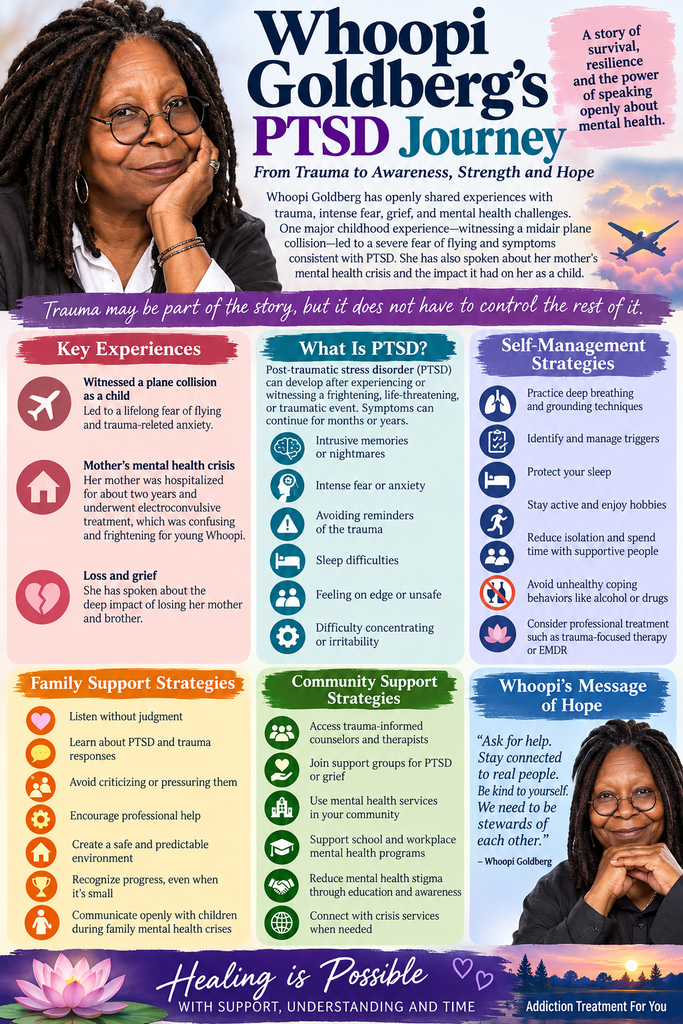
Whoopi Goldberg is known for her humor, acting career, and outspoken personality, but she has also publicly discussed experiences with trauma, intense fear, grief, and mental-health challenges. Reports have connected one particularly frightening childhood experience—witnessing a midair plane collision—with later panic attacks, severe fear of flying, and symptoms described as post-traumatic stress disorder (PTSD).
It is important not to reduce Goldberg’s life experiences to a diagnosis. Public information cannot substitute for a clinical evaluation, and accounts of her experiences vary in how they describe PTSD. What is well documented is that Goldberg has spoken openly about traumatic experiences and the ways she learned to cope with fear and loss.
Understanding Whoopi Goldberg’s Trauma
Goldberg has described developing an extreme fear of flying after witnessing two airplanes collide when she was young. Years later, she explained that representatives from Virgin Atlantic spent several hours teaching her about changes and advances in aviation. She said that gaining this knowledge helped her feel calmer when confronting flying.
Her childhood included other potentially traumatic experiences as well. Goldberg has spoken extensively about her mother, Emma, experiencing a severe mental-health crisis when Goldberg was a child. Her mother was hospitalized for approximately two years and underwent electroconvulsive treatment. Goldberg later described the confusion of being a child whose mother suddenly disappeared without anyone adequately explaining what had happened.
In a later conversation about grief and her childhood, Goldberg described retreating inward and developing the belief that she should not ask other people for things. She also discussed how those early experiences contributed to a powerful awareness that circumstances can suddenly change.
These experiences illustrate an important principle about trauma: the event itself is only part of the story. A person’s age, understanding of what happened, available support, sense of safety, and ability to process the experience can influence its long-term psychological impact.
What PTSD Can Look Like
PTSD can develop after experiencing or witnessing actual or threatened death, serious injury, sexual violence, or other traumatic events. Symptoms can involve intrusive memories or nightmares, avoidance of trauma reminders, changes in mood and thinking, and increased physical or emotional arousal.
Someone may experience:
- Intense fear when reminded of the traumatic event
- Avoidance of situations associated with the trauma
- Panic or overwhelming anxiety
- Nightmares or intrusive memories
- Feeling constantly alert or unsafe
- Sleep difficulties
- Irritability or difficulty concentrating
- Emotional withdrawal or isolation
Not everyone who experiences trauma develops PTSD. Some people experience temporary trauma reactions, while others develop persistent symptoms requiring professional treatment.
Self-Management Strategies
Goldberg’s experience with flying provides an interesting example of gradually addressing a trauma-related fear rather than simply pretending that the fear does not exist. She sought information about aviation and learned more about modern safety measures, which she said helped calm her.
For people living with PTSD or trauma-related anxiety, self-management can complement professional treatment.
- Identify triggers. Keep track of situations, sounds, places, images, or thoughts that produce intense anxiety.
- Use grounding techniques. Focus on the present environment by noticing what you can see, hear, touch, smell, and physically feel.
- Practice controlled breathing. Slow breathing can help decrease the body’s fight-or-flight response.
- Protect sleep. Regular sleep routines and reducing stimulating activities before bedtime can support emotional regulation.
- Reduce isolation. Trauma can create an urge to withdraw, but maintaining safe human relationships can be protective.
- Limit unhealthy coping behaviors. Alcohol or drugs may temporarily numb distress but can worsen PTSD symptoms and create additional problems.
- Seek professional treatment. Evidence-based approaches such as trauma-focused cognitive behavioral therapies and EMDR may be appropriate for some individuals.
Goldberg has also encouraged people to reduce social media’s influence on their emotional well-being and to ask for help when they need it.
Family Support Strategies
Family members sometimes struggle to understand why someone continues experiencing fear long after the danger has ended. PTSD is not simply an inability to “get over” something. Trauma can alter how a person responds to reminders of danger.
Families can help by:
- Listening without demanding details about the traumatic event
- Learning about PTSD and trauma responses
- Avoiding criticism or ridicule about triggers
- Asking what kind of support the person finds helpful
- Encouraging professional treatment without forcing conversations
- Recognizing progress, even when improvement happens gradually
- Maintaining predictable and emotionally safe routines
- Watching for increased isolation, substance use, severe depression, or suicidal thoughts
Goldberg’s childhood story also demonstrates why communicating with children during a family mental-health crisis matters. She has recalled being given very little information when her mother was hospitalized, leaving her to make sense of the situation herself. Age-appropriate explanations and reassurance can help children understand that an adult’s illness is not the child’s responsibility.
Community Support Strategies
Recovery should not depend entirely on the individual or family. Mental-health professionals, schools, workplaces, peer-support organizations, and community programs can create environments where people feel comfortable seeking assistance.
Helpful community resources can include:
- Trauma-informed counselors and therapists
- Primary-care and behavioral-health providers
- PTSD or trauma support groups
- Grief-support programs
- Veteran and first-responder trauma services when applicable
- School-based mental-health programs
- Crisis intervention services
- Community education designed to reduce mental-health stigma
Goldberg has participated publicly in conversations about mental health and has encouraged people to ask for help and maintain real-world human connections. She has also spoken openly about grief following the deaths of her mother and brother, saying that people need to become “stewards of each other.”
Trauma, Grief, and Resilience
Goldberg’s experiences also show that trauma and grief can overlap. Losing important people, experiencing frightening events, or growing up with unexplained family crises can influence how someone responds to uncertainty and relationships many years later.
Resilience does not mean forgetting what happened. It can mean developing healthier ways to respond when memories, fear, or grief return. Goldberg has described independence, humor, learning, and accepting life’s uncertainty as important elements of how she approaches difficult experiences. Her story also highlights the value of speaking more openly about mental health rather than treating psychological struggles as something families must hide.
Conclusion
Whoopi Goldberg’s public discussions of trauma provide an opportunity to understand how frightening childhood experiences can continue influencing emotions and behavior in adulthood. Her severe fear of flying, experiences surrounding her mother’s hospitalization, and later grief demonstrate that trauma can take many forms.
For someone experiencing PTSD symptoms, recovery does not have to mean facing everything alone. Self-management can build coping skills, families can provide safety and understanding, and communities can connect people with professional treatment and supportive relationships. Trauma may become part of someone’s story, but with appropriate treatment and support, it does not have to control the rest of that story.
Frequently Asked Questions
Here are some common questions:
1. Has Whoopi Goldberg experienced PTSD?
Goldberg has publicly described severe anxiety and trauma-related reactions connected with witnessing a midair plane collision. Some published accounts have characterized these experiences as PTSD and panic attacks. However, it is best to distinguish those reports from a formal clinical diagnosis confirmed independently.
2. What traumatic event contributed to her fear of flying?
Goldberg has said she witnessed a midair collision while living in San Diego. She explained that the visual memory stayed with her and contributed to a powerful fear of flying.
3. How severe was Whoopi Goldberg’s fear of flying?
Her fear became significant enough that she avoided flying for approximately 13 years. She often traveled by tour bus and used other transportation rather than airplanes.
4. Did Whoopi Goldberg eventually start flying again?
Yes. In 2009, Goldberg said she had flown six times within roughly six weeks after previously avoiding flying for 13 years. She participated in a Virgin Atlantic fear-of-flying program involving a pilot, psychologist, and someone who had completed the program.
5. What helped her manage her fear?
Education was one important component. Goldberg said aviation professionals spent hours explaining advances in aviation since her traumatic experience. She reported that understanding those changes helped her feel calmer.
6. Did childhood family experiences also affect Goldberg emotionally?
Yes. Goldberg has described being around eight years old when her mother experienced a serious mental-health crisis and was hospitalized for approximately two years. Her mother underwent electroconvulsive treatment and later told Goldberg that she initially did not recognize her children after leaving the hospital.
7. How did her mother’s hospitalization affect her as a child?
Goldberg explained that adults did not adequately explain what was happening. As a child, she wondered whether she had somehow caused her mother’s problems. She recalled becoming more withdrawn and developing a belief that she should avoid asking others for things or causing trouble.
8. What are common symptoms of PTSD?
PTSD symptoms vary, but they can include intrusive memories, nightmares, avoidance of trauma reminders, negative changes in thoughts or emotions, feeling constantly alert, difficulty sleeping, and intense physical or emotional reactions to reminders of trauma. A qualified clinician is needed to determine whether symptoms meet diagnostic criteria.
9. Does avoiding a feared situation help PTSD?
Avoidance may provide temporary relief, but persistent avoidance can sometimes maintain trauma-related anxiety. Evidence-based treatment may involve gradually and safely addressing traumatic memories or feared situations with professional guidance. Goldberg’s eventual return to flying illustrates how education and structured support can help someone confront a longstanding fear, although her experience should not be treated as a universal treatment plan.
10. What self-management strategies may help someone experiencing trauma-related anxiety?
Helpful strategies can include identifying triggers, practicing slow breathing and grounding techniques, maintaining regular sleep, exercising, reducing alcohol or drug use, staying connected with supportive people, and learning about trauma responses. Self-management can complement—but should not replace—professional care when symptoms are persistent or significantly interfere with daily life.
11. How can families support someone with PTSD?
Family members can listen without judgment, learn about trauma, avoid minimizing someone’s fears, maintain predictable routines, and encourage professional treatment when appropriate. Goldberg’s childhood experience also illustrates why children benefit from age-appropriate explanations when a parent experiences a mental-health crisis.
12. What community resources can help people experiencing PTSD?
Community resources may include primary-care providers, trauma-informed therapists, psychiatrists, PTSD support groups, grief programs, community mental-health centers, and crisis services. Trauma-focused psychotherapy can be particularly important when symptoms persist.
13. Can PTSD improve over time?
Yes. Many people experience substantial improvement with appropriate treatment and support. Recovery does not necessarily mean forgetting a traumatic experience. Instead, treatment can help memories and reminders become less disruptive and allow a person to regain control over everyday activities.
14. What can people learn from Whoopi Goldberg’s experience?
Her public accounts demonstrate how a frightening event can continue affecting someone’s behavior years later and how avoidance, fear, and traumatic memories can interfere with everyday life. Her experience with flying also shows the potential value of education, structured assistance, and gradually confronting a longstanding fear.
15. What is the main message for families dealing with trauma?
Trauma-related reactions deserve understanding rather than criticism. Self-management can strengthen coping skills, family support can create emotional safety, and community and professional resources can provide treatment and connection. Seeking help is an important part of recovery when fear, avoidance, or traumatic memories begin interfering with daily life.
Video: Whoopi Goldberg reveals her hidden PTSD battle #whoopigoldberg #ptsd