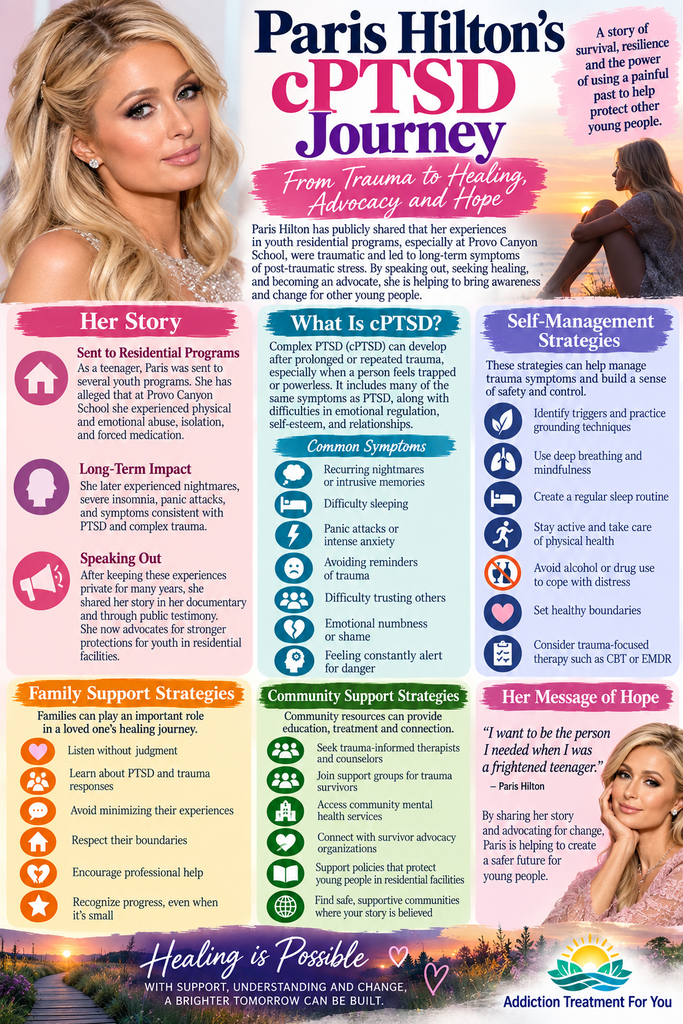
Paris Hilton is widely recognized as an entrepreneur, media personality, and entertainer, but behind her highly publicized image is a history of significant childhood and adolescent trauma. Hilton has publicly described living with severe post-traumatic stress symptoms following experiences at residential youth programs, particularly Provo Canyon School in Utah. She has described years of nightmares, insomnia, panic, fear, and difficulty processing what happened to her.
Although the term complex PTSD (CPTSD) is sometimes associated with prolonged or repeated trauma, Hilton herself has most clearly and repeatedly described her condition publicly as PTSD or severe PTSD. Therefore, it is more accurate to discuss her experiences through the lens of PTSD and complex trauma rather than assume a specific CPTSD diagnosis.
Paris Hilton’s Experience With Trauma
As a teenager, Hilton was sent to several residential programs because her parents believed these facilities could help address behavioral concerns. She has alleged that at Provo Canyon School she experienced physical and psychological abuse, forced medication, isolation, surveillance, and other degrading treatment. She described her approximately 11 months there as profoundly traumatizing. The school has stated that it changed ownership in 2000 and therefore cannot comment on experiences that occurred under previous ownership.
For many years, Hilton kept these experiences private. She has said she tried to bury the memories and create an outward appearance of having a perfect life. Yet the trauma continued to appear through recurring nightmares and severe insomnia.
She described waking from nightmares crying, sweating, struggling to breathe, and experiencing panic attacks. These experiences demonstrate an important characteristic of trauma: avoiding or suppressing painful memories does not necessarily eliminate their psychological effects.
Understanding PTSD and Complex Trauma
PTSD can occur following exposure to traumatic experiences and can affect emotions, relationships, sleep, behavior, and a person’s sense of safety.
Complex trauma generally refers to repeated or prolonged traumatic experiences, particularly when someone feels trapped or powerless. CPTSD is recognized as a diagnosis in the ICD-11 and includes core PTSD symptoms along with persistent difficulties involving emotional regulation, negative self-concept, and relationships.
Possible trauma-related symptoms include:
- Recurring nightmares or intrusive memories
- Difficulty sleeping
- Panic attacks or intense anxiety
- Avoiding reminders of traumatic experiences
- Difficulty trusting other people
- Feeling constantly alert for danger
- Emotional numbness or disconnection
- Shame or negative beliefs about oneself
- Difficulty maintaining relationships
- Strong emotional reactions to reminders of past experiences
Having some of these symptoms does not automatically mean someone has PTSD or CPTSD. Diagnosis requires evaluation by a qualified mental-health professional.
Self-Management Strategies
One of the most significant changes in Hilton’s journey occurred when she began talking publicly about what she said happened to her. While making the documentary This Is Paris, she discussed experiences she had kept secret for approximately two decades. Hilton subsequently reported that speaking about the trauma contributed to significant emotional relief and improvement in her nightmares.
People coping with trauma can develop their own healthy self-management strategies, although these should complement professional treatment when symptoms are significant.
- Recognize triggers. Identifying situations, sounds, memories, or interactions associated with trauma can make reactions easier to understand.
- Practice grounding. Slow breathing, mindfulness, and sensory grounding can help redirect attention toward the present.
- Create predictable routines. Regular schedules for sleep, eating, and activity can help restore feelings of stability.
- Protect sleep. PTSD frequently disrupts sleep, making sleep hygiene and professional treatment particularly important.
- Avoid excessive alcohol or drug use. Substances may temporarily numb distress but can complicate trauma recovery.
- Develop healthy boundaries. Survivors may need to learn that saying no and protecting their emotional safety are acceptable.
- Consider trauma-focused treatment. Evidence-based psychotherapy can help people process traumatic experiences safely.
- Find meaning without forcing it. Advocacy, creativity, work, or helping others may provide meaning, but survivors should not feel obligated to turn trauma into a public mission.
Family Support Strategies
Hilton’s story also demonstrates how trauma can affect entire families. She has said her parents believed they were sending her somewhere that would help her and did not understand what she said was happening inside the facility. Hilton has described eventually talking with her family about those experiences as part of confronting her past.
Families supporting someone with trauma can:
- Listen without immediately questioning or minimizing their experiences.
- Avoid statements such as “just forget about it” or “that happened years ago.”
- Learn about PTSD and trauma responses.
- Ask what makes the person feel safe rather than assuming what they need.
- Respect boundaries surrounding conversations about traumatic events.
- Encourage professional help without demanding disclosure.
- Recognize that nightmares, avoidance, irritability, or withdrawal may be trauma responses.
- Consider family counseling when trauma has affected communication or relationships.
Family members do not have to understand every detail of someone’s traumatic experience to provide compassion and support.
Community Support Strategies
Community became particularly important in Hilton’s recovery narrative. She connected with other survivors of residential treatment programs and said talking with people who understood similar experiences felt therapeutic.
Community resources for trauma survivors can include:
- Trauma-informed therapists and counselors
- PTSD and trauma survivor support groups
- Community mental-health centers
- Peer-support organizations
- Survivor advocacy organizations
- Primary-care and behavioral-health professionals
- Crisis-intervention programs
- Programs supporting survivors of institutional or childhood abuse
A supportive community can counteract the isolation often associated with trauma. Survivors may discover that other people have experienced similar reactions and that asking for help does not diminish their independence.
Turning Trauma Into Advocacy
Hilton eventually transformed her experiences into advocacy for young people in residential treatment facilities. She has testified publicly and supported efforts to increase oversight and protections for children in institutional settings. She has described advocacy as empowering and healing, saying that she wanted to become the person she needed when she was a frightened teenager.
Her experience also demonstrates the potential importance of survivor communities. In a 2021 discussion, Hilton described speaking publicly, connecting with people who understood her experiences, and working toward change as among the most healing experiences of her life.
Advocacy, however, is only one possible path. Someone recovering from trauma does not have to publicly disclose what happened to them. Recovery can occur privately through therapy, supportive relationships, self-care, and rebuilding a sense of safety.
Moving From Survival Toward Recovery
For years, Hilton has said she tried to separate her public identity from painful experiences she did not want others to know about. Eventually, discussing those experiences allowed her to connect her nightmares, insomnia, and emotional reactions with unresolved trauma.
Her journey highlights an important lesson about PTSD and complex trauma: survival strategies that protect someone during or immediately after trauma may become less helpful later in life. Healing can involve developing new coping strategies once safety has been established.
Self-management can help restore emotional control. Family support can rebuild trust and security. Community resources can provide professional treatment and connections with people who understand trauma.
Paris Hilton’s experience does not represent every trauma survivor, but it illustrates that the effects of trauma can remain hidden behind professional success, wealth, or a carefully constructed public image. Recovery is not about pretending that traumatic experiences never happened. It is about reaching a point where those experiences no longer control everyday life.
Frequently Asked Questions
Here are some common questions:
1. Does Paris Hilton have complex PTSD (CPTSD)?
Paris Hilton has publicly said she experiences severe PTSD related to traumatic experiences in residential youth programs. In a 2021 interview, she explicitly said she still had “severe PTSD” because of what happened. Public sources do not clearly establish that she has been formally diagnosed specifically with complex PTSD (CPTSD), so it is more accurate to describe her story as involving PTSD and prolonged or complex trauma.
2. What happened to Paris Hilton as a teenager?
Hilton has said she attended four residential youth facilities. She alleges that she experienced physical, verbal, and emotional abuse, isolation, forced medication, restraint, and other mistreatment. She has described her approximately 11 months at Provo Canyon School as particularly traumatic. The school has stated that it changed ownership in 2000 and therefore cannot comment on experiences occurring under previous ownership.
3. How did these experiences affect her mental health?
Hilton has described years of severe nightmares, insomnia, panic attacks, and PTSD symptoms. She said her recurring nightmares often involved being taken from her bedroom, locked away, and trying to escape.
4. What is complex PTSD?
Complex PTSD, or CPTSD, is associated particularly with prolonged or repeated interpersonal trauma. Under the ICD-11 framework, CPTSD includes the core symptoms of PTSD plus significant problems with emotional regulation, negative self-concept, and relationships. The U.S. DSM system does not recognize CPTSD as a separate diagnosis; many of these symptoms are encompassed within its broader PTSD diagnosis.
5. Why might Paris Hilton’s experiences be discussed in relation to complex trauma?
Hilton has described repeated traumatic experiences occurring while she was an adolescent, including situations in which she felt trapped, powerless, and unable to communicate freely with her family. Those characteristics can be associated with complex trauma. However, that observation should not be treated as a diagnosis of CPTSD.
6. Why did Paris Hilton keep her trauma private for so long?
Hilton has said that she tried to forget what happened and maintained an outward image of having a perfect life. She kept her experiences largely private for roughly two decades before discussing them publicly.
7. Did talking about her trauma help her?
Hilton has said that opening up while making This Is Paris was therapeutic. In 2021, she reported finally sleeping and said that discussing and releasing some of what she had experienced helped her nightmares improve.
8. What self-management strategies can help people with PTSD or complex trauma?
Helpful approaches may include identifying triggers, grounding exercises, mindfulness, regular physical activity, maintaining predictable routines, protecting sleep, developing healthy boundaries, and staying connected with trusted people. Alcohol or drugs should not be relied upon to manage trauma symptoms. Self-management is most effective as a complement to professional treatment when symptoms significantly interfere with everyday life.
9. What professional treatments can help PTSD and CPTSD?
Evidence-based PTSD psychotherapies can be effective even for people with histories of complex trauma. Treatment may focus on safely processing traumatic memories, reducing avoidance, managing emotional reactions, and improving everyday functioning. The National Center for PTSD notes that established PTSD treatments can also work well for people meeting criteria for CPTSD.
10. How can family members support someone with complex trauma?
Families can listen without judgment, learn about trauma responses, respect boundaries, and avoid pressuring someone to describe traumatic experiences. They can also encourage professional treatment and help create a predictable, emotionally safe environment.
11. Did Paris Hilton’s parents know what she says was happening?
Hilton has said that her parents did not know about the alleged mistreatment at the facilities. She has stated that they believed they were sending her to programs that would help her and that communications between students and their families were controlled.
12. Why is family communication important after trauma?
Trauma can interfere with trust, attachment, and emotional security. Allowing survivors to speak at their own pace, believing disclosures without interrogating them, and respecting boundaries can help rebuild trust. Family therapy may also be useful when traumatic experiences have significantly affected family relationships.
13. How can community support help trauma survivors?
Trauma-informed therapists, community mental-health centers, survivor groups, and peer-support organizations can reduce isolation and provide professional and social support. Hilton has described connecting with other survivors as an important part of speaking publicly about her experiences.
14. How did Paris Hilton turn her trauma into advocacy?
Hilton became an advocate for people who report abuse in residential youth programs. She has testified publicly and worked to increase protections and oversight for young people in congregate-care settings. Her advocacy has continued in recent years.
15. Does someone need to publicly discuss their trauma to recover?
No. Hilton chose public disclosure and advocacy, but that is only one possible path. Survivors can heal privately through therapy, supportive relationships, peer support, healthy coping strategies, and other approaches. No one should feel obligated to publicly disclose traumatic experiences.
16. Can PTSD or CPTSD improve?
Yes. Trauma may have lasting effects, but symptoms can improve substantially with appropriate treatment and support. The National Center for PTSD emphasizes that effective PTSD treatments can help people with PTSD as well as those who meet criteria for CPTSD.
17. What is the main lesson from Paris Hilton’s trauma journey?
Her story illustrates that significant trauma can exist behind an outward appearance of success. It also highlights three important components of recovery: self-management strategies can strengthen coping, family support can help rebuild safety and trust, and community and professional resources can reduce isolation and provide evidence-based treatment. Speaking publicly became meaningful for Hilton, but every survivor’s recovery process is different.
Video: What they really did to Paris Hilton at Canyon School #canyonschool #ptsd