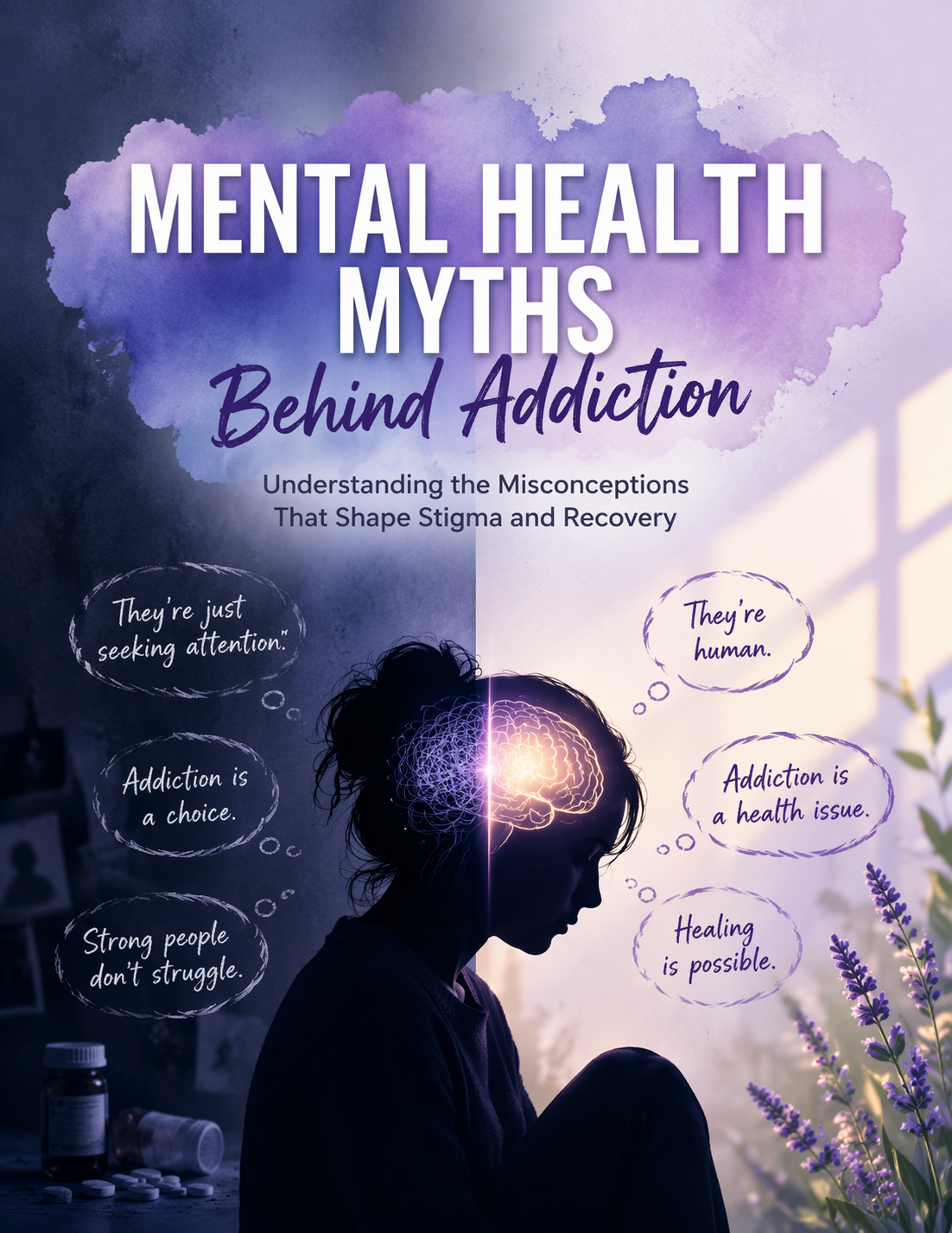
Mental health and addiction are often discussed as separate issues, but in reality, they are deeply interconnected. Despite growing awareness, many harmful myths about mental health continue to shape how addiction is understood and treated. Beliefs such as addiction being a simple choice or mental illness being a sign of weakness create stigma and prevent people from seeking help. These misconceptions not only distort public perception but also impact individuals on a personal level—leading to shame, isolation, and delayed intervention. Understanding the myths behind mental health is essential for recognizing addiction as a complex health condition influenced by psychological, biological, and social factors.
The Lies We Believe: Mental Health Myths Behind Addiction
Addiction is often misunderstood—not just as a behavior, but as a reflection of deeper mental health struggles. What makes this worse is that many widely accepted beliefs about mental health are simply wrong. These myths don’t just shape opinions; they actively contribute to stigma, delay treatment, and in many cases, make addiction more likely or harder to escape.
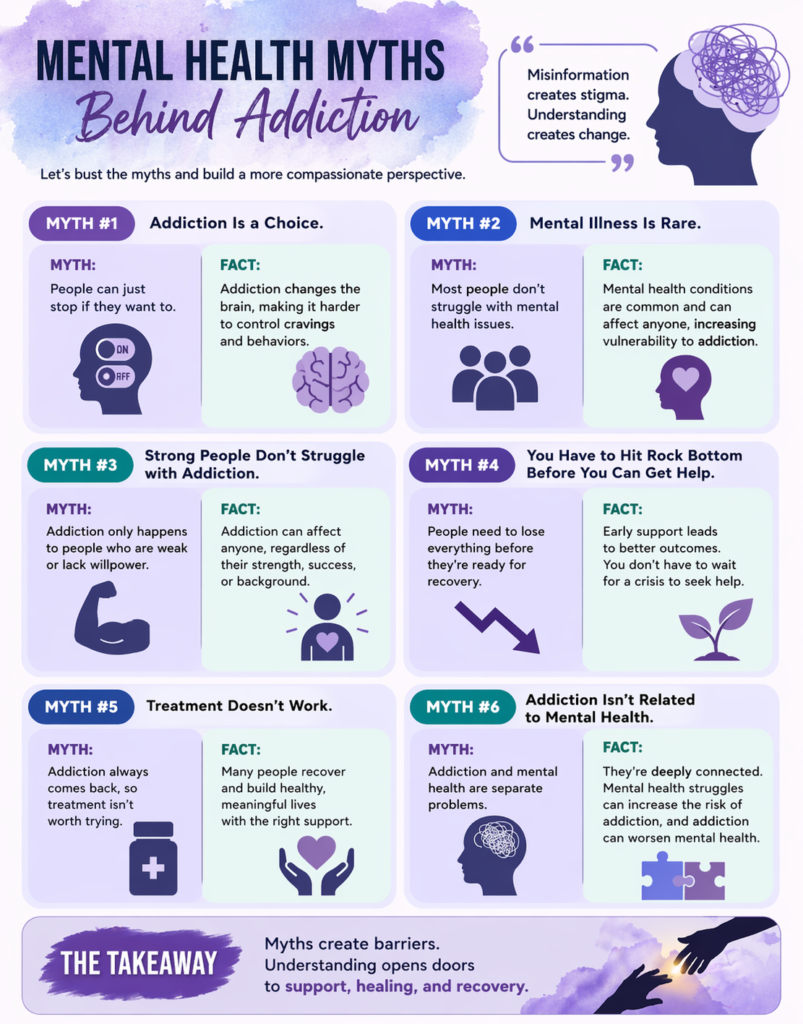
Myth 1: “Addiction Is a Choice”
One of the most persistent misconceptions is that addiction is purely a matter of willpower. While the first use of a substance may be voluntary, repeated use changes the brain—especially areas related to reward, motivation, and self-control. Over time, what started as a choice can become a compulsion.
Reducing addiction to a “choice” ignores the role of mental health conditions like depression, anxiety, and trauma. Many individuals turn to substances not to get high, but to cope. When we dismiss addiction as a moral failure, we overlook the underlying psychological pain driving it.
Myth 2: “Mental Illness Is Rare”
In reality, mental health conditions are common. Disorders such as anxiety and depression affect millions of people each year. When these conditions go untreated, individuals may seek relief in substances that temporarily numb distress.
This creates a dangerous cycle: mental health issues increase vulnerability to addiction, and addiction, in turn, worsens mental health. Ignoring how common these struggles are prevents early intervention and reinforces isolation.
Myth 3: “Strong People Don’t Struggle with Addiction”
Strength has nothing to do with whether someone develops an addiction. In fact, many high-functioning individuals—students, professionals, caregivers—quietly struggle with substance use.
This myth is especially harmful because it discourages people from asking for help. If addiction is seen as weakness, admitting a problem feels like admitting failure. As a result, people often wait until their situation becomes severe before seeking support.
Myth 4: “You Have to Hit Rock Bottom First”
The idea that someone must reach their lowest point before they can recover is not only false—it’s dangerous. Early intervention significantly improves outcomes.
Waiting for “rock bottom” normalizes suffering and delays treatment. Recovery doesn’t require losing everything; it requires recognizing a problem and having access to support.
Myth 5: “Treatment Doesn’t Work”
Another damaging belief is that recovery is unlikely or impossible. While relapse can be part of the process, many people do recover—especially when treatment addresses both addiction and underlying mental health conditions.
Evidence-based approaches such as therapy, medication, and support systems have helped countless individuals rebuild their lives. The belief that treatment doesn’t work often becomes a self-fulfilling barrier.
Why These Myths Matter
These misconceptions don’t exist in isolation—they shape how society responds to addiction. They influence policy, healthcare access, and personal attitudes. Most importantly, they affect whether someone feels safe enough to ask for help.
When mental health myths go unchallenged, addiction is more likely to be hidden, judged, and untreated.
Moving Forward: Replacing Myths with Understanding
Breaking these myths requires a shift in perspective:
- Viewing addiction as a health issue, not a moral failing
- Recognizing the deep connection between mental health and substance use
- Encouraging early support instead of waiting for a crisis
- Creating spaces where people can seek help without shame
Understanding is not just about being informed—it’s about changing how we respond to others and ourselves.
Final Thought
Behind every addiction is a story, and behind many of those stories are mental health struggles shaped by misunderstanding. Challenging these myths isn’t just an academic exercise—it’s a step toward compassion, effective treatment, and real recovery.
Rewiring Beliefs: Self-Management Strategies to Challenge Mental Health Myths Behind Addiction
Understanding addiction isn’t just about learning facts—it’s about unlearning the myths that shape how we think, feel, and respond to ourselves and others. Many of the most harmful beliefs about addiction are rooted in misinformation about mental health. These beliefs can quietly influence behavior, delay help-seeking, and reinforce cycles of shame and substance use.
The good news: these patterns can be challenged. Through intentional self-management strategies, individuals can begin to recognize, question, and replace harmful myths with more accurate and supportive perspectives.
Why Self-Management Matters
Self-management means taking an active role in understanding your thoughts, emotions, and behaviors. In the context of addiction and mental health, it involves recognizing how beliefs—especially false ones—affect coping strategies.
For example, believing “I should be able to handle this on my own” may lead someone to avoid seeking help. Over time, that isolation can intensify both mental health struggles and substance use.
Strategy 1: Identify the Myth Behind the Thought
The first step is awareness. Pay attention to automatic thoughts related to stress, coping, or substance use.
Ask yourself:
- What am I telling myself right now?
- Is this based on fact, or something I’ve always assumed to be true?
Common underlying myths include:
- “Addiction means I’m weak.”
- “My problems aren’t serious enough for help.”
- “I should be able to control this without support.”
Recognizing these thoughts is the foundation for change.
Strategy 2: Challenge Cognitive Distortions
Many mental health myths are reinforced by distorted thinking patterns—such as all-or-nothing thinking or overgeneralization.
Try reframing:
- Instead of “I failed, so I’ll never get better,” → “Setbacks happen, and they’re part of progress.”
- Instead of “Everyone else handles life better than me” → “I’m comparing my struggles to what I see, not the full reality.”
This approach, often used in cognitive behavioral techniques, helps weaken the power of false beliefs.
Strategy 3: Replace Shame with Curiosity
Shame thrives on myths. Curiosity breaks them.
Rather than asking:
- “What’s wrong with me?”
Shift to:
- “What am I trying to cope with?”
- “What need is this behavior meeting?”
This shift reframes addiction from a personal failure to a response—often an attempt to manage emotional pain, stress, or unresolved trauma.
Strategy 4: Build Healthier Coping Alternatives
If myths have led to unhealthy coping (like substance use), it’s important to replace—not just remove—those behaviors.
Healthy alternatives might include:
- Journaling to process emotions
- Physical activity to regulate stress
- Mindfulness or breathing exercises
- Talking to someone you trust
The goal isn’t perfection—it’s expanding your toolkit so substances aren’t the only option.
Strategy 5: Seek Accurate Information and Support
Misinformation fuels myths, so actively seeking reliable knowledge is essential. This might involve:
- Learning about the connection between mental health and addiction
- Talking with professionals or support groups
- Engaging with evidence-based resources
Support also helps normalize your experience. It reminds you that you’re not alone—and that what you’re going through is understood, not judged.
Strategy 6: Practice Self-Compassion
One of the most powerful ways to counter mental health myths is to change how you treat yourself.
Instead of harsh self-criticism, try:
- Acknowledging effort, even when progress feels small
- Accepting that healing is not linear
- Speaking to yourself the way you would to someone you care about
Self-compassion reduces shame, which is a major barrier to both mental health recovery and addiction treatment.
Why These Strategies Work
These approaches target the root of the problem—not just behavior, but belief systems. When harmful myths lose their influence, individuals are more likely to:
- Seek help earlier
- Use healthier coping strategies
- Stay engaged in recovery
- View themselves with understanding rather than judgment
Final Thought
Addiction doesn’t exist in a vacuum—it’s shaped by the way we think about mental health, often in ways we don’t even realize. By actively challenging these myths and managing our internal dialogue, we create space for change.
Understanding is powerful—but applying it through daily self-management leads to real, lasting transformation.
Breaking the Cycle Together: Family Support Strategies to Challenge Mental Health Myths Behind Addiction
Addiction rarely affects just one person—it impacts entire families. And just like individuals, families can unknowingly carry harmful myths about mental health that shape how they respond to a loved one struggling with addiction. These beliefs can create distance, reinforce stigma, and sometimes make recovery more difficult.
But families also have the power to be one of the strongest sources of support. By recognizing and challenging these myths together, they can create an environment that encourages understanding, healing, and long-term recovery.
Why Family Understanding Matters
Family reactions often influence whether someone feels safe enough to open up or seek help. When addiction is seen as a moral failure or a lack of discipline, responses may include blame, frustration, or withdrawal.
On the other hand, when families understand addiction as connected to mental health—often involving stress, trauma, anxiety, or depression—their approach becomes more supportive and solution-focused.
Strategy 1: Educate as a Family, Not Individually
One of the most effective ways to break myths is through shared learning.
Families can:
- Read about the connection between mental health and addiction
- Attend workshops, therapy sessions, or support groups together
- Discuss what they’ve learned openly
This creates a common understanding and reduces miscommunication. Instead of conflicting beliefs, the family begins to operate from the same informed perspective.
Strategy 2: Replace Blame with Understanding
A common myth is that addiction is a choice or a sign of weakness. This belief often leads to blame-based language like:
- “Why can’t you just stop?”
- “You’re not trying hard enough.”
Shifting away from blame involves asking:
- “What might they be struggling with internally?”
- “How can we support rather than criticize?”
This doesn’t mean ignoring harmful behaviors—it means addressing them without dehumanizing the person.
Strategy 3: Improve Communication Patterns
Healthy communication is essential in challenging myths and building trust.
Helpful approaches include:
- Using “I” statements instead of accusations (“I feel worried when…”)
- Listening without interrupting or immediately offering solutions
- Validating emotions, even if you don’t fully understand the behavior
When people feel heard rather than judged, they’re more likely to engage in honest conversations about their struggles.
Strategy 4: Set Boundaries Without Reinforcing Myths
Families often struggle to balance support with boundaries. Some may become overly permissive out of fear, while others may become overly strict due to frustration.
Healthy boundaries:
- Protect the well-being of everyone involved
- Avoid enabling harmful behaviors
- Are communicated clearly and consistently
Importantly, boundaries should not be based on punishment or the belief that someone needs to “learn a lesson.” Instead, they should reflect care, safety, and respect.
Strategy 5: Encourage Professional Help Early
The myth that someone must “hit rock bottom” before getting help can delay treatment.
Families can play a critical role by:
- Encouraging therapy or counseling early
- Offering to help find resources or attend appointments
- Normalizing mental health support as a strength, not a weakness
Early intervention often leads to better outcomes and prevents escalation.
Strategy 6: Address Family-Level Myths and Dynamics
Sometimes, myths are embedded in family culture—beliefs passed down over time, such as:
- “We don’t talk about feelings.”
- “You have to handle your problems on your own.”
Challenging these patterns may require:
- Family therapy
- Open discussions about past experiences and beliefs
- Willingness to change long-standing habits
When the family system evolves, it creates a healthier environment for everyone—not just the person struggling with addiction.
Strategy 7: Practice Collective Self-Compassion
Addiction can bring guilt, anger, and confusion to families. It’s important to recognize that no one has all the answers.
Families can support each other by:
- Acknowledging their own emotional responses without judgment
- Avoiding self-blame or blaming others
- Focusing on progress rather than perfection
A compassionate family environment reduces shame and fosters resilience.
Why These Strategies Matter
When families challenge mental health myths together, several things begin to change:
- Stigma is reduced
- Communication improves
- Support becomes more effective
- Recovery feels more possible
Most importantly, the person struggling with addiction no longer feels alone or misunderstood.
Final Thought
Addiction may begin with an individual, but recovery is often strengthened through connection. Families who are willing to question their assumptions, learn together, and support with empathy can become a powerful force for change.
Breaking myths isn’t just about correcting information—it’s about rebuilding relationships in a way that makes healing possible for everyone involved.
Stronger Together: Using Community Resources to Break Mental Health Myths Behind Addiction
Addiction is often framed as a personal struggle—but in reality, it’s deeply influenced by the communities people live in. The beliefs, attitudes, and resources available in a community can either reinforce harmful mental health myths or help dismantle them.
When communities actively challenge misinformation and provide accessible support, they create environments where individuals are more likely to seek help, feel understood, and begin recovery. Community resource strategies are not just about services—they’re about changing the narrative.
Why Community Resources Matter
Mental health myths don’t develop in isolation—they spread through culture, media, and social norms. Ideas like “addiction is a choice” or “therapy is only for severe cases” often go unchallenged when communities lack education and open dialogue.
Community resources—such as local organizations, support groups, clinics, and outreach programs—play a critical role in replacing myths with accurate, evidence-based understanding.
Strategy 1: Increase Access to Mental Health Education
Education is one of the most powerful tools for breaking myths.
Communities can:
- Host workshops on the connection between mental health and addiction
- Provide public seminars in schools, workplaces, and community centers
- Share accessible materials that explain addiction as a health condition
When accurate information becomes widely available, misconceptions lose their influence.
Strategy 2: Promote Peer Support Networks
Peer support groups offer something unique: shared experience. Hearing from others who have faced similar challenges helps normalize struggles and reduce stigma.
These groups:
- Challenge the myth that people are alone in their experiences
- Provide practical coping strategies
- Offer a sense of belonging and accountability
Whether in-person or virtual, peer networks create spaces where honesty replaces judgment.
Strategy 3: Improve Accessibility to Treatment Services
A common myth is that help is out of reach or only for extreme situations. Communities can counter this by making services more visible and accessible.
This includes:
- Expanding low-cost or free counseling options
- Offering mobile clinics or telehealth services
- Creating directories of local resources
When people know where to go and feel they can afford it, they’re more likely to seek help early.
Strategy 4: Partner with Schools and Workplaces
Mental health myths often take root early and persist into adulthood. Schools and workplaces are key environments for intervention.
Community initiatives can:
- Integrate mental health education into school curricula
- Provide workplace wellness programs
- Train staff to recognize signs of mental health struggles and substance misuse
These efforts help shift the culture from silence to support.
Strategy 5: Use Public Campaigns to Challenge Stigma
Public awareness campaigns can reshape how addiction and mental health are perceived.
Effective campaigns:
- Share real stories of recovery
- Highlight the science behind addiction
- Use inclusive, nonjudgmental language
By changing the public narrative, communities make it easier for individuals to come forward without fear of shame.
Strategy 6: Support Family and Caregiver Resources
Families often need guidance on how to respond to addiction. Community programs can offer:
- Educational workshops for caregivers
- Family counseling services
- Support groups specifically for loved ones
This helps families move away from myth-based reactions (like blame or denial) toward informed, supportive approaches.
Strategy 7: Encourage Collaboration Across Services
Addiction is rarely just one issue—it often intersects with mental health, housing, employment, and healthcare.
Communities can strengthen their response by:
- Coordinating between healthcare providers, social services, and nonprofits
- Creating integrated care systems
- Sharing information and resources across organizations
A collaborative approach ensures that individuals receive comprehensive support rather than fragmented care.
Why These Strategies Work
Community-based approaches address both the beliefs and the barriers surrounding addiction. When myths are replaced with understanding, and resources are readily available:
- Stigma decreases
- Early intervention becomes more common
- Recovery pathways become clearer and more accessible
Most importantly, individuals feel supported not just by a single person, but by an entire network.
Final Thought
Addiction doesn’t exist in a vacuum, and neither does recovery. Communities have the power to either reinforce harmful myths or become catalysts for change.
By investing in education, access, and connection, communities can transform how mental health and addiction are understood—creating spaces where seeking help is not just accepted, but encouraged.
Frequently Asked Questions
Here are some common questions:
1. Is addiction really a choice?
Answer:
Not in the way people often think. While the initial decision to use a substance may be voluntary, repeated use changes brain chemistry—especially areas related to reward, impulse control, and decision-making. Over time, addiction becomes a compulsive behavior rather than a simple choice.
2. How are mental health and addiction connected?
Answer:
They are strongly linked. Many people use substances to cope with conditions like anxiety, depression, or trauma. This is often called self-medication. At the same time, substance use can worsen mental health symptoms, creating a cycle that is difficult to break without addressing both issues together.
3. Is addiction a sign of weakness?
Answer:
No. Addiction affects people across all backgrounds—regardless of strength, intelligence, or success. It is a complex condition influenced by biology, environment, and mental health, not a lack of willpower.
4. Do people need to “hit rock bottom” before getting help?
Answer:
No, and this is a harmful myth. Early intervention leads to better outcomes. Waiting for someone to reach a crisis point can increase the risk of severe consequences, including health complications or overdose.
5. Is mental illness uncommon?
Answer:
No. Mental health conditions are very common and affect millions of people each year. Because they are so widespread, it’s important to normalize seeking help rather than treating these struggles as rare or abnormal.
6. Does treatment for addiction actually work?
Answer:
Yes. Many people recover with the right combination of treatment, which may include therapy, medication, and support systems. While relapse can occur, it does not mean failure—it often indicates that treatment needs adjustment.
7. Can someone recover without addressing mental health?
Answer:
It is much more difficult. If underlying mental health issues are ignored, the reasons behind substance use remain unresolved. Effective recovery typically involves treating both addiction and mental health.
8. Are people with addiction aware of their behavior?
Answer:
Sometimes, but not always fully. Addiction can impair judgment and self-awareness. Even when individuals recognize the problem, cravings and withdrawal symptoms can make stopping extremely challenging.
9. Why do mental health myths persist?
Answer:
They persist due to stigma, lack of education, cultural beliefs, and media portrayals. These myths are often passed down over time and go unchallenged, reinforcing misunderstanding and judgment.
10. How can we help reduce these myths?
Answer:
- Educate ourselves and others with accurate information
- Use nonjudgmental language
- Support people seeking help
- Promote open conversations about mental health
Small changes in understanding can lead to significant improvements in how addiction is treated and perceived.
Conclusion
Challenging mental health myths is a critical step toward addressing addiction more effectively and compassionately. When we replace misinformation with evidence-based understanding, we begin to reduce stigma and create pathways for support and recovery. Recognizing addiction as more than a personal failure allows individuals to seek help without fear of judgment and encourages families and communities to respond with empathy rather than blame. Ultimately, breaking these myths is not just about changing beliefs—it is about transforming outcomes, fostering connection, and making recovery more accessible for those who need it most.
Video: The Lies About Addiction That Ruin Lives #MentalHealth #Shorts