In today’s digital age, being constantly connected has become the norm—but so has the feeling of being unable to disconnect. Many people describe themselves as “hooked” on their phones or social media, often blaming a lack of self-control. However, this experience is not simply a personal weakness. The science behind online engagement reveals that digital platforms are intentionally designed to capture attention using principles from psychology and neuroscience. Features like notifications, endless scrolling, and personalized content tap into the brain’s reward system, reinforcing repeated use. Understanding the science of being hooked online shifts the perspective from blame to awareness, highlighting how human behavior is shaped by powerful external influences.
Hooked by Design: The Science of Being Hooked Online
In today’s digital world, being “hooked” online is often dismissed as a lack of self-control. But the reality is far more complex—and far more intentional. Social media platforms, apps, and digital environments are designed using psychological and neurological principles that keep users engaged for as long as possible. Understanding the science behind this can shift the conversation from blame to awareness.
The Brain’s Reward System
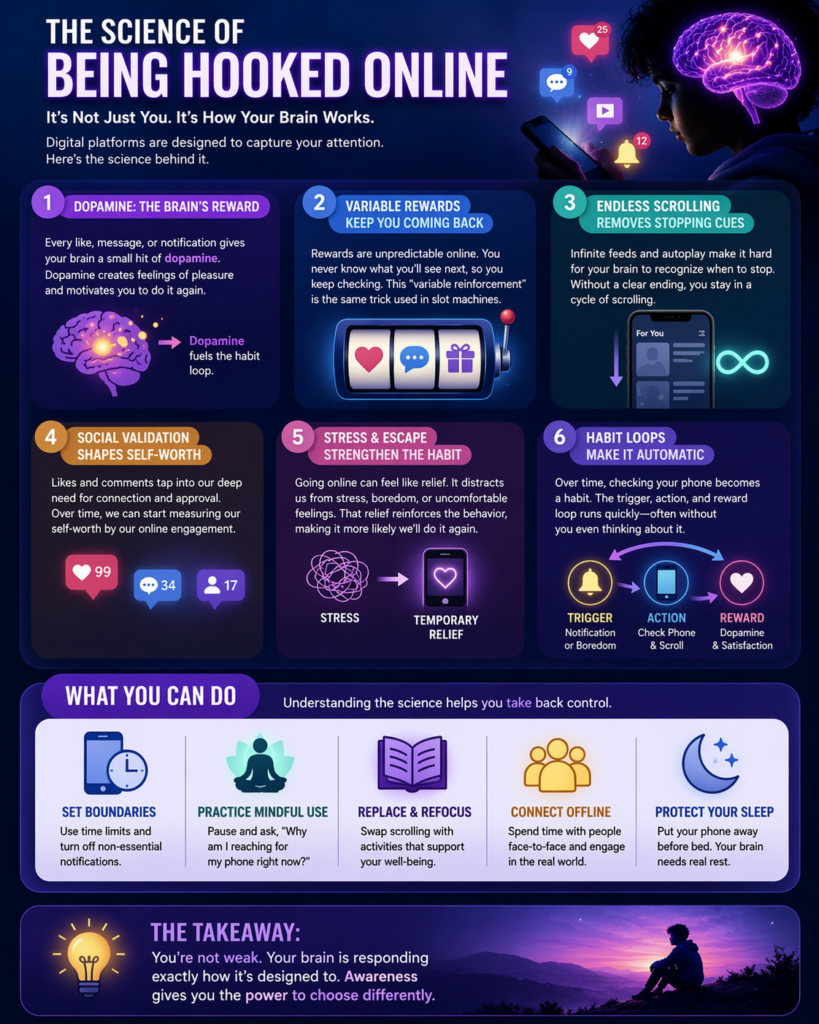
At the center of online engagement is the brain’s reward system, particularly the neurotransmitter dopamine. Dopamine is not just about pleasure—it’s about anticipation and motivation. Every notification, like, or new piece of content triggers a small release of dopamine, reinforcing the behavior.
This creates a loop:
- You check your phone
- You receive a reward (a message, like, or interesting content)
- Your brain learns to repeat the behavior
Over time, this loop strengthens, making the urge to check your device feel automatic.
Variable Rewards: The Slot Machine Effect
One of the most powerful psychological tools used in digital design is variable reinforcement. This means rewards are unpredictable—sometimes you get something exciting, sometimes you don’t.
This is the same principle used in gambling. Because you never know what you’ll get next, you keep checking. Scrolling through a feed or refreshing notifications becomes similar to pulling a slot machine lever—driven by the possibility of a rewarding outcome.
Endless Design and Time Distortion
Many platforms are built with features like infinite scroll, autoplay, and personalized content feeds. These remove natural stopping cues, making it easy to lose track of time.
Without clear endpoints, your brain doesn’t register a “completion” moment. Instead, it stays in a continuous state of seeking, which keeps you engaged longer than intended.
Social Validation and Identity
Humans are wired for social connection. Online platforms tap into this by turning social interaction into measurable feedback—likes, comments, shares.
This can create a strong link between self-worth and online validation. When engagement is high, it feels rewarding. When it’s low, it can lead to self-doubt or anxiety. This emotional connection increases the likelihood of repeated use.
Stress, Escape, and Coping
Being hooked online isn’t always about entertainment—it’s often about escape. People turn to digital spaces to distract from stress, loneliness, or mental health struggles.
This mirrors patterns seen in other forms of addiction:
- Temporary relief from discomfort
- Followed by a return of the original feeling
- Leading to repeated use
Without alternative coping strategies, this cycle can become deeply ingrained.
Why It’s Not Just “Lack of Discipline”
Framing excessive screen use as a personal failure ignores the powerful systems at play. These platforms are engineered to capture attention using well-researched behavioral science.
That doesn’t mean individuals are powerless—but it does mean awareness is essential. Recognizing these influences is the first step toward regaining control.
Breaking the Cycle
Understanding the science allows for more intentional use. Some strategies include:
- Setting time limits or app boundaries
- Turning off non-essential notifications
- Creating phone-free routines (like before bed)
- Replacing screen time with offline activities
These changes help interrupt automatic patterns and restore conscious decision-making.
Final Thought
Being “hooked” online isn’t an accident—it’s the result of design meeting human psychology. The more we understand how these systems work, the better equipped we are to navigate them.
Awareness doesn’t mean rejecting technology—it means using it on your terms, rather than letting it use you.
Taking Back Control: Self-Management Strategies for Understanding the Science of Being Hooked Online
Being “hooked” online is often framed as a personal failure—something tied to lack of discipline or poor time management. But as research shows, digital platforms are intentionally designed to capture and hold attention using powerful psychological and neurological mechanisms. Understanding this science is important—but applying that understanding through self-management is what leads to real change.
Self-management strategies help individuals recognize these patterns, regain control, and build a healthier relationship with technology.
Why Self-Management Matters
Awareness alone isn’t enough. You might know that apps are designed to keep you scrolling, yet you still find yourself reaching for your phone without thinking. That’s because these behaviors are often automatic, reinforced by habit loops and reward systems in the brain.
Self-management bridges the gap between knowledge and action. It allows you to move from reactive use to intentional use.
Strategy 1: Recognize Your Digital Triggers
The first step is identifying what prompts you to go online.
Ask yourself:
- Do I reach for my phone when I’m bored, stressed, or anxious?
- Are there specific times of day when I’m more likely to scroll?
These triggers are often emotional rather than practical. Recognizing them helps you understand that the behavior isn’t random—it’s a response.
Strategy 2: Interrupt the Habit Loop
Online engagement often follows a loop:
Trigger → Action (scrolling/checking) → Reward → Repeat
To break this cycle, you don’t need to eliminate the behavior completely—you just need to interrupt it.
Try:
- Pausing for 10–15 seconds before opening an app
- Asking, “Why am I doing this right now?”
- Delaying the action slightly to regain conscious control
Even small interruptions can weaken automatic habits over time.
Strategy 3: Set Intentional Boundaries
Without limits, digital use can easily become excessive because platforms have no natural stopping points.
Helpful boundaries include:
- Setting specific time limits for apps
- Creating “no phone” zones (like during meals or before bed)
- Turning off non-essential notifications
These boundaries reintroduce structure where digital environments remove it.
Strategy 4: Replace, Don’t Just Remove
Simply cutting down screen time often doesn’t work unless you replace it with something else.
Consider:
- Physical activity to release stress
- Reading or journaling for mental engagement
- Face-to-face interaction for social connection
The goal is to meet the same need (relaxation, connection, distraction) in a healthier way.
Strategy 5: Reframe Your Thinking
Instead of thinking:
- “I have no self-control.”
Shift to:
- “This is a learned behavior shaped by design, and I can change it.”
This reframing reduces guilt and increases motivation. It aligns with the science: your brain is responding exactly as it’s been conditioned to—but it’s also capable of adapting.
Strategy 6: Practice Mindful Engagement
Mindfulness means being aware of what you’re doing while you’re doing it.
Try:
- Noticing how you feel before, during, and after using apps
- Setting a clear intention before going online (“I’m checking messages for 5 minutes”)
- Stopping when that intention is met
This shifts your role from passive consumer to active decision-maker.
Strategy 7: Monitor and Reflect
Tracking your digital habits can provide valuable insight.
You might:
- Use screen time reports to identify patterns
- Reflect on how much time aligns with your goals
- Adjust your habits based on what you observe
Awareness becomes more concrete when it’s backed by real data.
Why These Strategies Work
These approaches target both the behavior and the underlying mechanisms:
- They disrupt automatic reward loops
- They reduce exposure to constant triggers
- They build alternative coping strategies
- They strengthen self-awareness and control
Over time, these changes rewire habits and reduce the sense of being “hooked.”
Final Thought
The science of being hooked online shows that our attention is constantly being shaped by forces designed to keep us engaged. But understanding that science gives you an advantage.
Self-management isn’t about rejecting technology—it’s about reclaiming your ability to choose how, when, and why you use it. With the right strategies, you can move from feeling controlled by your screen to being fully in control of your attention.
Connected, Not Controlled: Family Support Strategies for Understanding the Science of Being Hooked Online
In a world where screens are everywhere, being “hooked” online is no longer an individual issue—it’s a family experience. Whether it’s endless scrolling, gaming, or social media use, digital habits often develop within shared environments. What many families don’t realize is that this behavior isn’t just about distraction or lack of discipline—it’s driven by powerful psychological and neurological mechanisms.
Understanding the science of being hooked online allows families to move away from blame and toward support. With the right strategies, families can help each other build healthier, more intentional relationships with technology.
Why Family Support Matters
When excessive screen use is misunderstood, it can lead to conflict:
- “You’re always on your phone.”
- “Just turn it off.”
These responses, while common, overlook the deeper reasons behind the behavior—such as dopamine-driven reward systems, habit loops, and emotional coping.
Family support shifts the focus from control to understanding. It creates a space where habits can be discussed openly rather than judged.
Strategy 1: Learn the Science Together
Instead of singling out one person, families can explore the topic as a shared learning experience.
This might include:
- Discussing how apps are designed to keep attention
- Learning about dopamine and reward cycles
- Watching videos or reading articles together
When everyone understands that these behaviors are influenced by design, it reduces blame and increases empathy.
Strategy 2: Replace Judgment with Curiosity
Rather than reacting with frustration, try asking:
- “What do you enjoy most about being online?”
- “Do you feel different after spending a lot of time on your phone?”
Curiosity opens conversation. It helps uncover whether screen use is tied to boredom, stress, social connection, or escape—making it easier to address the root cause.
Strategy 3: Set Shared Digital Boundaries
Rules tend to work better when they’re created together, not imposed.
Families can:
- Agree on screen-free times (like during meals or before bed)
- Create shared expectations for device use
- Model the same behaviors they expect from others
When boundaries are collective, they feel fair and are more likely to be followed.
Strategy 4: Model Healthy Behavior
Family members influence each other more than they realize. If one person is constantly on their phone, it normalizes that behavior for everyone else.
Supportive modeling includes:
- Putting devices away during conversations
- Prioritizing face-to-face interaction
- Demonstrating balanced tech use
Change is more effective when it’s demonstrated, not just discussed.
Strategy 5: Encourage Offline Connection
Digital platforms often replace real-world interaction—but families can intentionally create alternatives.
This could involve:
- Shared activities like cooking, walking, or game nights
- Encouraging hobbies that don’t involve screens
- Spending quality time without digital interruptions
These experiences fulfill the same needs for connection and enjoyment in a healthier way.
Strategy 6: Recognize Emotional Triggers
Being hooked online is often linked to emotional states—stress, loneliness, or anxiety.
Families can support each other by:
- Noticing patterns (“You seem to go online more when you’re stressed”)
- Offering alternative ways to cope
- Creating a safe space to talk about emotions
Addressing the underlying feeling reduces reliance on digital escape.
Strategy 7: Practice Patience and Flexibility
Changing digital habits doesn’t happen overnight. There may be resistance, setbacks, or inconsistency.
Families can:
- Focus on gradual improvement rather than perfection
- Celebrate small changes
- Avoid turning setbacks into conflict
A supportive environment makes long-term change more sustainable.
Why These Strategies Work
Family-based approaches are powerful because they:
- Reduce shame and defensiveness
- Address both behavior and underlying causes
- Create consistent support systems
- Reinforce healthy habits through shared effort
When families work together, change feels less isolating and more achievable.
Final Thought
The science of being hooked online shows that our attention is shaped by forces designed to keep us engaged—but it also shows that habits can be reshaped with awareness and support.
Families don’t need to fight against each other—they can work together to understand, adapt, and build healthier digital lives. In doing so, they replace conflict with connection—and regain control, not just individually, but as a unit.
Beyond the Screen: Community Strategies for Understanding the Science of Being Hooked Online
The experience of being “hooked” online is often treated as a personal issue—something individuals should manage on their own. But the reality is much broader. Digital platforms are designed using behavioral science to capture attention, and these effects are felt across entire communities. From students in classrooms to employees in workplaces, the impact of constant digital engagement is collective, not isolated.
That’s why community resource strategies are essential. By addressing the science behind online habits at a community level, we can move from individual blame to shared awareness and meaningful change.
Why Community Involvement Matters
When excessive screen use is misunderstood, it’s often labeled as laziness or poor self-control. This overlooks the role of:
- Dopamine-driven reward systems
- Habit loops reinforced by app design
- Emotional coping through digital escape
Communities can reshape this narrative by providing education, resources, and supportive environments that promote healthier digital habits.
Strategy 1: Expand Public Education on Digital Behavior
Education is the foundation of change. Communities can offer:
- Workshops on how apps are designed to keep users engaged
- Public seminars on attention, dopamine, and habit formation
- Accessible materials explaining the science of digital addiction
When people understand why they feel hooked, they are more empowered to change their behavior.
Strategy 2: Integrate Digital Wellness into Schools
Young people are especially vulnerable to digital overuse because their habits are still developing.
Schools can:
- Teach students about attention and online design strategies
- Encourage critical thinking about social media use
- Promote balanced tech habits alongside academic learning
Early education helps prevent unhealthy patterns from becoming deeply ingrained.
Strategy 3: Promote Workplace Digital Balance
Workplaces are another key environment where screen use is constant.
Community and organizational efforts can include:
- Encouraging regular screen breaks
- Setting boundaries around after-hours communication
- Offering wellness programs focused on digital balance
These practices not only improve well-being but also enhance productivity and focus.
Strategy 4: Create Accessible Support Resources
For some individuals, being hooked online can significantly impact mental health, sleep, and daily functioning.
Communities can provide:
- Counseling services for technology-related stress or overuse
- Support groups focused on digital habits
- Online and in-person resources for managing screen time
Making support visible and accessible reduces stigma and encourages early intervention.
Strategy 5: Launch Public Awareness Campaigns
Community campaigns can shift how digital overuse is perceived.
Effective campaigns might:
- Highlight how platforms are designed to capture attention
- Share real-life stories of people regaining control
- Promote mindful and intentional technology use
These efforts help replace judgment with understanding on a larger scale.
Strategy 6: Encourage Tech-Free Community Spaces and Events
Communities can create opportunities for connection outside of screens by:
- Hosting device-free events or activities
- Promoting outdoor programs, arts, and social gatherings
- Designing spaces that encourage face-to-face interaction
These alternatives fulfill the same needs for connection and engagement without relying on digital platforms.
Strategy 7: Foster Collaboration Across Sectors
Addressing digital overuse requires collaboration between:
- Schools
- Healthcare providers
- Local organizations
- Employers
By working together, communities can create consistent messaging and integrated support systems that address both the behavioral and environmental aspects of being hooked on online content.
Why These Strategies Work
Community-based approaches are effective because they:
- Address the root causes of digital overuse
- Normalize conversations about technology and mental health
- Provide consistent support across different environments
- Reduce stigma and increase awareness
Instead of placing responsibility solely on individuals, communities create conditions that support healthier choices.
Final Thought
The science of being hooked online shows that our attention is not just a personal resource—it’s something constantly influenced by external systems. But just as these systems shape behavior, communities have the power to reshape the environment.
By investing in education, support, and connection, communities can help individuals move from being passively hooked to actively aware—creating a culture where technology serves people, not the other way around.
Frequently Asked Questions
Here are some common questions:
1. Why do I feel addicted to my phone or social media?
Answer:
Because your brain is responding to reward-based design. Notifications, likes, and new content trigger dopamine release, which reinforces the behavior. Over time, your brain learns to seek these rewards automatically, making it feel like an addiction.
2. What role does dopamine play in being “hooked” online?
Answer:
Dopamine is a neurotransmitter linked to motivation and reward. When you receive a message, like, or interesting content, your brain releases dopamine. This doesn’t just make you feel good—it encourages you to repeat the behavior, strengthening the habit loop.
3. Are apps intentionally designed to be addictive?
Answer:
They are designed to maximize engagement, which often uses the same psychological principles seen in addictive behaviors. Features like infinite scroll, autoplay, and notifications are built to keep users interacting for as long as possible.
4. What is “variable reward,” and why is it so powerful?
Answer:
Variable reward means you don’t know what you’ll get each time you check your phone. Sometimes it’s exciting, sometimes it’s not. This unpredictability keeps you coming back—similar to how slot machines work—because your brain anticipates a potential reward.
5. Why is it so hard to stop scrolling?
Answer:
Many platforms remove natural stopping points. Features like endless scrolling and autoplay keep content flowing continuously, so your brain doesn’t receive a clear signal to stop. This creates a cycle of ongoing engagement.
6. Is being hooked online the same as addiction?
Answer:
Not always. While it can resemble addiction, especially when it interferes with daily life, not all heavy use meets clinical criteria for addiction. However, the behavioral patterns—compulsion, reward-seeking, and difficulty stopping—are very similar.
7. Does social media affect mental health?
Answer:
It can. Excessive use has been linked to increased anxiety, depression, and low self-esteem, especially when people compare themselves to others or rely on online validation. However, balanced use can also provide connection and support.
8. Why do I check my phone without thinking?
Answer:
This is due to habit loops. Over time, your brain associates certain triggers (like boredom or notifications) with checking your phone. Eventually, the behavior becomes automatic, requiring little conscious thought.
9. Can I train my brain to break these habits?
Answer:
Yes. The brain is adaptable (a concept known as neuroplasticity). By setting boundaries, interrupting habits, and practicing mindful use, you can weaken old patterns and build healthier ones over time.
10. What are simple ways to reduce feeling “hooked”?
Answer:
- Turn off non-essential notifications
- Set time limits for apps
- Take regular breaks from screens
- Replace scrolling with offline activities
- Be mindful of why you’re going online
Small, consistent changes can significantly improve control over digital habits.
Conclusion
Recognizing the science behind online engagement is a critical step toward regaining control over our attention and habits. When we understand that our behaviors are influenced by reward systems, habit loops, and intentional design, we can begin to make more conscious choices about how we interact with technology. This awareness not only reduces self-blame but also empowers individuals, families, and communities to develop healthier digital practices. Ultimately, the goal is not to eliminate technology, but to use it in ways that support well-being rather than undermine it—transforming our relationship with the digital world from passive consumption to intentional engagement.
Video: They’re Playing Your Reward System #psychology #tech #awareness