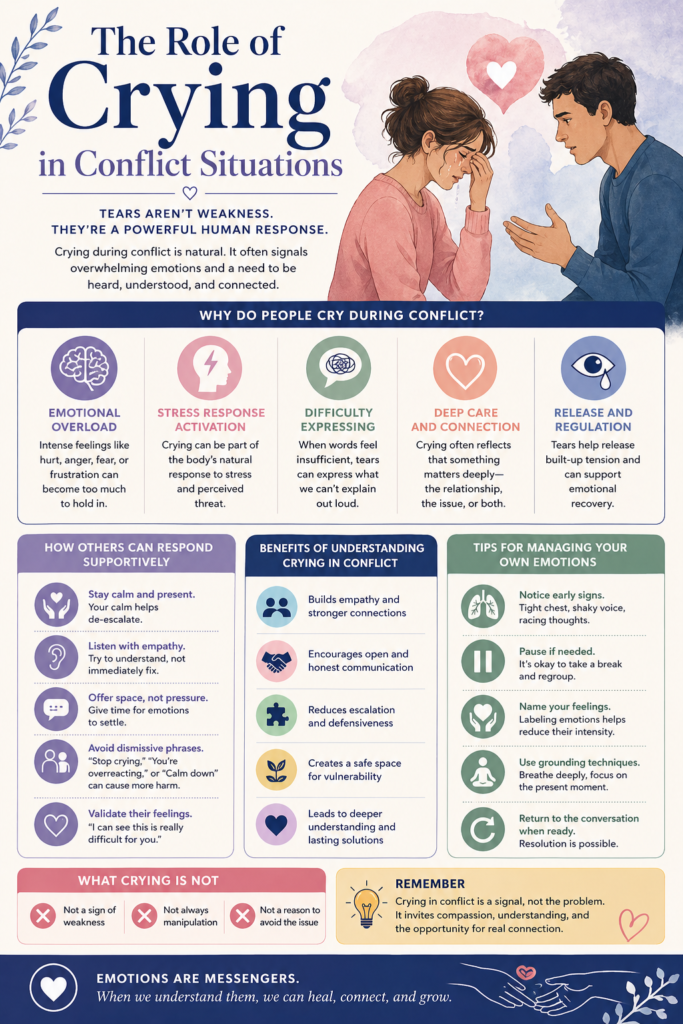
Crying during conflict is a common yet often misunderstood emotional response. In moments of disagreement, heightened feelings such as frustration, hurt, or fear can overwhelm a person’s ability to communicate effectively, leading to tears. While some may view crying as a sign of weakness or avoidance, it is more accurately understood as a natural physiological and psychological reaction to emotional intensity. Recognizing the role crying plays in conflict can help shift perspectives—from judgment to understanding—allowing for more meaningful and compassionate interactions.
The Role of Crying in Conflict Situations: What Tears Really Mean
Conflict is often seen as a battle of words, logic, and emotional control—but for many people, it also involves tears. Crying during arguments or tense conversations is a common yet misunderstood reaction. It’s frequently labeled as weakness, manipulation, or overreaction, when in reality, it is often a natural psychological and physiological response to emotional overload. Understanding why crying happens in conflict can shift how we interpret it—both in ourselves and in others.
Why Do People Cry During Conflict?
Crying in conflict is rarely about the surface issue alone. Instead, it reflects what’s happening internally.
1. Emotional Overload
Conflict can quickly activate intense emotions—hurt, frustration, fear, or rejection. When these feelings exceed a person’s capacity to process them, crying becomes a release valve.
2. Stress Response Activation
Arguments can trigger the body’s stress system (fight, flight, or freeze). For some individuals, especially those less inclined toward aggression, crying is part of the “freeze or submit” response, helping to de-escalate perceived threat.
3. Difficulty Verbalizing Feelings
Not everyone can easily articulate emotions in high-pressure moments. Tears can emerge when words fall short, serving as a nonverbal expression of distress.
Crying as Communication
Although often involuntary, crying sends powerful interpersonal signals:
- “I’m overwhelmed.”
- “This matters to me.”
- “I feel hurt or unsafe.”
In this sense, crying is not just emotional—it’s communicative. It can soften conflict, evoke empathy, or signal the need for a pause.
However, interpretation matters. If misunderstood, it may lead to:
- Frustration (“Why are you crying?”)
- Dismissal (“You’re overreacting”)
- Escalation (if the other person feels blamed or manipulated)
Is Crying Manipulative?
This is a common misconception. While crying can be used intentionally in rare cases, most of the time it is automatic and not consciously controlled.
The key difference lies in:
- Intent (Is the person trying to influence or simply reacting?)
- Pattern (Is crying consistent with emotional overwhelm or used strategically?)
Assuming manipulation without context can damage trust and shut down communication.
Gender and Social Conditioning
Crying in conflict is also shaped by social expectations:
- Some people are taught that crying is acceptable
- Others are discouraged from expressing vulnerability
This can lead to mismatched reactions, where one person cries, and the other becomes uncomfortable or dismissive—not because of the crying itself, but because of learned beliefs about emotion.
When Crying Escalates Conflict
While crying can reduce tension, it can also complicate communication when:
- The conversation shifts entirely to managing emotions
- The other person feels unable to express themselves
- Important issues remain unresolved
In these cases, both parties may benefit from pausing and returning to the discussion once emotions settle.
Healthy Ways to Respond to Crying (Your Own or Someone Else’s)
If You’re the One Crying:
- Acknowledge it: “I’m feeling overwhelmed right now.”
- Take a break if needed
- Return to the conversation when you feel more regulated
If Someone Else Is Crying:
- Stay calm and avoid judgment
- Ask: “Do you want to take a moment?”
- Focus on understanding, not fixing immediately
Final Thoughts
Crying in conflict isn’t a flaw—it’s a human response to emotional intensity. Rather than dismissing or fearing it, understanding its role can lead to more compassionate and effective communication. Tears don’t mean the conversation has failed; often, they signal that something meaningful is happening beneath the surface.
When approached with awareness and respect, even emotional moments like crying can become turning points toward deeper understanding rather than division.
Managing Emotional Responses in Conflict: Self-Strategies for Understanding Crying
Crying during conflict can feel confusing, frustrating, or even embarrassing—especially when it seems to interrupt communication or take over the moment. But rather than seeing it as a problem to eliminate, it’s more helpful to view crying as a signal from your emotional system. Learning how to manage and understand this response gives you more control—not by suppressing emotion, but by working with it more effectively.
Why Self-Management Matters
When you understand your own emotional reactions, you’re better able to:
- Stay engaged in difficult conversations
- Communicate more clearly
- Prevent escalation
- Recover more quickly after conflict
Crying doesn’t have to derail communication—it can become part of a more aware and intentional response.
1. Recognize Your Early Warning Signs
Crying rarely comes out of nowhere. There are often subtle cues beforehand:
- Tightness in your chest or throat
- Feeling overwhelmed or flooded
- Difficulty focusing or forming words
- Rising frustration or hurt
Learning to catch these early signs allows you to intervene before emotions peak.
2. Name What You’re Feeling
One of the simplest and most effective strategies is labeling your emotion:
- “I’m feeling overwhelmed right now.”
- “I think I’m getting hurt or frustrated.”
This does two things:
- Helps regulate your nervous system
- Signals to the other person what’s happening internally
Naming emotions can sometimes reduce the intensity enough to prevent crying—or make it feel less out of control.
3. Pause Without Avoiding
Taking a break isn’t the same as shutting down.
Try:
- “I need a few minutes to collect my thoughts.”
- Step away briefly, breathe, or reset
The key is to return to the conversation, not avoid it entirely. This builds confidence that you can handle conflict without becoming overwhelmed.
4. Use Grounding Techniques
When emotions spike, your body is in a stress response. Grounding helps bring it back down.
Effective techniques include:
- Slow, deep breathing (inhale 4 seconds, exhale 6 seconds)
- Focusing on physical sensations (feet on the ground, hands on a surface)
- Looking around and naming objects in your environment
These methods help shift your brain out of emotional overload and back into a regulated state.
5. Reframe Crying as Information, Not Failure
Instead of thinking:
- “I can’t handle conflict.”
Try:
- “This reaction is telling me something matters or feels intense.”
This shift reduces shame and helps you approach your response with curiosity instead of judgment.
6. Build Emotional Tolerance Over Time
Like any skill, handling strong emotions improves with practice.
You can build tolerance by:
- Reflecting after conflicts: What triggered the reaction?
- Gradually staying present in slightly uncomfortable conversations
- Practicing communication skills in low-stress situations
Over time, your threshold for emotional intensity increases.
7. Improve Communication Before Conflict Escalates
Many emotional reactions come from feeling unheard or misunderstood.
Try to:
- Express concerns earlier rather than letting them build up
- Use “I” statements (“I feel…” instead of “You always…”)
- Clarify intentions and avoid assumptions
Better communication reduces the likelihood of emotional overload in the first place.
8. Address Underlying Triggers
Sometimes crying in conflict is tied to deeper patterns:
- Fear of rejection or abandonment
- Past experiences with conflict
- High sensitivity to criticism
Understanding these patterns—on your own or with support—can reduce the intensity of your reactions in the moment.
Final Thoughts
Crying in conflict isn’t something you need to “fix”—it’s something you can learn to understand and manage. With awareness, regulation strategies, and practice, you can stay more grounded, communicate more effectively, and feel less overwhelmed during difficult conversations.
The goal isn’t to stop crying entirely—it’s to feel like you’re in control of how you respond, even when emotions run high.
Supporting Emotional Expression: Family Strategies for Understanding Crying in Conflict
Crying during conflict can be difficult for families to navigate. It may feel uncomfortable, confusing, or even disruptive—especially when emotions run high, and communication breaks down. However, crying is often not about avoiding the issue, but about emotional overwhelm and the need to be understood. When families learn to respond to tears with awareness rather than frustration, conflict can shift from reactive to constructive.
Why Family Understanding Matters
In family dynamics, emotional responses are often interconnected. One person’s crying can trigger:
- Discomfort or impatience
- A desire to “fix” the situation quickly
- Withdrawal or escalation
Without understanding, this can lead to misinterpretations like:
- “They’re being dramatic.”
- “They’re trying to manipulate the situation.”
In reality, crying is often a signal of vulnerability, not strategy.
1. Reframe Crying as Emotional Communication
Instead of seeing crying as a problem, view it as a message:
- “I’m overwhelmed.”
- “This is important to me.”
- “I feel hurt or misunderstood.”
Helping family members adopt this perspective reduces judgment and increases empathy.
2. Stay Calm and Regulated
How you respond in the moment matters more than what you say.
Try to:
- Keep your tone steady
- Avoid reacting with frustration or sarcasm
- Pause before responding if you feel triggered
Emotional regulation is contagious—your calmness can help de-escalate the situation.
3. Avoid Dismissing or Shutting Down
Statements like:
- “Stop crying.”
- “You’re overreacting.”
can make the situation worse by increasing shame and emotional intensity.
Instead, try:
- “I can see this is really affecting you.”
- “Do you want a moment, or do you want to keep talking?”
This keeps the door open for communication.
4. Give Space Without Abandoning
Sometimes the best support is allowing a brief pause.
- Offer a break: “Let’s take a few minutes and come back to this.”
- Stay available, but don’t pressure for immediate resolution
This helps the person regain composure without feeling ignored.
5. Focus on the Issue—Not Just the Emotion
While it’s important to acknowledge feelings, families should also gently return to the topic once emotions settle.
- “I want to understand what upset you—can we talk about it when you’re ready?”
This ensures that crying doesn’t derail the conversation entirely.
6. Encourage Open Emotional Expression Outside of Conflict
Families that talk about emotions regularly tend to have less intense reactions during disagreements.
You can:
- Normalize talking about feelings in everyday situations
- Model expressing emotions calmly
- Reinforce that vulnerability is acceptable
This builds emotional resilience over time.
7. Recognize Individual Differences
Not everyone responds to conflict the same way:
- Some cry easily
- Others become quiet or defensive
- Some may appear unemotional
Understanding these differences prevents unfair judgments and promotes more balanced interactions.
8. Reflect as a Family After Conflict
Once things have calmed down, take time to reflect:
- What triggered the emotional response?
- How did everyone react?
- What could be handled differently next time?
These conversations build awareness and improve future communication.
Final Thoughts
Crying in conflict isn’t a weakness or a disruption—it’s part of how some people process intense emotions. Families that learn to respond with patience, curiosity, and respect create a safer emotional environment where issues can actually be resolved.
The goal isn’t to eliminate tears, but to understand what they’re signaling and respond in a way that strengthens the connection rather than creating distance.
Community Support for Emotional Expression: Resources to Understand Crying in Conflict
Crying during conflict is often misunderstood—not just within families, but across society. Many people grow up without learning how to interpret or respond to strong emotional reactions, which can lead to miscommunication, frustration, or avoidance. Community resources play a key role in normalizing emotional expression, building communication skills, and helping individuals and groups navigate conflict more effectively.
Why Community Resources Matter
Understanding crying in conflict isn’t just a personal or family issue—it’s a social and educational gap. Without guidance, people may:
- Misinterpret crying as manipulation or weakness
- Avoid conflict altogether
- Escalate situations due to discomfort with emotions
Community-based support helps reframe crying as a valid emotional response and teaches practical ways to handle it constructively.
1. Counseling and Therapy Services
Local counseling centers and therapists provide a structured space to explore emotional responses.
They help individuals:
- Understand why they cry during conflict
- Identify emotional triggers and patterns
- Learn regulation and communication skills
Group or family therapy can also improve how others respond to crying, making conflict less reactive and more productive.
2. Communication and Conflict Resolution Workshops
Many communities offer workshops through:
- Community centers
- Universities
- Nonprofit organizations
These programs focus on:
- Active listening
- Emotional awareness
- De-escalation techniques
- Expressing needs without overwhelm
They provide tools that help people stay engaged in conflict without becoming flooded with emotion.
3. Mental Health Education Programs
Public health initiatives and local organizations often run sessions on:
- Emotional regulation
- Stress management
- Understanding reactions like crying
These programs help normalize emotional responses and reduce stigma, making it easier for individuals to accept and manage their reactions.
4. Support Groups and Peer Networks
Peer support groups create spaces where people can share experiences openly.
Benefits include:
- Hearing others describe similar reactions
- Learning practical coping strategies
- Reducing shame around emotional expression
Knowing that others also cry during conflict can shift the perspective from “something is wrong with me” to “this is something I can understand and work with.”
5. School and Workplace Programs
Many schools and workplaces now incorporate emotional intelligence training.
These programs teach:
- Recognizing emotional cues
- Responding appropriately to distress (including crying)
- Managing conflict respectfully
Early exposure to these skills helps people develop healthier responses long before patterns become ingrained.
6. Online Resources and Educational Platforms
Accessible online tools can reinforce learning, including:
- Articles and blogs on emotional regulation
- Guided exercises for managing overwhelm
- Videos on conflict communication
These resources allow individuals to explore the topic privately and at their own pace.
7. Crisis and Emotional Support Services
In situations where emotional reactions feel overwhelming or unmanageable, crisis support services can help stabilize the moment.
They provide:
- Immediate emotional support
- Grounding and coping strategies
- Referrals for ongoing care
This is especially helpful when crying is linked to deeper distress or unresolved issues.
8. Community Culture and Awareness
Beyond formal programs, community attitudes shape how crying is perceived.
Communities that promote:
- Emotional openness
- Respect for vulnerability
- Healthy communication
create environments where individuals feel safer expressing emotions without fear of judgment.
Final Thoughts
Crying in conflict doesn’t have to remain confusing or disruptive. With the support of community resources, it can be understood as a meaningful emotional signal rather than a barrier to communication.
By combining education, peer support, and skill-building opportunities, communities can help individuals:
- Respond to emotions more effectively
- Navigate conflict with greater confidence
- Build stronger, more empathetic relationships
The more we understand emotional expression at a community level, the easier it becomes for individuals to turn moments of conflict into opportunities for connection and growth.
Frequently Asked Questions
Here are some common questions:
1. Why do people cry during conflict?
Crying during conflict is usually a response to emotional overload. Feelings like hurt, frustration, fear, or feeling misunderstood can become intense, and crying helps release that emotional pressure.
2. Is crying a sign of weakness?
No. Crying is a natural emotional and physiological response. It reflects that something matters or feels overwhelming—not that someone is weak or incapable.
3. Can crying be controlled?
To some extent, emotional responses can be managed, but crying itself is often automatic. With practice (like grounding and emotional awareness), people can sometimes reduce or delay it—but not always prevent it entirely.
4. Is crying during an argument manipulative?
Most of the time, no. Crying is usually involuntary. It may be perceived as manipulative, but intent matters—most people are reacting emotionally, not trying to control the situation.
5. Why do some people cry more easily than others?
Differences can come from:
- Personality and sensitivity
- Past experiences
- Stress levels
- Social conditioning around emotions
Some people simply have a lower threshold for emotional expression.
6. Why does crying sometimes make conflict worse?
Crying can shift focus away from the issue and:
- Make the other person uncomfortable
- Interrupt communication
- Lead to frustration if it feels unresolved
This doesn’t mean crying is the problem—it just means the response to it matters.
7. What should I do if I start crying during a conflict?
You can:
- Acknowledge it: “I’m feeling overwhelmed.”
- Take a short break
- Use calming techniques (slow breathing, grounding)
- Return to the conversation when ready
This helps you stay in control of the situation.
8. How should I respond if someone else starts crying?
- Stay calm and nonjudgmental
- Avoid dismissive comments
- Offer space if needed
- Show understanding: “I can see this is really affecting you.”
Supportive responses help de-escalate the situation.
9. Does crying mean the conflict can’t be resolved?
Not at all. Crying can actually signal that the issue is important and meaningful. With patience, the conversation can continue once emotions settle.
10. Why do I cry even when I’m angry?
Anger often overlaps with other emotions, such as hurt, frustration, or feeling unheard. Crying can occur when those underlying emotions surface.
11. Can anxiety cause crying during conflict?
Yes. Conflict can trigger anxiety, which may lead to:
- Feeling overwhelmed
- Difficulty thinking clearly
- Physical stress responses (including crying)
This creates a strong emotional reaction even if the issue seems small.
12. Is it better to avoid conflict if I tend to cry?
Avoiding conflict may reduce short-term discomfort, but it can lead to unresolved issues and increased stress over time. Learning to manage emotional responses is more effective than avoiding them.
13. Can crying be a healthy part of communication?
Yes. When understood and handled well, crying can:
- Signal emotional honesty
- Encourage empathy
- Deepen understanding
It becomes helpful when it’s acknowledged without shutting down the conversation.
14. How can I reduce crying during difficult conversations?
You can try:
- Recognizing early emotional signs
- Practicing breathing or grounding techniques
- Expressing feelings earlier (before they build up)
- Taking breaks when needed
These strategies help prevent emotional overload.
15. What’s the most important takeaway?
Crying in conflict isn’t something to fear or eliminate—it’s something to understand. When approached with awareness and empathy, it can actually support better communication rather than disrupt it.
Conclusion
Understanding crying in conflict situations encourages a more balanced and empathetic approach to communication. Rather than as a disruption, tears can be viewed as signals of emotional significance and vulnerability. When individuals and those around them respond with awareness and patience, conflicts are less likely to escalate and more likely to be resolved. Ultimately, acknowledging the role of crying helps create space for healthier dialogue, stronger relationships, and a deeper understanding of emotional expression.
Video: The Hidden Power of Crying During Fight #emotionalhealth #psychology