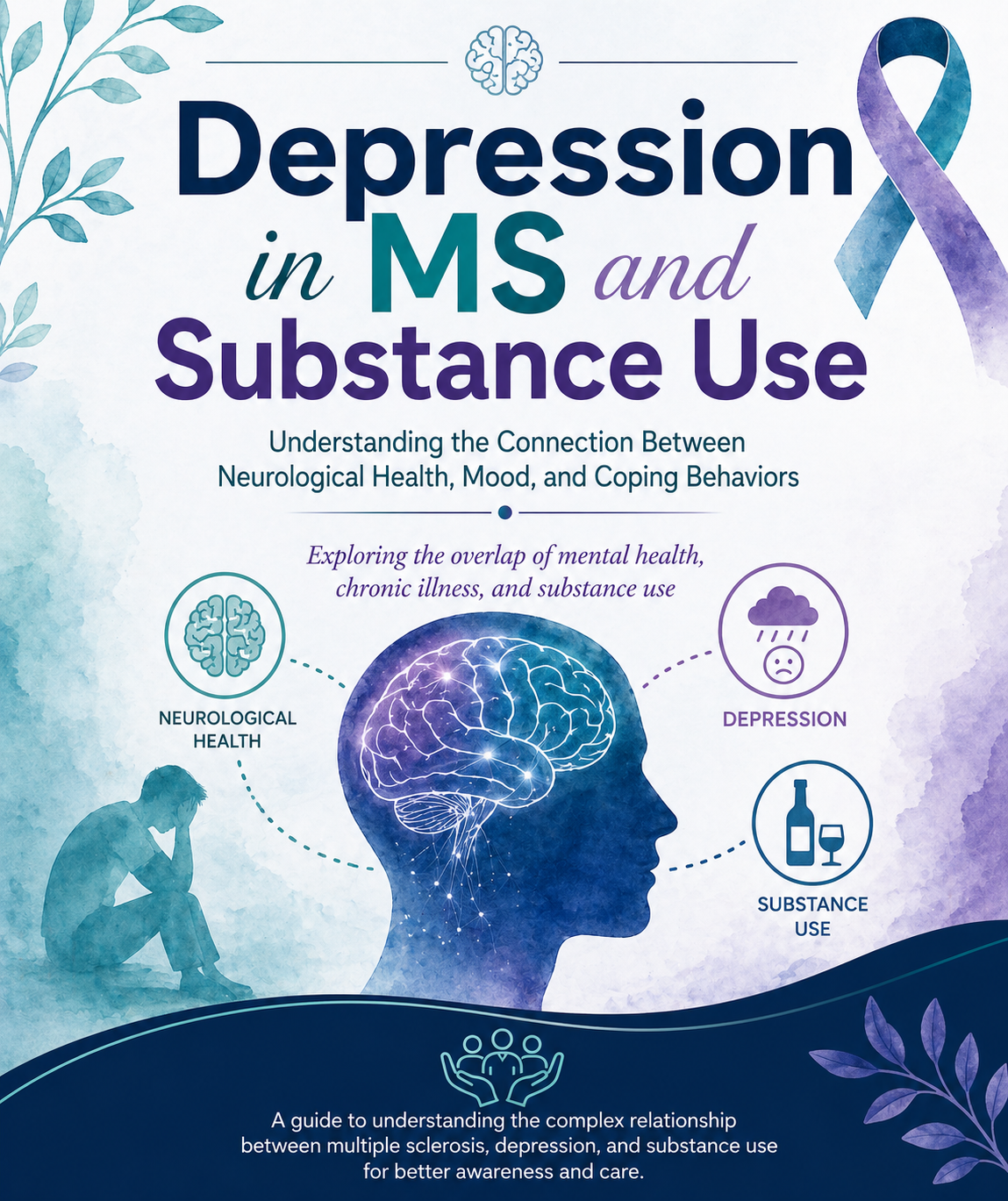
Depression is a prevalent yet often overlooked challenge for those living with Multiple Sclerosis (MS), driven by both neurological changes and the emotional toll of managing a chronic illness. For some, substance use serves as a coping mechanism for feelings of low mood, fatigue, or the unpredictable nature of MS symptoms. Unfortunately, this combination can create a vicious cycle, where depression, physical symptoms, and substance use amplify each other. Gaining insight into how these factors interact is crucial for identifying patterns, enhancing treatment approaches, and promoting overall well-being.
Depression in Multiple Sclerosis and Substance Use: Understanding the Overlap
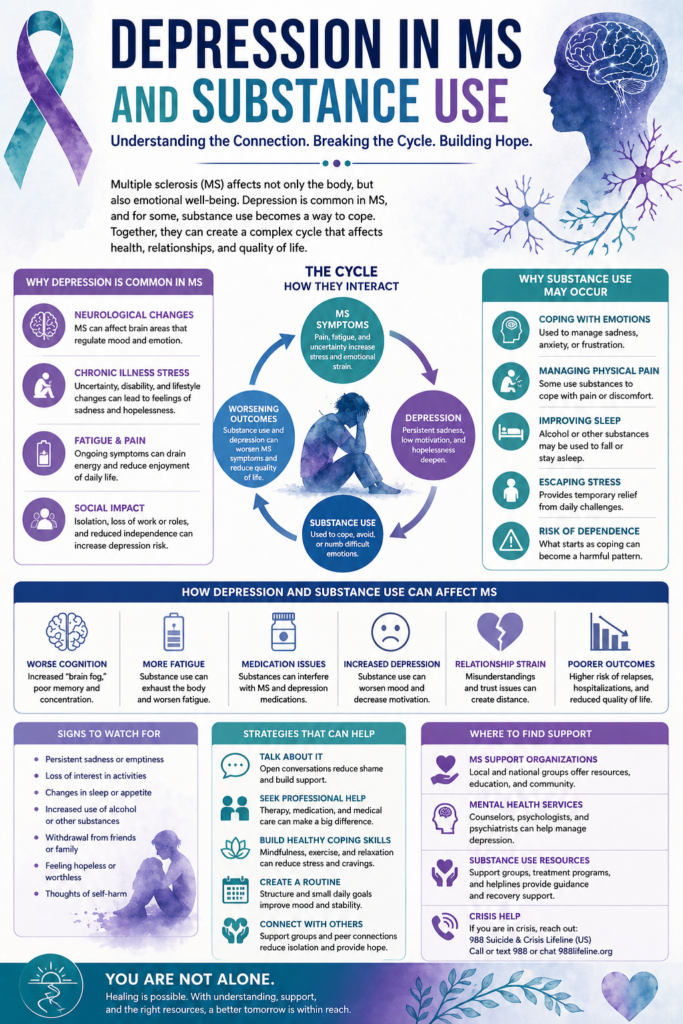
Depression is one of the most common and challenging symptoms experienced by people with Multiple Sclerosis (MS). At the same time, some individuals turn to substances—such as alcohol, nicotine, or other drugs—as a way to cope with emotional distress, physical discomfort, or the unpredictability of the disease. When depression and substance use intersect in MS, they can create a complex cycle that affects both mental health and physical functioning. Understanding this overlap is essential for improving quality of life and developing more effective, integrated approaches to care.
Why Depression Is Common in MS
Depression in MS is not caused by just one factor—it’s the result of both biological and psychological influences.
1. Neurological Changes
MS affects the brain and central nervous system, sometimes impacting areas that regulate mood. This means depression can be partly neurological, not just emotional.
2. Chronic Illness Stress
Living with a condition that is unpredictable and progressive can lead to:
- Loss of independence
- Changes in identity
- Ongoing uncertainty
These stressors can significantly contribute to depressive symptoms.
3. Fatigue and Physical Symptoms
MS-related fatigue, pain, and mobility issues can reduce daily functioning, which may increase feelings of frustration, isolation, or hopelessness.
Where Substance Use Fits In
Substance use often enters as a coping mechanism, but it can quickly complicate both depression and MS symptoms.
Common Reasons for Substance Use in MS:
- Managing emotional distress or depression
- Coping with pain or discomfort
- Escaping stress or uncertainty
- Trying to improve sleep
While these may provide temporary relief, they often worsen symptoms over time.
The Cycle: Depression ↔ Substance Use ↔ MS Symptoms
The relationship between these factors is often cyclical:
- Depression increases emotional distress
- Substance use is used to cope
- Substance use worsens mood, fatigue, or cognition
- MS symptoms become harder to manage
- Increased symptoms lead to more depression
This cycle can make it difficult to identify what’s causing what, but breaking even one part of it can lead to improvement.
How Substance Use Impacts MS and Depression
1. Worsened Mood
Substances like alcohol are central nervous system depressants, which can deepen depressive symptoms over time.
2. Increased Fatigue and Cognitive Issues
Many substances impair:
- Memory
- Concentration
- Energy levels
These effects can overlap with MS symptoms, making daily functioning more difficult.
3. Medication Interference
Substances may interfere with MS treatments or antidepressants, reducing their effectiveness or increasing side effects.
4. Reduced Motivation for Self-Care
Depression and substance use together can make it harder to:
- Attend appointments
- Follow treatment plans
- Maintain routines
Warning Signs of Overlap
- Persistent low mood alongside increasing substance use
- Using substances specifically to cope with MS symptoms
- Worsening fatigue, cognition, or emotional stability
- Reduced effectiveness of medications
- Withdrawal from support systems
Recognizing these patterns early can make intervention more effective.
Approaches to Managing Both
1. Integrated Care
Treating depression and substance use together, rather than separately, leads to better outcomes. This may include:
- Medical care for MS
- Mental health support
- Substance use counseling
2. Healthier Coping Strategies
Replacing substance use with alternatives can reduce both depression and symptom flare-ups:
- Mindfulness or relaxation techniques
- Light physical activity (as tolerated)
- Structured daily routines
- Social connection
3. Honest Communication with Providers
Open conversations about substance use—without fear of judgment—allow for:
- Safer treatment planning
- Better medication management
- More accurate understanding of symptoms
4. Support Systems
Family, peer groups, and counseling can provide:
- Emotional support
- Accountability
- Shared understanding
These are especially important when managing multiple challenges at once.
Final Thoughts
Depression in MS is not simply a reaction to illness—it can be deeply connected to neurological changes, life stress, and coping behaviors like substance use. When these factors overlap, they can reinforce one another, making both mental and physical health harder to manage.
However, this cycle is not permanent. With awareness, integrated support, and gradual changes, it’s possible to reduce the impact of both depression and substance use. The key is not to treat them in isolation, but to recognize how they interact—and to approach care in a way that addresses the whole person, not just individual symptoms.
Managing Depression in MS and Substance Use: Practical Self-Management Strategies
Living with depression alongside Multiple Sclerosis (MS) can already feel overwhelming. When substance use becomes part of the picture—whether as a coping mechanism or habit—it can make emotional and physical symptoms even harder to understand and manage. The good news is that self-management strategies can help you recognize patterns, regain control, and improve both mood and daily functioning over time.
Why Self-Management Matters
Depression, MS symptoms, and substance use often interact in ways that aren’t always obvious. Without awareness, it can feel like everything is happening at once.
Self-management helps you:
- Identify what’s driving your symptoms
- Reduce the impact of triggers
- Make small, meaningful changes
- Build a sense of control over your health
1. Track Patterns Between Mood, Symptoms, and Use
One of the most powerful tools is simple awareness.
Try tracking:
- Mood (low, stable, anxious, etc.)
- Physical symptoms (fatigue, pain, cognitive fog)
- Substance use (type, timing, amount)
Over time, patterns may emerge, such as:
- Increased use during a low mood
- Worse fatigue after using substances
- Temporary relief followed by deeper depression
This helps you move from “everything feels random” to “I see what’s happening.”
2. Understand the “Short-Term Relief vs. Long-Term Impact” Cycle
Substances often provide quick relief—but at a cost.
Reframe your experience:
- Short-term: reduced stress, numbness, escape
- Long-term: worsened mood, fatigue, and symptom control
Recognizing this trade-off helps you make more informed decisions without self-judgment.
3. Build Healthier Coping Alternatives
You don’t need to remove coping—you need to replace it.
Start small with options like:
- Gentle movement (stretching, short walks)
- Breathing or relaxation exercises
- Listening to music or engaging in calming activities
- Structured daily routines
The goal is to create go-to strategies when stress or low mood hits.
4. Work With Your Energy, Not Against It
MS-related fatigue is real and unpredictable. Trying to push through it can worsen both mood and physical symptoms.
Instead:
- Prioritize tasks based on energy levels
- Break activities into smaller steps
- Schedule rest without guilt
Managing energy effectively can reduce the urge to use substances for relief.
5. Set Realistic and Flexible Goals
All-or-nothing thinking can make change feel impossible.
Instead of:
- “I need to completely stop everything right now.”
Try:
- “I’ll reduce frequency this week.”
- “I’ll have one substance-free day.”
Progress in this context is gradual and flexible, not perfect.
6. Strengthen Emotional Awareness
Depression can make emotions feel flat or overwhelming at the same time.
Build awareness by asking:
- What am I feeling right now?
- What triggered this feeling?
- What do I need in this moment?
This helps separate emotional distress from automatic coping through substance use.
7. Protect Your Treatment Plan
If you’re using medications for MS or depression:
- Take them consistently
- Notice if substance use affects how you feel on them
- Avoid using substances as a substitute for treatment
Your treatment plan works best when it’s supported, not undermined.
8. Create a Supportive Environment
Even self-management doesn’t mean doing everything alone.
Consider:
- Talking to someone you trust
- Joining a support group (MS or recovery-focused)
- Seeking counseling if needed
Support adds structure and accountability, which can make change more sustainable.
9. Watch for Warning Signs
Be mindful of:
- Increasing reliance on substances
- Worsening depression or hopelessness
- Isolation from others
- Decline in daily functioning
These signs indicate it may be time to seek additional help.
Final Thoughts
Managing depression in MS alongside substance use isn’t about quick fixes—it’s about understanding how these pieces interact in your life. With awareness, small changes, and consistent effort, you can begin to break the cycle and create a more stable balance.
You don’t have to solve everything at once. Even small steps—tracking patterns, reducing use, or building one healthier habit—can lead to meaningful improvements in both mental and physical well-being.
Supporting a Loved One with MS, Depression, and Substance Use: Family Strategies That Help
When Multiple Sclerosis (MS), depression, and substance use intersect, families often feel unsure how to respond. Mood changes, fatigue, and substance use can blur together, making it difficult to know what’s causing what—or how to help without overstepping. The reality is that family support can play a powerful role, not by “fixing” the situation, but by creating stability, understanding, and a path toward healthier coping.
Why Family Support Matters
Depression and substance use can reinforce each other, especially in someone managing a chronic condition like MS:
- MS symptoms → stress, fatigue, uncertainty
- Depression → low motivation, emotional distress
- Substance use → temporary relief but worsened symptoms
Families can help interrupt this cycle by offering consistency, awareness, and encouragement.
1. Learn How These Issues Interact
Understanding the overlap is key.
Recognize that:
- Depression in MS may be partly neurological, not just emotional
- Substance use is often an attempt to cope, not simply a “bad choice.”
- Fatigue and mood changes may be symptoms—not lack of effort
This knowledge helps replace frustration with informed empathy.
2. Focus on Observation, Not Assumption
Instead of jumping to conclusions, pay attention to patterns:
- When does mood seem lowest?
- When does substance use increase?
- Are symptoms worse after use?
Use language like:
- “I’ve noticed you seem more tired and down lately—how are you feeling?”
This opens a conversation without blame.
3. Communicate Without Judgment
Shame and criticism can push people further into isolation or substance use.
Helpful approaches:
- Stay calm and non-confrontational
- Use “I” statements (“I’m concerned about you”)
- Avoid labels or ultimatums
The goal is to keep communication open, not force change.
4. Encourage Small, Realistic Changes
Big expectations can feel overwhelming for someone dealing with MS and depression.
Instead:
- Support gradual reductions in substance use
- Encourage small routines (getting up at a set time, light activity)
- Acknowledge effort, not just outcomes
Small wins build momentum over time.
5. Support Medical and Mental Health Care
Integrated care is essential.
Families can:
- Encourage appointments with healthcare providers
- Help track symptoms or questions
- Offer to attend visits for support (if welcomed)
This reinforces that managing MS, depression, and substance use is a team effort.
6. Help Create a Stable Environment
Consistency can reduce stress and improve emotional regulation.
You can:
- Maintain predictable routines at home
- Reduce unnecessary stressors
- Encourage healthy habits (sleep, meals, hydration)
A stable environment supports both physical and mental resilience.
7. Set Healthy Boundaries
Support doesn’t mean enabling.
It’s important to:
- Avoid covering up or minimizing harmful behaviors
- Be clear about what you can and cannot accept
- Protect your own well-being
Boundaries create structure and accountability, not punishment.
8. Watch for Warning Signs
Be aware of changes that may signal worsening depression or substance use:
- Increased isolation
- Loss of interest in daily activities
- Escalating substance use
- Expressions of hopelessness
These signs may indicate the need for additional support or intervention.
9. Take Care of Yourself
Supporting someone with complex needs can be emotionally draining.
Make sure you:
- Seek your own support (friends, counseling, groups)
- Take breaks when needed
- Avoid taking full responsibility for their choices
You can be supportive without sacrificing your own health.
Final Thoughts
When MS, depression, and substance use overlap, the situation can feel complicated—but family support remains one of the most powerful influences. By focusing on understanding rather than control, and encouragement rather than pressure, families can help their loved one recognize patterns, feel less alone, and move toward healthier coping.
You don’t need to have all the answers. Sometimes the most meaningful support is simply showing up with consistency, patience, and a willingness to understand.
Community Resources for Managing Depression in MS and Substance Use: Building a Support Network
Living with depression alongside Multiple Sclerosis (MS) can be challenging on its own. When substance use is also involved, the situation becomes more complex—affecting mood, physical health, and daily functioning. No single solution addresses all of these factors, which is why community resources are essential. They provide accessible, structured, and integrated support to help individuals better understand their symptoms and develop healthier ways of coping.
Why Community Resources Matter
Depression, MS, and substance use often overlap in ways that can feel overwhelming:
- MS symptoms → fatigue, pain, unpredictability
- Depression → low motivation, emotional distress
- Substance use → temporary relief but long-term worsening
Community resources help bridge gaps among medical care, mental health, and behavioral support, making it easier to manage all three together rather than in isolation.
1. Neurology and MS Specialty Clinics
MS-focused clinics are often the foundation of care.
They provide:
- Ongoing monitoring of disease progression
- Management of fatigue, pain, and cognitive symptoms
- Guidance on how MS may impact mood and behavior
These providers can also help identify when depression or substance use is affecting overall health.
2. Mental Health Services
Depression in MS is both biological and emotional, making mental health care essential.
Community-based services include:
- Individual counseling or therapy
- Psychiatric care for medication management
- Cognitive-behavioral therapy (CBT) for coping skills
These services help individuals:
- Understand emotional patterns
- Reduce depressive symptoms
- Improve resilience and daily functioning
3. Substance Use and Recovery Programs
Addressing substance use directly is a key part of managing the overall cycle.
Community options may include:
- Outpatient treatment programs
- Peer recovery groups
- Harm-reduction services
- Intensive outpatient or residential care (if needed)
These programs focus on:
- Identifying triggers
- Developing alternative coping strategies
- Reducing or stopping substance use safely
4. Integrated Care Programs
Some communities offer programs that combine:
- Medical care for MS
- Mental health support
- Substance use treatment
These integrated models are especially effective because they:
- Treat the whole person
- Reduce conflicting advice
- Improve coordination between providers
5. Support Groups and Peer Networks
Connecting with others who understand the experience can be powerful.
Options include:
- MS-specific support groups
- Depression or mental health groups
- Recovery-focused peer meetings
Benefits:
- Shared experiences and validation
- Practical, real-life coping strategies
- Reduced isolation
Hearing others’ stories can help individuals recognize patterns in their own lives.
6. Rehabilitation and Wellness Programs
Programs focused on physical and cognitive health can indirectly improve mood and reduce reliance on substances.
These may include:
- Physical therapy or exercise programs tailored to MS
- Occupational therapy for daily functioning
- Wellness classes (stress reduction, mindfulness, relaxation)
Improving physical function often leads to better emotional stability.
7. Case Management and Social Services
Navigating multiple systems can be overwhelming.
Case managers or social workers can help:
- Coordinate care across providers
- Connect individuals to financial or insurance resources
- Ensure consistent follow-up
This support reduces barriers that often interfere with treatment.
8. Educational Programs and Public Health Resources
Community education helps individuals better understand the connection between MS, depression, and substance use.
These programs may cover:
- Symptom management
- Medication education
- Coping strategies
- Risk awareness
Knowledge empowers individuals to make more informed decisions about their health.
9. Crisis and Immediate Support Services
In times of acute distress, immediate help is critical.
Crisis resources can provide:
- Emotional support during severe depressive episodes
- Guidance during substance-related crises
- Referrals for urgent care
These services act as a safety net when symptoms escalate.
Final Thoughts
Managing depression in MS alongside substance use requires more than isolated efforts—it requires a network of support. Community resources offer that network by combining medical care, emotional support, and practical guidance into a more complete approach.
No one resource has to do everything. The most effective strategy is often a combination:
- Medical treatment for MS
- Mental health care for depression
- Support for reducing or managing substance use
- Peer and community connection
By engaging with these resources, individuals can begin to understand how these challenges interact—and take meaningful steps toward greater stability, improved well-being, and a better quality of life.
Frequently Asked Questions
Here are some common questions:
1. Why is depression common in MS?
Depression is common in Multiple Sclerosis (MS) due to a combination of brain changes and life challenges. MS can affect areas of the brain involved in mood regulation, while the stress of living with a chronic illness also plays a major role.
2. How does substance use relate to depression in MS?
Substances are often used to cope with:
- Low mood
- Stress or anxiety
- Pain or fatigue
However, while they may provide short-term relief, they often worsen depression and MS symptoms over time.
3. Can MS itself cause depression, or is it just emotional?
Both. Depression in MS can be:
- Neurological (due to brain changes)
- Psychological (due to stress, lifestyle changes, uncertainty)
This is why it’s important to treat depression as a real medical concern, not just a reaction.
4. Does alcohol make depression in MS worse?
Yes. Alcohol is a central nervous system depressant, which can:
- Deepen depressive symptoms
- Increase fatigue
- Worse coordination and cognition
It may also interfere with medications.
5. Can substance use affect MS symptoms directly?
Yes. Substance use can:
- Increase fatigue
- Impaired memory and concentration
- Affect balance and coordination
- Trigger inflammation or worsen overall health
These effects can overlap with MS symptoms, making them harder to manage.
6. How can I tell if substance use is affecting my mood?
Look for patterns such as:
- Feeling worse emotionally after using
- Increased reliance on substances during low moods
- Temporary relief followed by a “crash.”
Tracking mood and use over time can make this clearer.
7. Is it safe to use substances while taking MS or antidepressant medications?
Not always. Some substances can:
- Reduce medication effectiveness
- Increase side effects
- Create unsafe interactions
It’s important to discuss this honestly with a healthcare provider.
8. Can reducing substance use improve depression?
In many cases, yes. Reducing or stopping use can lead to:
- More stable mood
- Better sleep
- Improved response to medications
- Increased energy
Even small reductions can make a difference.
9. Why is it hard to stop using substances when depressed?
Depression can lower motivation and increase the desire for relief or escape. Substances may feel like one of the few things that help, even if temporarily. This creates a cycle that’s difficult—but not impossible—to break.
10. What are the warning signs that things are getting worse?
- Increasing substance use
- Persistent or worsening depression
- Loss of interest in daily life
- Isolation from others
- Difficulty managing MS symptoms
These signs suggest it may be time to seek additional support.
11. What kind of treatment works best?
The most effective approach is integrated care, which includes:
- Medical treatment for MS
- Mental health support for depression
- Substance use counseling or support
Treating all three together leads to better outcomes.
12. Can therapy help even if depression is neurological?
Yes. Even when depression has a neurological component, therapy can:
- Improve coping strategies
- Reduce stress
- Help manage emotional reactions
- Support behavior changes
It complements medical treatment.
13. Are there healthier ways to cope than using substances?
Yes. Alternatives include:
- Light physical activity
- Relaxation or breathing techniques
- Structured routines
- Social connection
- Creative or calming activities
These support both mental and physical health without negative side effects.
14. Should I talk to my doctor about substance use?
Yes. Honest communication helps providers:
- Adjust treatment safely
- Understand symptom patterns
- Offer appropriate support
Healthcare providers are there to help—not judge.
15. What’s the most important takeaway?
Depression, MS, and substance use are deeply connected, but they can be managed. Understanding how they interact is the first step toward making changes that improve both mental health and overall quality of life.
Conclusion
Addressing depression in MS alongside substance use requires a broader, more integrated perspective. Rather than viewing each issue in isolation, it is important to recognize how they influence one another and contribute to ongoing challenges in both mental and physical health. With increased awareness, supportive interventions, and a willingness to explore healthier coping strategies, it is possible to break this cycle. Ultimately, understanding this overlap empowers individuals and those around them to move toward more effective care, improved emotional balance, and a better quality of life.
Video: Nobody Warned Me About This MS Depression Trap #Health #Awareness