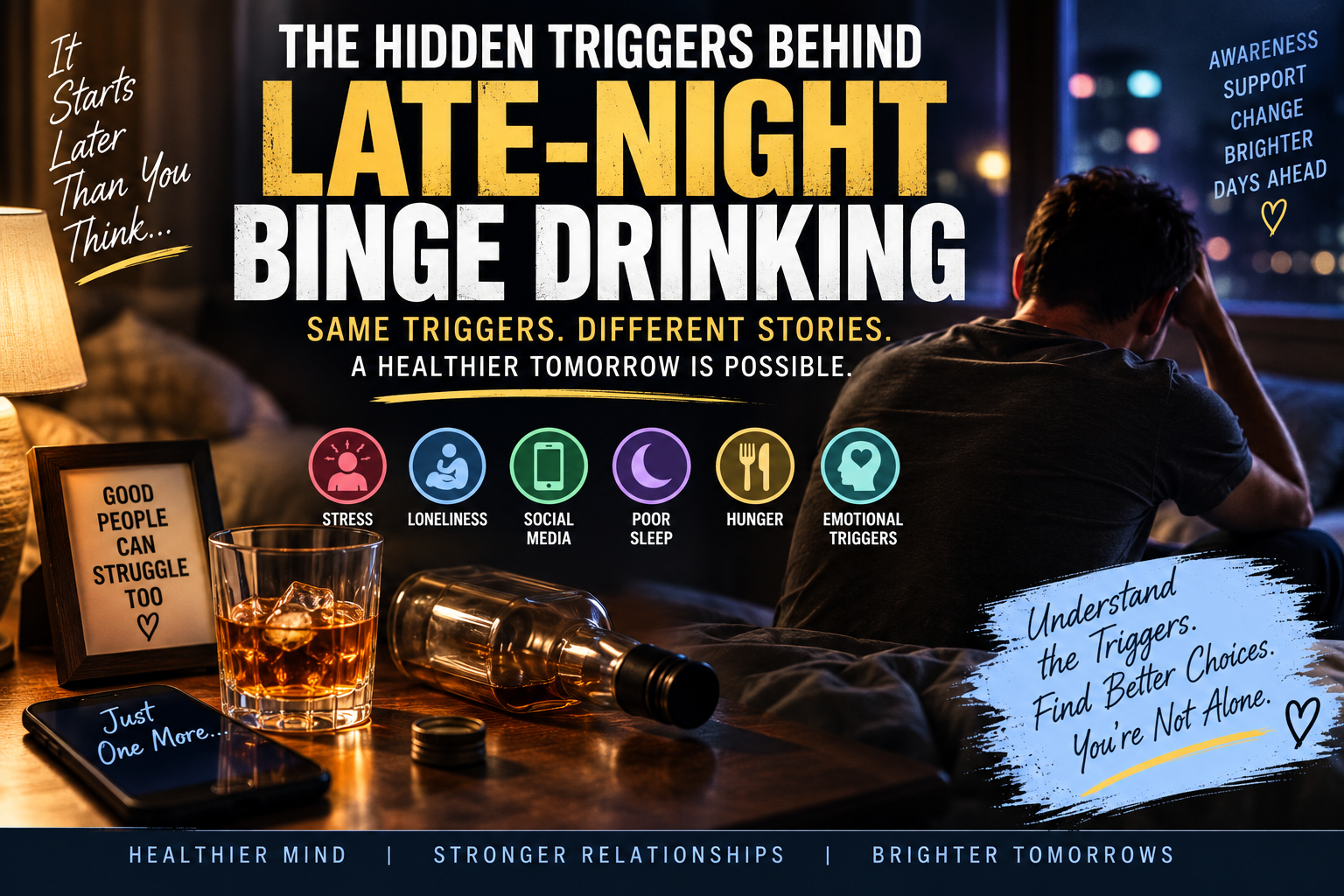
Late-night binge drinking can look spontaneous from the outside: someone finishes a stressful day, pours a drink to relax, and suddenly several drinks have disappeared. But excessive drinking rarely occurs in isolation. Stress, loneliness, poor sleep, emotional distress, environmental cues, social habits, and easy access to alcohol can combine to create a powerful pattern.
Understanding these hidden triggers can help shift the conversation from “Why can’t I control myself?” to “What happens before I start drinking, and what can I change?” For some people, repeated binge drinking may also be a warning sign of alcohol use disorder (AUD), a treatable medical condition.
What Is Binge Drinking?
Binge drinking generally refers to consuming enough alcohol in a short period to raise blood alcohol concentration to 0.08% or higher. The National Institute on Alcohol Abuse and Alcoholism notes that this typically corresponds to about five or more drinks for a man or four or more for a woman within approximately two hours, although factors such as body size, medications, food intake, and drinking speed influence intoxication.
Binge drinking does not automatically mean that someone has AUD. However, repeated episodes increase the risk of injuries, alcohol poisoning, unsafe decisions, sleep disruption, relationship problems, and eventually alcohol-related medical complications.
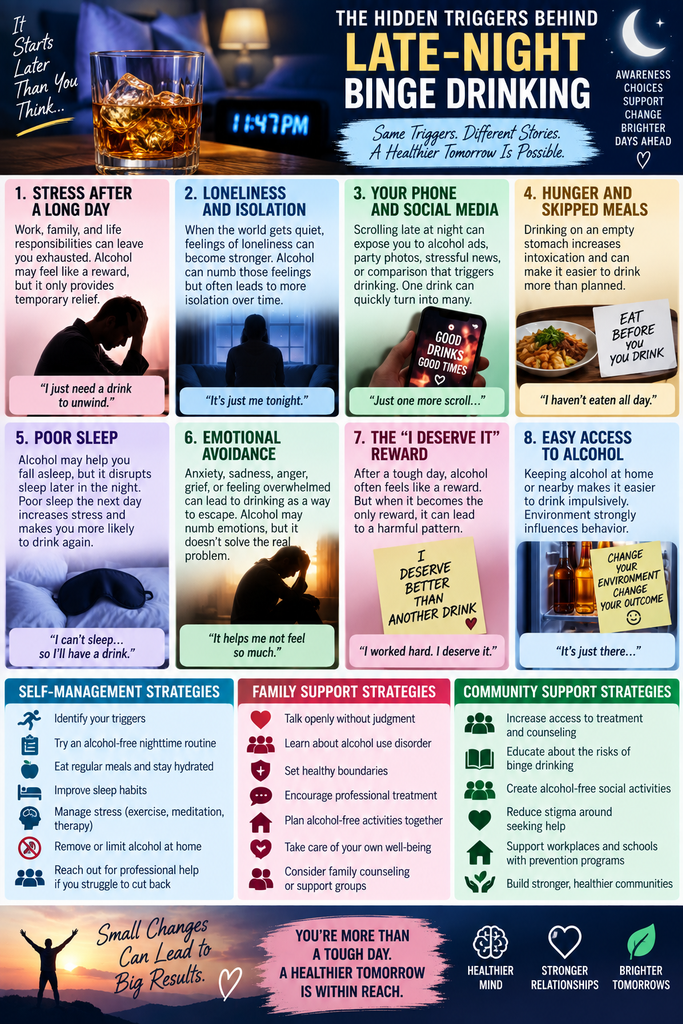
Hidden Trigger #1: Stress After a Long Day
One of the strongest late-night triggers can be the transition from responsibility to downtime.
A person may spend the entire day managing work, family, finances, caregiving, or other responsibilities. Once the house becomes quiet, alcohol can begin to feel like a reward.
The brain may gradually learn an association:
Stress → Nighttime → Alcohol → Temporary Relief
After enough repetition, simply reaching the end of the day can trigger an urge to drink.
Healthier alternatives can include:
- Taking a shower after work to establish a transition ritual.
- Exercising or walking before settling down for the evening.
- Listening to music or a podcast.
- Drinking a favorite nonalcoholic beverage.
- Practicing breathing or relaxation exercises.
- Calling someone supportive before cravings become intense.
The goal is to teach the brain that relaxation can occur without alcohol.
Hidden Trigger #2: Loneliness and Isolation
Nighttime can amplify loneliness.
During the day, work, errands, conversations, and responsibilities provide distraction. At night, those distractions disappear, and difficult emotions may become harder to ignore.
Alcohol can temporarily numb loneliness, but repeated drinking can eventually increase isolation. Someone may cancel plans, hide their alcohol consumption, avoid family members, or spend evenings drinking alone.
That creates another cycle:
Loneliness → Drinking → Withdrawal from others → More loneliness
Breaking the cycle requires building connection before isolation becomes overwhelming.
Hidden Trigger #3: Your Phone and Social Media
Phones can become unexpected drinking triggers.
Scrolling through social media may expose someone to alcohol advertisements, party photos, drinking videos, stressful news, arguments, relationship reminders, or images that encourage comparison with other people’s lives.
Someone may start scrolling while drinking one beverage and continue consuming alcohol almost automatically because their attention is focused on the screen.
Helpful changes include:
- Keeping alcohol away from the couch or bedroom.
- Establishing a nighttime phone cutoff.
- Unfollowing accounts that repeatedly trigger drinking.
- Avoiding alcohol-centered social media content.
- Replacing late-night scrolling with reading, music, or another relaxing activity.
Sometimes changing the environment is easier than repeatedly trying to overpower a craving.
Hidden Trigger #4: Hunger and Skipped Meals
Drinking after skipping dinner or eating very little can be especially risky.
Alcohol is absorbed more quickly on an empty stomach, increasing intoxication. Hunger can also reduce patience and decision-making, making it easier to act impulsively.
A consistent evening meal can therefore become part of a broader alcohol-management strategy.
Consider:
- Eating regular meals throughout the day.
- Including protein, fiber, and complex carbohydrates.
- Keeping healthy evening snacks available.
- Drinking water regularly.
- Avoiding intentionally skipping meals so alcohol has a stronger effect.
Nutrition does not prevent alcohol-related harm, but stable eating patterns can remove one factor that contributes to risky drinking.
Hidden Trigger #5: Poor Sleep
Alcohol and sleep can create a particularly deceptive relationship.
Alcohol may initially make someone sleepy, which can create the impression that it improves sleep. However, drinking can disrupt sleep quality later in the night and contribute to fragmented sleep.
Poor sleep then increases fatigue and stress the following day.
The cycle becomes:
Can’t sleep → Drink → Fall asleep → Poor-quality sleep → Fatigue → Stress → Drink again
Addressing insomnia directly may reduce the perceived need for alcohol at bedtime.
Hidden Trigger #6: Emotional Avoidance
Sometimes late-night drinking is less about wanting alcohol and more about not wanting to feel something else.
Common emotions underneath drinking can include:
- Anxiety
- Sadness
- Anger
- Shame
- Grief
- Rejection
- Boredom
- Relationship frustration
- Fear about the future
- Feeling overwhelmed
Alcohol may temporarily suppress these emotions, but it does not resolve their source.
A useful question is:
“What am I hoping this drink will make me stop feeling?”
The answer may reveal the actual problem that needs attention.
Hidden Trigger #7: The “I Deserve It” Reward
Alcohol is often marketed and culturally portrayed as a reward.
“I worked hard.”
“The kids are finally asleep.”
“I survived another week.”
“I deserve a drink.”
There is nothing unusual about wanting a reward after a difficult day. The problem develops when alcohol becomes the only reliable reward.
Creating alternative rewards—favorite foods, hobbies, movies, exercise, games, baths, music, or social activities—can weaken the connection between accomplishment and alcohol.
Hidden Trigger #8: Alcohol Is Too Easy to Reach
Environment strongly influences behavior.
A person trying to reduce drinking may have a much harder time when several bottles are sitting on the kitchen counter or cold beer is always waiting in the refrigerator.
Environmental strategies can include:
- Not keeping large quantities of alcohol at home.
- Avoiding buying alcohol “just in case.”
- Keeping appealing nonalcoholic drinks available.
- Changing the room where evening relaxation normally occurs.
- Avoiding regular late-night trips to stores that sell alcohol.
Reducing exposure to triggers is a legitimate behavioral strategy—not a sign of weakness.
Self-Management Strategies
Understanding triggers is useful only when that knowledge leads to a plan.
A person concerned about late-night binge drinking can begin by tracking when, where, why, and how much they drink. Patterns often become visible within a relatively short period.
Helpful strategies include:
- Keep a drinking and trigger diary.
- Identify the hours when cravings are strongest.
- Delay acting on a craving and engage in another activity.
- Establish an alcohol-free nighttime routine.
- Eat regular meals and maintain hydration.
- Improve sleep habits.
- Schedule evening activities during high-risk hours.
- Remove alcohol from the immediate environment.
- Identify at least one person to contact when cravings become difficult.
- Discuss repeated binge drinking honestly with a healthcare professional.
- Consider behavioral therapy or specialized alcohol treatment when self-directed changes are not enough.
For people with AUD, medications such as naltrexone, acamprosate, and disulfiram may be considered in appropriate circumstances. Medication decisions should be made in consultation with a healthcare professional.
Importantly, someone who drinks heavily every day or experiences shaking, sweating, nausea, anxiety, hallucinations, or seizures when alcohol wears off should not abruptly stop without medical guidance. Severe alcohol withdrawal can be life-threatening.
Family Support Strategies
Watching someone repeatedly binge drink can leave relatives frustrated, frightened, and exhausted. Family support works best when compassion is combined with boundaries.
Families can help by:
- Discussing concerns when the person is sober rather than intoxicated.
- Using specific observations instead of labels such as “alcoholic.”
- Encouraging professional evaluation.
- Avoiding arguments during intoxication.
- Not purchasing alcohol for someone whose drinking is causing harm.
- Refusing to cover up repeated alcohol-related consequences.
- Encouraging alcohol-free family activities.
- Learning the warning signs of alcohol poisoning.
- Participating in counseling or family support programs.
- Protecting their own emotional and physical well-being.
Family members cannot control another person’s recovery. They can, however, help create an environment that supports healthier choices.
Community Support Strategies
Recovery becomes easier when someone does not have to manage everything alone.
Community support can include primary-care professionals, addiction specialists, therapists, peer recovery coaches, mutual-help groups, recovery community organizations, faith communities, workplace assistance programs, and sober recreational groups.
Communities can also help by:
- Making addiction treatment easier to access.
- Providing evening and telehealth counseling options.
- Creating alcohol-free social activities.
- Educating people about binge drinking and alcohol poisoning.
- Reducing stigma surrounding AUD treatment.
- Supporting peer recovery programs.
- Providing transportation alternatives to impaired driving.
- Encouraging workplaces to provide confidential behavioral-health resources.
The goal is not simply to tell people to stop drinking. It is to make healthier choices more accessible.
Recognizing an Emergency
Binge drinking can cause alcohol poisoning.
Warning signs include severe confusion, inability to remain awake, vomiting, seizures, slow or irregular breathing, pale or bluish skin, and loss of consciousness.
A severely intoxicated person should not simply be left to “sleep it off.” If alcohol poisoning is suspected, call 911. Keep the person on their side when possible to reduce the risk of aspiration, remain with them, and follow emergency instructions.
When Late-Night Drinking May Be Something More
A pattern deserves closer attention when someone repeatedly drinks more than intended, cannot reliably reduce consumption, spends significant time drinking or recovering, experiences strong cravings, continues despite relationship or health problems, or needs increasing amounts to obtain the same effect.
These patterns can indicate AUD and warrant professional assessment.
Treatment does not always mean residential rehabilitation. Depending on severity and individual circumstances, options can include primary care, outpatient counseling, medications, intensive outpatient treatment, mutual-help programs, or residential care.
Breaking the Nighttime Cycle
Late-night binge drinking often begins before the first drink is poured.
The real trigger may have happened hours earlier: an argument, exhausting shift, skipped meal, lonely evening, stressful social-media post, sleepless night, or feeling that alcohol is the only available reward.
That is why effective change involves more than removing the bottle. It means understanding the purpose alcohol has started serving and finding safer ways to meet that need.
Self-management can identify and interrupt triggers. Families can provide encouragement while maintaining healthy boundaries. Communities can make professional treatment and recovery support more accessible.
Instead of asking only, “How do I stop drinking tonight?”, a more useful question may be:
“What happens every night that makes me want to drink—and what can I change before the craving begins?”
Finding that answer can be an important first step toward breaking the cycle.
Frequently Asked Questions
Here are some common questions:
1. What is late-night binge drinking?
Late-night binge drinking refers to consuming a large amount of alcohol over a relatively short period during the evening or nighttime. In the United States, binge drinking is commonly defined as a pattern that brings blood alcohol concentration to 0.08% or higher—typically about 5 or more drinks for men or 4 or more drinks for women within about two hours, although intoxication varies by individual.
2. Why do some people drink more heavily at night?
Nighttime may be when daytime distractions disappear, and stress, loneliness, boredom, anxiety, or relationship problems become more noticeable. Alcohol can temporarily provide relaxation or emotional escape, causing the brain to gradually associate nighttime with drinking.
3. Can stress trigger binge drinking?
Yes. Someone who experiences work, financial, caregiving, or relationship stress may begin treating alcohol as a reward at the end of the day. Repeating this pattern can create a learned cycle of stress → alcohol → temporary relief → repeated drinking.
4. Why is loneliness a hidden drinking trigger?
Loneliness may intensify when the house falls quiet. Drinking can temporarily numb uncomfortable feelings, but excessive alcohol use can eventually increase social withdrawal, producing a cycle of loneliness → drinking → isolation → greater loneliness.
5. Can social media trigger late-night drinking?
It can for some people. Alcohol advertisements, party photographs, stressful news, relationship reminders, and social comparison may trigger emotions or cravings. Mindless scrolling can also distract someone from noticing how quickly they are drinking.
6. Does drinking alcohol actually help with sleep?
Alcohol may make a person feel sleepy initially, but it can disrupt normal sleep architecture and fragment sleep later in the night. Poor-quality sleep can then increase fatigue, irritability, and stress the following day, potentially reinforcing another night of drinking.
7. Can skipping dinner make binge drinking more dangerous?
Yes. Alcohol is generally absorbed more quickly when consumed on an empty stomach, which can lead to faster intoxication. Regular meals do not make heavy drinking safe, but avoiding drinking on an empty stomach can reduce one important risk factor.
8. What does emotional avoidance have to do with drinking?
Some people drink not because they particularly want alcohol but because they want temporary relief from anxiety, grief, anger, shame, rejection, boredom, or other uncomfortable emotions. Asking “What am I hoping alcohol will make me stop feeling?” can sometimes reveal an underlying trigger.
9. Why does “I deserve a drink” become a problem?
Rewarding yourself is normal. Problems can develop when alcohol becomes the primary or only reward after stress, accomplishment, or a difficult day. Developing other enjoyable rewards can weaken this learned connection.
10. Does keeping alcohol at home make binge drinking more likely?
For some people, yes. Easy availability removes a barrier between craving and drinking. Reducing the amount of alcohol kept at home and keeping appealing nonalcoholic alternatives available can help change the environment surrounding the behavior.
11. How can someone identify personal drinking triggers?
Keeping a brief trigger diary can help. Record when drinking begins, what happened beforehand, emotions at the time, who was present, how much was consumed, and what happened afterward. Repeated patterns may reveal triggers that were previously difficult to recognize.
12. What can someone do when a nighttime craving begins?
Changing activities and environments can help interrupt an automatic pattern. A person might eat, take a walk, exercise, shower, call a supportive person, leave the room where drinking normally occurs, prepare a nonalcoholic beverage, or engage in another planned activity while the craving passes.
13. Does binge drinking mean someone has alcohol use disorder?
Not automatically. However, repeated binge drinking can be a warning sign. Drinking more than intended, unsuccessful attempts to cut down, strong cravings, increasing tolerance, withdrawal symptoms, and continuing to drink despite health or relationship problems can indicate alcohol use disorder (AUD).
14. How can families help someone who binge drinks at night?
Families can discuss concerns when the individual is sober, avoid arguments during intoxication, encourage professional assessment, establish reasonable boundaries, avoid purchasing alcohol or covering up alcohol-related consequences, and plan enjoyable alcohol-free activities together.
15. Should family members remove all alcohol from the house?
Reducing easy access may help some people, but families should avoid turning the home into a constant surveillance system. When significant alcohol dependence is present, simply removing alcohol can also be medically risky if it leads to abrupt withdrawal. Professional guidance may be necessary.
16. What community resources can help?
Primary-care clinicians, addiction specialists, therapists, peer recovery coaches, mutual-help groups, recovery community organizations, and outpatient or residential treatment programs can provide different levels of assistance. SAMHSA’s FindTreatment.gov can help people in the United States locate treatment services.
17. Are medications available for alcohol use disorder?
Yes. FDA-approved medications include naltrexone, acamprosate, and disulfiram. They work differently and are not appropriate for everyone, so medication should be selected with a qualified healthcare professional.
18. Is it safe for a heavy drinker to suddenly stop drinking?
Not always. Someone who has developed physical alcohol dependence can experience dangerous withdrawal. Shaking, sweating, severe agitation, hallucinations, confusion, or seizures require medical attention. Severe alcohol withdrawal can become life-threatening.
19. What are the warning signs of alcohol poisoning?
Emergency warning signs include inability to wake the person, severe confusion, repeated vomiting, seizures, slow or irregular breathing, and pale or bluish skin. Call 911 immediately if alcohol poisoning is suspected. Do not assume the person can simply “sleep it off.”
20. What is the most important step in breaking the late-night binge-drinking cycle?
Look at what happens before the first drink. The true trigger may be stress, loneliness, hunger, poor sleep, social media, emotional distress, boredom, or an established nighttime routine. Identifying that pattern creates an opportunity to intervene earlier—before a craving becomes a binge.
Video: How to end the late-night drinking loop #recoveryjourney #alcoholfree #shorts