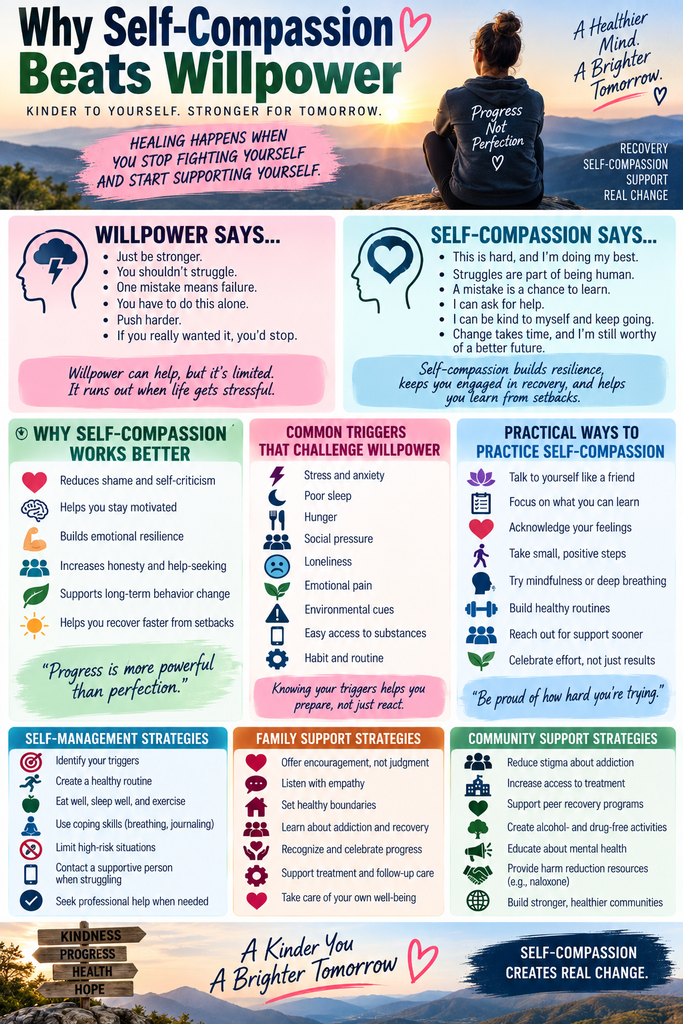
When someone is trying to overcome addiction or change an unhealthy behavior, the advice often sounds simple: “You just need more willpower.” But recovery is rarely that simple. Substance use disorders involve changes in motivation, reward, stress responses, habits, and decision-making. Expecting willpower alone to overcome these influences can leave people feeling ashamed when they struggle.
Self-compassion offers a different approach. It means recognizing suffering, responding to mistakes without excessive self-criticism, and treating yourself with the same understanding you might offer someone else who is struggling. Self-compassion does not mean ignoring harmful behavior or avoiding responsibility. Instead, it creates an emotional environment in which a person can acknowledge a problem and decide what to do next.
Why Willpower Has Limits
Willpower can certainly help people make decisions, but it is not an unlimited resource or a complete treatment strategy.
Imagine someone in early recovery who has had a stressful day, slept poorly, skipped lunch, argued with a family member, and then encounters an unexpected craving. Telling that person simply to “be stronger” ignores everything influencing the moment.
Recovery becomes more sustainable when the individual learns to anticipate vulnerable situations rather than depending on determination alone.
Common factors that can weaken self-control include:
- Stress
- Sleep deprivation
- Hunger
- Strong emotions
- Environmental triggers
- Social pressure
- Loneliness
- Habitual routines
- Easy access to substances
- Untreated mental-health concerns
Instead of asking, “Why wasn’t I strong enough?”, someone can ask, “What made this situation difficult, and how can I prepare differently next time?”
That shift is the foundation of self-compassion.
What Self-Compassion Really Means
Self-compassion is sometimes misunderstood as making excuses.
It is actually possible to hold two ideas simultaneously:
“What I did caused harm.”
and
“I still deserve the opportunity to change.”
Someone practicing self-compassion can accept responsibility for missing treatment, drinking again, using drugs, lying to a family member, or returning to another harmful behavior without deciding that the mistake proves they are worthless.
This distinction matters because shame often says:
“I am a bad person.”
Healthy accountability says:
“I made a harmful choice. What needs to happen next?”
The second response creates a path forward.
The Shame-Addiction Cycle
Shame can become part of the addiction cycle.
A person uses a substance and regrets it afterward. That regret becomes harsh self-criticism. The individual begins thinking, “I’m a failure,” “I’ll never recover,” or “I’ve ruined everything.”
Those thoughts create more emotional distress.
The person may then use alcohol or drugs again to escape the distress.
The cycle can look like this:
Trigger → Substance Use → Regret → Shame → Emotional Pain → More Substance Use
Self-compassion interrupts the cycle after a setback:
Trigger → Substance Use → Recognition → Compassion → Learning → Treatment → Continued Recovery
The behavior is still taken seriously. The difference is what happens afterward.
Why Self-Compassion Can Support Recovery
Self-compassion can make it psychologically safer to acknowledge problems.
Someone dominated by shame may hide a relapse, skip appointments, lie about substance use, or withdraw from supportive people because they fear disappointing them.
Someone who believes mistakes can be discussed without humiliation may be more willing to say:
“I used again. I need help figuring out what happened.”
That conversation can lead to changes in treatment rather than another period of secrecy.
Self-compassion may support:
- Greater emotional regulation
- Reduced shame
- More honest communication
- Increased willingness to seek help
- Better responses to setbacks
- Greater persistence after mistakes
- Healthier coping strategies
- More realistic expectations about recovery
Compassion does not remove consequences. It helps people respond constructively to them.
Self-Management Strategies
Self-compassion becomes most useful when translated into actions.
Change the Way You Talk to Yourself
Notice what you say internally after making a mistake.
Instead of:
“I’m hopeless.”
Try:
“I had a setback. I need to understand what triggered it.”
Instead of:
“I ruined my recovery.”
Try:
“Something in my recovery plan wasn’t strong enough for this situation. What needs to change?”
The goal is not positive thinking. It is accurate, constructive thinking.
Identify Triggers Without Judging Them
Keep track of situations associated with cravings or setbacks.
Consider:
- What happened?
- Where were you?
- Who were you with?
- What emotion were you experiencing?
- Were you hungry, angry, lonely, or tired?
- What did you need at that moment?
- What could you do differently next time?
Curiosity provides more useful information than criticism.
Build a Recovery Routine
Do not require yourself to make every healthy decision in the most difficult moment.
Create routines ahead of time:
- Maintain regular sleep.
- Eat consistent meals.
- Exercise appropriately.
- Attend treatment appointments.
- Schedule recovery meetings.
- Take prescribed medications correctly.
- Plan sober activities.
- Maintain contact with supportive people.
- Reduce exposure to high-risk environments.
Structure reduces the amount of willpower required.
Practice the “Friend Test”
When self-criticism becomes intense, ask:
“Would I say this to someone I love who was trying to recover?”
If the answer is no, reconsider how you are speaking to yourself.
Compassion does not require lowering standards. It means applying those standards without cruelty.
Ask for Help Earlier
People often wait until cravings become overwhelming before contacting someone.
A better strategy is to reach out as soon as warning signs appear.
That might mean calling a therapist, sponsor, peer recovery specialist, healthcare professional, trusted friend, or family member.
Asking for help before a crisis is a recovery skill.
What Happens After a Relapse?
Relapse can trigger enormous shame.
The person may think:
“I threw everything away.”
But a return to substance use does not erase the knowledge, relationships, skills, or healthy behaviors developed during recovery.
A relapse should instead trigger questions:
- What was happening before the relapse?
- Were cravings increasing?
- Was treatment being missed?
- Did stress increase?
- Was sleep deteriorating?
- Did contact with supportive people decrease?
- Did the person return to a high-risk environment?
- Does the treatment plan need to change?
For opioid use, relapse can be particularly dangerous because tolerance may decrease during abstinence, increasing overdose risk. Naloxone availability and evidence-based treatment are therefore especially important.
Family Support Strategies
Families sometimes believe harsh confrontation will motivate someone to change.
Statements such as “You obviously don’t care,” “You’re weak,” or “If you wanted recovery badly enough, you’d stop” may increase shame without addressing the underlying problem.
Families can support accountability without humiliation.
Helpful strategies include:
- Listen before immediately giving advice.
- Learn about substance use disorders.
- Separate the person from the behavior.
- Recognize positive recovery efforts.
- Encourage professional treatment.
- Discuss setbacks calmly when the person is sober.
- Avoid repeatedly rescuing someone from consequences.
- Establish clear and consistent boundaries.
- Encourage healthy routines.
- Participate in family counseling when appropriate.
- Protect your own emotional health.
A useful family message is:
“I love you, I believe change is possible, and I cannot support behavior that harms you or our family.”
Compassion and boundaries can exist together.
Community Support Strategies
Communities also influence whether people experience recovery through shame or support.
Stigma can discourage people from admitting that they are struggling. Someone may avoid treatment because they fear losing their job, disappointing their family, being judged by healthcare professionals, or being labeled by others.
Communities can promote recovery by:
- Using respectful, person-first language.
- Expanding access to addiction treatment.
- Supporting peer recovery programs.
- Providing mental-health services.
- Offering recovery-friendly workplaces.
- Creating sober recreational opportunities.
- Educating families about addiction.
- Supporting harm-reduction services.
- Making naloxone widely available.
- Encouraging people to seek treatment early.
A community that makes it safe to ask for help creates more opportunities for recovery.
Self-Compassion Is Not Permission
One important distinction should remain clear:
Self-compassion is not permission to continue harmful behavior.
Someone can say:
“I deserve compassion.”
while also saying:
“This behavior needs to change.”
Self-compassion without accountability can become avoidance. Accountability without compassion can become shame.
Recovery benefits from both.
Replace Perfection With Progress
People sometimes enter recovery believing they must perform perfectly.
No cravings.
No difficult emotions.
No bad days.
No mistakes.
That expectation is unrealistic.
Recovery is better measured by questions such as:
Am I recognizing problems earlier?
Am I asking for help sooner?
Am I recovering from setbacks faster?
Am I becoming more honest?
Am I building healthier relationships?
Am I learning what triggers me?
These are meaningful signs of progress.
Why Self-Compassion Can Be Stronger Than Willpower
Willpower says:
“I have to resist.”
Self-compassion asks:
“What do I need right now to make the healthier choice easier?”
That might mean leaving a triggering environment, eating something, sleeping, calling a supportive person, attending a meeting, scheduling therapy, taking prescribed medication, or simply acknowledging that today is difficult.
Recovery becomes less about proving personal strength and more about building conditions that support healthier decisions.
The Bigger Picture
Addiction recovery is not a test of character.
Determination matters, but lasting change usually requires more than determination. It can require treatment, behavioral skills, supportive relationships, healthy routines, medications when appropriate, environmental changes, and repeated opportunities to practice new responses.
Self-management teaches a person to recognize triggers and respond constructively. Families can replace humiliation with compassion while maintaining boundaries. Communities can reduce stigma and make professional support easier to reach.
The next time the mind says, “I should be stronger than this,” consider a different response:
“This is difficult. What can I learn from this moment, and what support will help me make my next healthy choice?”
Recovery does not require hating the person you were.
Sometimes lasting change begins when you decide that the person you are becoming deserves care, patience, accountability, and another opportunity to move forward.
Frequently Asked Questions
Here are some common questions:
1. What is self-compassion?
Self-compassion means responding to personal struggles, mistakes, and setbacks with understanding rather than harsh self-criticism. It does not mean ignoring harmful behavior. It means recognizing the problem while believing you are still capable of learning and changing.
2. Why isn’t willpower enough for addiction recovery?
Willpower can help with individual decisions, but addiction involves much more than determination. Cravings, stress, learned habits, environmental cues, brain reward systems, emotional distress, and substance availability can all influence behavior. Recovery is usually stronger when willpower is combined with treatment, coping skills, supportive relationships, and environmental changes.
3. Why can self-compassion be more helpful than simply “trying harder”?
Self-compassion changes the question from “Why am I so weak?” to “What made this difficult, and what would help me respond differently next time?” This approach encourages problem-solving rather than spending emotional energy on self-punishment.
4. Is self-compassion just making excuses?
No. Self-compassion and accountability can exist together. Someone can say, “My behavior hurt people, and I need to change it” without concluding, “I am a terrible person who will never change.”
5. What’s the difference between guilt and shame?
Guilt generally focuses on behavior: “I did something I regret.” Shame focuses on identity: “I am a bad person.” Appropriate guilt can motivate someone to repair harm, while intense shame may encourage secrecy, isolation, and hopelessness.
6. Can shame contribute to addictive behavior?
It can. Someone may use alcohol or drugs, regret the behavior, become overwhelmed by shame, and then use substances again to escape those painful feelings. This can create a cycle of trigger → substance use → shame → emotional distress → more substance use.
7. How can self-compassion interrupt the addiction cycle?
After a setback, self-compassion encourages someone to stop, recognize what happened, identify the trigger, seek support, and adjust the recovery plan. The mistake becomes information that can guide the next decision rather than proof that recovery is impossible.
8. Does self-compassion mean relapse is acceptable?
No. Relapse can have serious consequences and should be addressed promptly. Self-compassion means responding to relapse with assessment and action rather than humiliation. The treatment plan may need to change.
9. What should someone say to themselves after a setback?
Instead of saying, “I ruined everything,” try: “I had a setback. What happened before it, and what support do I need now?” This does not minimize the event; it directs attention toward recovery.
10. Can someone be compassionate toward themselves while still taking responsibility?
Absolutely. A person can apologize, repair relationships, attend treatment, follow boundaries, and accept consequences while treating themselves with dignity. Compassion does not remove responsibility—it can make responsibility easier to face honestly.
11. How can someone practice self-compassion every day?
Useful practices include:
- Notice harsh self-talk and replace it with realistic language.
- Treat yourself as you would a struggling friend.
- Recognize triggers without judging yourself for having them.
- Maintain regular sleep, meals, exercise, and treatment routines.
- Practice mindfulness or breathing exercises.
- Journal about difficult emotions.
- Ask for support before a problem becomes a crisis.
- Recognize progress rather than demanding perfection.
12. What is the “friend test”?
When criticizing yourself, ask: “Would I speak this way to someone I love who was genuinely trying to recover?” If you would never call that person worthless or hopeless, consider whether using those words against yourself is helpful.
13. Why are routines more reliable than willpower?
Healthy routines reduce the number of difficult decisions someone has to make in high-risk moments. Regular meals, adequate sleep, scheduled therapy, recovery meetings, exercise, medication when prescribed, and planned sober activities can create conditions that support healthier choices automatically.
14. What should someone do when cravings become strong?
Rather than criticizing yourself for having a craving, recognize it as a signal to use your recovery plan. Leave the triggering environment, contact a supportive person, attend a meeting, use learned coping skills, or contact a healthcare professional when additional treatment is needed.
15. How can families encourage self-compassion without enabling addiction?
Families can communicate respectfully while maintaining clear boundaries. A helpful message is: “I care about you and support your recovery, but I cannot support behaviors that are harming you or our family.” Compassion does not require providing money, hiding consequences, or accepting unsafe behavior.
16. What should families avoid saying?
Statements such as “You’re weak,” “You obviously don’t care,” or “If you really wanted to stop, you would” can intensify shame. Families can instead describe specific behaviors, explain their concerns, establish boundaries, and encourage professional help.
17. How can communities promote self-compassion in recovery?
Communities can reduce stigma, provide accessible addiction and mental-health treatment, support peer recovery programs, create sober social opportunities, educate families, provide harm-reduction resources, and use language that recognizes the individual rather than defining someone solely by addiction.
18. Does self-compassion replace professional addiction treatment?
No. Self-compassion is a useful recovery skill, not a substitute for medical or behavioral-health treatment. Depending on the substance and severity, recovery may involve counseling, medications, peer support, outpatient programs, residential treatment, or other professional services.
19. What does “progress, not perfection” really mean?
It means evaluating whether someone is moving in a healthier direction rather than expecting a flawless recovery. Recognizing triggers earlier, becoming more honest, asking for help sooner, attending treatment consistently, and recovering more quickly from setbacks are all meaningful forms of progress.
20. What is the biggest lesson about self-compassion and willpower?
Willpower asks, “Can I force myself to resist?” Self-compassion asks, “What do I need to make the healthier choice easier?”
Recovery does not require choosing between responsibility and kindness. The stronger approach combines self-compassion, accountability, treatment, healthy routines, family support, and community resources. Instead of using shame to force change, self-compassion creates space to understand what went wrong, learn from it, and make a healthier decision next time.
Video: Why willpower isn’t enough for sobriety #addiction #healing