Love should provide safety, respect, trust, and the freedom to be yourself. Yet some people remain deeply emotionally attached to partners who repeatedly hurt, manipulate, intimidate, or control them. From the outside, friends and family may wonder, “Why don’t they just leave?”
The answer can be complicated.
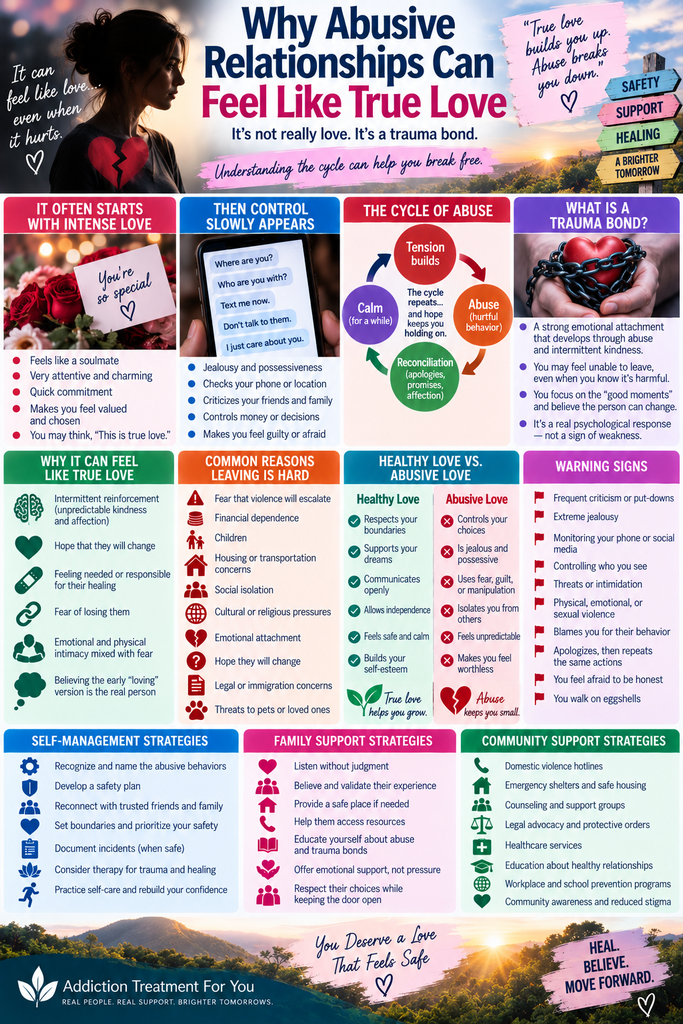
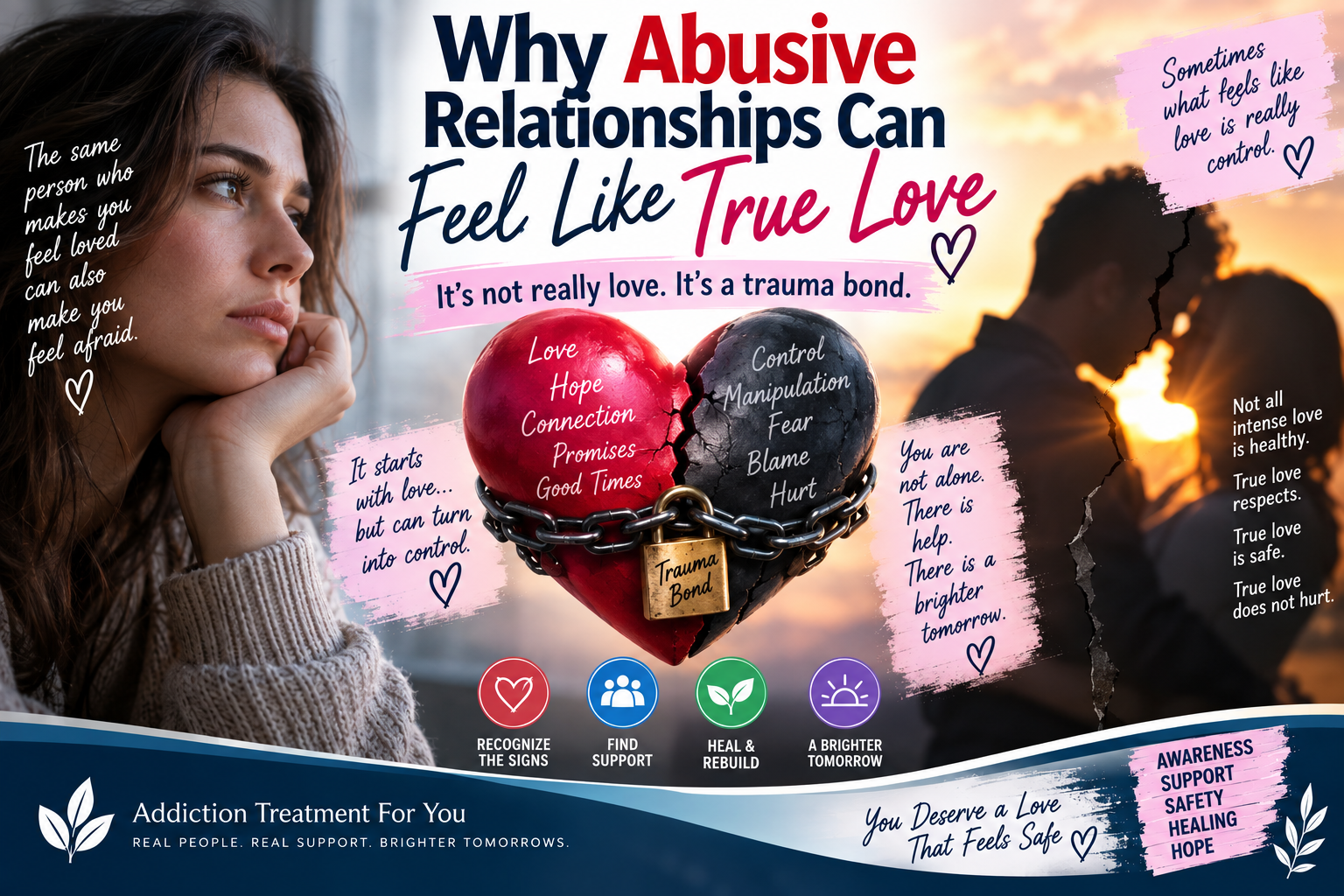
An abusive relationship can contain periods of affection, apologies, promises, intimacy, fear, conflict, and reconciliation. When emotional connection becomes intertwined with unpredictable mistreatment and relief, a powerful attachment may develop. This is sometimes described as a trauma bond.
Understanding this pattern is important because feeling strongly attached to someone does not mean the relationship is healthy. Abuse is not true love, even when the emotions involved feel intensely real.
Why Abuse Can Become Confused With Love
Abusive relationships do not necessarily begin with obvious abuse. A partner may initially appear intensely loving, attentive, protective, or committed.
Over time, controlling behaviors may gradually emerge.
They might include jealousy, monitoring their phone, criticizing their friendships, controlling their money, demanding constant location updates, humiliating the partner, threatening to leave, or attempting to isolate them from their family.
Because these behaviors can develop gradually, the individual may continue to compare the current relationship to the loving relationship they remember from the beginning.
They may think:
“The person I fell in love with is still in there.”
That hope can become extremely powerful.
Understanding the Cycle of Abuse
Some abusive relationships follow a repeating pattern, although not every relationship follows exactly the same sequence.
Tension may gradually build. Arguments increase. The abusive partner becomes increasingly controlling, threatening, or unpredictable.
An abusive incident then occurs.
Afterward, the abusive partner may apologize, cry, promise to change, give gifts, become affectionate, or explain the behavior as something that will never happen again.
A period of relative calm follows.
The survivor experiences relief.
That relief can feel extraordinarily powerful because it follows fear and distress.
Eventually, tension may begin building again.
Tension → Abuse → Reconciliation → Calm → Tension
Over time, this unpredictable combination of distress and relief can make leaving emotionally complicated.
What Is a Trauma Bond?
Trauma bonding is a term commonly used to describe a strong emotional attachment that can develop within a relationship involving abuse or coercive control.
The person may understand intellectually that the relationship is harmful while simultaneously feeling emotionally unable to separate from the abusive partner.
They may miss the partner intensely when apart.
They may defend the partner to family members.
They may minimize abusive incidents.
They may focus heavily on the partner’s positive qualities.
They may believe that enough love, patience, or understanding will eventually change the relationship.
These reactions should not be interpreted as weakness. They demonstrate how complicated attachment, fear, hope, and repeated relationship experiences can become.
The Power of Intermittent Reinforcement
One reason unhealthy relationships can become emotionally intense involves intermittent reinforcement.
When affection and kindness occur unpredictably between episodes of mistreatment, the person never knows when the positive version of the relationship will return.
Imagine receiving affection every day. It becomes predictable.
Now imagine affection arriving unpredictably after periods of rejection, criticism, or fear.
The return of affection may feel especially meaningful because it brings relief.
The person begins waiting for the next good period.
This unpredictability can strengthen attachment even when the overall relationship is harmful.
“But They Love Me”
An abusive partner may genuinely say they love the person.
But healthy love must be evaluated by behavior, not by declarations alone.
Love does not require someone to tolerate:
- Physical violence
- Sexual coercion
- Threats or intimidation
- Constant humiliation
- Financial control
- Isolation from family and friends
- Stalking or excessive monitoring
- Destruction of belongings
- Threats involving children or pets
- Repeated manipulation and fear
Someone can feel love toward another person and still recognize that remaining in the relationship is unsafe.
Why Leaving Can Be So Difficult
Asking why someone stays often places attention on the wrong person.
A better question is:
“What makes leaving difficult or dangerous?”
Possible barriers include:
- Fear that violence will escalate
- Financial dependence
- Children
- Housing insecurity
- Immigration concerns
- Social isolation
- Religious or cultural pressures
- Threats against family members or pets
- Shame or embarrassment
- Low self-confidence
- Hope that the partner will change
- Emotional attachment
- Lack of transportation
- Limited community resources
Leaving can sometimes increase danger, particularly when an abusive partner realizes they are losing control. Safety planning is therefore important.
Self-Management Strategies
Self-management does not mean that the survivor is responsible for stopping another person’s abusive behavior. Responsibility for abuse belongs to the person committing it.
Instead, self-management focuses on increasing awareness, safety, and personal autonomy.
- Name the behavior. Write down specific incidents rather than minimizing them as simply “bad arguments.”
- Recognize patterns. Notice whether apologies and affectionate periods repeatedly follow abusive incidents.
- Reconnect with trusted people. Isolation makes abusive control easier to maintain.
- Protect important documents. When safe, maintain access to identification, financial information, medications, and important telephone numbers.
- Develop a safety plan. Think about where you could go and whom you could contact during an emergency.
- Avoid confronting an abusive partner when doing so could increase danger.
- Seek professional support. A therapist trained in trauma or intimate-partner violence can help someone understand the relationship without forcing decisions.
- Practice self-compassion. Leaving and emotionally detaching can take time.
The goal is not to ask, “Why did I allow this?”
A healthier question is:
“What do I need to become safer and regain control of my life?”
Family Support Strategies
Families often become frustrated when someone repeatedly returns to an abusive relationship.
Statements such as “I told you so,” “You’re choosing this,” or “If you go back, don’t call me again” can unintentionally increase isolation.
Instead, family members can:
- Listen without humiliation or blame.
- Tell the person they deserve safety and respect.
- Avoid demanding that they leave immediately unless an emergency requires immediate intervention.
- Maintain communication whenever safely possible.
- Help identify community resources.
- Offer transportation or temporary assistance when appropriate.
- Help develop a safety plan.
- Avoid directly confronting the abusive partner when doing so could increase danger.
- Respect the survivor’s privacy while responding appropriately to immediate safety threats.
- Encourage professional counseling and domestic-violence services.
One of the most powerful messages a family member can communicate is:
“You can talk to me without being judged.”
Community Support Strategies
Leaving an abusive relationship often requires more than emotional strength. People may need practical resources.
Communities can provide:
- Domestic-violence hotlines
- Emergency shelters
- Trauma-informed counseling
- Legal advocacy
- Protective-order information
- Housing assistance
- Financial resources
- Childcare assistance
- Healthcare services
- Transportation
- Support groups
- Workplace safety planning
Healthcare professionals can privately screen for intimate-partner violence and provide referrals without blaming the patient.
Schools and community organizations can also teach young people about healthy relationships, consent, boundaries, jealousy, digital monitoring, and coercive control before unhealthy patterns become normalized.
What Healthy Love Looks Like
Understanding abuse also requires understanding healthy relationships.
Healthy love allows both people to maintain identities outside the relationship.
Partners can disagree without intimidation.
A healthy partner does not need passwords, constant location updates, or control over friendships to feel secure.
Healthy relationships include:
Respect. Trust. Consent. Safety. Independence. Communication. Accountability.
Arguments can happen in healthy relationships.
Fear should not be the foundation of them.
Healing After an Abusive Relationship
Leaving the relationship may end the immediate relationship dynamic, but emotional recovery can take considerably longer.
A survivor may still miss the abusive partner.
They may remember positive experiences.
They may question whether leaving was a mistake.
They may experience grief, anxiety, loneliness, guilt, or an urge to reconnect.
These feelings do not prove that the relationship was healthy.
Healing may involve trauma-focused therapy, rebuilding relationships with family and friends, restoring financial independence, establishing boundaries, identifying unhealthy relationship patterns, and gradually learning what safety feels like.
When Immediate Help Is Needed
Threats of serious violence, strangulation, stalking, weapons, forced sexual activity, escalating violence, or threats to kill the individual, children, pets, or other family members require particular concern.
When immediate physical danger exists, contacting emergency services or an appropriate domestic-violence service may be necessary.
People considering leaving should remember that separation can sometimes be a particularly dangerous period. A personalized safety plan developed with a trained domestic-violence professional can therefore be more appropriate than simply telling someone to “pack up and leave.”
The Takeaway
Abusive relationships can sometimes feel like powerful love because attachment becomes mixed with hope, fear, reconciliation, affection, and relief. Those feelings can be genuine even though the relationship itself is harmful.
Understanding this distinction removes an important source of shame.
The question is not:
“If the relationship is abusive, why do I still love them?”
It may be:
“Why has love become connected with fear, and what will help me experience love without being harmed?”
Self-management can rebuild awareness and autonomy. Family support can reduce isolation. Community resources can provide safety and practical assistance. Professional care can help survivors process trauma and establish healthier relationship patterns.
True love does not require someone to prove their devotion by enduring abuse.
Love can be intense without being frightening. Love can involve attachment without control. And most importantly, love should never require you to sacrifice your safety.
Frequently Asked Questions
Here are some common questions:
1. Why can an abusive relationship feel like true love?
An abusive relationship can feel like true love because periods of affection, intimacy, apologies, and promises may alternate with mistreatment, fear, and emotional distress.
The emotional relief experienced when an abusive partner becomes affectionate again can strengthen attachment. A person may continue hoping that the loving behavior they experienced earlier in the relationship will return permanently.
These feelings can be genuine, but a strong emotional attachment does not necessarily indicate a healthy or safe relationship.
2. What is trauma bonding?
Trauma bonding describes a strong emotional attachment that can develop between a person experiencing abuse and the person harming them.
It may involve repeated patterns of mistreatment followed by affection, reconciliation, or promises of change.
Someone experiencing a trauma bond may recognize that the relationship is harmful while still feeling emotionally attached to their partner.
Trauma bonding is not a formal psychiatric diagnosis, and not every survivor of abuse experiences it.
3. How is trauma bonding different from genuine love?
Healthy love involves mutual respect, trust, emotional safety, independence, and accountability.
Trauma bonding develops within a relationship involving abuse or coercive control, where fear, uncertainty, and emotional attachment may become intertwined.
A person experiencing trauma bonding may feel intense relief when their partner temporarily stops mistreating them.
The intensity of an emotional connection does not determine whether a relationship is healthy.
4. Why do people stay in abusive relationships?
People may remain in abusive relationships for many reasons, including emotional attachment, fear, financial dependence, children, housing insecurity, social isolation, threats, or hope that their partner will change.
Some survivors may also face significant danger when attempting to leave.
Remaining in an abusive relationship does not mean someone enjoys being mistreated or lacks the desire for a healthier life.
Understanding the barriers to leaving is more helpful than blaming the survivor.
5. Can someone genuinely love a partner who abuses them?
Yes. Someone can experience genuine feelings of love, attachment, affection, or concern toward a partner who mistreats them.
Emotions do not automatically disappear when a person recognizes that a relationship is harmful.
However, loving someone does not create an obligation to tolerate violence, intimidation, manipulation, or controlling behavior.
It is possible to care about another person while recognizing that maintaining the relationship may be unsafe.
6. What are the common warning signs of an abusive relationship?
Abuse can involve physical, emotional, psychological, sexual, or financial harm.
Common warning signs include:
- Excessive jealousy and possessiveness.
- Monitoring phone calls, messages, or social media activity.
- Isolating someone from friends and family.
- Controlling money, transportation, or employment.
- Repeated humiliation, criticism, or intimidation.
- Threatening violence or self-harm to control a partner.
- Pressuring someone into unwanted sexual activity.
- Blaming the survivor for the abusive behavior.
- Making repeated promises to change without sustained behavioral improvement.
Abuse does not have to involve physical violence to be serious.
7. Why does an abusive partner sometimes become loving after an argument?
Some abusive partners become affectionate, apologetic, or attentive after an abusive incident.
They may promise that the behavior will never happen again, offer gifts, or express intense affection.
This reconciliation can temporarily restore hope and emotional connection.
However, an apology alone does not establish that the abusive behavior has stopped.
Meaningful change requires sustained accountability and an end to abusive behavior, not simply periods of affection between incidents.
8. What is the cycle of abuse?
The cycle of abuse is a model describing a pattern that may occur in some abusive relationships.
It can involve four stages:
- Tension building: Conflict, intimidation, or controlling behavior increases.
- Abusive incident: Emotional, physical, sexual, or other forms of abuse occur.
- Reconciliation: The abusive partner may apologize, promise change, or become affectionate.
- Calm: The relationship may temporarily appear stable before harmful behavior returns.
Not every abusive relationship follows this pattern. Some involve continuous coercive control without distinct periods of reconciliation or calm.
9. Why can leaving an abusive relationship feel like withdrawal?
Some survivors experience intense emotional distress after separating from an abusive partner.
They may experience loneliness, anxiety, grief, intrusive thoughts, difficulty sleeping, or a strong desire to reconnect.
These reactions can reflect attachment, trauma-related stress, disrupted routines, fear, and the loss of an important relationship.
Although people sometimes compare these experiences to withdrawal from an addictive substance, trauma bonding is not the same as substance dependence.
Professional counseling and supportive relationships can help individuals manage these difficult emotions.
10. Can childhood trauma influence adult relationship patterns?
Childhood experiences can influence how people understand attachment, emotional safety, conflict, and relationships.
Someone who grew up around unpredictable affection, emotional neglect, or violence may have difficulty recognizing unhealthy relationship patterns later in life.
However, childhood trauma does not mean a person will inevitably enter an abusive relationship.
Many survivors of childhood trauma develop healthy relationships, particularly when they have access to supportive relationships and appropriate mental health care.
Experiencing abuse is never the survivor’s responsibility, regardless of their childhood experiences.
11. Can an abusive partner change?
Some people who have engaged in abusive behavior may make meaningful changes, but change cannot be established through apologies, promises, gifts, or temporary improvements alone.
It requires sustained accountability, respect for boundaries, and an end to controlling or abusive behavior.
Specialized intervention programs may be appropriate for individuals who engage in intimate-partner violence.
A survivor is not responsible for changing an abusive partner and does not need to remain in an unsafe relationship while waiting for change.
12. Why do survivors sometimes return to abusive partners?
Returning to an abusive partner may involve emotional attachment, fear, financial barriers, housing needs, concern for children, threats, or the belief that the relationship will improve.
Some survivors leave and return multiple times before achieving lasting separation.
Others may decide that remaining temporarily is the safest available option while developing a plan.
Families and friends should avoid interpreting a return as evidence that the survivor does not want help.
Continued support can preserve important connections and future opportunities for safety.
13. What self-management strategies can help someone experiencing trauma bonding?
Self-management should focus on safety, emotional awareness, and rebuilding personal autonomy.
Helpful strategies include:
- Recognizing and documenting abusive behaviors when it is safe to do so.
- Identifying patterns of manipulation and reconciliation.
- Reconnecting with trusted friends and family.
- Developing a personalized safety plan.
- Practicing grounding techniques during emotional distress.
- Rebuilding interests and activities outside the relationship.
- Seeking counseling from a professional experienced in trauma and intimate-partner violence.
- Establishing boundaries will not increase danger.
Self-management does not mean that a survivor is responsible for preventing another person’s abusive behavior.
14. How can family members support someone in an abusive relationship?
Families can provide emotional and practical support without blaming or pressuring the survivor.
Helpful approaches include:
- Listening without judgment.
- Believing the person’s account of their experiences.
- Maintaining communication whenever safely possible.
- Avoiding criticism when the survivor is not ready to leave.
- Offering transportation, temporary housing, or other practical assistance when appropriate.
- Helping locate domestic-violence resources.
- Supporting the development of a personalized safety plan.
- Respecting the survivor’s decisions and privacy.
A helpful statement is:
“I care about your safety. You can talk to me, and I will help you explore your options.”
15. What should families avoid saying to someone experiencing abuse?
Statements such as “Why don’t you just leave?” or “You must enjoy the drama” can increase shame and isolation.
Families should also avoid threatening to withdraw support if the survivor returns to the relationship.
Directly confronting the abusive partner may increase danger, particularly if the partner responds with retaliation.
Instead, family members can maintain communication, express concern about specific abusive behaviors, and offer assistance without making the survivor feel responsible for the abuse.
16. How can communities help survivors of abusive relationships?
Communities can provide resources that address both immediate safety and long-term recovery.
Important services include:
- Domestic-violence hotlines and crisis intervention.
- Emergency shelters and transitional housing.
- Trauma-informed mental health counseling.
- Legal advocacy and protective-order information.
- Financial assistance and employment support.
- Childcare and transportation resources.
- Healthcare services.
- Survivor support groups.
- Education about healthy relationships and coercive control.
Community support is particularly important for survivors who lack financial independence or supportive family relationships.
17. Can therapy help someone recover from trauma bonding?
Therapy can help survivors understand abusive relationship patterns, process traumatic experiences, develop coping strategies, and rebuild confidence.
Depending on the individual’s needs, treatment may include cognitive behavioral therapy, trauma-focused psychotherapy, or other evidence-based approaches.
A therapist experienced in intimate-partner violence can help the survivor explore their options without blaming them or pressuring them into decisions that may compromise safety.
Couples counseling is generally not recommended when ongoing abuse or coercive control is present because it may increase risk or allow the abusive partner to misuse information shared during sessions.
18. How long does it take to heal after an abusive relationship?
There is no universal recovery timeline.
Healing depends on factors such as the duration and severity of abuse, available support, financial stability, ongoing safety concerns, and the individual’s mental health.
Some survivors experience relief shortly after leaving. Others may continue experiencing grief, anxiety, fear, or emotional attachment for months or longer.
Recovery is not necessarily linear. Missing a former partner does not mean the relationship was healthy or that leaving was the wrong decision.
19. How can someone recognize a healthy relationship after experiencing abuse?
Healthy relationships generally involve mutual respect, trust, consent, emotional safety, and the freedom to maintain independence.
Partners can disagree without threats, intimidation, or humiliation.
A healthy partner respects boundaries, supports outside friendships, and does not require constant access to personal communications or location information.
A useful question is:
“Can I express my needs, disagree, and make independent decisions without fearing punishment or retaliation?”
Feeling safe to communicate honestly is an important characteristic of a healthy relationship.
20. When should someone seek immediate help?
Immediate assistance may be necessary when a partner threatens serious violence, uses weapons, engages in strangulation, forces sexual activity, stalks the survivor, or threatens children, family members, or pets.
A survivor who believes they are in immediate danger should contact emergency services when it is safe to do so.
For confidential assistance in the United States, the National Domestic Violence Hotline provides safety planning, information, and connections to local resources.
Call 1-800-799-SAFE (7233) or text START to 88788.
Survivors should use a safe device when seeking help if their partner monitors their phone or internet activity.
Video: If they do this, it’s not love—it’s control. #emotionalabuse #redflags #psychology