Have you ever reached for cookies, candy, ice cream, or another sweet food after an emotionally difficult day? Sometimes hunger is responsible. Sometimes it is habit, convenience, poor sleep, or simply enjoying something sweet. But for some people, cravings can also become connected with stress, difficult emotions, and past traumatic experiences.
The relationship between trauma and eating is complicated. Sugar cravings do not prove that someone has trauma, and eating sweets is not automatically an addiction. However, understanding why certain foods become comforting can help people recognize emotional eating patterns and develop healthier coping strategies.
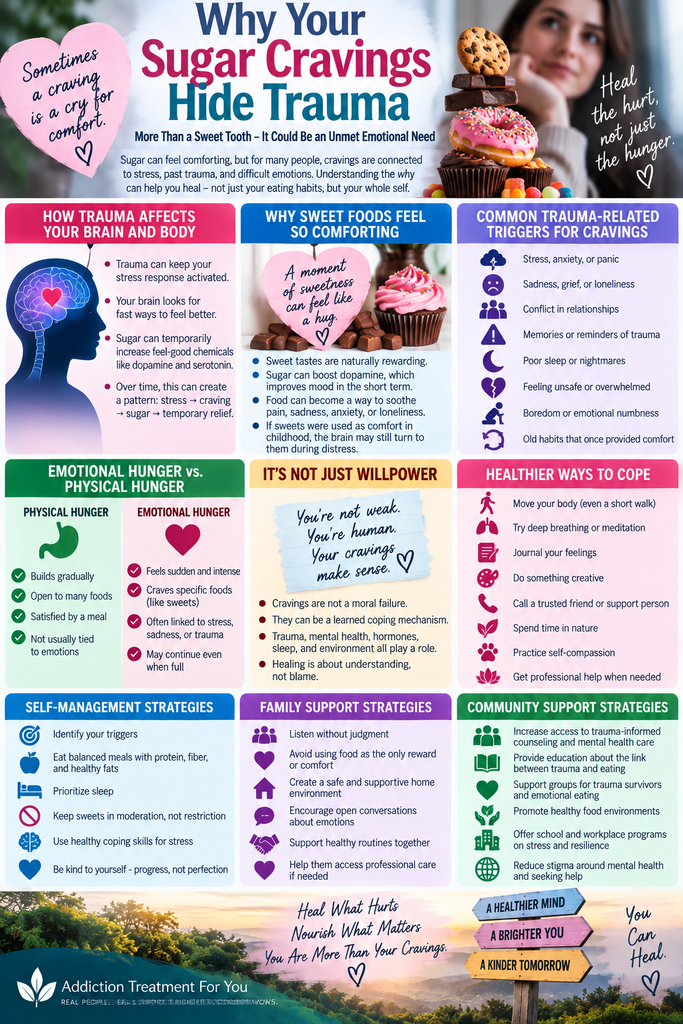
How Trauma Can Affect the Stress Response
Trauma can involve experiences that overwhelm a person’s ability to cope, including abuse, violence, neglect, serious accidents, loss, or other frightening events.
After trauma, some people continue experiencing an increased stress response even after the immediate danger has passed. Anxiety, hypervigilance, sleep disturbances, intrusive memories, or emotional numbness may occur.
Food can sometimes become part of coping with these uncomfortable feelings.
Eating something pleasurable can temporarily shift attention away from emotional distress. Over time, the brain may begin associating certain foods with comfort:
Stress → Craving → Sweet Food → Temporary Relief
When this pattern recurs, reaching for sweets in times of distress can become automatic.
Why Sweet Foods Can Feel Comforting
Humans naturally tend to enjoy sweet tastes. Foods containing sugar and other highly palatable ingredients can activate brain systems involved in pleasure, motivation, and reward.
This does not mean sugar affects everyone like an addictive drug. The neuroscience is more complicated than popular claims such as “sugar is more addictive than cocaine.”
Instead, sweet foods can become strongly associated with pleasurable experiences and emotional relief.
For someone experiencing chronic stress, sadness, loneliness, or traumatic memories, that brief comfort may become particularly appealing.
The problem is not enjoying dessert.
The concern arises when food becomes one of the person’s only reliable methods of regulating difficult emotions.
Emotional Hunger Versus Physical Hunger
Learning to recognize why you want to eat can be useful.
Physical hunger often develops gradually and can usually be satisfied by several different foods.
Emotional cravings may feel more sudden and specific:
“I need chocolate right now.”
They may also occur after arguments, loneliness, upsetting memories, stressful workdays, rejection, or other emotionally intense experiences.
Before reaching for food, consider asking:
“Am I physically hungry, emotionally overwhelmed, or both?”
There is no need for judgment. The purpose is awareness.
Childhood Experiences Can Shape Adult Eating Patterns
Food is deeply connected with childhood experiences.
Some children receive sweets as rewards:
“If you’re good, you can have dessert.”
Others receive food as comfort:
“Don’t cry. Here’s some ice cream.”
In other households, food availability may be unpredictable due to poverty, neglect, family instability, or other circumstances.
These experiences can influence how adults relate to food.
Someone who learned that sweets meant safety, comfort, celebration, or affection may naturally return to those foods when experiencing emotional distress later in life.
Recognizing that pattern is not about blaming parents or families. It is about understanding how coping behaviors develop.
The Stress–Sleep–Craving Connection
Trauma is not the only explanation for cravings.
Poor sleep, irregular meals, restrictive dieting, stress, medications, hormonal changes, and environmental cues can all influence appetite and food choices.
This matters because people should not automatically interpret every craving as psychological trauma.
Sometimes the solution may involve addressing sleep or nutrition. In other circumstances, unresolved emotional distress may deserve greater attention.
Often several factors occur together.
When Restriction Makes Cravings Worse
A common response to sugar cravings is extreme restriction:
“I’m never eating sugar again.”
For some people, rigid food rules can increase preoccupation with forbidden foods and contribute to cycles of restriction followed by overeating.
A more sustainable approach may involve regular balanced meals, adequate nutrition, reasonable portions, and learning to enjoy foods without labeling yourself as “good” or “bad” for eating them.
Food does not determine moral character.
Self-Management Strategies
Self-management begins with curiosity rather than shame.
- Track your emotional triggers. Notice whether cravings occur after stress, conflict, loneliness, boredom, traumatic reminders, or poor sleep.
- Pause before reacting. Give yourself several minutes to identify what you are experiencing before automatically reaching for food.
- Eat regular balanced meals. Skipping meals can intensify hunger and make cravings more difficult to manage.
- Prioritize protein and fiber. Balanced meals containing protein, fiber, healthy fats, fruits, vegetables, and whole grains can support satiety.
- Protect your sleep. Inadequate sleep can affect appetite and emotional regulation.
- Develop additional coping strategies. Walking, journaling, music, breathing exercises, hobbies, meditation, or talking with a supportive person can provide alternatives when emotional distress arises.
- Avoid shame after eating sweets. Guilt can reinforce unhealthy eating cycles rather than resolve them.
- Consider professional help. Persistent trauma symptoms, binge eating, severe food restriction, or significant distress about eating deserve professional evaluation.
The goal is not necessarily to eliminate sugar. The goal is to increase the number of healthy ways you can respond to emotional distress.
Family Support Strategies
Families can influence recovery in positive and negative ways.
Criticizing someone’s body, monitoring every bite of food, or saying, “You just need more willpower,” can increase shame.
Families can instead:
- Listen without judging eating habits.
- Avoid making negative comments about weight or body size.
- Stop labeling foods as morally “good” or “bad.”
- Provide regular opportunities for balanced family meals.
- Encourage enjoyable activities that do not revolve around food.
- Recognize emotional triggers rather than focusing exclusively on eating behavior.
- Encourage counseling when trauma symptoms or disordered eating are present.
- Avoid using food as the only reward, punishment, or comfort.
A more useful question than “Why are you eating that?” may be:
“You’ve had a difficult day. What would help you feel supported?”
Community Support Strategies
Communities can help people develop healthier relationships with food and emotional health.
Healthcare professionals can screen for trauma histories, depression, anxiety, eating disorders, food insecurity, and other factors that may contribute to problematic eating patterns.
Schools can teach children emotional regulation without creating shame around food or body size.
Workplaces can improve access to mental health resources and reduce stigma surrounding psychological care.
Community organizations can provide:
- Trauma-informed counseling
- Nutrition education
- Eating-disorder treatment
- Peer-support programs
- Affordable mental healthcare
- Food assistance programs
- Stress-management education
- Support groups for trauma survivors
Food behavior rarely exists in isolation. Mental health, financial circumstances, family relationships, physical health, culture, and environment can all matter.
Trauma-Informed Care Looks Beyond the Behavior
Traditional approaches sometimes focus only on stopping an unwanted behavior.
“Stop eating sugar.”
Trauma-informed care asks another question:
“What purpose might this behavior be serving?”
Perhaps food temporarily reduces anxiety.
Perhaps it provides comfort during loneliness.
Perhaps eating helps distract someone from painful memories.
Perhaps sweets became associated with safety during childhood.
Understanding the function of a behavior does not mean ignoring its possible health consequences. It means addressing the reason the behavior continues rather than simply demanding that it stop.
When Sugar Cravings May Signal Something More
Occasional cravings are normal.
Professional assessment may be appropriate when eating involves recurrent episodes of feeling out of control, severe restriction, purging behaviors, intense guilt, significant preoccupation with food or body image, or eating patterns that interfere with physical or emotional health.
Similarly, someone experiencing nightmares, intrusive memories, avoidance, persistent hypervigilance, severe anxiety, depression, or other trauma-related symptoms may benefit from evaluation by a mental health professional.
Evidence-based trauma treatment may include trauma-focused psychotherapy, while eating disorders require individualized assessment and treatment.
You Don’t Have to Fight Food to Heal
Recovery should not turn food into another enemy.
A healthier goal is developing enough awareness to recognize the difference between enjoying something sweet and repeatedly needing food to escape emotional pain.
Try changing the question.
Instead of:
“Why can’t I control myself around sugar?”
Ask:
“What am I needing right now?”
Maybe the answer is food.
Maybe it is sleep.
Maybe it is comfort.
Maybe it is connection.
Maybe it is help processing something painful.
Recognizing the difference can be an important step toward healthier coping.
The Takeaway
Sugar cravings have many possible causes, and trauma should never be assumed solely because someone enjoys or frequently craves sweets. But for some people, food can become intertwined with emotional regulation and past experiences.
Understanding that relationship replaces shame with curiosity.
Self-management helps identify patterns. Family support creates emotional safety. Community resources provide treatment and connection. Trauma-informed care looks beyond the craving to understand the person experiencing it.
Healing is not necessarily about never eating another piece of chocolate.
Sometimes it begins with understanding what you were really hungry for.
Frequently Asked Questions
Here are some common questions:
1. Can trauma really cause sugar cravings?
Trauma does not automatically cause sugar cravings, but chronic stress and difficult emotions can influence eating behavior. Some people learn to use highly palatable foods as a source of comfort or temporary emotional relief. Over time, stress and eating may become strongly associated.
2. Do sugar cravings mean I have unresolved trauma?
No. Sugar cravings alone are not evidence of trauma. Cravings can be influenced by hunger, food preferences, restrictive dieting, habits, poor sleep, stress, environmental cues, medications, and other factors. Trauma is only one possible contributor for some people.
3. Why do sweets feel comforting when I am stressed?
Sweet and highly palatable foods can activate brain systems involved in pleasure, motivation, and reward. Eating something enjoyable may also temporarily distract from sadness, anxiety, anger, loneliness, or other uncomfortable emotions.
If this happens repeatedly, the brain can learn a pattern:
Stress → Sugar craving → Eating → Temporary relief
The temporary relief can reinforce the behavior, making someone more likely to repeat it during future stressful situations.
4. Is sugar actually addictive?
The answer is more complicated than many social-media claims suggest. Sweet foods can be highly rewarding, and some people report cravings and difficulty controlling certain eating behaviors. However, describing ordinary sugar consumption as equivalent to substance addiction oversimplifies the science.
Statements such as “sugar is more addictive than cocaine” should therefore be treated cautiously.
5. What is emotional eating?
Emotional eating refers to eating in response to emotions rather than—or in addition to—physical hunger. Stress, loneliness, boredom, sadness, anger, anxiety, and difficult memories can sometimes contribute.
Occasional emotional eating is common. It becomes more concerning when food becomes someone’s primary way of managing emotional distress or when eating repeatedly feels out of control.
6. How can I tell emotional hunger from physical hunger?
Physical hunger generally develops gradually and can often be satisfied by several different foods.
Emotional cravings may appear suddenly and focus intensely on a particular food, such as chocolate, cookies, candy, or ice cream.
Try asking:
“Am I physically hungry, emotionally distressed, or experiencing both?”
There is no wrong answer. The purpose is to recognize the pattern without judging yourself.
7. Can childhood experiences affect adult sugar cravings?
They can influence someone’s relationship with food. For example, a child may learn that sweets mean celebration, affection, reward, or comfort.
Other children may experience food insecurity or unpredictable access to meals. These experiences can influence later eating patterns, although childhood experiences do not determine how someone will eat as an adult.
8. Can poor sleep increase cravings?
Yes. Inadequate sleep can affect appetite regulation, decision-making, stress tolerance, and food preferences. Someone who is exhausted and emotionally overwhelmed may therefore find highly rewarding foods particularly appealing.
Improving sleep can be an important part of managing cravings.
9. Can restrictive dieting make sugar cravings stronger?
For some people, yes. Strictly labeling foods as forbidden can increase attention to those foods and sometimes contribute to cycles of restriction followed by overeating.
A sustainable eating pattern generally focuses on adequate nutrition and balance rather than guilt, punishment, or extreme restriction.
10. What should I do when a sugar craving appears?
Pause and identify what is happening before automatically responding.
Ask yourself:
What am I feeling?
When did I last eat?
Did something stressful just happen?
Did I sleep well?
Am I looking for food, comfort, distraction, or connection?
If you are hungry, eating is an appropriate response. If emotional distress is a contributing factor, you may also benefit from another coping strategy.
11. What self-management strategies can help?
Helpful approaches may include:
- Eating regular, balanced meals
- Getting adequate sleep
- Identifying emotional triggers
- Avoiding extreme food restriction
- Practicing mindfulness or relaxation
- Exercising regularly
- Journaling about emotions and cravings
- Talking with supportive people
- Developing enjoyable activities unrelated to food
- Seeking professional help when eating feels out of control
The goal is not necessarily eliminating sweets. It is developing more ways to respond to emotional needs.
12. Should I completely eliminate sugar if I emotionally eat?
Not necessarily. Complete restriction may not be appropriate or sustainable for everyone.
Rather than immediately declaring certain foods forbidden, consider examining when, why, and how you eat them. A registered dietitian or other qualified healthcare professional can provide individualized nutritional guidance when needed.
13. How can families help someone struggling with emotional eating?
Family members can provide support without becoming food monitors.
They can avoid criticizing weight or eating habits, reduce negative body talk, listen when the person discusses emotional difficulties, encourage balanced meals, participate in healthy activities together, and support professional treatment when appropriate.
A useful question may be:
“What kind of support would help you right now?”
14. What should families avoid saying?
Comments such as “You have no willpower,” “Just stop eating sugar,” or “You shouldn’t be eating that” can increase shame without addressing the underlying behavior.
Families should also avoid constantly monitoring someone’s food intake unless this is part of a professionally supervised treatment plan.
Support works better when it combines compassion with appropriate boundaries.
15. How can communities support people dealing with trauma and emotional eating?
Communities can improve access to trauma-informed mental health care, nutrition services, eating disorder treatment, peer support, affordable healthy foods, stress management programs, and education about emotional health.
Schools and workplaces can also help by reducing stigma surrounding mental healthcare and creating easier pathways to professional support.
16. What is trauma-informed care?
Trauma-informed care recognizes that past experiences may influence present behaviors and emphasizes safety, trust, collaboration, empowerment, and the avoidance of unnecessary retraumatization.
Instead of only asking:
“How do we stop this behavior?”
A trauma-informed approach may also ask:
“What happened, what does this behavior accomplish for the person, and what healthier coping strategies could meet that need?”
17. When does emotional eating become a bigger concern?
Professional evaluation may be appropriate when someone frequently feels unable to control eating, experiences recurrent binge-eating episodes, severely restricts food, uses vomiting or other compensatory behaviors, becomes intensely preoccupied with weight or food, or experiences significant emotional distress related to eating.
These symptoms can indicate an eating disorder or another condition requiring professional assessment.
18. When should someone seek help for trauma?
Professional help should be considered when traumatic experiences are associated with persistent nightmares, intrusive memories, avoidance, hypervigilance, anxiety, depression, emotional numbness, substance use, self-harm, or significant difficulty functioning.
Trauma-related conditions are treatable, and evidence-based psychotherapy can help many people.
19. Can treating trauma reduce emotional eating?
For someone whose eating behavior is strongly connected with trauma-related distress, addressing the underlying trauma may help reduce the need to use food as an emotional coping mechanism.
However, treatment should be individualized. Some people may benefit from coordinated care involving a mental health professional, a primary care clinician, and a registered dietitian.
20. What is the most important message about sugar cravings and trauma?
Do not automatically diagnose yourself from a craving.
A desire for something sweet may simply mean you enjoy sweets or are hungry. But when cravings repeatedly appear alongside stress, loneliness, anxiety, or painful memories, they can provide useful information about your emotional patterns.
Instead of asking:
“Why don’t I have enough willpower?”
Try asking:
“What does my mind or body need right now?”
Video: The truth about why you can’t stop eating sugar #stress #wellness