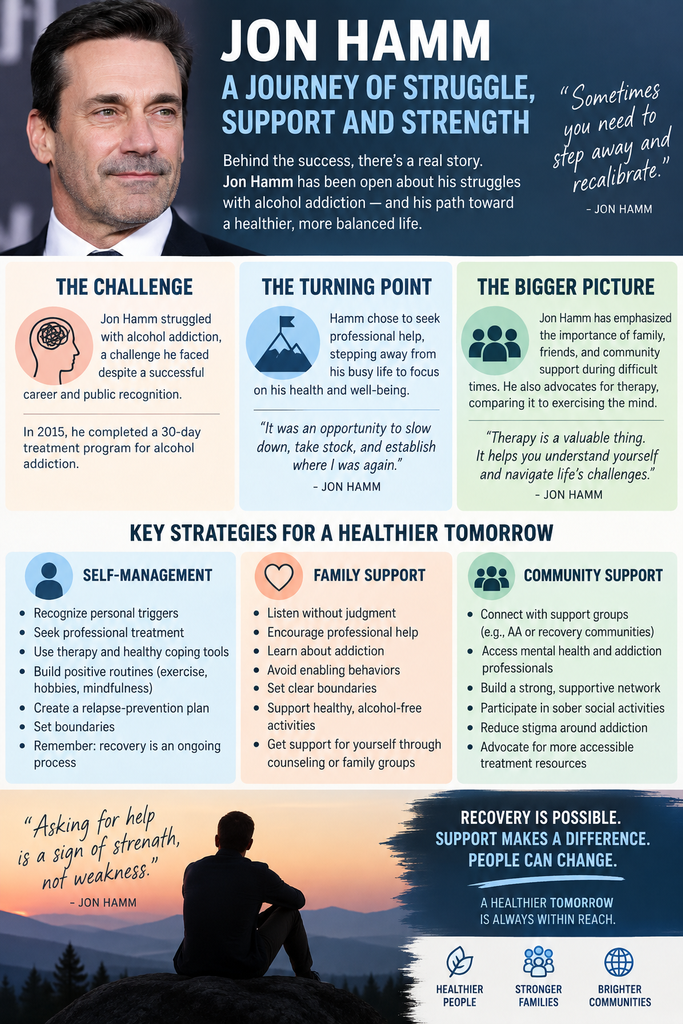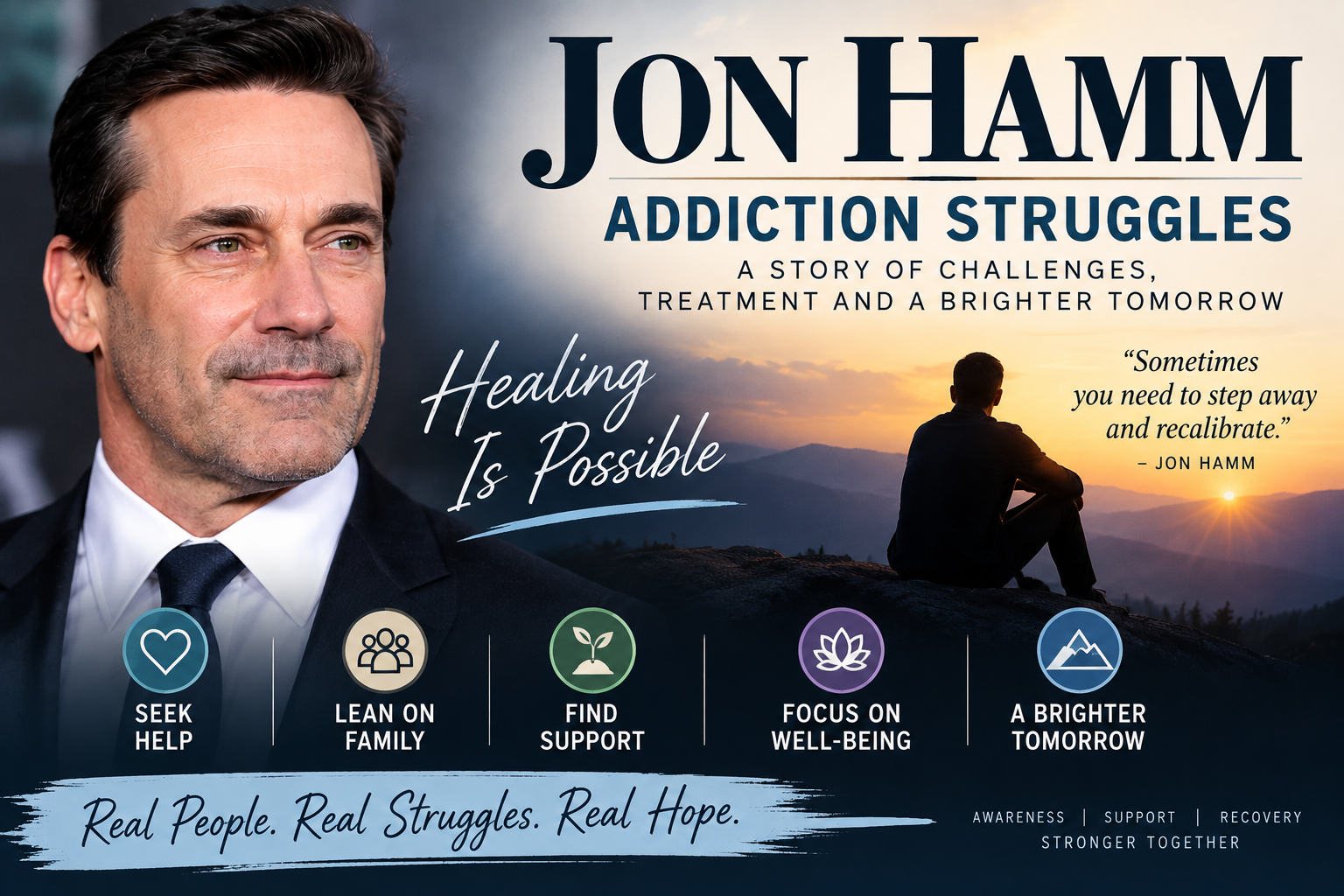
Jon Hamm is widely known for his award-winning portrayal of Don Draper on Mad Men, but behind his professional success, he has also publicly acknowledged a struggle with alcohol addiction. In 2015, Hamm’s representative confirmed that he had completed treatment for alcohol addiction. Hamm later spoke positively about treatment and therapy, describing the value of temporarily stepping away from everyday pressures to focus on himself and “recalibrate.”
His experience provides an opportunity to discuss an important reality about addiction: professional achievement, intelligence, money, and public recognition do not protect someone from developing a substance use disorder. Recovery often requires recognizing a problem, accepting professional help, developing healthier coping strategies, and allowing supportive people to become part of the process.
Understanding Jon Hamm’s Struggle With Alcohol
In March 2015, Hamm completed a 30-day treatment program for alcohol addiction. At the time, his representative confirmed that his longtime partner, Jennifer Westfeldt, had supported him during treatment. Hamm himself emphasized the importance of having family, friends, and coworkers available during difficult periods of life.
Hamm has generally maintained boundaries around the private details of his addiction. That distinction is important. Public figures can help reduce stigma by discussing treatment, but they are not obligated to disclose every aspect of their medical or personal lives.
Hamm has also spoken openly about therapy. After losing his mother when he was young and his father when he was 20, he sought professional help during a difficult period. Years later, he continued advocating for therapy and compared it to exercising the mind.
Rather than trying to diagnose the reasons behind Hamm’s alcohol problems from a distance, his story can be used to illustrate how professional treatment, psychological support, relationships, and self-reflection can contribute to recovery.
Self-Management Strategies
Recovery requires more than simply deciding not to drink. Alcohol use can become connected with stress, emotional distress, habits, environments, relationships, and learned coping patterns. A personalized recovery plan can help an individual identify these influences and develop healthier responses.
Helpful self-management strategies may include:
- Recognizing personal triggers. Stress, loneliness, celebrations, relationship difficulties, grief, work pressure, and certain social situations can increase urges to drink.
- Seeking professional treatment. Addiction specialists can determine whether outpatient treatment, residential care, medications, behavioral therapies, or another level of care is appropriate.
- Using therapy as an ongoing resource. Cognitive behavioral therapy and other evidence-based approaches can help people recognize unhealthy thought and behavioral patterns.
- Developing alternatives to alcohol. Exercise, hobbies, meditation, adequate sleep, social activities, and meaningful routines can provide healthier ways of managing stress.
- Creating a relapse-prevention plan. Individuals can identify warning signs and decide in advance whom to contact and what actions to take when cravings or old behaviors return.
- Maintaining boundaries. Recovery may require avoiding people, environments, or situations strongly associated with previous alcohol use.
- Accepting that recovery is ongoing. Treatment can be an important beginning rather than the end of the recovery process.
Hamm later described his treatment experience as an opportunity to slow down, reassess his life, and establish where he was again. His comments demonstrate one potential benefit of structured treatment: creating enough distance from everyday pressures to examine what needs to change.
Family Support Strategies
Family members frequently want to help someone struggling with alcohol but may not know what healthy support looks like. Supporting recovery does not mean controlling another person’s behavior or protecting them from every consequence.
Families can help by:
- Listening without shaming. Statements expressing concern are generally more productive than accusations or labels.
- Encouraging professional help. Family members can offer assistance finding treatment while recognizing that recovery ultimately requires the individual’s participation.
- Learning about alcohol use disorder. Understanding addiction as a treatable health condition can reduce blame and unrealistic expectations.
- Avoiding enabling behaviors. Paying repeated alcohol-related debts, covering up consequences, making excuses, or supplying alcohol can unintentionally allow harmful patterns to continue.
- Establishing clear boundaries. Families can explain what behaviors they will and will not accept while maintaining compassion.
- Supporting healthy routines. Alcohol-free activities and environments can make recovery easier.
- Getting help for themselves. Counseling and family support groups can help relatives manage stress and understand what they can and cannot control.
Hamm specifically acknowledged receiving support from family and friends when his treatment became public. His experience reinforces an important principle: recovery may be deeply personal, but supportive relationships can still play a meaningful role.
Community Support Strategies
Recovery also occurs within communities. People may need continuing sources of connection after completing formal treatment. Isolation can make recovery more difficult, while supportive environments can provide encouragement and accountability.
Community resources may include mutual-help groups, recovery community organizations, behavioral health professionals, primary care providers, addiction specialists, peer recovery coaches, faith communities, sober recreational activities, and workplace assistance programs.
Communities can also help by changing the language surrounding addiction. Treating someone as morally defective because they need rehabilitation can discourage others from seeking care. Hamm later spoke positively about rehabilitation despite the stigma attached to it, describing treatment as a valuable opportunity to focus on himself and regain balance.
Treatment Is a Sign of Action, Not Failure
One of the most useful lessons from Jon Hamm’s publicly documented experience is that entering treatment should not automatically be viewed as evidence that someone’s life has fallen apart. It can represent recognition that something needs to change and a willingness to act.
Someone can appear successful professionally while struggling privately. Addiction does not have one appearance, occupation, income level, or personality type. This is why families should pay attention to changes in behavior and functioning rather than assuming that a successful person could not have an alcohol problem.
Hamm’s decision to obtain professional treatment also challenges the stigma surrounding rehabilitation. Seeking treatment means using available resources to address a serious problem.
Recovery Requires More Than Willpower
Alcohol addiction can involve biological, psychological, social, and environmental factors. Telling someone to “just stop drinking” overlooks the complexity of alcohol use disorder.
Effective recovery may involve professional assessment, behavioral therapy, medications when clinically appropriate, family education, peer support, lifestyle changes, treatment of co-occurring mental health conditions, and continuing relapse-prevention strategies. The exact combination differs from person to person.
Hamm’s comments about both rehabilitation and therapy illustrate another valuable principle: seeking professional assistance can coexist with independence and personal responsibility. Getting help is itself an action a person takes toward managing a problem.
Moving Forward
Jon Hamm’s experience should not be treated as a complete picture of his private recovery because he has deliberately kept many details personal. What he has publicly shared, however, provides a useful starting point for conversations about alcohol addiction, treatment, therapy, social support, and stigma.
For individuals struggling with alcohol, self-management can mean recognizing triggers, accepting professional treatment, developing healthier coping mechanisms, and preparing for difficult moments. Families can provide encouragement while establishing healthy boundaries. Communities can make treatment easier to access while creating environments where people are not ashamed to ask for help.
Recovery is rarely the result of a single decision or a single treatment episode. It is often a continuing process of learning, adjusting, rebuilding relationships, managing stress, and using support when necessary. Jon Hamm’s willingness to publicly acknowledge treatment helps reinforce a message that can benefit others: a person does not have to wait until everything is lost before seeking help.
Frequently Asked Questions
Here are some common questions:
1. Did Jon Hamm struggle with addiction?
Yes. Jon Hamm has publicly acknowledged receiving treatment for alcohol addiction. In 2015, his representative confirmed that he had completed an inpatient rehabilitation program. His decision to seek treatment brought attention to the fact that alcohol problems can affect people regardless of career success, income, or public image.
2. What type of addiction did Jon Hamm receive treatment for?
Hamm received treatment for alcohol addiction. Publicly available information does not establish that he was treated for other substance addictions, so it is important not to speculate beyond what he has disclosed.
3. When did Jon Hamm go to rehab?
Hamm completed a 30-day rehabilitation program in 2015. He later discussed treatment as an opportunity to step away from everyday pressures and reassess his well-being.
4. Why did Jon Hamm seek treatment?
Hamm has not publicly provided every detail surrounding his decision. He has described rehabilitation positively, however, as a chance to focus on himself and regain perspective. Because addiction is complex, it would be inappropriate to attribute his alcohol problems to one specific event without evidence.
5. Did childhood loss contribute to Jon Hamm’s alcohol addiction?
Hamm experienced significant losses at a young age—his mother died when he was 10, and his father died when he was 20—and he has discussed receiving therapy during difficult periods of his life. However, we cannot conclude that these experiences caused his alcohol addiction. Trauma, grief, genetics, mental health, environment, stress, and learned behaviors can all interact in substance use disorders.
6. Has Jon Hamm talked about therapy?
Yes. Hamm has spoken positively about psychotherapy and continues to discuss its value. In 2026, he again described therapy, including couples therapy, as useful tools for improving relationships, communication, and personal growth.
7. How did family and friends support Jon Hamm?
When his treatment became public, Hamm expressed appreciation for the support of family and friends. This highlights an important recovery principle: supportive relationships can provide encouragement while the individual takes responsibility for treatment and behavioral change.
8. What self-management strategies can someone learn from his experience?
A person struggling with alcohol can benefit from identifying triggers, seeking professional assessment, participating in therapy, establishing alcohol-free routines, developing healthier ways of handling stress, setting boundaries, and creating a relapse-prevention plan. Treatment should be individualized because recovery needs vary considerably from person to person.
9. How can families help someone struggling with alcohol addiction?
Families can learn about alcohol use disorder, communicate concerns without humiliation or blame, encourage professional treatment, avoid enabling harmful behaviors, establish appropriate boundaries, and participate in family counseling or support groups when helpful. Family members also need to protect their own emotional health.
10. What role can the community play in addiction recovery?
Community resources can provide connection after formal treatment. Addiction professionals, primary-care clinicians, therapists, peer recovery specialists, mutual-help programs, recovery organizations, and sober social networks can all become parts of a broader support system.
11. Does going to rehab mean someone has failed?
No. Entering treatment means a person is taking action to address a health problem. Addiction stigma can make people reluctant to seek care, which is one reason public conversations about treatment can be valuable.
12. Is alcohol use disorder treatable?
Yes. Alcohol use disorder is treatable, although recovery may be a long-term process. Treatment can include behavioral therapies, medications when appropriate, mutual-support programs, management of co-occurring mental health conditions, and continuing recovery support.
13. Is Jon Hamm currently sober?
Hamm has discussed his past treatment publicly, but details of a person’s current alcohol use or sobriety should not be assumed unless they have clearly disclosed them. It is more accurate to say that Hamm received treatment for alcohol addiction in 2015 rather than make unsupported claims about his present recovery status.
14. What is the biggest lesson from Jon Hamm’s experience?
His experience illustrates that addiction can exist behind an outward appearance of success. Seeking treatment, using therapy, accepting support, and addressing problems before they become even more destructive can be important steps toward better health.
15. Where can someone get help for alcohol addiction?
In the United States, the SAMHSA National Helpline and FindTreatment.gov can help individuals and families locate treatment resources. If alcohol withdrawal is suspected, medical guidance is particularly important because severe withdrawal can become dangerous.
Video: Why Jon Hamm Chose Sobriety #mentalhealth #shorts