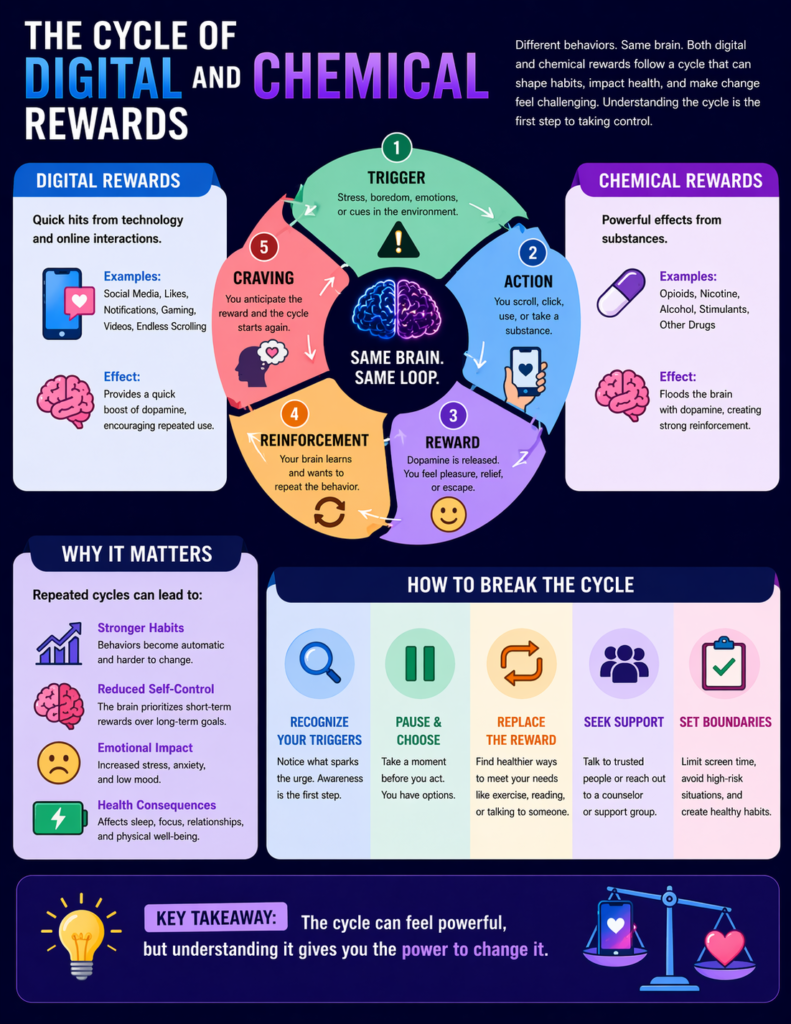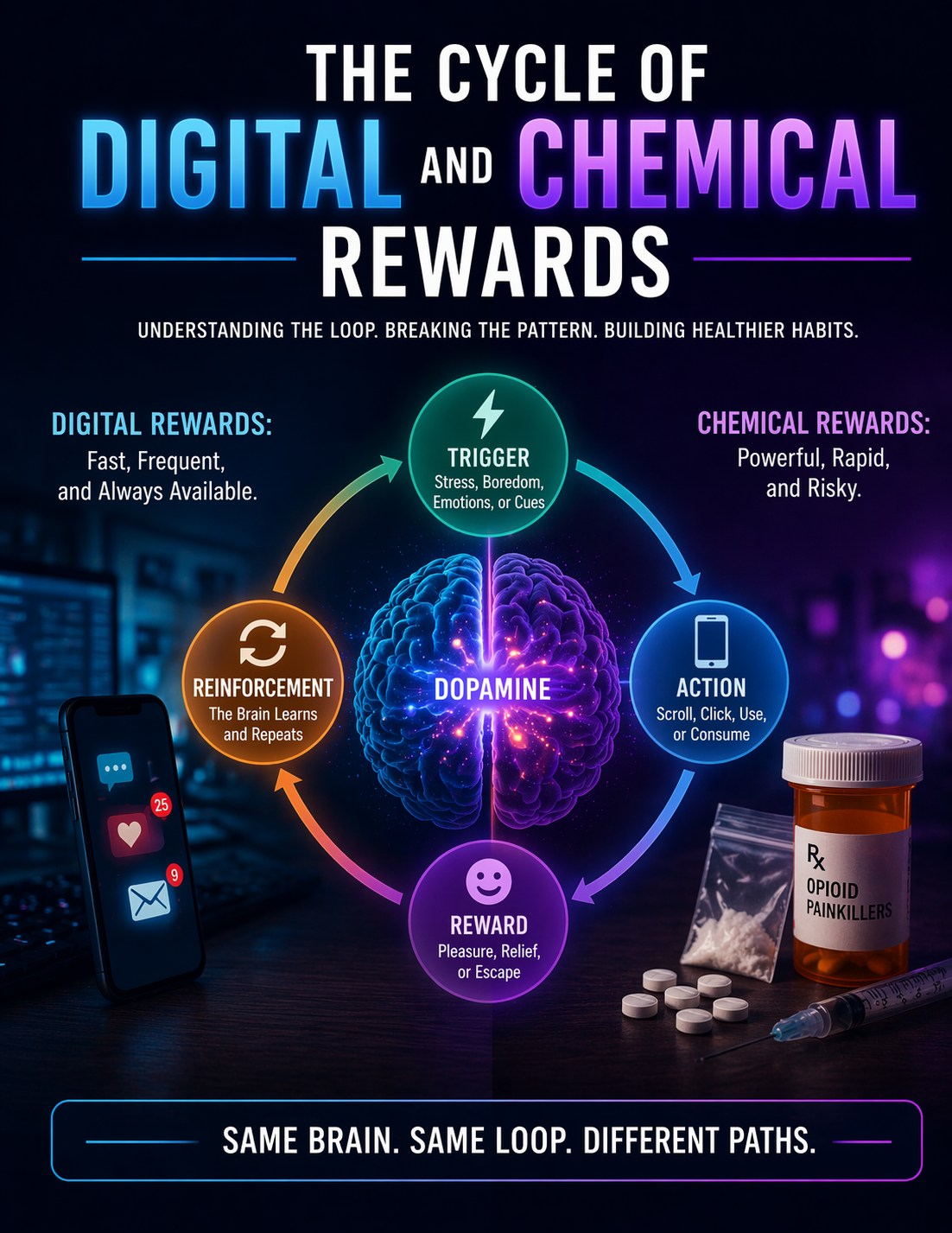
The cycle of digital and chemical rewards highlights how both technology use and substance use are driven by the same underlying processes in the brain. At the center of this cycle is the reward system, in which behaviors are reinforced by dopamine release, creating patterns of repetition and, in some cases, compulsion. Whether it’s scrolling through social media or using substances to cope with stress, these behaviors often begin as intentional choices but gradually become automatic responses to emotional or environmental triggers. Understanding this cycle is essential for recognizing how habits form, why they are difficult to break, and how both digital and chemical rewards can impact mental health and daily functioning.
Chasing the High: The Cycle of Digital and Chemical Rewards
In today’s world, the concept of addiction is no longer limited to substances like drugs or alcohol. Increasingly, behaviors such as social media use, gaming, and constant phone checking are being recognized for their addictive potential. While these may seem very different on the surface, both digital and chemical addictions share a common foundation: the brain’s reward system.
Understanding the cycle of digital and chemical rewards reveals how these behaviors are formed, reinforced, and sustained—and why breaking them can be so challenging.
The Brain’s Reward System: A Shared Pathway
At the core of both digital and chemical rewards is dopamine, a neurotransmitter responsible for motivation, reinforcement, and the anticipation of pleasure.
- Chemical rewards (like opioids or other substances) directly alter brain chemistry, producing intense and immediate effects.
- Digital rewards (such as notifications, likes, or new content) trigger smaller but more frequent dopamine releases.
Although the intensity differs, both activate the same neural pathways. Over time, the brain begins to associate certain behaviors—whether taking a substance or checking a phone—with reward.
The Reward Cycle
Both types of behaviors follow a similar cycle:
- Trigger – Stress, boredom, emotional discomfort, or environmental cues
- Action – Using a substance or engaging in digital behavior
- Reward – Relief, pleasure, or distraction
- Reinforcement – The brain learns to repeat the behavior
With repetition, this cycle becomes automatic. What starts as a conscious choice gradually turns into a habit—and in some cases, a compulsion.
Escalation and Tolerance
In chemical addiction, tolerance develops when the brain requires more of a substance to achieve the same effect. A similar pattern can occur with digital behavior.
- Scrolling longer to feel satisfied
- Needing more engagement (likes, messages) for the same emotional impact
- Switching between apps to maintain stimulation
The brain adapts, reducing sensitivity to rewards and increasing the need for more frequent or intense stimulation.
Escape and Emotional Regulation
Both digital and chemical rewards are often used as coping mechanisms.
People may turn to:
- Substances to numb emotional pain
- Screens to distract from stress, anxiety, or loneliness
While these behaviors provide temporary relief, they do not address the underlying issue. As a result, the original discomfort returns—often stronger—leading to repeated use and a deepening cycle.
Loss of Control and Habit Formation
As the cycle continues, self-control becomes more difficult. This is not simply a matter of willpower. Repeated activation of reward pathways strengthens neural connections, making the behavior more automatic.
Over time:
- The behavior becomes a default response to triggers
- Awareness decreases
- Attempts to stop may lead to discomfort or withdrawal-like symptoms
This is why both digital overuse and substance use can feel difficult to control, even when someone wants to change.
Breaking the Cycle
Understanding the cycle is the first step toward change. Both digital and chemical reward patterns can be interrupted with intentional strategies:
- Identify triggers and recognize patterns
- Replace behaviors with healthier coping mechanisms
- Set boundaries around use (screen time or substance exposure)
- Seek support when needed—especially for substance-related concerns
The brain is adaptable. With consistent effort, new habits can form, and old patterns can weaken.
Why This Understanding Matters
Recognizing the similarities between digital and chemical rewards changes how we think about behavior. It shifts the focus from judgment to understanding.
Instead of asking:
- “Why can’t I stop?”
We begin to ask:
- “What is this behavior doing for me, and what do I actually need?”
This shift is critical for both prevention and recovery.
Final Thought
The cycle of digital and chemical rewards highlights a fundamental truth: our brains are wired to seek relief, connection, and pleasure. In a world full of powerful stimuli, it’s easy for these natural systems to be overstimulated.
But awareness creates choice. By understanding how these cycles work, we gain the ability to step back, make intentional decisions, and build healthier ways to meet our needs—without being controlled by the very systems designed to hook us.
Breaking the Loop: Self-Management Strategies for Understanding the Cycle of Digital and Chemical Rewards
The cycle of digital and chemical rewards—whether it’s scrolling through social media or using substances—follows a powerful pattern rooted in the brain’s reward system. While these behaviors may seem different, they are driven by the same neurological processes: triggers, actions, rewards, and reinforcement.
Understanding this cycle is important—but real change comes from learning how to manage it. Self-management strategies give individuals the tools to recognize these patterns, interrupt them, and build healthier alternatives.
Why Self-Management Matters
The reward cycle often operates automatically. You may reach for your phone without thinking or turn to substances during stress without fully realizing why. This is because repeated behaviors become wired into the brain.
Self-management helps you:
- Become aware of these automatic patterns
- Regain control over your responses
- Replace harmful habits with healthier ones
It shifts behavior from unconscious reaction to intentional choice.
Strategy 1: Identify Your Triggers
Every reward cycle begins with a trigger. These can be:
- Emotional (stress, anxiety, boredom)
- Environmental (notifications, certain places, social settings)
- Social (peer influence, isolation)
Ask yourself:
- When do I feel the urge to engage in this behavior?
- What am I experiencing right before it happens?
Understanding triggers is the first step in disrupting the cycle.
Strategy 2: Pause and Create Awareness
The space between trigger and action is where change happens.
Try:
- Pausing for a few seconds before acting
- Taking a deep breath
- Asking, “What do I actually need right now?”
This moment of awareness interrupts the automatic loop and gives you a chance to choose a different response.
Strategy 3: Replace the Reward, Not Just the Behavior
Simply removing a behavior often doesn’t work because the underlying need remains.
Instead:
- If you’re seeking stress relief → try exercise or deep breathing
- If you’re seeking distraction → try reading or a hobby
- If you’re seeking connection → reach out to someone
The goal is to meet the same need in a healthier way.
Strategy 4: Set Clear Boundaries
Boundaries help limit exposure to triggers and reduce the frequency of the cycle.
Examples include:
- Setting time limits for screen use
- Avoiding environments where substance use is present
- Turning off notifications or removing certain apps
These changes reduce the intensity of the habit loop over time.
Strategy 5: Reframe Your Thinking
It’s easy to fall into self-criticism:
- “I have no self-control.”
Instead, reframe:
- “My brain has learned this pattern, and I can unlearn it.”
This perspective aligns with the science of behavior and encourages growth rather than shame.
Strategy 6: Build Consistent Habits
New habits weaken old ones. Consistency is more important than perfection.
You might:
- Create a daily routine with structured activities
- Schedule time for healthy coping strategies
- Practice small changes regularly
Over time, these new patterns become automatic, replacing the old cycle.
Strategy 7: Seek Support When Needed
Some cycles—especially those involving substances—can be difficult to break on your own.
Support can include:
- Talking to a trusted person
- Seeking professional help
- Joining support groups
Connection reduces isolation and provides accountability.
Why These Strategies Work
Self-management strategies are effective because they:
- Target both the trigger and the behavior
- Interrupt automatic reward loops
- Build alternative pathways in the brain
- Promote long-term behavioral change
They don’t just stop the cycle—they reshape it.
Final Thought
The cycle of digital and chemical rewards is powerful, but it’s not permanent. Your brain is adaptable, and your habits can change.
Self-management is not about perfection—it’s about awareness, intention, and gradual progress. By understanding the cycle and actively working to manage it, you can move from feeling controlled by your behaviors to being in control of them.
Stronger Together: Family Support Strategies for Understanding the Cycle of Digital and Chemical Rewards
The cycle of digital and chemical rewards—driven by triggers, actions, and dopamine reinforcement—doesn’t just affect individuals. It impacts families as well. Whether it’s a loved one struggling with substance use or constantly being “hooked” online, families often witness these patterns without fully understanding them.
Without that understanding, responses can turn into frustration, conflict, or blame. But when families learn how these reward cycles work, they can shift from reacting emotionally to supporting effectively. Family support becomes a powerful tool in breaking unhealthy patterns and building healthier ones together.
Why Family Support Matters
Both digital and chemical behaviors are often misunderstood as simple choices. This belief can lead to comments like:
- “Just stop.”
- “Why are you doing this?”
However, these behaviors are rooted in the brain’s reward system and reinforced over time. When families understand that these patterns are learned—not just chosen—they can respond with empathy rather than judgment.
Supportive environments make it easier for individuals to recognize their behavior and feel safe enough to change it.
Strategy 1: Learn the Reward Cycle as a Family
Education is the first step toward understanding.
Families can:
- Learn about triggers, dopamine, and habit loops
- Discuss how both digital use and substance use follow similar patterns
- Recognize that these behaviors are reinforced, not random
Shared knowledge creates a common language and reduces misunderstandings.
Strategy 2: Replace Blame with Curiosity
Instead of reacting with frustration, try asking:
- “What were you feeling before this happened?”
- “What do you get out of this behavior?”
Curiosity helps uncover the purpose behind the behavior—whether it’s stress relief, distraction, or emotional escape. This understanding allows families to address the root cause, not just the behavior.
Strategy 3: Improve Communication
Open, respectful communication is essential.
Families can:
- Use “I” statements (“I feel concerned when…”)
- Listen without interrupting or judging
- Validate emotions even if they don’t agree with the behavior
When individuals feel heard, they are more likely to engage in honest conversations and consider change.
Strategy 4: Set Healthy Boundaries Together
Boundaries provide structure while maintaining support.
Examples include:
- Limiting screen time during certain hours
- Setting expectations around substance use environments
- Creating shared guidelines for healthy behavior
When boundaries are discussed and agreed upon as a family, they feel less like punishment and more like support.
Strategy 5: Encourage Healthy Alternatives
Since reward cycles are driven by needs (relief, connection, stimulation), families can help provide healthier options.
This might include:
- Spending quality time together
- Encouraging hobbies or physical activities
- Supporting social connections outside of screens or substances
Replacing the reward is more effective than simply removing the behavior.
Strategy 6: Recognize Emotional Triggers
Families can help identify patterns that individuals may not notice themselves.
For example:
- Increased screen time during stress
- Substance use during emotional distress
Gently pointing out these patterns can increase awareness without creating defensiveness.
Strategy 7: Practice Patience and Consistency
Breaking reward cycles takes time. There may be setbacks, especially when habits are deeply ingrained.
Families can support progress by:
- Focusing on small improvements
- Avoiding harsh criticism during setbacks
- Staying consistent in their support and boundaries
A stable, patient environment makes change more sustainable.
Strategy 8: Seek Support When Needed
Some cycles—especially those involving substances—require additional help.
Families can:
- Participate in family therapy
- Join support groups
- Encourage professional guidance
External support provides tools and perspectives that strengthen family efforts.
Why These Strategies Work
Family-based strategies are effective because they:
- Reduce shame and defensiveness
- Address both emotional needs and behaviors
- Create consistent support systems
- Reinforce healthier habits through shared effort
When families work together, the individual is no longer facing the cycle alone.
Final Thought
The cycle of digital and chemical rewards can feel overwhelming—but it is not unbreakable. With understanding, patience, and support, families can play a key role in disrupting these patterns.
By shifting from blame to awareness and from control to connection, families create an environment where real change becomes possible. In that space, recovery—whether from digital overuse or substance dependence—can begin and grow.
Building Better Systems: Community Resource Strategies for Understanding the Cycle of Digital and Chemical Rewards
The cycle of digital and chemical rewards—driven by triggers, behaviors, and dopamine-driven reinforcement—extends beyond individual habits. It is shaped by the environments people live in, the resources available to them, and the messages they receive from society. While individuals and families play important roles in recognizing and managing these patterns, communities are essential in creating the conditions that either reinforce or disrupt these cycles.
By developing strong community resource strategies, we can move from simply reacting to addictive behaviors to actively understanding and preventing them.
Why Community Resources Matter
Both digital overuse and substance-related behaviors are influenced by broader social factors:
- Accessibility and exposure
- Stress and economic conditions
- Availability of support systems
- Cultural attitudes toward mental health
Without community-level awareness, these cycles can continue unchecked. Community resources provide education, support, and alternatives that help individuals break free from automatic reward-driven behaviors.
Strategy 1: Expand Public Education on Reward Cycles
Understanding the science behind behavior is a powerful tool.
Communities can:
- Host workshops explaining how dopamine, triggers, and habit loops work
- Provide accessible materials on both digital overuse and substance use
- Incorporate education into schools, libraries, and community centers
When people understand why behaviors occur, they are more likely to approach them with awareness rather than judgment.
Strategy 2: Increase Access to Mental Health Services
The cycle of reward-based behaviors is often rooted in emotional needs such as stress, anxiety, or trauma.
Communities can support individuals by:
- Expanding affordable counseling and therapy services
- Offering crisis support and early intervention programs
- Integrating mental health care with substance use treatment
Addressing underlying mental health challenges reduces reliance on unhealthy coping mechanisms.
Strategy 3: Develop Peer Support and Recovery Networks
Peer support creates connection and shared understanding.
Community initiatives may include:
- Support groups for substance use and digital overuse
- Recovery centers and safe spaces
- Mentorship programs led by individuals with lived experience
These networks reduce isolation and provide practical strategies for managing reward cycles.
Strategy 4: Promote Healthy Alternatives and Engagement
Since reward cycles are driven by the need for stimulation, connection, or relief, communities can provide healthier outlets.
Examples include:
- Recreational programs (sports, arts, outdoor activities)
- Community events that encourage face-to-face interaction
- Safe, engaging spaces for youth and adults
These alternatives fulfill the same needs without reinforcing harmful patterns.
Strategy 5: Launch Public Awareness Campaigns
Changing how people think about addiction and digital behavior is key.
Effective campaigns can:
- Explain the science behind reward cycles
- Challenge myths about willpower and personal failure
- Promote understanding and compassion
Public messaging shapes cultural attitudes, making it easier for individuals to seek help.
Strategy 6: Collaborate Across Systems
The cycle of digital and chemical rewards intersects with multiple sectors.
Communities can strengthen their response by connecting:
- Schools
- Healthcare providers
- Social services
- Local organizations
Collaboration ensures that individuals receive consistent support across different areas of their lives.
Strategy 7: Address Environmental and Social Stressors
Stress is a major trigger for reward-seeking behaviors.
Communities can reduce risk by:
- Supporting employment and financial stability programs
- Improving access to healthcare and housing
- Creating safe, supportive environments
When stress is reduced, the need for unhealthy coping mechanisms also decreases.
Why These Strategies Work
Community-based approaches are effective because they:
- Address both the causes and the behaviors
- Reduce stigma and increase awareness
- Provide accessible, consistent support
- Create environments that promote healthier choices
Instead of placing responsibility solely on individuals, these strategies recognize the role of the environment in shaping behavior.
Final Thought
The cycle of digital and chemical rewards is not just a personal challenge—it is a community issue shaped by shared environments and systems. By investing in education, support, and connection, communities can help individuals understand and manage these patterns more effectively.
When communities take an active role, they transform from passive observers into powerful agents of change—creating spaces where healthier behaviors are not only possible, but supported every day.
Frequently Asked Questions
Here are some common questions:
1. What is the cycle of digital and chemical rewards?
Answer:
It is a repeating pattern in which a trigger leads to a behavior (such as scrolling or substance use), followed by a reward (pleasure, relief, or distraction), which reinforces the behavior. Over time, this loop becomes automatic and harder to break.
2. How are digital and chemical rewards similar?
Answer:
Both activate the brain’s reward system and involve dopamine. While chemical rewards (like drugs) produce stronger and more immediate effects, digital rewards (like notifications or likes) are smaller but more frequent. Despite the difference in intensity, they follow the same behavioral cycle.
3. What role does dopamine play in this cycle?
Answer:
Dopamine is a neurotransmitter that reinforces behavior. It signals your brain that something is rewarding and worth repeating. Each time a behavior leads to a reward, dopamine strengthens the connection, making you more likely to repeat it.
4. What are common triggers in this cycle?
Answer:
Triggers can be:
- Emotional (stress, anxiety, boredom)
- Environmental (notifications, certain places)
- Social (peer influence, loneliness)
These triggers initiate the urge to engage in the behavior.
5. Why do these behaviors become automatic?
Answer:
Repeated exposure strengthens neural pathways in the brain. Over time, the behavior becomes a habit, requiring less conscious thought. This is why people may check their phone or engage in certain behaviors without realizing it.
6. Is this cycle the same as addiction?
Answer:
Not always, but it can lead to addiction. The cycle explains how habits form and become reinforced. When the behavior becomes compulsive and begins to interfere with daily life, it may meet the criteria for addiction—especially in the case of substances.
7. Why is it so hard to break the cycle?
Answer:
Because the brain has learned to associate the behavior with reward. Stopping the behavior can lead to discomfort, cravings, or a sense of loss, making it difficult to change without intentional effort and support.
8. Can digital behaviors be as harmful as chemical ones?
Answer:
They are generally less physically dangerous, but they can still impact mental health, attention, sleep, and daily functioning. In severe cases, digital overuse can significantly affect well-being and productivity.
9. How can someone interrupt this cycle?
Answer:
- Identify triggers
- Pause before acting
- Replace the behavior with a healthier alternative
- Set boundaries (time limits, environment changes)
- Seek support if needed
Interrupting the cycle weakens the habit over time.
10. Can the brain change these patterns?
Answer:
Yes. The brain is capable of change through neuroplasticity. With consistent effort, new habits can form, and old patterns can weaken. This is why strategies like mindfulness and routine-building are effective.
Final Thought
The cycle of digital and chemical rewards explains why certain behaviors feel so compelling—but it also shows that change is possible. By understanding how the cycle works, you gain the tools to interrupt it, reshape it, and take back control of your habits.
Conclusion
Recognizing the cycle of digital and chemical rewards provides a powerful framework for change. When we understand that these behaviors are shaped by neurological patterns rather than a simple lack of willpower, we can approach them with greater awareness and compassion. Breaking the cycle requires intentional effort—identifying triggers, developing healthier coping strategies, and creating supportive environments. By shifting from judgment to understanding, individuals, families, and communities can work toward reducing harmful patterns and building more balanced, sustainable ways to meet emotional and psychological needs.
Video: The Reward Loop Trapping Millions #dopamine #socialMediaAddiction #psychology