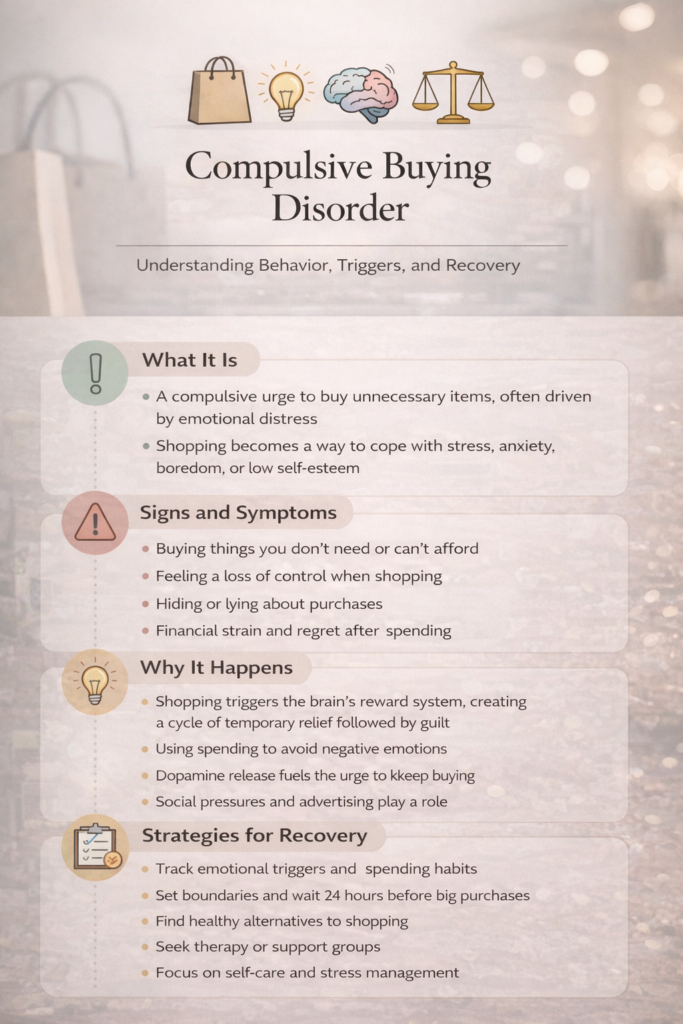
Compulsive Buying Disorder (CBD), also known as oniomania, is a behavioral condition marked by a persistent and uncontrollable urge to shop, even when it leads to negative emotional, financial, or social consequences. Although shopping is a typical and often necessary activity, CBD extends beyond normal behavior and becomes an unhealthy way of coping with feelings such as stress, anxiety, loneliness, or low self-worth. Individuals with this condition often experience a repeating cycle of anticipation, short-term satisfaction, and then guilt or regret after making purchases. As consumer culture grows and online shopping becomes more accessible, it is increasingly important to understand the psychological, social, and biological factors that contribute to compulsive buying in order to improve awareness, prevention, and treatment efforts.
Compulsive Buying Disorder: When Shopping Stops Being a Choice
🛍️ What Is Compulsive Buying Disorder?
Compulsive Buying Disorder (CBD)—sometimes called oniomania—is a behavioral pattern where a person feels an overwhelming, repetitive urge to shop and spend, even when it leads to distress or harm. Unlike occasional impulse purchases, CBD involves a loss of control, where buying becomes a way to cope with emotions rather than meet real needs.
People with this condition often describe a cycle:
tension → urge to buy → temporary relief or “high” → guilt or regret → repeat.
🧠 Why It Happens: The Psychology Behind It
At its core, compulsive buying is not about the items—it’s about emotional regulation.
- Dopamine and reward: Shopping activates the brain’s reward system, giving a short-lived boost of pleasure.
- Emotional escape: Feelings like anxiety, loneliness, boredom, or low self-worth can trigger the urge to buy.
- Cognitive distortions: Thoughts like “This will make me feel better” or “I deserve this” reinforce the behavior.
- Conditioning: Over time, the brain learns that spending = relief, strengthening the habit loop.
⚠️ Signs It May Be More Than “Just Shopping.”
It can be tricky to tell when normal spending crosses into something harmful. Some warning signs include:
- Buying things you don’t need or can’t afford
- Feeling out of control when shopping
- Hiding purchases or lying about spending
- Using shopping to cope with stress or sadness
- Experiencing guilt, shame, or regret afterward
- Financial strain, debt, or relationship conflict
If these patterns feel familiar, it’s not about willpower—it’s about understanding the underlying drivers.
🔄 The Addiction-Like Cycle
Compulsive buying shares similarities with other behavioral addictions:
- Trigger – emotional discomfort or stress
- Craving – urge to shop or browse
- Behavior – purchasing or spending
- Reward – temporary relief or excitement
- Crash – guilt, financial worry, emotional low
This cycle can become deeply ingrained, especially when reinforced over time.
🌱 Healing and Recovery: What Helps?
Recovery doesn’t mean enjoying shopping again—it means regaining control and intention.
1. Build awareness
Track spending and emotional triggers. Patterns often reveal themselves quickly.
2. Create pause points
Use strategies like a 24-hour rule before buying non-essential items.
3. Replace the reward
Engage in activities that boost natural “feel-good” chemicals:
- Exercise (endorphins)
- Social connection (oxytocin)
- Creative outlets or hobbies
4. Address the root cause
Therapies like Cognitive Behavioral Therapy (CBT) can help challenge distorted thinking and build healthier coping skills.
5. Reduce temptation
Unsubscribe from marketing emails, limit browsing apps, or set spending boundaries.
6. Seek support
Talking to a therapist, a support group, or a trusted person can reduce feelings of isolation and increase accountability.
💬 Final Thoughts
Compulsive Buying Disorder is often misunderstood as a lack of discipline—but it’s much deeper than that. It’s a learned coping strategy that can be unlearned with the right tools and support.
The goal isn’t perfection. It’s progress, awareness, and reclaiming choice.
Taking Back Control: Self-Management Strategies for Understanding Compulsive Buying Disorder
🛍️ Why Self-Management Matters
Compulsive Buying Disorder (CBD) isn’t just about overspending—it’s about a pattern of using shopping to cope with emotions. While professional support can be important, self-management strategies are often the first step in recognizing patterns, interrupting the cycle, and rebuilding control.
The goal isn’t to eliminate shopping altogether—it’s to shift from impulsive to intentional behavior.
🧠 Step 1: Understand Your Triggers
Compulsive buying rarely happens “out of nowhere.” It’s usually tied to emotional or situational triggers.
Common triggers include:
- Stress or anxiety
- Loneliness or boredom
- Low self-esteem
- Social pressure or comparison (especially online)
Try this:
Keep a simple log of when you feel the urge to shop. Note:
- What you’re feeling
- Where you are
- What happened just before the urge
Patterns will start to emerge—and awareness is the foundation of change.
🔄 Step 2: Recognize the Cycle
CBD often follows a predictable loop:
Trigger → Urge → Purchase → Temporary Relief → Guilt/Regret
Understanding this cycle helps you step in before the purchase happens.
Ask yourself in the moment:
- What am I actually feeling right now?
- Will buying this solve that feeling—or just delay it?
⏸️ Step 3: Create a Pause Between Urge and Action
Impulse thrives on immediacy. Slowing things down weakens it.
Practical tools:
- The 24-hour rule for non-essential purchases
- Add items to a cart, but don’t check out
- Set spending limits or use cash instead of cards
Even a short pause can shift the brain from emotional to rational decision-making.
💡 Step 4: Challenge Thought Patterns
Compulsive buying is often fueled by automatic thoughts:
- “I need this to feel better.”
- “It’s on sale—I’ll regret not buying it.”
- “I deserve this.”
Reframe them:
- “This feeling will pass without buying.”
- “A sale isn’t savings if I don’t need it.”
- “I deserve stability more than this purchase.”
This is a core principle of cognitive-behavioral strategies.
🌱 Step 5: Replace the Reward
Shopping provides a quick emotional boost—but it’s temporary. Replacing it with healthier rewards helps retrain the brain.
Try:
- Movement (walking, workouts) → boosts endorphins
- Connection (calling a friend) → increases oxytocin
- Creative outlets (writing, art, music)
- Mindfulness or relaxation techniques
The key is finding alternatives that actually meet the emotional need.
🚫 Step 6: Reduce Exposure to Temptation
The environment plays a huge role in behavior.
Helpful changes:
- Unsubscribe from promotional emails
- Remove saved payment methods from apps
- Limit time on shopping websites or social media
- Avoid browsing when feeling emotionally vulnerable
Less exposure = fewer triggers.
🤝 Step 7: Build Accountability and Support
Isolation can strengthen compulsive behaviors. Support creates perspective and accountability.
Options include:
- Talking to a trusted friend or family member
- Joining a support group
- Working with a therapist (especially CBT-focused)
You don’t have to manage it alone.
💬 Final Thoughts
Understanding Compulsive Buying Disorder is about more than stopping spending—it’s about learning what your behavior is trying to tell you.
Self-management is not about perfection. It’s about:
- noticing patterns
- creating space between urge and action
- choosing responses that align with your long-term well-being
Change happens gradually, but every moment of awareness is a step toward control.
Stronger Together: Family Support Strategies for Understanding Compulsive Buying Disorder
🏠 Why Family Support Matters
Compulsive Buying Disorder (CBD) doesn’t just affect the individual—it often impacts finances, trust, and emotional dynamics within a family. At the same time, family members can play a powerful role in recovery, accountability, and long-term change.
Support isn’t about controlling the person’s behavior—it’s about creating an environment that encourages awareness, stability, and healthier coping.
🧠 Understanding the Behavior (Not Just the Spending)
Before jumping into solutions, it helps to understand that compulsive buying is usually emotion-driven, not simply poor decision-making.
People may shop to cope with:
- Stress or anxiety
- Depression or loneliness
- Low self-esteem
- Emotional emptiness
When families understand the why, responses become more supportive and less reactive.
💬 Strategy 1: Communicate Without Shame or Blame
Conversations about money and behavior can easily turn into criticism, which often leads to secrecy or defensiveness.
Helpful approaches:
- Use “I” statements: “I’m concerned about how this is affecting you.”
- Focus on impact, not character
- Stay calm and avoid confrontational language
Avoid:
- Labeling (“You’re irresponsible”)
- Shaming or guilt-tripping
- Bringing up past mistakes repeatedly
Supportive communication builds trust—shame shuts it down.
🤝 Strategy 2: Encourage Openness and Accountability
Secrecy fuels compulsive behavior. Families can help by gently promoting transparency.
Examples:
- Regular, judgment-free check-ins about spending
- Shared financial planning discussions
- Setting mutual goals (e.g., saving, debt reduction)
The goal is not surveillance—it’s shared awareness.
💰 Strategy 3: Set Healthy Financial Boundaries
Boundaries protect both the individual and the family system.
Possible boundaries:
- Limiting access to shared credit accounts
- Creating a structured budget together
- Agreeing on spending limits
Important: Boundaries should be clear, consistent, and respectful—not punitive.
🌱 Strategy 4: Support Healthier Coping Alternatives
Since compulsive buying often fills an emotional need, families can help introduce and reinforce healthier outlets.
Encourage:
- Physical activity (boosts mood naturally)
- Social connection (reduces isolation)
- Hobbies or creative activities
- Relaxation or mindfulness practices
Even simple shared activities can reduce the urge to shop.
🚫 Strategy 5: Avoid Enabling the Behavior
Support can sometimes unintentionally turn into enabling.
Watch for:
- Covering up debt or financial consequences
- Frequently, “bailing out” the person
- Ignoring the issue to avoid conflict
While these actions may feel helpful in the short term, they can prolong the cycle.
🧩 Strategy 6: Encourage Professional Help
Family support is valuable—but it’s not a substitute for treatment.
Encourage:
- Therapy (especially Cognitive Behavioral Therapy)
- Financial counseling
- Support groups for behavioral addictions
Framing help as a resource rather than a punishment makes it more approachable.
❤️ Strategy 7: Take Care of Yourself Too
Supporting someone with CBD can be emotionally draining.
Family members should:
- Set their own boundaries
- Seek support if needed
- Avoid taking responsibility for the other person’s choices
Healthy support requires emotional balance on both sides.
💬 Final Thoughts
Compulsive Buying Disorder is not just a financial issue—it’s an emotional and behavioral pattern that can be changed with understanding and support.
Families can make a meaningful difference by:
- communicating with empathy
- setting healthy boundaries
- encouraging accountability and growth
Recovery is rarely a solo process. With the right support system, it becomes more sustainable—and more human.
Beyond the Individual: Community Resource Strategies for Understanding Compulsive Buying Disorder
🌍 Why Community Support Matters
Compulsive Buying Disorder (CBD) is often experienced in isolation—but recovery doesn’t have to be. Community resources provide structure, accountability, education, and connection, all of which are critical for understanding and managing this behavior.
While self-management and family support are important, community-based strategies expand the support system and reduce the risk of relapse.
🧠 Understanding CBD Through a Community Lens
CBD is not just about spending—it’s tied to:
- Emotional regulation
- Social influence and consumer culture
- Access to credit and online shopping
- Mental health challenges
Community resources help individuals see that their experience is shared, understood, and treatable, which reduces shame and increases motivation for change.
🤝 Strategy 1: Support Groups and Peer Networks
Peer support can be one of the most effective tools for change.
Benefits include:
- Shared experiences and reduced isolation
- Accountability from others facing similar struggles
- Practical coping strategies from real-life perspectives
Examples:
- Groups modeled after 12-step programs
- Behavioral addiction support groups
- Online forums and moderated communities
Hearing “you’re not the only one” can be a turning point.
🧩 Strategy 2: Mental Health Services
Community-based mental health services provide professional guidance at various levels of accessibility.
Options include:
- Outpatient therapy clinics
- Community mental health centers
- Sliding-scale or low-cost counseling services
Therapies like Cognitive Behavioral Therapy (CBT) help individuals:
- Identify triggers
- Challenge harmful thought patterns
- Build healthier coping mechanisms
💰 Strategy 3: Financial Counseling and Education
Since CBD often leads to financial strain, financial literacy support is essential.
Community resources may offer:
- Budgeting workshops
- Debt management programs
- Credit counseling services
These services help individuals move from crisis management to long-term stability.
📚 Strategy 4: Educational Programs and Workshops
Knowledge reduces stigma and empowers change.
Look for:
- Community seminars on behavioral addictions
- Workshops on impulse control and decision-making
- Public health campaigns about consumer behavior
Education helps individuals and families understand that CBD is not a moral failure—it’s a behavioral health issue.
🌱 Strategy 5: Pro-Social and Recreational Programs
Healthy environments can reduce triggers and provide alternatives to shopping.
Community-based activities:
- Fitness classes or recreational sports
- Art, music, or creative workshops
- Volunteer opportunities
These programs offer:
- Natural mood regulation
- Social connection
- A sense of purpose
🚫 Strategy 6: Reducing Environmental Triggers
Communities also shape behavior through environment and access.
Helpful strategies include:
- Promoting awareness of aggressive marketing tactics
- Encouraging digital literacy around targeted ads
- Supporting policies around responsible lending and credit use
While individuals make choices, environments influence those choices.
🤲 Strategy 7: Integrated Support Systems
The most effective approach combines multiple resources:
- Peer support for connection
- Therapy for insight and skill-building
- Financial counseling for stability
- Community programs for healthy engagement
This layered support creates a stronger foundation for long-term recovery.
💬 Final Thoughts
Understanding Compulsive Buying Disorder requires looking beyond the individual. Community resources provide the tools, relationships, and structure needed to support meaningful change.
Recovery becomes more sustainable when people feel:
- connected instead of isolated
- supported instead of judged
- empowered instead of overwhelmed
No one has to navigate this alone—and with the right community support, change is not only possible, but more achievable.
Frequently Asked Questions
Here are some common questions:
What is Compulsive Buying Disorder?
Answer:
Compulsive Buying Disorder is a behavioral condition where a person feels an uncontrollable urge to shop and spend money, often to cope with negative emotions. The behavior continues despite harmful consequences such as debt, stress, or relationship problems.
Is Compulsive Buying Disorder considered an addiction?
Answer:
While not officially classified as a substance addiction, CBD is often considered a behavioral addiction because it involves similar patterns—cravings, loss of control, temporary reward, and continued behavior despite negative outcomes.
What causes compulsive buying?
Answer:
There is no single cause, but contributing factors include:
- Emotional distress (anxiety, depression, loneliness)
- Low self-esteem
- Brain reward system activation (dopamine release)
- Social influences like advertising and consumer culture
How is it different from normal shopping?
Answer:
Normal shopping is controlled and purposeful. Compulsive buying involves:
- Loss of control
- Buying unnecessary items
- Emotional dependence on shopping
- Guilt or regret after purchases
What are common signs and symptoms?
Answer:
- Frequent impulse purchases
- Spending beyond financial means
- Hiding purchases or lying about spending
- Feeling a “rush” when buying and guilt afterward
- Financial or relationship problems due to spending
Who is at risk for CBD?
Answer:
Anyone can be affected, but a higher risk is associated with:
- Individuals experiencing stress or emotional distress
- People with other mental health conditions
- Environments with easy access to shopping (especially online)
Can online shopping make it worse?
Answer:
Yes. Online shopping increases risk because it is:
- Convenient and always accessible
- Less regulated (easy credit use)
- Designed with targeted ads and impulse triggers
How is Compulsive Buying Disorder treated?
Answer:
Common approaches include:
- Cognitive Behavioral Therapy (CBT) to change thought patterns
- Financial counseling for money management
- Support groups for accountability
- Developing healthier coping strategies
Can someone recover from CBD?
Answer:
Yes. Recovery is possible with awareness, support, and consistent effort. It often involves learning to manage triggers, building new habits, and addressing underlying emotional needs.
What can someone do to manage urges to shop?
Answer:
- Use a waiting period before purchases
- Track emotional triggers
- Avoid shopping apps or marketing emails
- Replace shopping with healthier activities (exercise, socializing)
How can family or friends help?
Answer:
- Offer support without judgment
- Encourage open conversations about spending
- Help set healthy financial boundaries
- Suggest professional help if needed
Why do people feel better after shopping?
Answer:
Shopping activates the brain’s reward system, releasing dopamine and creating a temporary sense of pleasure. However, this feeling is short-lived and often followed by guilt, reinforcing the cycle.
Conclusion
Compulsive Buying Disorder is more than a problem of overspending—it reflects deeper emotional and behavioral patterns that require understanding, not judgment. Addressing CBD involves recognizing its underlying triggers, breaking the cycle of impulsive purchasing, and developing healthier coping strategies through self-management, family support, and community resources. Recovery is a gradual process that benefits from increased awareness, structured support systems, and, when necessary, professional intervention. By viewing compulsive buying through a behavioral health lens, individuals and those around them can move toward greater control, financial stability, and overall well-being.
Video: The Cycle Nobody Talks About (Compulsive Buying) #Psychology #Recovery