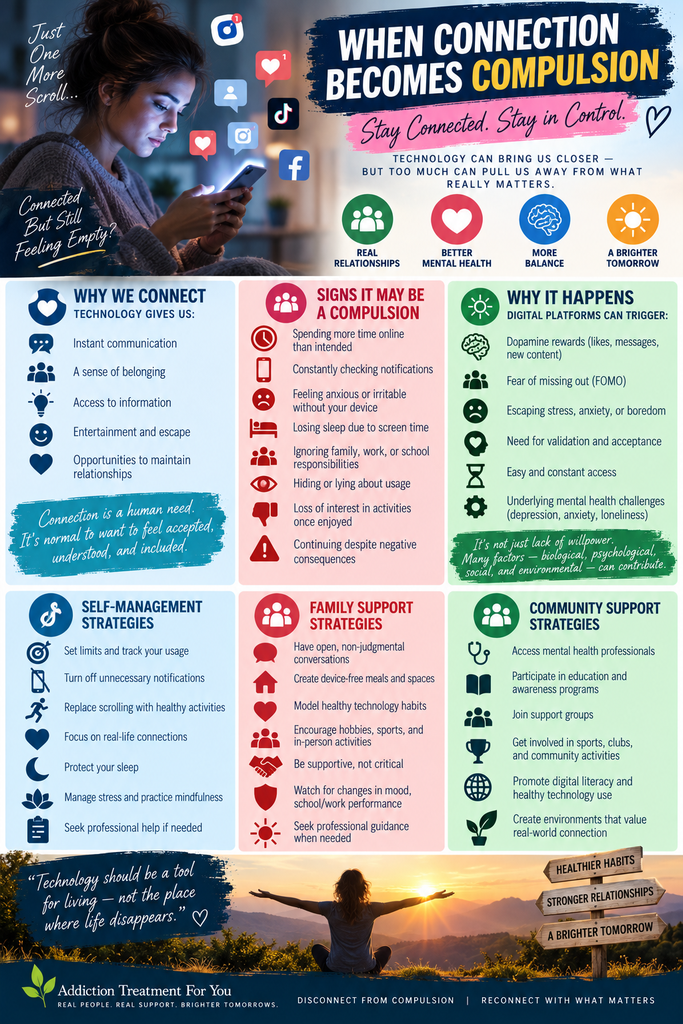
Technology helps us stay connected to family, friends, work, entertainment, and communities around the world. A smartphone can provide companionship during a lonely moment, information within seconds, and opportunities to maintain relationships that distance once made difficult.
But what happens when connection becomes compulsion?
For some people, checking notifications, scrolling social media, gaming, messaging, or staying constantly online gradually changes from something they choose to do into something they feel they have to do. The American Psychological Association notes that social media itself is not inherently good or bad, but excessive use can interfere with sleep, physical activity, and face-to-face interaction.
The goal is not necessarily to eliminate technology. It is to recognize when technology is no longer serving you—and begin rebuilding control.
Connection Is a Human Need
Wanting connection is normal.
People naturally want to feel noticed, accepted, understood, and included. Digital platforms can meet some of these needs by providing instant communication and feedback.
A message arrives.
Someone likes your photograph.
A video makes you laugh.
A notification creates curiosity.
For a moment, boredom, loneliness, stress, or anxiety may disappear.
The problem can develop when reaching for a device becomes the automatic response to nearly every uncomfortable emotion.
Instead of asking, “Do I want to check my phone?” a person may realize they are checking it without consciously deciding to.
When Healthy Use Becomes Problematic
Spending a lot of time online does not automatically mean someone has an addiction.
What matters is also control, consequences, and functioning.
Potential warning signs include:
- Repeatedly staying online longer than intended
- Trying unsuccessfully to reduce use
- Feeling a strong urge to constantly check notifications
- Becoming irritable or distressed when unable to connect
- Losing sleep because of scrolling, gaming, or messaging
- Ignoring school, work, household, or family responsibilities
- Checking the phone throughout meals and conversations
- Using technology primarily to escape difficult emotions
- Hiding or lying about the amount of time spent online
- Losing interest in hobbies that were previously enjoyable
- Continuing the behavior despite recognizing negative consequences
The APA identifies similar signs of problematic social-media use among adolescents, including using despite wanting to stop, repeatedly exceeding intended time, cravings, deception to maintain access, and disruption of relationships or educational opportunities.
Is Social Media Addiction an Official Diagnosis?
This distinction is important.
Terms such as “social media addiction,” “phone addiction,” and “internet addiction” are commonly used, but they should not automatically be treated as formal diagnoses. Problematic internet use remains an evolving area of research and clinical discussion.
Gaming is different. The World Health Organization recognizes gaming disorder in ICD-11. It involves impaired control over gaming, increasing priority given to gaming over other activities, and continuing or escalating gaming despite negative consequences, with significant impairment in functioning.
Therefore, someone who enjoys technology frequently should not automatically be labeled “addicted.”
The more useful question may be:
Is this behavior interfering with the life I want to live?
Why Is It So Difficult to Disconnect?
Digital activities can provide immediate rewards.
Notifications, messages, new videos, comments, games, and continuously changing content give people reasons to check again and again. Meanwhile, smartphones make access almost effortless.
But the emotional reason for compulsive use can be equally important.
Someone may reach for a phone when experiencing:
- Loneliness
- Anxiety
- Stress
- Boredom
- Sadness
- Rejection
- Insecurity
- Conflict
- Fear of missing out
- Difficulty being alone with their thoughts
The American Psychiatric Association notes that psychological, social, and environmental factors can contribute to problematic internet use, and that depression, anxiety, isolation, and limited in-person connection may increase vulnerability for some people.
That means simply saying “put your phone down” may not address the underlying problem.
Sometimes we also need to ask:
“What am I trying not to feel when I pick it up?”
Self-Management Strategies
The goal of self-management is not to punish yourself for enjoying technology. It is to restore intentional choice.
Helpful strategies include:
- Track your patterns. Review screen time reports to identify which apps consume the most time.
- Identify emotional triggers. Notice whether you scroll when lonely, anxious, angry, stressed, or bored.
- Turn off unnecessary notifications. Fewer interruptions can reduce automatic checking.
- Create phone-free areas. Consider keeping devices away from meals, family conversations, bathrooms, and the bedroom.
- Protect sleep. Establish a reasonable time to stop stimulating online activities.
- Replace rather than simply remove. Substitute scrolling with walking, reading, music, exercise, hobbies, or calling someone.
- Practice intentional use. Before opening an app, decide why you are opening it.
- Take planned breaks. Short periods away from social media can reveal which habits have become automatic.
- Strengthen offline relationships. Make regular face-to-face interaction part of your routine.
- Seek professional help when needed. If compulsive use is disrupting sleep, relationships, work, school, or emotional health, consider speaking with a qualified mental health professional.
Recent guidance from the American Psychiatric Association particularly emphasizes replacing compulsive digital habits with another activity rather than focusing only on stopping them.
Family Support Strategies
Problematic technology use can become a family problem when conversations turn into arguments about phones, gaming, screen time, or social media.
Constant criticism may increase defensiveness.
Instead of beginning with:
“You’re addicted to that phone!”
families can begin with:
“I’ve noticed you’re sleeping less and spending less time doing things you used to enjoy. Is something going on?”
Families can help by:
- Creating reasonable technology expectations together
- Having device-free family meals
- Modeling healthy technology habits themselves
- Avoiding humiliation or labels such as “lazy” or “addicted”
- Asking about the emotional reason behind excessive use
- Encouraging hobbies, sports, friendships, and outdoor activities
- Protecting consistent sleep routines
- Encouraging face-to-face conversations
- Watching for declining school or work performance
- Seeking professional help when functioning is significantly affected
For adolescents especially, adults should remember that rules are more convincing when adults model them too.
It is difficult to tell a teenager to put away the phone during dinner while every adult at the table is checking notifications.
Don’t Remove Connection Without Replacing It
This is particularly important.
Imagine that someone’s primary social interaction happens online. Taking away the phone may remove the problematic behavior—but it may also remove the person’s main source of belonging.
Families should therefore ask:
What will replace the screen?
Possibilities include:
- Family activities
- Sports or exercise
- Clubs
- Volunteering
- Art or music
- Religious or spiritual communities
- In-person friendships
- Outdoor recreation
- Classes
- Support groups
- Community organizations
The goal is not simply less internet.
The goal is more life outside the internet.
Community Support Strategies
Families and individuals should not have to address problematic technology use alone.
Community support may include:
- Mental health counselors
- Psychologists and psychiatrists
- Primary care professionals
- School counselors
- Family therapy
- Behavioral therapy
- Youth programs
- Recreation centers
- Support groups
- Digital-literacy education
- Community sports and clubs
- Programs promoting healthy social connection
Cognitive behavioral approaches may be used to address problematic internet behaviors and underlying coping patterns, while family therapy and treatment of coexisting mental health concerns may also be helpful depending on the individual.
Parents and Adolescents
Young people require particular attention because technology is deeply integrated into their education and social lives.
Simply measuring hours online may not tell the entire story.
Parents should also consider:
What is my child doing online?
Why are they using it?
What is the activity replacing?
A teenager spending two hours video chatting with supportive friends may have a very different experience from that of a teenager spending two hours compulsively comparing their appearance to edited social media images.
APA guidance emphasizes that social media should not replace opportunities for in-person, reciprocal interaction and recommends monitoring problematic patterns that interfere with daily functioning.
When Should Someone Seek Professional Help?
Professional evaluation may be appropriate when digital behavior repeatedly interferes with:
- Sleep
- Education
- Employment
- Relationships
- Hygiene or self-care
- Physical activity
- Emotional well-being
- Financial responsibilities
- Parenting or caregiving
- Attempts to control the behavior
A clinician can also evaluate whether depression, anxiety, ADHD, loneliness, trauma, or another condition may be contributing to the behavior.
Treatment should address the whole person—not merely the screen.
Relearning How to Be Present
One of the quieter consequences of compulsive digital behavior is losing comfort with ordinary moments.
Waiting in line becomes scrolling.
Eating becomes scrolling.
Watching television becomes scrolling while watching television.
A conversation pauses for three seconds—and someone reaches for a phone.
Recovery from compulsive technology habits can therefore involve relearning how to tolerate boredom, silence, waiting, and uncomfortable emotions without immediately seeking stimulation.
Try taking a short walk without your phone.
Eat one meal without a screen.
Have a conversation without checking notifications.
Sit quietly for ten minutes.
At first, these moments may feel strangely uncomfortable.
That discomfort can reveal just how automatic digital habits have become.
Connection Should Add to Life, Not Replace It
Technology has given us extraordinary ways to communicate. The solution is not to pretend that smartphones, social media, gaming, and online communities have no value.
For most people, they do.
The challenge is maintaining the difference between using technology for connection and depending on technology to avoid life.
Healthy connection should leave room for sleep.
For family.
For movement.
For work.
For hobbies.
For face-to-face friendships.
And sometimes, simply for silence.
Final Thoughts
When connection becomes compulsion, the answer does not necessarily require abandoning technology. It may require rebuilding boundaries around it.
Self-management can help someone recognize triggers and regain intentional control. Families can create supportive boundaries without shame. Communities can provide counseling, education, recreation, and meaningful opportunities for real-world connection.
Most importantly, excessive digital behavior should not automatically be interpreted as laziness or lack of discipline. Sometimes the screen is meeting an emotional need that has not been addressed elsewhere.
So instead of asking only:
“How many hours am I online?”
consider asking:
“What is my online life replacing?”
When digital connection begins replacing sleep, responsibilities, relationships, movement, emotional coping, and the ability to be present, it may be time to make a change.
Technology should be a tool for living—not the place where life disappears.
Frequently Asked Questions
Here are some common questions:
1. What does “when connection becomes compulsion” mean?
It describes the point at which using smartphones, social media, messaging, gaming, or other digital activities shifts from intentional connection toward behavior that feels difficult to control. The concern is not simply how many hours someone spends online, but whether the behavior interferes with sleep, relationships, work, school, health, or everyday responsibilities.
2. Is social media addiction a recognized mental health diagnosis?
“Social media addiction” is commonly used to describe problematic or compulsive behavior, but it is not currently a standalone diagnosis in the DSM-5-TR. Gaming disorder, however, is recognized in the World Health Organization’s ICD-11. It involves impaired control over gaming and continued or increasing gaming despite significant negative consequences.
3. What are signs that digital connection may be becoming compulsive?
Warning signs can include repeatedly spending more time online than intended, constantly checking notifications, unsuccessful attempts to reduce use, losing sleep, neglecting responsibilities, becoming distressed when unable to access a device, hiding the extent of use, and continuing to use despite problems with relationships or daily functioning.
4. Does spending several hours a day on a phone mean someone has an addiction?
Not necessarily. Someone may legitimately spend substantial time online for employment, education, relationships, entertainment, or creative activities. Functioning and control matter as much as screen time. A better question is whether digital behavior is causing significant problems or replacing important parts of life.
5. Why can social media feel so difficult to stop checking?
Digital platforms provide rapidly changing information and social rewards such as messages, likes, comments, videos, and notifications. Easy access also allows checking to become automatic. Emotional factors—including boredom, loneliness, stress, anxiety, and fear of missing out—can further reinforce repeated use.
6. Can loneliness contribute to compulsive digital behavior?
Yes. Someone who feels lonely may use online interactions to find connection and a sense of belonging. The difficulty occurs when digital interaction increasingly replaces opportunities for meaningful offline relationships or when someone remains emotionally isolated despite spending substantial time connected online.
7. Can anxiety or depression contribute to excessive internet use?
They can. Some people use scrolling, gaming, videos, or messaging to temporarily escape uncomfortable emotions. When problematic digital behavior occurs alongside persistent anxiety, depression, ADHD, trauma-related symptoms, or other concerns, professional evaluation can help identify what is driving the behavior.
8. Can excessive technology use affect sleep?
Yes. Late-night scrolling, gaming, messaging, and other stimulating activities can delay bedtime and shorten sleep. Notifications may also interrupt sleep. Establishing a consistent bedtime and keeping devices out of the bedroom may help protect sleep.
9. What self-management strategies can help?
Useful strategies include:
- Tracking screen time and identifying your highest-use apps
- Turning off unnecessary notifications
- Creating phone-free meals and activities
- Keeping devices away from the bed
- Setting specific times for social media
- Identifying emotions that trigger automatic scrolling
- Replacing screen time with exercise, hobbies, reading, or social activities
- Spending more time in face-to-face relationships
- Seeking professional support when self-directed changes are unsuccessful
10. Is a “digital detox” necessary?
Not necessarily. Completely eliminating technology may be unrealistic because digital tools are integrated into modern work, education, healthcare, and relationships. For many people, creating sustainable boundaries and learning intentional use may be more practical than attempting permanent abstinence.
11. How can families help someone whose technology use has become problematic?
Families can approach the situation with curiosity rather than shame. Instead of saying, “You’re addicted to your phone,” discuss specific changes such as lost sleep, declining grades, missed responsibilities, or withdrawal from family activities. Families can establish shared technology boundaries while modeling those behaviors themselves.
12. Should parents simply take a teenager’s phone away?
Sometimes temporary limits may be appropriate, but removing a device without understanding what it provides can miss the underlying problem. A teenager may rely on the internet for friendships, a sense of belonging, entertainment, or emotional escape. Parents should consider both what needs to decrease and what healthy activity or connection will replace it.
13. What are helpful family technology rules?
Families might establish device-free meals, protect bedtime from unnecessary screen use, schedule shared activities, limit notifications, and agree on situations where everyone puts their phones away. Rules are more effective when adults demonstrate the same healthy habits expected of children.
14. How can communities support healthier technology habits?
Schools and communities can provide digital literacy education, mental health services, recreational programs, sports, clubs, volunteer opportunities, and safe opportunities for face-to-face interaction. Healthcare professionals can also screen for sleep difficulties, emotional distress, and functional problems associated with excessive digital behavior.
15. When should someone consider professional help?
Professional support may be appropriate when digital behavior repeatedly interferes with sleep, education, employment, relationships, physical activity, self-care, parenting, finances, or emotional health—or when someone repeatedly tries to cut back but cannot.
16. What type of professional can help?
A primary care clinician can provide an initial assessment, while psychologists, psychiatrists, licensed therapists, and other qualified mental health professionals can evaluate behavioral patterns and possible underlying conditions. Treatment may include behavioral strategies, psychotherapy, family interventions, and treatment of coexisting mental health concerns.
17. Can someone have a healthy relationship with social media after compulsive use?
For many people, yes. The goal may be learning to use technology deliberately rather than automatically. Healthy digital use leaves enough room for sleep, exercise, responsibilities, relationships, hobbies, and periods when a person can comfortably be offline.
18. What is the biggest lesson from “When Connection Becomes Compulsion”?
The central lesson is that technology should support life rather than gradually replace it. Digital connection can be valuable, but problems can arise when someone loses control of its use or relies on it as the primary way to escape emotions and meet social needs.
Video: