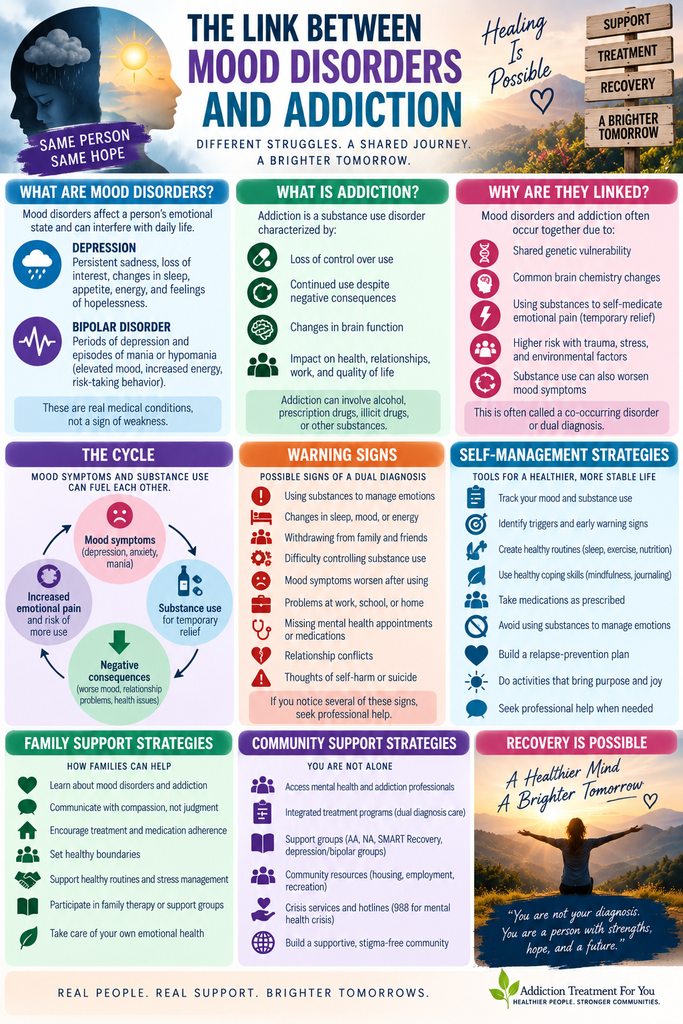
Mood disorders and addiction frequently overlap, creating a complicated cycle in which emotional symptoms and substance use can intensify one another. Someone living with depression or bipolar disorder may turn to alcohol or drugs hoping to escape sadness, anxiety, emotional pain, insomnia, or overwhelming mood changes. What begins as temporary relief can eventually create additional problems.
At the same time, alcohol and other drugs can worsen mood symptoms, interfere with treatment, disrupt sleep, damage relationships, and contribute to impulsive or dangerous behavior. When a mood disorder and substance use disorder occur together, healthcare professionals often refer to them as co-occurring disorders or a dual diagnosis.
Understanding this connection is important because treating only the substance use—or only the mood disorder—may leave an important part of the problem unaddressed.
What Are Mood Disorders?
Mood disorders are mental health conditions involving significant disturbances in emotional state. Two major categories are depressive disorders and bipolar disorders.
Depression can involve persistent sadness or loss of interest along with changes in sleep, appetite, energy, concentration, motivation, and feelings of worthlessness or hopelessness.
Bipolar disorders involve episodes of depression along with periods of mania or hypomania. Mania can include unusually elevated or irritable mood, decreased need for sleep, increased activity, racing thoughts, rapid speech, impulsivity, and risky decision-making.
These conditions are more than ordinary emotional ups and downs. Symptoms can significantly interfere with relationships, employment, education, health, and everyday functioning.
Why Are Mood Disorders and Addiction Connected?
There is no single explanation.
Mood disorders and substance use disorders can share biological, psychological, environmental, and social risk factors. Genetics, stress, trauma, family history, brain function, social environment, and access to substances may all influence vulnerability.
For some people, the mood disorder develops first.
For others, heavy or prolonged substance use may contribute to depression, anxiety, mood instability, or other psychiatric symptoms.
And sometimes it is difficult to determine which came first.
This is one reason a thorough professional evaluation is important.
The Self-Medication Cycle
Imagine someone experiencing depression.
They feel emotionally numb, lonely, exhausted, and unable to sleep. Alcohol temporarily helps them relax and fall asleep.
The brain begins making an association:
Emotional pain → alcohol → temporary relief.
The person drinks again whenever those feelings appear.
Over time, however, alcohol may disrupt sleep quality, worsen depression, increase interpersonal problems, and create tolerance or dependence.
Now the cycle becomes:
Depression → drinking → temporary relief → consequences → worsening depression → more drinking.
The substance that originally seemed to provide relief may eventually become another source of suffering.
Bipolar Disorder and Substance Use
Substance use can be particularly complicated for someone living with bipolar disorder.
During manic or hypomanic periods, impulsivity, increased energy, reduced sleep, and risk-taking may contribute to heavier alcohol or drug use. During depressive episodes, substances may be used to escape sadness, hopelessness, or emotional pain.
Alcohol and drugs can also complicate the recognition of bipolar symptoms because intoxication and withdrawal may sometimes resemble psychiatric symptoms.
For example, stimulants may produce agitation and sleeplessness, while alcohol withdrawal can cause anxiety, irritability, and sleep disturbance.
A clinician therefore needs to understand both the person’s psychiatric symptoms and substance-use history.
Warning Signs of Co-Occurring Problems
Possible signs that mood symptoms and substance use are interacting include:
- Using alcohol or drugs primarily to change or escape emotions
- Needing substances to relax, sleep, socialize, or feel “normal”
- Increasing substance use during depressive or manic periods
- Missing psychiatric medications because of alcohol or drug use
- Mood symptoms becoming worse after intoxication or withdrawal
- Repeated relationship, employment, school, financial, or legal problems
- Continuing substance use despite recognizing emotional consequences
- Increasing isolation
- Difficulty controlling the amount or frequency of substance use
- Repeated relapse during periods of emotional distress
- Suicidal thoughts occurring during intoxication, withdrawal, or severe depression
These signs do not establish a diagnosis by themselves. They indicate that professional assessment may be appropriate.
Why Treating Both Conditions Matters
A person with depression and alcohol use disorder does not have to decide which condition is the “real” problem.
Both deserve treatment.
Integrated treatment attempts to address mental health symptoms and substance use together rather than treating them as completely separate issues.
Depending on individual needs, treatment might include psychotherapy, addiction treatment, medications, peer support, psychiatric care, primary care, family involvement, and recovery services.
The treatment plan should be individualized.
Self-Management Strategies
Professional treatment can be strengthened by everyday strategies that help someone recognize patterns and maintain stability.
Helpful self-management strategies may include:
- Track mood and substance use. Recording both can reveal connections that are difficult to notice from memory.
- Identify emotional triggers. Loneliness, rejection, stress, conflict, boredom, and insomnia may increase vulnerability.
- Protect sleep. Regular sleep is particularly important for mood stability, especially for people with bipolar disorder.
- Take prescribed medication consistently. Do not stop psychiatric medications because you feel better or because of substance use without discussing it with the prescriber.
- Avoid using substances as emotional medication. Temporary relief can reinforce a harmful coping pattern.
- Develop alternative coping skills. Exercise, relaxation techniques, journaling, hobbies, structured activities, and supportive conversations may help.
- Create a relapse-prevention plan. Identify warning signs and determine whom to contact before a crisis develops.
- Maintain regular appointments. Continued treatment allows clinicians to recognize changes earlier.
- Build a daily routine. Regular meals, sleep, exercise, responsibilities, and recovery activities can provide stability.
- Ask for help early. Do not wait until symptoms become overwhelming.
Self-management should complement—not replace—professional care.
Family Support Strategies
Families often notice changes before the individual recognizes them.
A relative may observe that someone is sleeping less, drinking more, becoming increasingly isolated, missing work, spending impulsively, stopping medication, or behaving very differently.
These observations can be valuable.
Families can help by:
- Learning about both mood disorders and substance use disorders
- Encouraging integrated mental health and addiction treatment
- Speaking calmly about specific behaviors rather than attacking character
- Avoiding labels such as “lazy,” “crazy,” or “weak”
- Supporting medication adherence as directed by clinicians
- Learning early warning signs of depression, mania, relapse, and withdrawal
- Establishing healthy boundaries around money, housing, transportation, and substance use
- Avoiding covering up serious consequences
- Encouraging healthy sleep and daily routines
- Developing a crisis plan
- Participating in family therapy when appropriate
- Seeking their own emotional support
Supporting someone does not mean accepting unsafe behavior.
Compassion and boundaries can exist together.
What Families Should Watch For
A family member should pay particular attention when someone’s behavior changes rapidly.
Examples include:
- Suddenly needing very little sleep
- Becoming unusually energetic or agitated
- Rapid or pressured speech
- Impulsive spending
- Increased sexual or other risky behavior
- Dramatic increases in alcohol or drug use
- Severe withdrawal from friends and family
- Expressions of hopelessness
- Giving possessions away
- Talking about death
- Stopping medications
- Becoming confused, paranoid, or severely impaired
These changes may require urgent professional assessment.
Community Support Strategies
Recovery becomes stronger when people have access to multiple forms of support.
Community resources may include:
- Primary care professionals
- Psychiatrists and psychiatric clinicians
- Addiction medicine specialists
- Psychologists and therapists
- Integrated dual-diagnosis treatment programs
- Outpatient addiction treatment
- Residential treatment when clinically appropriate
- Peer recovery specialists
- Alcoholics Anonymous, Narcotics Anonymous, SMART Recovery, or other peer-support programs
- Depression and bipolar support groups
- Family support organizations
- Case management
- Housing and employment services
- Crisis services
Community support is especially important because recovery involves more than symptom reduction.
People also need relationships, housing, meaningful activity, healthcare, financial stability, purpose, and belonging.
Medication and Recovery
Medication can be an important part of treating some mood disorders and substance use disorders.
Antidepressants, mood stabilizers, antipsychotic medications, and other psychiatric treatments may be appropriate depending on the diagnosis.
Medications are also available for certain substance use disorders, including alcohol and opioid use disorders.
However, medication selection becomes more complicated when conditions occur together. Healthcare professionals need to consider interactions, intoxication and withdrawal risks, adherence, medical conditions, and the person’s overall treatment plan.
Never stop psychiatric medication abruptly or combine medication with alcohol or drugs without discussing the risks with a qualified clinician.
Recovery Requires More Than Removing the Substance
If someone has spent years using alcohol to manage depression, simply removing alcohol leaves an important question:
How will they manage depression now?
The same applies to someone using stimulants during depressive periods or substances during manic episodes.
Recovery therefore involves developing new ways of responding to emotions.
That may mean learning how to tolerate distress, communicate needs, manage conflict, establish routines, recognize mood changes, improve sleep, attend therapy, and ask for support.
Sobriety removes one problem.
Recovery helps build alternatives.
Reducing Shame
People with co-occurring disorders sometimes experience shame from multiple directions.
They may hear:
“You should control your drinking.”
“You should just think positively.”
“You need more discipline.”
“You don’t look depressed.”
“Why can’t you just stop?”
These statements misunderstand both addiction and mental illness.
Neither condition should be reduced to character weakness.
Accountability remains important in recovery, but accountability is different from humiliation.
People are more likely to discuss symptoms honestly when they believe they can ask for help without being degraded.
When a Crisis Requires Immediate Help
Mood disorders combined with substance use can increase the danger of impulsive behavior, overdose, severe withdrawal, and suicide.
Immediate help is especially important when someone:
- Talks about suicide or wanting to die
- Has attempted suicide
- Has taken a potentially dangerous overdose
- Cannot be safely awakened
- Has severe breathing difficulty
- Experiences seizures
- Develops severe confusion or hallucinations
- Becomes dangerously manic, psychotic, or aggressive
- Is unable to care for basic needs
In the United States, call or text 988 for the Suicide & Crisis Lifeline when someone is experiencing a suicidal or mental health crisis. For a medical emergency or suspected overdose, call 911 or seek emergency medical care.
A Better Question Than “Which Came First?”
Families often want to know:
“Did depression cause the addiction, or did the addiction cause the depression?”
Sometimes clinicians can identify the sequence clearly.
Sometimes they cannot.
But treatment does not always have to wait for a perfect answer.
A more useful question may be:
“What is keeping both problems going, and what can we do about it now?”
That shifts attention from blame toward recovery.
Final Thoughts
The link between mood disorders and addiction is complex. Depression or bipolar disorder can increase vulnerability to substance use, while alcohol and drugs can worsen mood symptoms and complicate psychiatric treatment.
When both conditions are present, addressing only one may leave the other driving instability.
Self-management can help individuals recognize triggers, protect sleep, follow treatment plans, and develop healthier coping strategies. Families can provide education, encouragement, boundaries, and early recognition of warning signs. Communities can provide integrated treatment, peer support, healthcare, crisis services, and opportunities for meaningful connection.
Most importantly, recovery should address the whole person.
Someone is not simply “an addict.”
Someone is not simply “bipolar.”
Someone is not simply “depressed.”
They are a person whose biological, psychological, social, and environmental needs may all influence recovery.
Treat the mood. Treat the addiction. Support the person. Build the life that makes recovery worth protecting.
Frequently Asked Questions
Here are some common questions:
1. What is the connection between mood disorders and addiction?
Mood disorders and substance use disorders can occur together and influence one another. Someone may use alcohol or drugs to cope with depression, mood instability, insomnia, or emotional distress, while substance use can also trigger or worsen psychiatric symptoms. When both conditions are present, they are commonly referred to as co-occurring disorders or a dual diagnosis.
2. Which mood disorders are commonly associated with substance use disorders?
Depressive disorders and bipolar disorders are important examples. However, having depression or bipolar disorder does not mean someone will develop an addiction. Risk differs substantially among individuals.
3. Why might someone with depression use alcohol or drugs?
Some people discover that substances temporarily reduce sadness, loneliness, anxiety, emotional pain, or insomnia. This is sometimes described as self-medication. The temporary relief can reinforce repeated use, even though the substance may ultimately worsen symptoms.
4. How can self-medication turn into addiction?
A person may begin learning a pattern such as: emotional distress → substance use → temporary relief. As the behavior is repeated, tolerance, cravings, loss of control, and negative consequences may develop. Substance use may then create additional emotional distress, reinforcing the cycle.
5. Can alcohol make depression worse?
Yes. Although alcohol may temporarily make someone feel relaxed, problematic drinking can interfere with sleep, relationships, judgment, treatment adherence, and emotional regulation. Heavy alcohol use and withdrawal may also intensify depressive or anxiety symptoms.
6. Why is substance use particularly concerning with bipolar disorder?
Mania and hypomania can involve impulsivity, reduced need for sleep, increased activity, and risky decision-making. Substance use may further impair judgment or destabilize mood. During depressive episodes, substances may instead be used to escape sadness or hopelessness.
7. Can drugs cause symptoms that resemble a mood disorder?
Yes. Intoxication and withdrawal can sometimes produce symptoms resembling psychiatric conditions. For example, stimulants can cause agitation, increased energy, and sleeplessness, while withdrawal from some substances may involve depression, irritability, or anxiety. This is why a careful clinical evaluation is important.
8. Which usually comes first—the mood disorder or addiction?
Either can occur first, and sometimes they emerge around the same period. Shared genetic, biological, psychological, environmental, and social factors can also contribute to both. Determining the sequence may require evaluating symptoms during periods of reduced or absent substance use.
9. What are warning signs of a possible co-occurring disorder?
Possible signs include:
- Using substances primarily to manage emotions
- Drinking or using more during mood episodes
- Increasing isolation
- Significant changes in sleep or energy
- Difficulty controlling substance use
- Missing medications or appointments
- Mood symptoms worsening after substance use
- Repeated relapse during emotional distress
- Problems at work, school, or home
- Increasing impulsive or dangerous behavior
- Suicidal thoughts or severe hopelessness
These signs warrant attention but do not establish a diagnosis by themselves.
10. Should addiction and a mood disorder be treated separately?
When possible, coordinated or integrated treatment is helpful because the conditions can affect one another. Treating substance use without addressing significant depression or bipolar symptoms may leave an important relapse trigger untreated, while psychiatric treatment may be complicated by ongoing substance use.
11. What treatments may be used for co-occurring disorders?
Treatment depends on the individual and may include psychotherapy, psychiatric care, addiction treatment, medications, peer recovery support, behavioral interventions, family involvement, and medical care. Some people need outpatient treatment, while others may require more intensive services.
12. Can medication be used when someone also has an addiction?
Yes. Medications may be appropriate for mood disorders and certain substance use disorders. Treatment should be individualized because clinicians need to consider medication interactions, substance use, withdrawal risk, medical conditions, and the person’s psychiatric history.
13. What self-management strategies can support recovery?
Helpful strategies can include tracking mood and substance use, protecting sleep, identifying triggers, maintaining treatment appointments, taking medications as prescribed, developing healthier coping skills, creating a relapse-prevention plan, establishing structured daily routines, and contacting supportive people when warning signs emerge.
14. Why is sleep particularly important?
Sleep and mood regulation are closely connected. Significant changes in sleep may worsen emotional functioning, and reduced need for sleep can be an important warning sign of mania or hypomania in someone with bipolar disorder. Substance use can further disrupt normal sleep patterns.
15. How can families help someone with both conditions?
Families can learn about addiction and mood disorders, encourage professional treatment, communicate without shaming, support healthy routines, recognize early warning signs, and establish appropriate boundaries. Families can also participate in therapy or support programs when appropriate.
16. What should families avoid doing?
Families should avoid humiliating the person, dismissing psychiatric symptoms, providing money that knowingly supports substance use, covering up dangerous behavior, or assuming they can personally control another person’s recovery. Support and boundaries can exist together.
17. What community resources can support recovery?
Resources may include psychiatrists, addiction medicine professionals, therapists, primary care clinicians, integrated dual-diagnosis programs, peer recovery specialists, outpatient or residential programs, and groups such as AA, NA, SMART Recovery, or mood-disorder support groups.
18. Can someone fully recover when they have both addiction and a mood disorder?
Recovery is possible. Some mood disorders require long-term management, and substance use disorders may also require ongoing recovery support. A meaningful recovery can include improved symptom control, sustained remission from problematic substance use, healthier relationships, better functioning, and improved quality of life.
19. Why is reducing shame important?
Shame can discourage people from revealing substance use or psychiatric symptoms and delay treatment. Addiction and mood disorders are health conditions—not evidence that someone is weak or morally defective. Accountability remains important, but it can occur without humiliation.
20. When does the situation become an emergency?
Immediate help is warranted when someone has suicidal intent, attempts suicide, experiences a suspected overdose, cannot be awakened, has serious breathing problems, experiences seizures or severe withdrawal, or becomes dangerously manic, psychotic, confused, or unable to care for themselves. In the United States, call or text 988 for a suicidal or mental health crisis; call 911 for a life-threatening medical emergency.
21. What is the biggest lesson about mood disorders and addiction?
The most important lesson is that these problems can become interconnected, so recovery should address the whole person rather than one symptom at a time. Understanding mood symptoms, treating problematic substance use, strengthening coping skills, involving supportive family when appropriate, and connecting with community resources can all contribute to recovery.
Video: What nobody tells you about mood disorders and addiction #mentalhealthawareness #shorts