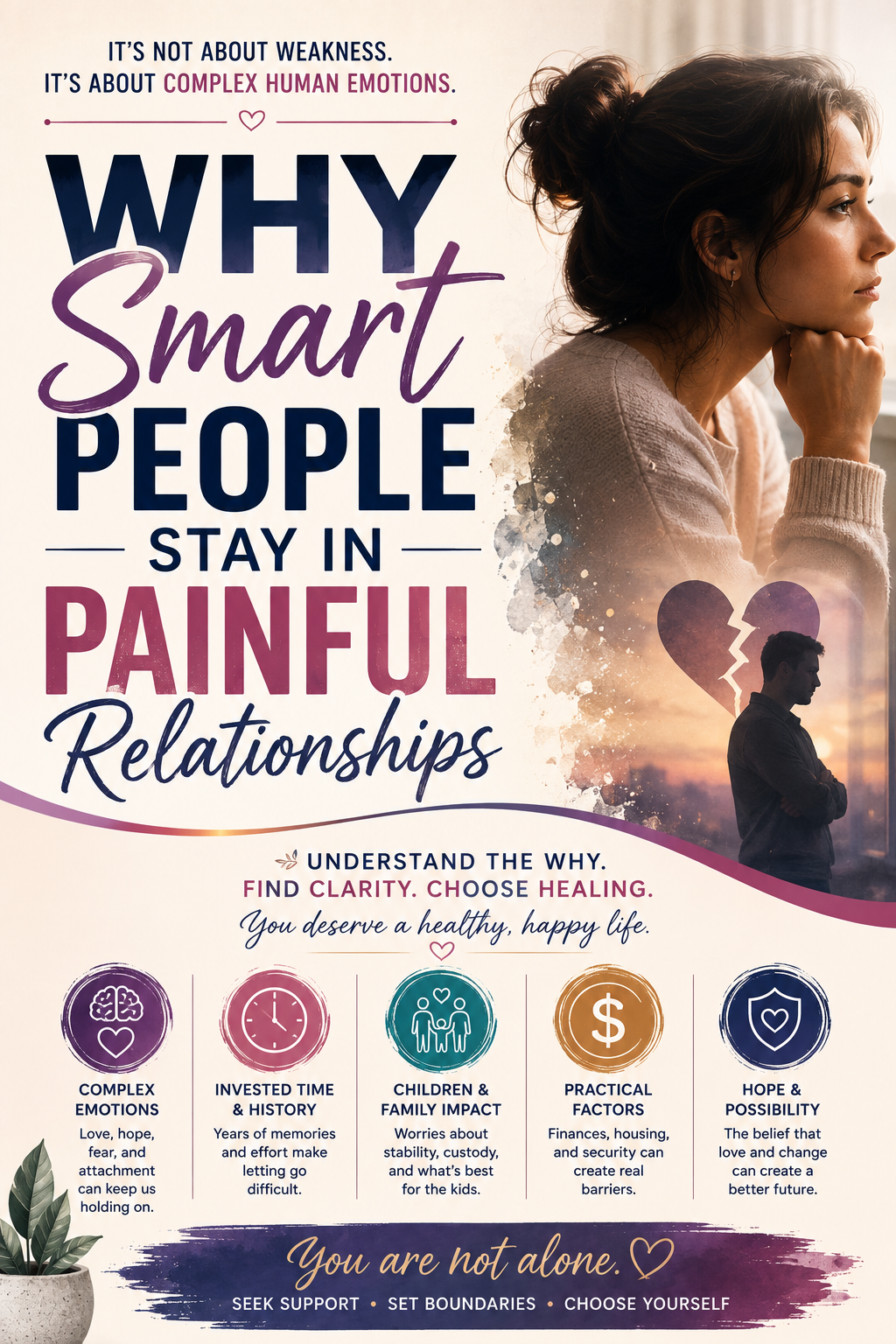
Intelligence does not protect someone from becoming trapped in a painful relationship. A highly educated, successful, emotionally aware person may recognize that a relationship is unhealthy and still struggle to leave. Love, attachment, hope, fear, financial concerns, children, isolation, cultural expectations, and patterns of emotional manipulation can all influence the decision to stay.
The better question is often not, “Why doesn’t this person just leave?” but “What makes leaving so complicated?”
Understanding these factors replaces judgment with insight and can help people make healthier, safer decisions.
Intelligence and Emotional Attachment Are Different
A person may make excellent decisions professionally while struggling with decisions involving someone they love. Relationships activate emotions, attachments, memories, expectations, and fears, which differ from those involved in analytical problem-solving.
Someone may logically recognize, “This relationship is hurting me,” while emotionally thinking, “Maybe things will get better.”
Both thoughts can exist at the same time.
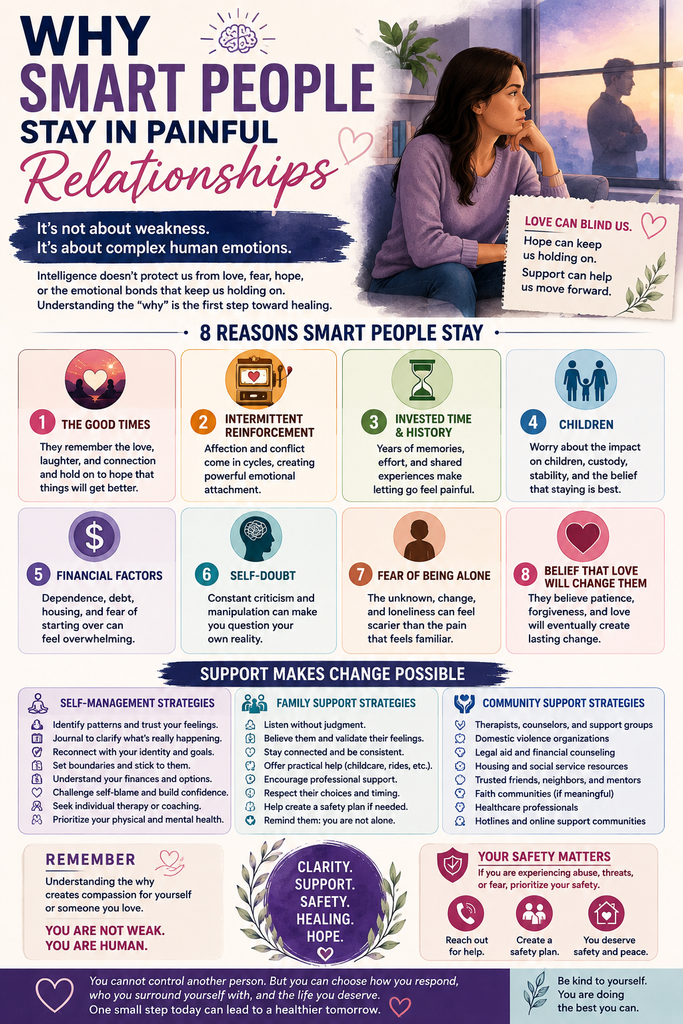
1. They Remember the Good Times
Painful relationships are rarely painful every moment. There may also be affection, laughter, companionship, intimacy, apologies, gifts, or periods of genuine connection.
These positive experiences can create hope that the relationship will eventually return to what it once was.
A person may think:
- “This isn’t who he really is.”
- “We used to be so happy.”
- “He’s going through a difficult time.”
- “I know he can change.”
- “Things are getting better.”
Hope can be powerful, even when the pattern repeatedly returns.
2. Intermittent Reinforcement Can Strengthen Attachment
When affection and conflict alternate unpredictably, the emotional experience can become particularly difficult to leave.
A partner may experience:
Pain → Apology → Affection → Hope → Calm → Conflict → Pain
The relief following conflict can feel intensely rewarding. This unpredictable pattern of positive and negative experiences is sometimes described as intermittent reinforcement.
Instead of asking why someone stays, it may be more useful to recognize how powerful unpredictable rewards can become.
3. They Have Invested Years in the Relationship
Leaving may mean confronting the loss of years of emotional, financial, and practical investment.
A person may think:
- “We’ve been together for 20 years.”
- “We’ve built a family.”
- “We’ve worked so hard for this marriage.”
- “I don’t want everything we’ve built to disappear.”
Past investment can make starting over feel overwhelming. However, time already invested does not necessarily determine what someone should choose for the future.
4. Children Can Make the Decision More Complicated
Parents may remain together because they believe preserving the household is best for their children.
They may worry about custody, finances, school changes, holidays, housing, or the emotional consequences of separation.
However, children also learn about relationships by observing adults. Chronic hostility, intimidation, humiliation, or emotional instability can influence their understanding of what relationships are supposed to look like.
The goal should not simply be keeping a household together at any cost. The goal should be creating the healthiest and safest environment possible for children.
5. Financial Dependence Can Create Real Barriers
Leaving is not merely an emotional decision.
A person may need to consider:
- Housing
- Income
- Childcare
- Healthcare
- Transportation
- Joint debt
- Retirement savings
- Legal expenses
- Employment
- Access to bank accounts
Someone can understand perfectly well that a relationship is unhealthy yet lack the resources to leave safely.
6. Self-Doubt Can Develop Gradually
Repeated criticism, blame, humiliation, or manipulation may gradually change how someone sees themselves.
A previously confident person may begin questioning:
“Am I overreacting?”
“Maybe I’m the problem.”
“Maybe nobody else would want me.”
“Perhaps I really am too sensitive.”
When someone repeatedly receives messages questioning their judgment, trusting their own perceptions may become increasingly difficult.
7. Fear of Being Alone Can Be Powerful
Leaving may mean losing a partner, home, routine, mutual friendships, financial stability, family traditions, and an imagined future all at once.
Even an unhappy relationship can feel familiar.
The unknown may initially seem more frightening than familiar pain.
8. They Keep Believing Love Will Create Change
Intelligent and compassionate people often see potential in others.
They may believe that enough patience, understanding, forgiveness, encouragement, or sacrifice will eventually produce change.
But love cannot substitute for another person’s accountability.
A partner must ultimately choose to recognize harmful behaviors and work toward changing them.
Self-Management Strategies
The goal of self-management is not to force yourself into an immediate decision. It is to strengthen clarity, independence, emotional health, and personal safety.
Helpful strategies include:
- Identify patterns. Look at repeated behavior rather than isolated arguments or apologies.
- Write down what happens. Journaling can help clarify recurring patterns and how they affect you.
- Reconnect with your identity. Resume hobbies, friendships, education, work, or activities that provide meaning.
- Establish boundaries. Decide which behaviors you will no longer participate in or tolerate.
- Protect financial awareness. Understand household income, expenses, debts, insurance, and important documents.
- Challenge self-blame. Another person’s harmful behavior is not automatically evidence that you caused it.
- Practice emotional regulation. Exercise, mindfulness, adequate sleep, and relaxation strategies can improve decision-making under stress.
- Consider individual counseling. A therapist can provide a confidential space to examine relationship patterns.
- Create a safety plan when necessary. If threats, violence, stalking, or coercive control are present, professional safety planning may be important.
Family Support Strategies
Family members often want to say, “Just leave.”
Although well-intended, this response may make someone feel misunderstood or ashamed and could cause them to withdraw further.
Families can instead:
- Listen without immediately criticizing the partner.
- Believe the person’s experiences and concerns.
- Avoid calling them weak or foolish for staying.
- Maintain regular contact.
- Offer practical assistance when appropriate.
- Help with transportation or childcare when possible.
- Encourage professional counseling.
- Respect that major relationship decisions may take time.
- Learn about emotional abuse and coercive control.
- Help develop a safety plan when abuse is present.
Support works best when it increases someone’s options rather than replacing one controlling relationship with another source of pressure.
Community Support Strategies
Isolation can make painful relationships much harder to navigate. Community connections provide perspective, resources, and practical assistance.
Helpful resources may include:
- Individual therapists and counselors
- Marriage and family therapists when couples counseling is appropriate and safe
- Support groups
- Domestic violence organizations
- Legal aid programs
- Financial counselors
- Housing assistance
- Social service organizations
- Faith communities when personally meaningful
- Trusted friends, coworkers, and neighbors
- Healthcare professionals
Community support can help someone realize that they do not have to solve every problem alone.
Understanding His or Her Journey
A person who remains in a painful relationship may be experiencing several competing emotions simultaneously: love, grief, hope, fear, loyalty, guilt, embarrassment, attachment, and uncertainty.
Leaving can also be a process rather than a single event.
Some people emotionally detach before physically leaving. Others establish boundaries and attempt counseling. Some leave and later return, only to make another decision. Others determine that the relationship can improve because both partners genuinely participate in change.
Every situation is different.
When a Painful Relationship Becomes an Abusive Relationship
Relationship conflict and abuse are not the same thing.
Warning signs requiring greater concern include:
- Physical violence
- Threats of violence
- Sexual coercion
- Stalking
- Intimidation
- Destruction of property
- Extreme jealousy or monitoring
- Isolation from friends and relatives
- Controlling access to money
- Preventing someone from working
- Threatening children, pets, or loved ones
- Creating fear about what will happen if the person leaves
When these behaviors are present, safety should take priority over repairing the relationship. Leaving an abusive relationship can sometimes increase danger temporarily, which is why individualized safety planning with qualified domestic violence professionals can be important.
Intelligence Does Not Make Someone Immune to Relationship Pain
Smart people do not stay in painful relationships because they lack intelligence.
They may stay because they love someone. They may hope for change. They may share children, finances, memories, and responsibilities. They may fear starting over. They may have been gradually isolated or emotionally worn down. Sometimes they simply are not ready to make a different decision yet.
Understanding these realities changes the conversation.
Instead of asking:
“How could someone so smart stay?”
Ask:
“What emotional, practical, or safety barriers are making change difficult, and how can we help?”
Intelligence may help someone understand a relationship, but understanding alone does not automatically dissolve attachment. Healing often begins when people regain clarity, strengthen their support system, rebuild confidence, establish boundaries, and recognize that protecting their well-being is not a failure.
Sometimes the smartest decision is not made quickly. It is made when someone finally has the information, resources, support, and safety needed to choose what comes next.
Frequently Asked Questions
Here are some common questions:
1. Why do intelligent people stay in unhealthy relationships?
Intelligence does not eliminate emotional attachment. Love, hope, shared history, children, finances, fear, loneliness, cultural expectations, and practical barriers can make leaving extremely complicated. Someone can recognize that a relationship is unhealthy while still feeling emotionally connected to their partner.
2. Does staying in a painful relationship mean someone is weak?
No. Staying does not automatically indicate weakness, poor judgment, or lack of intelligence. Relationship decisions involve emotional, financial, social, family, and sometimes safety considerations that outsiders may not fully understand.
3. Why doesn’t someone simply leave when they know the relationship is unhealthy?
Leaving can involve much more than ending an emotional connection. A person may need housing, money, childcare, transportation, legal assistance, healthcare coverage, employment, or a safety plan. They may also fear losing their family structure, social network, or financial stability.
4. Can love make someone overlook unhealthy behavior?
Yes. Strong emotional attachment can influence how people interpret a partner’s behavior. Someone may focus on positive memories, apologies, promises, or periods when the relationship improves, and continue to hope that those good periods will eventually become permanent.
5. What is intermittent reinforcement in relationships?
Intermittent reinforcement occurs when positive experiences and painful experiences happen unpredictably. A relationship may cycle through conflict, apology, affection, hope, calm, and another conflict. Because the positive experiences are unpredictable, they can sometimes strengthen emotional attachment and hope.
6. Why do successful people sometimes tolerate unhealthy relationships?
Professional competence and relationship decision-making involve different processes. Someone can confidently manage employees, finances, patients, students, or complicated projects while experiencing fear, attachment, self-doubt, or uncertainty within an intimate relationship.
7. Why can years invested in a relationship make leaving harder?
Someone may feel that ending the relationship means losing years of effort, memories, sacrifices, and shared accomplishments. They may think, “I’ve already invested so much.” However, past investment does not necessarily determine what will create the healthiest future.
8. Why do parents sometimes stay because of their children?
Parents may worry about custody, housing, finances, school changes, holidays, and the emotional impact of separation. They may genuinely believe staying together provides stability. However, children’s well-being also depends on the emotional safety and health of their home environment.
9. Can repeated criticism make an intelligent person doubt themselves?
Yes. Persistent criticism, blame, humiliation, or manipulation may gradually undermine confidence. A person who was once extremely self-assured may begin to question their perceptions and wonder whether they are responsible for the relationship’s problems.
10. Why is being alone sometimes more frightening than staying?
Leaving may involve losing familiar routines, companionship, mutual friendships, financial security, traditions, and expectations about the future. Familiar pain can sometimes feel more predictable than an uncertain future.
11. Can someone love their partner and still recognize that the relationship is unhealthy?
Absolutely. Love and relationship health are not the same thing. Someone can genuinely love another person while recognizing that certain behaviors are damaging their emotional or physical well-being.
12. Can one partner’s love change the other person?
Love can encourage and support change, but it cannot force it. Sustainable behavioral change requires the other partner to recognize the problem, accept responsibility, and consistently work toward healthier behavior.
13. How can someone gain clarity about a painful relationship?
Helpful strategies may include:
- Identifying recurring relationship patterns
- Journaling significant interactions
- Talking with trusted people
- Reconnecting with personal interests and goals
- Establishing boundaries
- Understanding personal finances
- Seeking individual counseling
- Evaluating whether promises are followed by consistent behavioral change
Clarity often develops gradually rather than after one conversation or argument.
14. How should family members help someone who stays?
Avoid repeatedly saying, “Why don’t you just leave?” Instead, listen without judgment, remain connected, respect the person’s decision-making process, offer practical assistance, encourage professional support, and help them explore options.
15. Can couples counseling help a painful relationship?
Sometimes. Couples therapy may help partners improve communication, conflict resolution, and relationship functioning when both people can participate safely and honestly. When coercive control, intimidation, or abuse is present, individual guidance and safety planning may need to come first.
16. What’s the difference between an unhappy relationship and an abusive relationship?
Relationship dissatisfaction can involve arguments, emotional distance, incompatibility, or poor communication. Abuse involves patterns of power, control, intimidation, coercion, threats, physical violence, sexual coercion, stalking, financial control, or other behaviors that create fear or restrict another person’s freedom.
17. Why might someone leave and then return?
Emotional attachment, financial problems, children, promises of change, fear, loneliness, housing difficulties, or safety concerns can influence a return. Leaving a difficult relationship may be a process rather than a single decision.
18. What should someone do if they feel unsafe?
Safety should become the priority when threats, violence, stalking, coercive control, or intimidation are present. A qualified domestic violence professional can help develop an individualized safety plan and identify local resources. In an immediate emergency, contact emergency services.
19. Can a painful relationship become healthy again?
Some relationships can improve when both partners recognize the problems and consistently participate in meaningful change. Progress should be evaluated through sustained behavior—such as accountability, respect, communication, empathy, and honoring boundaries—rather than promises alone.
20. What is the most important thing to understand about someone who stays?
Do not confuse staying with stupidity.
A person may simultaneously understand that a relationship is painful, love their partner, hope for improvement, worry about their children, fear financial instability, and struggle with the possibility of starting over.
Instead of asking “Why are you still there?”, a more supportive question is:
“What would help you feel safer, stronger, and more able to make the decision that’s right for you?”
Compassion, practical resources, healthy boundaries, and supportive relationships can help someone move from confusion toward clarity—whatever decision they ultimately make.
Video: Why You Can’t Escape a Toxic Relationship #toxicrelationships #shorts