Living with a husband who displays narcissistic behaviors can be emotionally exhausting. He may frequently seek admiration, become defensive when criticized, minimize your feelings, blame others, try to control conversations, or have difficulty acknowledging the harm his behavior causes. These patterns can affect communication, trust, intimacy, and the emotional health of the entire family.
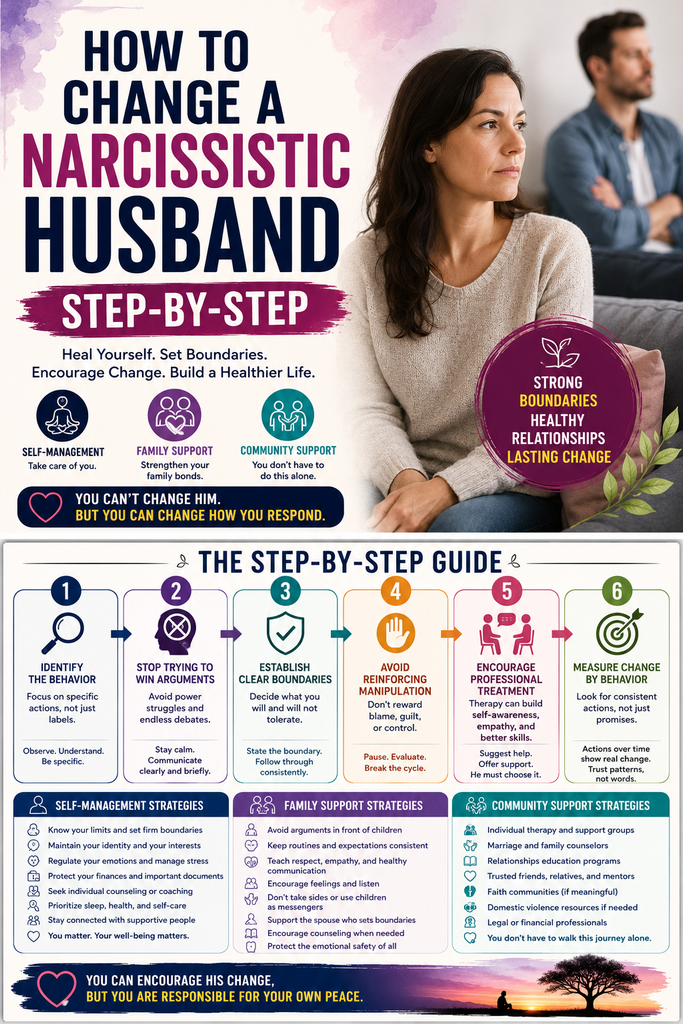
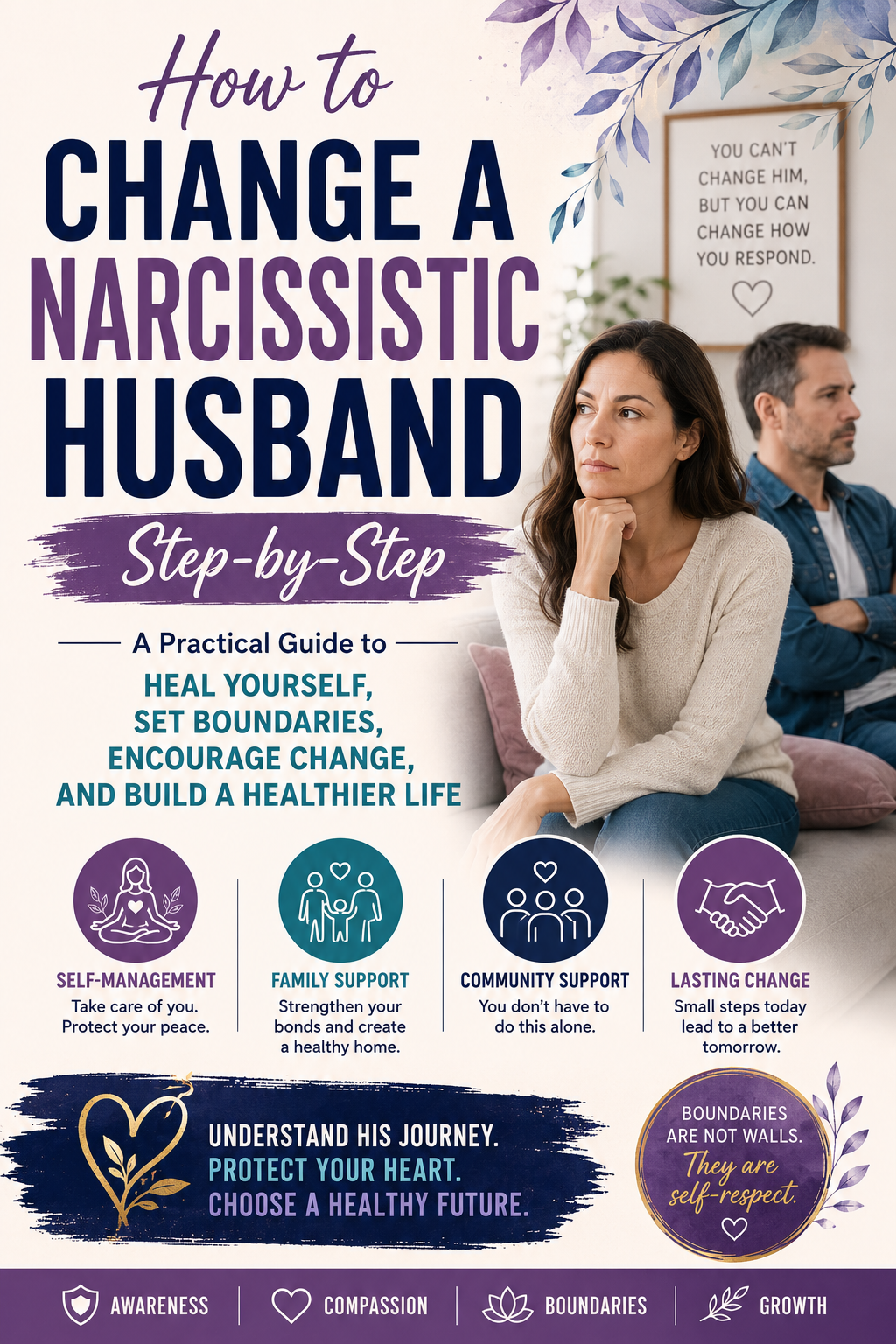
How to Change a Narcissistic Husband Step-by-Step
There is an important distinction between narcissistic traits and narcissistic personality disorder (NPD). Many people occasionally behave selfishly, defensively, or arrogantly. NPD is a mental health condition that requires evaluation by a qualified professional. A spouse should avoid trying to diagnose a partner based solely on difficult behavior.
Most importantly, you cannot force a narcissistic husband to change. Meaningful change requires his willingness to recognize problematic behaviors, accept responsibility, and consistently work on healthier patterns. What you can change is how you respond, what boundaries you establish, and what behaviors you are willing to accept.
Step 1: Identify the Behavior, Not Just the Label
Instead of repeatedly calling your husband a narcissist, identify specific behaviors that are creating problems.
Examples may include:
- Constantly dismissing your feelings
- Refusing to accept responsibility
- Blaming you for his behavior
- Controlling money, friendships, or activities
- Requiring excessive praise or attention
- Reacting strongly to criticism
- Manipulating conversations
- Giving the silent treatment as punishment
- Ignoring personal boundaries
Focusing on observable behavior makes communication clearer and reduces arguments about labels.
Step 2: Stop Trying to Win Every Argument
Arguments with someone who is highly defensive can quickly become circular. Hours may be spent debating who said what without addressing the original problem.
Try to communicate calmly and briefly. State the issue, explain what you need, and avoid becoming trapped in endless attempts to prove your perspective.
You can disagree without continuing the argument indefinitely.
Step 3: Establish Clear Boundaries
Boundaries describe what you will do when unacceptable behavior occurs. They are not attempts to control another person.
For example, instead of saying, “You are not allowed to yell at me,” a boundary might be: “If yelling begins, I will end the conversation and return when we can speak calmly.”
Healthy boundaries may involve:
- Ending conversations involving insults or threats
- Protecting personal privacy
- Maintaining appropriate friendships
- Keeping access to personal resources
- Refusing to participate in humiliating conversations
- Taking time away from escalating arguments
- Protecting children from adult conflicts
A boundary becomes meaningful when it is consistently followed.
Step 4: Avoid Reinforcing Manipulation
Sometimes unhealthy relationship patterns continue because one person repeatedly gives in simply to restore peace.
Watch for patterns involving guilt, intimidation, blame shifting, excessive flattery followed by demands, or denial of events that occurred.
Instead of immediately defending yourself, pause and evaluate what is happening.
Ask yourself:
- Am I being pressured into something I do not want?
- Am I apologizing simply to stop the conflict?
- Are my feelings repeatedly being dismissed?
- Am I becoming afraid to express disagreement?
- Is the same harmful behavior repeatedly occurring without accountability?
Recognizing patterns can make them easier to interrupt.
Step 5: Encourage Professional Treatment
If your husband recognizes that his behavior is harming relationships, psychotherapy may help him develop greater self-awareness and healthier ways of relating to others.
Treatment may focus on:
- Emotional regulation
- Empathy and perspective-taking
- Communication skills
- Anger management
- Self-esteem
- Relationship patterns
- Responses to criticism
- Accountability
- Childhood experiences or other contributing factors
Change is usually gradual. Attending a few counseling sessions does not automatically mean long-standing behavior patterns have changed.
Step 6: Measure Change by Behavior
Promises can sound convincing after a major argument. Sustainable change is demonstrated through repeated actions.
Signs of meaningful progress may include:
- Accepting responsibility without immediately blaming someone else
- Offering genuine apologies
- Respecting boundaries
- Listening without constantly interrupting
- Showing concern for another person’s feelings
- Tolerating disagreement
- Continuing therapy
- Changing harmful behavior consistently over time
Look for patterns rather than isolated good days.
Self-Management Strategies
Supporting someone else’s growth should never require abandoning your own emotional well-being. Developing your own coping strategies can help you think more clearly and respond intentionally.
Helpful strategies include:
- Know your limits. Decide which behaviors you will and will not tolerate.
- Maintain your identity. Continue friendships, interests, goals, and activities outside the relationship.
- Practice emotional regulation. Pause before responding during emotionally intense conversations.
- Document important information when appropriate. Keeping accurate records can be useful when conflicts involve finances, parenting, or recurring disputes.
- Protect financial independence. Understand household finances and maintain appropriate access to important documents and resources.
- Challenge self-doubt. Repeated criticism can gradually influence how someone sees themselves.
- Seek individual counseling. Therapy can provide a private environment for examining relationship patterns and developing healthy boundaries.
- Prioritize physical health. Sleep, exercise, nutrition, and social connection can improve resilience during chronic relationship stress.
Your goal does not have to be making him understand everything. Sometimes the healthier goal is to decide how you will respond, regardless of whether he agrees.
Family Support Strategies
Narcissistic behaviors can affect the entire household. Children and relatives may become caught between family members, pressured to choose sides, or used to carry messages.
Families can support healthier relationships by:
- Avoiding arguments in front of children whenever possible.
- Refusing to use children as messengers between parents.
- Maintaining predictable household expectations.
- Supporting respectful communication.
- Encouraging family members to express emotions safely.
- Avoiding excuses for repeatedly harmful behavior.
- Supporting the spouse who establishes reasonable boundaries.
- Encouraging professional counseling when relationship patterns become persistent.
- Teaching children that disagreement does not justify humiliation, intimidation, or cruelty.
Family support should promote accountability without turning every disagreement into a battle between family members.
Community Support Strategies
Isolation can make unhealthy relationship patterns harder to recognize. Maintaining supportive connections outside the marriage can provide perspective and practical assistance.
Community resources may include:
- Individual therapists or counselors
- Licensed marriage and family therapists
- Mental health professionals experienced with personality disorders
- Relationship education programs
- Support groups
- Trusted friends and relatives
- Faith communities when personally meaningful
- Domestic violence organizations when controlling, threatening, or abusive behaviors are present
- Legal or financial professionals when significant financial or custody concerns exist
Couples counseling may help some relationships, particularly when both partners can participate safely and honestly. However, when coercive control, intimidation, or abuse is present, individual professional guidance may be more appropriate before pursuing couples therapy.
Understanding His Journey Without Excusing Harm
Some narcissistic behaviors may develop around deep insecurity, difficulty regulating emotions, sensitivity to rejection or criticism, learned relationship patterns, or other psychological factors. Understanding these possibilities can provide context, but understanding a behavior does not require accepting it.
Compassion and accountability can exist together.
A husband can have emotional struggles and still be responsible for how he treats his spouse and children. Similarly, a wife can care about her husband’s psychological well-being while maintaining firm boundaries around disrespectful or harmful behavior.
When the Relationship Becomes Unsafe
Narcissistic traits should never be used to excuse abuse. Emotional abuse, threats, stalking, physical violence, sexual coercion, financial control, intimidation, or deliberately isolating someone from friends and family require greater attention than ordinary communication strategies.
If you feel unsafe, prioritize safety and seek confidential assistance from an appropriate professional or domestic violence resource. Do not rely solely on confronting the person or attempting to change his personality.
Change Starts With Responsibility
There is no guaranteed step-by-step method for transforming a narcissistic husband. Long-term personality and relationship patterns rarely disappear because a spouse finds the perfect words.
Real change begins when he recognizes the problem, accepts responsibility, seeks appropriate help, and repeatedly behaves differently.
Your responsibility is different. You can communicate clearly, set boundaries, protect your well-being, maintain supportive relationships, and decide what you need in a healthy marriage.
You can encourage his journey toward change—but you do not have to lose yourself while waiting for it to happen.
Frequently Asked Questions
Here are some common questions:
1. Can you really change a narcissistic husband?
You cannot force another adult to change. You can encourage healthier behavior, communicate expectations, establish boundaries, and suggest professional treatment, but meaningful change ultimately requires his willingness to recognize problems and behave differently.
2. What is the first step when dealing with a narcissistic husband?
Focus on specific behaviors rather than immediately using the label “narcissist.” Identify patterns such as blaming, excessive criticism, controlling behavior, manipulation, lack of accountability, or repeated dismissal of your feelings.
3. Does having narcissistic traits mean my husband has narcissistic personality disorder?
No. People can display narcissistic traits without having narcissistic personality disorder (NPD). NPD is a diagnosable mental health condition that requires assessment by a qualified mental health professional.
4. Should I tell my husband that he is a narcissist?
Labeling him during an argument may increase defensiveness without changing the behavior. It is often more productive to describe the specific problem: “When you insult me during disagreements, I will end the conversation until we can speak respectfully.”
5. What boundaries should I establish?
Boundaries depend on the relationship but may address:
- Yelling and insults
- Invasions of privacy
- Financial control
- Repeated criticism
- Manipulation
- Threats or intimidation
- Disrespect toward children
- Interference with friendships or family relationships
A boundary should clearly explain what you will do if unacceptable behavior occurs.
6. Why doesn’t arguing with him seem to work?
Highly defensive people may experience disagreement as criticism or rejection. Arguments can become focused on blame, proving who is right, or revisiting unrelated problems. Brief, specific communication may be more productive than repeatedly trying to win the argument.
7. Should I ignore narcissistic behavior?
Not necessarily. Ignoring every problem may allow unhealthy patterns to continue. Instead, identify which behaviors require boundaries, which disagreements are not worth escalating, and which situations require professional intervention.
8. Can therapy change narcissistic behavior?
Psychotherapy may help a motivated person develop greater self-awareness, emotional regulation, empathy, communication skills, and healthier relationship patterns. However, treatment requires participation and usually takes time. Therapy attendance alone does not guarantee change.
9. What are signs that my husband is genuinely changing?
Look for consistent behavior rather than promises.
Possible signs include:
- Accepting responsibility
- Respecting boundaries
- Listening to your concerns
- Showing greater empathy
- Apologizing without immediately blaming you
- Tolerating disagreement
- Reducing controlling behaviors
- Continuing treatment
- Demonstrating improvement over time
10. What if he apologizes but keeps repeating the same behavior?
An apology becomes meaningful when behavior changes. Repeated cycles of harmful behavior followed by apologies and promises should be evaluated by what happens afterward, not simply by how convincing the apology sounds.
11. How can I communicate without escalating arguments?
Keep your message calm, brief, and specific. Address one behavior at a time, avoid unnecessary personal attacks, and disengage when conversations become insulting or threatening. You do not have to continue every argument until the other person agrees with you.
12. How can I protect my emotional health?
Maintain activities and relationships outside the marriage. Helpful strategies may include:
- Staying connected with supportive people
- Maintaining hobbies and personal goals
- Getting adequate sleep and exercise
- Practicing stress-management techniques
- Protecting appropriate privacy
- Understanding household finances
- Seeking individual counseling
- Maintaining healthy boundaries
Supporting your husband’s growth should not require sacrificing your identity.
13. How can family members provide support?
Family members can listen without judgment, avoid becoming messengers between spouses, encourage healthy boundaries, provide practical assistance, and support professional counseling when appropriate. Children should not be placed in the middle of adult conflicts.
14. What community resources can help?
Helpful resources may include individual therapists, marriage and family counselors, support groups, relationship education programs, healthcare professionals, trusted community organizations, legal services, financial professionals, and domestic violence resources when abuse or coercive control is present.
15. Should we try couples counseling?
Couples counseling may help when both partners can participate safely, honestly, and voluntarily. When there is intimidation, coercive control, violence, or fear of retaliation, individual professional guidance and safety planning may be more appropriate before considering couples therapy.
16. Can understanding his childhood or emotional struggles help?
Understanding someone’s history may explain why certain patterns developed and may increase compassion. However, an explanation is not an excuse. Adults remain responsible for how they treat their partners and families.
17. How long should I wait for him to change?
There is no universal timeline. Instead of focusing only on how long you have waited, evaluate whether measurable change is occurring. Consider whether he accepts responsibility, respects boundaries, seeks appropriate help, and consistently demonstrates healthier behavior.
18. What if I am constantly questioning whether I am the problem?
Repeated criticism, blame, or manipulation can contribute to self-doubt. Consider documenting recurring patterns, discussing your experiences with a trusted person, and seeking individual counseling to gain an independent perspective.
19. When does narcissistic behavior become abuse?
Narcissistic traits and abuse are not synonymous. However, threats, physical violence, sexual coercion, stalking, intimidation, extreme financial control, deliberate isolation, or creating fear are serious warning signs regardless of whether someone has NPD.
If you feel unsafe, prioritize safety and seek confidential professional assistance rather than attempting to change the person through confrontation.
20. What is the most important lesson about changing a narcissistic husband?
The goal should not be discovering the perfect technique that finally makes another person change.
You can influence the relationship, but you cannot control another person’s choices.
You can communicate clearly, establish boundaries, protect your emotional and financial well-being, maintain supportive relationships, and encourage professional help.
His responsibility is to recognize harmful patterns and work consistently to change them.
Your responsibility is to protect your well-being and decide what you require from a healthy relationship.
Compassion can help you understand his journey, but boundaries and accountability protect yours.
Video: The Only Way a Narcissist Changes #accountability #mentalhealth #shorts